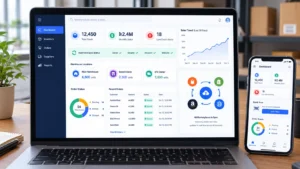
B2B Buying Has Outgrown Basic Storefronts
Your B2B customers expect the same seamless buying experience they get as consumers. But they need account-specific pricing, approval workflows, and bulk ordering tools that no basic storefront can handle.
We see this disconnect every day when business owners call us frustrated with their current setup. Their wholesale customers want to place orders online, but the standard e-commerce platform treats a $50,000 industrial equipment purchase the same as a $20 consumer product. The pricing is wrong. The checkout process breaks. The approval chain gets bypassed.
This is exactly why businesses need custom B2B e-commerce solutions built specifically for complex business transactions.
B2B buyers now research vendors online, compare options independently, and expect to complete purchases digitally without constant phone calls to sales reps. They want account dashboards that show their contract terms, order history, and custom catalog. They need bulk pricing that updates automatically based on volume tiers.
Most importantly, they want this to work reliably every time.
Basic storefronts were built for simple consumer transactions. Add a product to the cart, enter payment information, and ship to one address. But B2B transactions involve purchase orders, net payment terms, multiple shipping locations, and managers who need to approve orders before they process.
When you force complex B2B requirements into a consumer-focused platform, everything becomes a workaround. You end up with pricing that doesn’t match your contracts, checkout flows that confuse business buyers, and manual processes that should be automated.
Your B2B customers notice these problems immediately. And they start looking for vendors who have figured out how to make B2B buying as smooth as B2C buying, but with all the business features they actually need.
Why Off-the-Shelf Platforms Fall Short for B2B Sellers
We see the same pattern every month. Business owners call us after spending months trying to make a standard e-commerce platform work for their B2B operations, only to realize these systems were never designed for business-to-business complexity.
Off-the-shelf platforms work perfectly for simple retail transactions. But B2B sales involve account-specific pricing, multi-level approvals, complex product configurations, and real-time data sync with existing business systems. These requirements don’t fit into the one-size-fits-all approach that most e-commerce platforms offer.
GET IN TOUCH
Ready to replace platform workarounds with a custom B2B ecommerce solution? Call us for a free consultation
Pricing That Can’t Adapt to Every Account
Standard platforms assume every customer pays the same price for the same product. But your B2B customers have negotiated contracts, volume discounts, regional pricing, and account-specific terms that change based on order history and relationship length.
We have clients who sell the same industrial part to three different customers at three different prices. Customer A gets a 15% volume discount, Customer B pays list price plus freight, and Customer C has a locked-in contract rate from two years ago. No standard platform handles this without constant manual price adjustments.
The pricing engine needs to check the customer account, verify their contract terms, apply the correct discount tier, and calculate shipping based on their specific zone and delivery preferences. All automatically. Most platforms make you choose between showing everyone the same price or hiding prices completely until they call for a quote.
Which defeats the entire purpose of online B2B selling.
Approval Chains Bolted On, Not Built In
B2B purchases require approvals before orders process. A purchasing manager places a $25,000 equipment order, but their supervisor needs to approve it before the order goes to fulfillment. Some companies have three-level approval workflows depending on the order value and product category.
Standard platforms treat approvals as an afterthought feature that gets added later. The approval step breaks the checkout flow, creates confusing status messages, and often fails to notify the right people when orders are waiting for approval.
We build the approval workflow directly into the ordering process. The system knows which orders need approval and who needs to approve them and automatically sends notifications to the right managers. Orders sit in a clear approval queue, not in some confusing pending status that nobody understands.
Catalogs That Don’t Scale With Complex SKUs
B2B product catalogs are nothing like retail catalogs. You might have 50,000 SKUs with variations for size, color, material, voltage, and regional specifications. Some products are only available to certain customer types. Others require technical documentation and compatibility charts.
Standard platforms struggle when you have this many products with complex variations. The search function breaks down. Product pages become cluttered with technical specifications. Customers can’t find what they need without calling your sales team for help.
And that’s exactly what you’re trying to avoid.
We organize complex catalogs with role-based access, advanced filtering, and technical specification search that actually works. Your electrical contractors see different products than your general contractors. Search results include technical specs, compatibility information, and related accessories all in one view.
ERP Data That Never Quite Syncs
Your ERP system contains real-time inventory levels, customer account information, pricing data, and order status. But getting this data to sync properly with an off-the-shelf e-commerce platform becomes a constant technical headache.
The integration works most of the time. But not all the time. Inventory numbers get out of sync, customer pricing doesn’t update correctly, and orders sometimes disappear between systems. You end up with staff manually checking data between systems and fixing sync errors instead of focusing on customer service.
We build direct custom API integrations between your e-commerce system and your existing ERP. Real-time data sync means inventory levels update instantly, customer pricing stays accurate, and orders flow automatically into your fulfillment process without manual intervention.
Because when B2B customers place large orders, they expect the system to work reliably every single time.
When Does a Business Need Custom B2B Ecommerce?
Custom B2B e-commerce makes the most sense when your buying process includes requirements that standard platforms cannot handle without extensive customization or manual work. This may include negotiated pricing for individual accounts, multiple approval levels, customer-specific catalogs, complex product configurations, purchase orders, net payment terms, or real-time ERP and CRM integration.
A custom system can also be valuable when your sales team spends significant time processing routine orders, correcting pricing issues, checking inventory across systems, or answering questions that customers could handle through self-service tools.
That does not mean every B2B company needs a custom e-commerce platform. If your products, pricing, checkout process, and integrations are relatively straightforward, an established platform may be the more practical choice. Custom development becomes more compelling when your business processes are a competitive differentiator and forcing them into a standard platform creates ongoing operational costs.
Customized B2B eCommerce Solutions From Tecveq
We build B2B e-commerce systems that work exactly the way your business operates. No forcing your complex B2B requirements into a consumer-focused platform that wasn’t designed for business sales.
Our customized B2B e-commerce solutions handle account-specific pricing, multi-level approvals, complex product catalogs, and real-time integration with your existing ERP and CRM systems. We design every feature around how your B2B customers actually buy and how your team actually processes orders.
Instead of workarounds and manual fixes, you get a system built for B2B from the ground up. Your wholesale customers log in to see their contract pricing, place orders with the right approval workflow, and receive order confirmations that automatically sync with your back-office systems.
Account-Based Pricing & Contract Terms
We build pricing engines that automatically apply the correct rates for each customer account. Your system checks negotiated pricing and contract terms, applies customer-specific discount tiers, and calculates pricing based on volume thresholds, regional variations, and other account rules.
Customer A sees their 15% volume discount applied automatically. Customer B sees net pricing plus their specific freight terms. Customer C sees their locked-in contract rates from their annual agreement. All without your staff manually adjusting prices for each order.
The system stores unlimited pricing rules per customer account. Contract start and end dates, minimum order quantities, excluded products, and seasonal pricing adjustments all get applied automatically when customers place orders.
And when contracts expire or pricing changes, you update the customer account once, and their pricing updates across every product immediately.
Multi-Level Approval Workflows
We build approval processes directly into your ordering system. Orders that exceed preset dollar amounts or include restricted products automatically route to the right managers for approval before processing.
Your purchasing managers place orders normally, but orders above their approval limit go to their supervisor’s approval queue. The supervisor receives immediate email and dashboard notifications. They can approve, reject, or request modifications with comments that go back to the original requester.
The system tracks every approval step with timestamps and user records. Customers can check their order status and see exactly where orders are in the approval process. No more phone calls asking “where is my order” when it’s sitting in an approval queue.
Complex approval chains work just as smoothly. Orders can require sequential approvals from department managers, budget approvers, and final authorization from executives based on your specific business rules.
Custom Catalogs & Role-Based Access
We organize your product catalog so different customer types see exactly what they need to see. Customer groups can have specific catalogs with different products, pricing, technical specifications, and access rules. Your electrical contractors can see different products from your general contractors or retail customers without exposing products that aren’t relevant to their accounts.
Role-based access controls which products appear for each customer group. Restricted products don’t show up for unauthorized users. Technical specifications, installation guides, and compatibility charts appear automatically for products that require them.
Advanced search filters work across technical specifications, product categories, brand names, and model numbers. Customers can filter by voltage requirements, size specifications, material types, or any other product attribute that matters to their business.
Bulk product lists make it easy for customers to add multiple related items in one step. They can upload their own product lists, search by manufacturer part numbers, or use quick order forms for frequently purchased item combinations.
Bulk Ordering & Quick Reorder Tools
We build ordering tools designed for how B2B customers actually purchase. Quick reorder buttons for frequently purchased items. Bulk upload for product lists. Shopping lists that customers can save and share with their team members.
Customers can upload spreadsheets with part numbers and quantities instead of adding items one by one. The system validates part numbers, checks availability, applies their pricing, and creates the order automatically.
Reorder functionality remembers previous purchases with quantities and frequencies. Customers can reorder their regular monthly supplies with two clicks. Or modify quantities and add items to their standard reorder list.
Shopping cart functionality works for large orders with hundreds of line items. Customers can save incomplete orders, share them with colleagues for review, and return later to complete the purchase. No timeouts that lose their work.
Real-Time ERP & CRM Integration
We connect your B2B e-commerce system directly to your existing ERP and CRM systems with real-time API integration. Customer data, inventory levels, pricing information, and order details sync automatically between systems.
When customers place orders online, the order data flows immediately into your ERP system for fulfillment processing. Inventory levels update in real-time so customers never see out-of-stock items as available. Customer account information stays synchronized across all systems.
Order status updates automatically as orders move through your fulfillment process. Customers can check their order status online and receive automated notifications when orders ship with tracking information.
The integration works both ways. Changes you make in your ERP system update customer pricing and product information on the e-commerce site immediately. No overnight batch updates or manual data entry to keep systems synchronized.
We have built integrations with most major ERP systems and can connect to custom business management software and can connect to custom business management systems through API development. The integration becomes invisible to your team and your customers once it’s working properly.
B2B Ecommerce Website Development, Built Around Your Operations
We don’t sell you a licensed platform and hope it fits your business. We build custom software solutions designed around your specific B2B operations, workflows, and customer requirements
Our B2B e-commerce website development process starts with understanding exactly how your business operates. How do orders flow through your system? What approvals are required? How do you price different customer types? What integrations do you need with existing systems?
Then we build the system around your answers. Custom database structure, custom user interfaces, custom business logic that matches your processes exactly. No monthly platform fees, no feature limitations, no workarounds for requirements that don’t fit the standard template.
Your system works the way your business works, not the way a platform vendor thinks businesses should work.
Custom Portals for Wholesalers & Distributors
Wholesale and distribution operations need features that retail-focused platforms don’t offer. Territory management, dealer pricing tiers, drop-ship coordination, and inventory allocation across multiple warehouses.
We build wholesale portals that handle exclusive territories and dealer hierarchies. Your regional distributors see different product lines and pricing than your national accounts. Territory restrictions prevent dealers from competing outside their assigned regions.
Drop-ship functionality coordinates orders between you, your suppliers, and your customers automatically. When a dealer orders products you don’t stock, the system routes those line items to the appropriate supplier while keeping the rest of the order in your fulfillment process.
Inventory allocation lets you reserve stock for different customer tiers. Your platinum dealers get priority allocation during supply shortages. Seasonal inventory gets distributed across regions based on historical demand patterns.
Multi-warehouse management shows real-time inventory across all your locations. Orders automatically route to the closest warehouse with availability. Regional pricing adjustments factor in shipping costs from different distribution points.
Manufacturer-Ready Product Configuration
Manufacturing businesses sell complex products with multiple configuration options. Industrial equipment with voltage variations, material choices, size specifications, and accessory packages that affect pricing and lead times.
We build product configurators that guide customers through available options while checking compatibility and calculating accurate pricing. Each configuration choice updates available options for subsequent selections to prevent incompatible combinations.
Technical specifications sync with your engineering systems to ensure configured products meet manufacturing standards. CAD drawings, technical documentation, and installation guides generate automatically for each configured product.
Quote generation creates detailed specifications and pricing for complex configurations. Customers can save quote configurations, share them with colleagues, and convert approved quotes to orders with engineering drawings attached.
Lead time calculations factor in current manufacturing schedules for configured products. Customers see realistic delivery dates based on current production capacity and material availability.
Custom pricing algorithms handle complex manufacturing cost calculations. Base product costs plus option pricing plus material surcharges plus regional delivery adjustments all calculate automatically for each configuration.
Vendor & Partner Self-Service Portals
Business partnerships require specialized portal functionality for vendors, suppliers, and channel partners. Purchase order management, inventory consignment, co-op marketing coordination, and commission tracking.
We build vendor portals where suppliers can view purchase orders, update delivery schedules, submit invoices electronically, and track payment status. Real-time communication reduces phone calls and email chains for routine order management.
Consignment inventory tracking lets vendors monitor their products at your locations. Real-time sales data, inventory levels, and restocking alerts help vendors manage their inventory investment efficiently.
Partner portals provide channel partners with marketing materials, product information, pricing guidelines, and sales tools. Partners can download current product catalogs, access training materials, and submit deal registrations for large opportunities.
Commission tracking gives sales partners real-time visibility into their earned commissions. Order tracking, commission rates, and payment schedules all display in their partner dashboard.
Co-op marketing coordination helps partners access marketing development funds. Partners can submit marketing campaigns for approval, track fund usage, and receive reimbursement processing through the portal system.
The self-service approach reduces administrative overhead while giving partners better access to the information and tools they need to sell your products effectively.
B2B Custom Ecommerce Solutions for Every Industry
Different industries have different B2B buying requirements. We build custom B2B e-commerce solutions that handle the specific workflows, regulations, and business processes that matter in your industry.
Manufacturing companies need product configurators and engineering integrations. Healthcare organizations require compliance tracking and approval workflows. Industrial suppliers need technical specifications and compatibility checking. Wholesale distributors need territory management and dealer portals.
We have built systems for businesses across multiple industries, and we understand the specific e-commerce requirements that make each industry unique. Your system includes the industry-specific functionality you need without the generic features that don’t apply to your business.
Manufacturing
Manufacturing operations sell complex products with multiple configuration options, engineering specifications, and custom manufacturing requirements. Standard e-commerce platforms can’t handle the technical complexity of manufactured products.
We build product configurators that guide customers through available options while checking engineering compatibility. Each configuration choice updates pricing automatically and generates accurate lead times based on current manufacturing schedules.
Engineering integration connects your e-commerce system to CAD systems and product lifecycle management software. Technical drawings, specifications, and manufacturing instructions sync automatically for configured products.
Quote-to-order workflows handle complex pricing calculations for custom manufacturing. Material costs, labor estimates, tooling requirements, and delivery schedules all factor into automated quote generation.
Quality control integration tracks manufacturing progress and automatically updates customers when orders move through production milestones. Customers receive notifications when manufacturing starts, quality inspections are complete, and products ship.
Bills of materials sync between your e-commerce system and manufacturing resource planning software. Component availability checking prevents orders for products that can’t be manufactured due to material shortages.
Wholesale Distribution
Wholesale distribution requires territory management, dealer pricing hierarchies, and multi-warehouse coordination that retail platforms don’t support.
We build dealer portals with territory restrictions and exclusive product access. Regional dealers see different product lines and pricing based on their geographic territory and dealer level.
Multi-warehouse inventory management shows real-time stock across all distribution centers. Orders route automatically to the closest warehouse with availability, and regional pricing adjustments factor in shipping costs from different locations.
Drop-ship coordination handles orders that include products from multiple suppliers. The system routes line items to appropriate suppliers while maintaining unified order tracking for customers.
Volume pricing tiers adjust automatically based on order history and dealer performance. Platinum dealers get better pricing and priority allocation during supply shortages.
EDI integration connects with major retail and institutional customers who require electronic data interchange for purchase orders and invoicing.
Healthcare & Professional Services
Healthcare organizations require compliance documentation, approval workflows, and audit trails that standard platforms don’t provide.
We build systems that track product certifications, expiration dates, and regulatory compliance information. Medical device orders include required documentation and compliance certificates automatically.
Approval workflows route orders through required authorization processes. Budget approvals, clinical approvals, and administrative sign-offs all integrate into the ordering system based on product categories and order values.
Audit trails track every order action with user identification and timestamps. Complete order history with approval records and compliance documentation remains accessible for regulatory inspections.
Controlled substance tracking integrates with DEA reporting requirements for pharmaceutical orders. License verification and quantity tracking ensure orders comply with federal regulations.
Professional licensing verification checks customer credentials before allowing access to restricted product categories. Only licensed practitioners can order prescription items or controlled medical devices.
Account management tools track customer licensing renewals, certification updates, and continuing education requirements.
GET IN TOUCH
Get your custom B2B ecommerce system built around your operations. Contact Tecveq today for a no-obligation project estimate.
Industrial Suppliers
Industrial customers need technical specifications, compatibility checking, and bulk ordering tools designed for complex supply requirements.
We build advanced search functionality that filters by technical specifications. Customers can search by voltage requirements, material specifications, temperature ratings, or any other technical parameter that matters for their application.
Compatibility checking prevents orders for incompatible products. The system knows which products work together and warns customers about potential compatibility issues before they complete orders.
Technical documentation libraries provide installation guides, maintenance instructions, and safety data sheets for every product. Documentation downloads automatically with product orders.
Bulk upload tools let customers order from spreadsheets with manufacturer part numbers. The system validates part numbers, checks availability, applies customer pricing, and creates orders automatically.
Cross-reference databases help customers find equivalent products when their preferred items are unavailable. Alternative suggestions include technical specifications and pricing comparisons.
Project management tools let customers organize products by job site or project number. Orders can be split across multiple delivery dates and locations for complex installation projects.
Beyond B2B Ecommerce Platforms: A System Built Around You
Most B2B e-commerce platforms force you to change your business processes to fit their system limitations. We build custom systems that adapt to the way your business actually operates.
Licensed platforms offer pre-built features that work for some businesses but rarely work perfectly for any business. You get features you don’t need and pay monthly fees for functionality that doesn’t match your requirements. When you need something the platform doesn’t offer, you’re stuck waiting for the vendor to add it or finding expensive workarounds.
We take a completely different approach. Instead of licensing software and hoping it fits, we build your e-commerce system from the ground up around your specific business requirements.
Your pricing structure becomes our pricing engine. Your approval processes become our workflow system. Your product catalog structure becomes our database design. The result is a system that works exactly the way you need it to work, not the way a platform vendor thinks businesses should work.
No monthly platform fees that increase every year. No feature limitations that force you to compromise on functionality. No waiting for vendor updates that may never come. Your system belongs to you and grows with your business requirements.
B2B e-commerce platforms assume all businesses operate the same way. But your industry, customer base, and operational requirements are unique. Generic platforms handle the common 80% of requirements reasonably well but struggle with the 20% of features that make your business different from your competitors’.
That 20% is often where your competitive advantage lives.
We focus on building the specific functionality that gives you an advantage over competitors who are stuck with generic platform limitations. Custom integrations that automate your unique processes. Specialized features that match your industry requirements. User interfaces designed around how your customers actually buy from you.
The development process starts with understanding your current operations in detail. We map your order flow, approval processes, pricing structure, and customer interactions. Then we design the system architecture around those existing processes instead of forcing you to adapt to platform constraints.
Database design reflects your actual product structure, customer hierarchy, and business relationships. User interface design matches your customer’s workflow and buying patterns. Integration points connect with your existing business systems without data conversion headaches.
Most importantly, you own the complete system and source code. Future modifications, feature additions, and system changes happen on your timeline based on your business priorities. No vendor gatekeeping or additional licensing fees for functionality you need.
Custom development costs more upfront than platform licensing. But over three to five years, the total cost is often lower when you factor in monthly fees, transaction costs, customization expenses, and integration costs that platforms require.
And the functionality difference is substantial. Your custom system handles complex requirements that would be impossible or extremely expensive to implement on a licensed platform.
The system scales with your business growth without hitting platform limitations or requiring expensive plan upgrades. Adding new features, customer types, or business processes happens through development work, not vendor negotiations.
What Comes With Every Tecveq B2B Ecommerce Build
Every custom B2B e-commerce system we build includes discovery, design, development, security, and ongoing support. You get a complete solution, not just the software development.
We don’t start coding until we understand exactly how your business operates and what your system needs to accomplish. The discovery process maps your current workflows, identifies integration requirements, and designs the system architecture before any development begins.
Your finished system includes everything needed to handle B2B transactions securely. Payment processing that works with business payment terms, user interfaces designed for business buyers, and ongoing monitoring to keep everything running smoothly.
Dedicated Discovery & Requirements Mapping
We spend the first two weeks mapping your current business processes in detail. Order flow, approval chains, pricing structure, customer relationships, and integration requirements all get documented before we write the first line of code.
The discovery process includes interviews with your sales team, operations staff, and key customers. We need to understand how orders actually flow through your business, not just how you think they should flow.
Requirements mapping covers every system touchpoint. How do orders get from your e-commerce system into your ERP? What customer data needs to sync between systems? Which approval workflows need to trigger based on order value or customer type?
We document the complete technical architecture before development starts. Database structure, integration points, user roles, and security requirements all get planned during discovery. Changes during development cost time and money, so we get the requirements right upfront.
The discovery deliverable is a complete system specification that both teams agree on. No surprises during development about features that weren’t included or requirements that weren’t understood.
Poorly defined requirements are a common source of delays, scope changes, and unexpected development costs in custom software projects.
We avoid that problem by spending adequate time on discovery and documentation before any coding starts.
B2B Ecommerce Spec Sheets & Industry Standards
Every B2B buyer’s procurement team eventually asks the same question: does this system actually meet our compliance and security requirements, or are we going to find out the hard way after go-live? Tecveq builds every B2B e-commerce system against documented technical standards from day one, not as an afterthought bolted on before launch.
Here’s what’s built into every system Tecveq delivers.
PCI DSS & Payment Security Compliance
Payment data handling isn’t optional in B2B, especially when net terms, invoicing, and multiple payment methods are all running through the same checkout. Tecveq builds payment flows aligned with PCI DSS requirements, keeping card data handling, tokenization, and transaction logging within compliant boundaries. This matters more in B2B than most platforms admit, since a single account often processes far higher transaction volumes than a typical consumer checkout, which raises the stakes on every security gap.
SSO & Role-Based Access Control
A single company account might have a purchasing manager, a finance approver, and a handful of regular buyers, all needing different levels of access. Tecveq builds single sign-on support alongside role-based access control, so permissions are enforced at the account level rather than left to manual oversight. Buyers see only the catalogs, pricing, and order tools relevant to their role, and approval chains route correctly without someone in the back office manually checking every order.
API-First, Headless-Ready Architecture
Systems that lock data behind rigid templates eventually become the reason a business can’t move fast. Tecveq builds on an API-first foundation, meaning the storefront, backend, and any future channel—a mobile app, a dealer portal, a field sales tool—can all pull from the same data layer without duplicate systems or manual syncing. When a headless setup makes sense for the business, the architecture is already there to support it rather than requiring a rebuild later.
Documented Specs for ERP & CRM Integration
Pricing and inventory data going stale between systems is one of the most common reasons B2B e-commerce systems fail after launch. Tecveq documents every ERP and CRM integration point before development starts, mapping exactly how customer records, stock levels, and pricing rules move between systems and how often they sync. That documentation becomes the reference point for the business’s internal team long after the project wraps, not just something used during the build.
Scalable Infrastructure for High SKU Catalogs
A catalog with a few hundred SKUs behaves very differently than one with tens of thousands, especially once role-based visibility, tiered pricing, and search performance all have to work together without slowing down. Tecveq architects infrastructure to handle catalog growth from the start so performance doesn’t degrade as SKU counts, account numbers, or order volume climb. The system that works at launch is built to still work two years and ten times the catalog size later.
Tecveq Company Information
| Category | Details |
|---|---|
| Company Name | Tecveq |
| Business Type | Custom Software Development Agency |
| Headquarters | M3CH+JG7, Farid Town, Sahiwal, 57000 |
| Additional Offices | Pakistan, Bahrain |
| Phone | 0307 3319555 |
| 0307 3319555 | |
| info@tecveq.com | |
| Website | https://tecveq.com |
| Core Services | Custom B2B Ecommerce Solutions, Custom Software Development, AI & Automation, ERP Development, Mobile App Development, API Integration, Digital Marketing |
| Industries Served | Healthcare, Manufacturing, Education, Real Estate, Finance, Logistics, Wholesale Distribution, Construction, Professional Services |
| Project Timeline | 8-16 weeks (typical projects) |
| Discovery Phase | 2 weeks |
| Development Approach | Custom build from ground up |
| Consultation | Free initial consultation (30-45 minutes) |
| System Ownership | Complete source code ownership |
| Support Model | Ongoing maintenance, monitoring & technical support |
| Integration Capabilities | Real-time API connections with ERP, CRM, and business systems |
| Key Differentiators | No platform fees, full ownership, industry-specific solutions, scalable architecture |
| Track Record | 200+ successful projects across multiple industries |
| Geographic Reach | UK, Pakistan, Bahrain with remote project delivery globally |
UI/UX Designed for Business Buyers
B2B buyers have completely different interface needs than consumer shoppers. They need account dashboards, order history, approval status, and bulk ordering tools. Consumer-focused design patterns confuse business users.
We design interfaces specifically for business purchasing workflows. Account managers need different dashboard views than purchasing managers. Approval workflows need clear status indicators and notification systems.
Mobile responsiveness works for business users who check orders and approve requests from their phones. But the primary interface design focuses on desktop workflows where most B2B purchasing actually happens.
Navigation structures organize products and features around business logic, not marketing categories. Technical specifications, compatibility information, and documentation access get prioritized over promotional content.
Search functionality handles complex product queries with technical filtering. Business buyers search by part numbers, specifications, and compatibility requirements, not keywords and descriptions.
The interface design process includes feedback sessions with your actual customers. We test navigation, ordering workflows, and feature placement with real business users before finalizing the design.
User acceptance testing happens with your team and selected customers. We refine interface elements and workflows based on actual usage patterns, not assumptions about how business buyers should behave.
Secure Checkout, Net Terms & PO Support
B2B transactions require payment processing that handles purchase orders, net terms, and account-based billing. Consumer payment processing doesn’t work for business purchasing requirements.
We integrate payment gateways that support business payment methods. Credit cards for small orders, purchase order processing for established accounts, and ACH transfers for large transactions.
Net payment terms integrate with your existing billing processes. Orders can be approved and processed immediately while payment follows your standard 30, 60, or 90-day terms.
Purchase order workflows capture PO numbers, budget codes, and approval documentation required for business purchasing compliance. The system validates PO information before processing orders.
Security compliance meets business transaction requirements. PCI DSS compliance for credit card processing, SSL encryption for all data transmission, and secure user authentication for account access.
Account-based billing consolidates multiple orders into periodic invoices based on your billing cycle. Monthly, quarterly, or custom billing schedules integrate with your accounting systems automatically.
Credit limit checking prevents orders that exceed approved credit terms. The system checks available credit before processing orders and holds orders that exceed limits for manual review.
Ongoing Support & System Monitoring
Custom systems need ongoing maintenance, security updates, and technical support. We provide complete system monitoring and support services after your system launches.
System monitoring includes server performance, database optimization, security scanning, and integration monitoring. We identify and resolve technical issues before they affect your customers or operations.
Security updates happen automatically for system components and manually for custom code changes. We maintain security patches and vulnerability monitoring as part of ongoing support services.
Technical support includes bug fixes, minor feature adjustments, and integration troubleshooting. Your team has direct access to our development team for technical issues and system questions.
Performance optimization monitors system speed and database efficiency. As your order volume grows, we optimize queries and server configuration to maintain fast response times.
Backup and disaster recovery ensures your system and data stay protected. Automated daily backups with tested recovery procedures protect against data loss and system failures.
Documentation updates include system administration guides, user training materials, and technical integration documentation. Your team gets complete information needed to operate and maintain the system effectively.
Support response times are guaranteed based on issue severity. Critical issues affecting order processing get immediate attention. Non-critical requests receive a response within one business day.
Results Businesses See After Launch
Our clients typically see immediate improvements in order processing efficiency and customer satisfaction once their custom B2B e-commerce system goes live. The most common results include faster order processing, reduced manual data entry, and customers who place larger orders more frequently.
We track results for every client during the first six months after launch. The improvements vary by industry and business size, but the patterns are consistent across different types of B2B operations.
Businesses that previously handled most orders by phone or email see the biggest operational improvements. Manual order entry errors drop significantly when customers enter their own orders directly into the system with account-specific pricing and product validation.
Customer service teams spend less time answering routine questions about order status, pricing, and product availability. The self-service features handle most standard inquiries automatically, freeing up your team to focus on complex customer needs and relationship building.
Order processing speed improves dramatically when approval workflows and ERP integration work automatically. Orders that used to take days to process now move through the system in hours. Customers receive order confirmations immediately instead of waiting for manual processing.
The average order size often increases when customers can easily add related products, see quantity discounts, and use bulk ordering tools. Business buyers place more complete orders when they can see their full product catalog with account-specific pricing in one organized interface.
Customer retention improves when the ordering process becomes convenient and reliable. B2B customers stick with vendors who make purchasing easy, especially when they can reorder frequently purchased items quickly and track order status in real-time.
New customer acquisition gets easier when prospects can evaluate your products and pricing without requiring sales calls for basic information. Self-service account registration and quote generation let potential customers explore your offerings before committing to sales discussions.
Administrative overhead decreases significantly once data flows automatically between your e-commerce system and back-office systems. Manual data entry between systems becomes unnecessary when orders, customer information, and inventory levels sync automatically.
Inventory management accuracy improves with real-time integration. Customers stop placing orders for out-of-stock items, and your team stops overselling products that aren’t available. Real-time inventory management prevents the customer service issues that come from inventory discrepancies.
Sales team productivity increases when routine orders process automatically through the e-commerce system. Sales representatives can focus on complex opportunities and relationship management instead of processing standard reorders and answering basic product questions.
The financial impact varies by business size and order volume, but most clients see the system pay for itself through operational efficiency improvements within the first year. Reduced administrative costs, fewer order processing errors, and increased order frequency typically offset the development investment quickly.
Geographic expansion becomes much easier when your B2B e-commerce system can handle customers in new regions automatically. Regional pricing, shipping zones, and territory management features support business growth without additional administrative complexity.
Customer data quality improves significantly when customers manage their own account information through self-service portals. Shipping addresses, contact information, and purchasing preferences stay current when customers can update their own records instead of relying on phone calls and email updates.
The competitive advantage becomes apparent quickly when your customers compare your ordering experience to other vendors who still rely on manual processes. Ease of ordering becomes a significant factor in vendor selection for many B2B buyers.
Industries We’ve Delivered B2B Ecommerce Systems For
We have built custom B2B e-commerce systems for businesses across multiple industries. Each industry has specific requirements for how B2B transactions work, what compliance rules apply, and how customers expect to interact with vendors.
Healthcare organizations need systems that track regulatory compliance and handle controlled substance ordering. Educational institutions require budget approval workflows and procurement compliance features. Financial services companies need audit trails and security features that meet banking regulations.
The industry experience helps us ask the right questions during discovery and anticipate requirements that businesses might not think to mention upfront.
Healthcare operations require compliance tracking for medical device certifications, pharmaceutical licensing, and controlled substance regulations. We build systems that verify customer licenses before allowing access to restricted products and maintain audit trails for regulatory inspections.
Education institutions need procurement systems that handle budget approvals, purchase order requirements, and vendor compliance documentation. Educational purchasing often involves complex approval chains and compliance requirements that vary by institution type and funding source.
Real estate professionals need systems that handle commission tracking, territory management, and multi-location coordination. Real estate B2B transactions often involve service providers, contractors, and vendors who work across multiple properties and regional markets.
Finance industry suppliers require systems with enhanced security features, audit trail capabilities, and integration with financial institution compliance systems. Banking and insurance companies have specific vendor management requirements that affect how B2B purchasing works.
Logistics companies need systems that coordinate with shipping carriers, handle freight calculations, and manage multi-warehouse operations. Transportation and warehousing businesses have complex pricing structures based on zones, weight, and service levels.
Manufacturing clients require product configurators, engineering system integration, and custom manufacturing workflow support. Manufacturing B2B transactions involve complex pricing calculations and lead time management that standard platforms can’t handle.
Professional services firms need systems that handle project-based purchasing, client billing integration, and service provider coordination. Law firms, accounting practices, and consulting companies have unique B2B purchasing requirements that vary significantly from product-based businesses.
Construction industry suppliers deal with project management integration, job site delivery coordination, and contractor account management. Construction B2B transactions often involve large orders with complex delivery requirements and payment terms tied to project milestones.
Each industry brings different regulatory requirements, business processes, and customer expectations. Our development process includes research into industry-specific requirements that affect system design and feature prioritization.
We don’t use template solutions across different industries. The system architecture, user interface design, and feature set get customized based on how each industry actually conducts B2B transactions.
The discovery process for each new industry involves learning about regulatory requirements, standard business practices, and customer expectations that might not be obvious to software developers without industry experience.
Cross-industry experience helps us identify features and solutions that work well across multiple business types while still customizing the specific elements that make each industry unique.
Let’s Build Your B2B E-commerce System
We start with a free consultation to understand your current processes and system requirements. No sales pressure, no generic proposals. Just an honest assessment of what it would take to build a system that works for your specific business.
GET IN TOUCH
Start seeing these results in your business. Schedule your free B2B ecommerce consultation
We’ll ask about your current order processing, customer requirements, and integration needs. Then we’ll give you a realistic timeline and project estimate based on your actual requirements.
Most discovery calls take 30 to 45 minutes. We’ll tell you upfront if custom development makes sense for your situation or if you’d be better off with a different solution.
Ready to get started? Send us a message on WhatsApp or call now to schedule your free consultation.
Frequently Asked Questions
Does a custom B2B e-commerce system cost more than a licensed platform?
Custom development often costs less over time since there are no recurring license fees or per-user charges. You pay once for a system built around your actual workflow instead of paying indefinitely for features you don’t use.
Can Tecveq integrate with an existing ERP or CRM?
Yes, we build custom integrations with your existing ERP, CRM, or accounting systems during development. Your data stays connected across platforms without manual re-entry.
How long does a custom B2B e-commerce build take?
Timelines vary based on complexity, but most projects take a few weeks to a few months from planning to launch. We break the process into phases so you see progress at every stage.
Is a custom solution the right fit for a smaller wholesale business?
Yes, we scale the build to match your current order volume and team size, not a one-size-fits-all package. You only pay for the features your business actually needs.
What happens after the system goes live?
We provide ongoing support, updates, and technical maintenance after launch. Any issues or new feature requests are handled directly without disrupting your operations.
Are there any B2B platforms that include product inspection and shipping support services?
Are there any B2B platforms that include product inspection and shipping support services? Most standard platforms don’t.
Tecveq builds product inspection checkpoints and shipping support directly into your custom B2B e-commerce system, so orders are quality-checked before dispatch and customers get real-time shipment tracking built right into their account.