
AEO Services in Pakistan for Startups & Growing Businesses

Answer Engine Optimization (AEO) is how your business gets found by ChatGPT, Perplexity, Google AI Overviews, and other AI search tools that millions now rely on instead of traditional Google. If you’re running a startup or growing business in Pakistan, AEO services ensure your brand shows up when customers ask AI assistants questions about your industry. At Tecveq, we handle the technical setup, content strategy, and ongoing optimization so your business earns citations across all major AI platforms. Our team also builds AI agents and custom ML models, so we understand how these systems read and cite content. Answer Engine Optimization Services We Offer in Pakistan Every business needs visibility, but the channels have changed. Your customers aren’t just typing keywords into Google anymore. They’re asking ChatGPT questions, using Perplexity to compare options, and relying on Google’s AI Overview for quick answers. To reach them, you need more than SEO. You need Answer Engine Optimization. Here’s what we handle for you: AEO Audit & AI Visibility Report Before we optimize anything, we run a complete audit to see where your brand currently appears in AI answers and AI search results. This means checking whether ChatGPT recommends your business, if Perplexity cites your content, and how Google AI Overviews handle queries in your industry. Many Pakistani businesses discover they’re completely invisible in AI search results, even when they rank well on traditional Google. The audit identifies these gaps and shows exactly what’s needed to earn AI citations. We deliver a detailed report with screenshots, competitor comparisons, and a clear roadmap of priorities. Answer-First Content Optimization AI systems cite websites that give direct, well-structured answers. If your content buries the answer under 500 words of introduction, AI tools skip it. We restructure your existing content (or create new content) to answer customer questions immediately. That means your first sentence gives the real answer, followed by supporting details. We also optimize for the specific questions AI tools pull from—questions like “What’s the best SaaS for small businesses in Pakistan?” or “How much does e-commerce setup cost?” This is different from traditional SEO copywriting. You’re not targeting keyword rankings. You’re targeting being the source AI tools cite. Schema Markup & Structured Data Setup Search engines and AI tools understand your content better when it’s structured with schema markup. We implement: Proper schema doesn’t just help ranking. It tells AI systems what your page is actually about, which increases the chance they cite you correctly. Technical AEO (Site Speed, Crawlability, llms.txt) AI tools crawl your website just like Google does, but they have different requirements. We ensure your site: The llms.txt file is new and most Pakistani businesses haven’t added it yet. It’s a simple text file in your root directory that gives AI systems permission to index your content. We set this up as part of the technical foundation. Entity & Brand Authority Building AI tools cite sources they trust. Authority comes from mentions across reputable websites, verified business listings, clear author credentials, and consistent brand information. We work on building your entity in Google Knowledge Graph, getting your business listed on Clutch and Goodfirms, ensuring consistent NAP (Name, Address, Phone) data, and creating content that other websites naturally want to link to. This takes time, but it’s foundational for earning AI citations. AI Citation Tracking & Monthly Reporting You can’t improve what you don’t measure. We track where your brand appears in ChatGPT responses, Perplexity citations, Google AI Overviews, and other platforms. Every month, you get a clear report showing which queries led to citations, which content pieces earned AI mentions, and what’s still missing. This data guides the next month’s optimization work. AI Platforms We Optimize Your Brand For Not all AI search tools work the same way. Each has different citation patterns and requirements. We optimize for the platforms where your customers actually search. ChatGPT Visibility ChatGPT now serves over 200 million users monthly. When someone asks ChatGPT a question about your industry, you want your business mentioned. ChatGPT pulls from indexed websites and its training data. To earn citations, your content needs to be discoverable, authoritative, and directly answer the question being asked. We optimize your content specifically for the types of questions ChatGPT users ask in your industry. Google AI Overviews & Featured Snippets Google’s AI Overviews appear at the top of search results, pulling information from multiple sources. If your content is structured correctly, Google will cite you. Featured snippets (the box that appears above organic results) are an entry point to AI Overviews. We optimize for both by structuring answers in formats Google prefers: definitions, lists, tables, and step-by-step processes. Perplexity & Gemini Citations Perplexity is growing fast in Pakistan, especially among professionals and students. Gemini (Google’s AI chatbot) is integrated into Gmail, Google Workspace, and Android devices. Both platforms cite sources more explicitly than ChatGPT. We ensure your content is structured in ways these tools recognize and prefer to cite. Voice Search & Bing Copilot Voice search through Alexa, Google Assistant, and Siri relies on the same answer-first content structure. Bing Copilot cites sources similarly to Perplexity. The same optimization that earns ChatGPT citations also improves your visibility in voice search and Bing Copilot results. AEO vs SEO vs GEO: Which Service Fits Your Business? These three strategies overlap, but they target different search channels and have different goals. Here’s how they compare: Factor SEO (Search Engine Optimization) AEO (Answer Engine Optimization) GEO (Geographic/Local SEO) Target Platform Google Search, Bing Search ChatGPT, Perplexity, Google AI Overviews, Gemini Google Maps, local search results Primary Goal Rank in top 10 organic results Get cited by AI tools as a source Appear in “Near Me” searches and local packs Content Focus Keywords, backlinks, page authority Direct answers, structured data, authority Location pages, local reviews, NAP consistency Best For Long-term organic traffic Brand visibility in AI conversations Local businesses, service areas, multiple locations Timeline 3–6 months to see results 2–4 months for first citations 4–8 weeks for local pack
Cash Management System Development Company for Businesses in Pakistan and Beyond
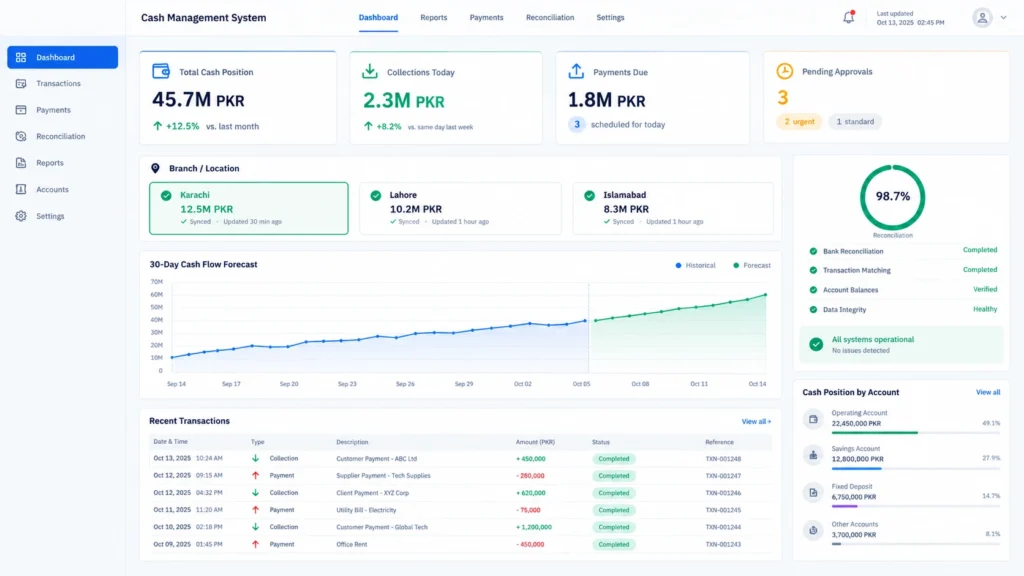
Tecveq is a software development company which builds cash management software to track cash, automate payments, and reconcile accounts in one place. Whether you run a retail chain, a restaurant group, a fuel network, or a growing finance business, we design and develop a system around your workflow, not the other way around. The real challenge isn’t understanding what a cash management system does. It’s finding a cash management system development company that understands your business. Many companies struggle with cash tracking across multiple locations, reconciliation errors, and reporting delays. We solve these problems by building software that fits how you actually work. Custom Cash Management System Development Services Ready-made software often forces you to change how you operate. That’s backward. We build custom cash management systems that align with your existing processes, integrate with your current tools, and scale as your business grows. When you work with a cash management system development company, you’re making an investment in how your business handles money. That investment should pay off in faster reconciliation, fewer errors, better visibility, and time saved on manual processes. Too many companies settle for software that does most of what they need, then spend years working around its limitations. We take a different approach. We start by understanding your business completely. What does a typical day look like? Where does cash come from? How many locations do you have? What reporting do you need? Which systems are you already using? Only after answering these questions do we design a system that actually fits. Custom Cash Management Software Development Every business handles cash differently. A retail chain needs to track sales across branches. A restaurant tracks petty cash, employee advances, and daily settlements. A fuel distribution network manages cash across remote stations. We start by understanding your exact workflow, then build software that automates the parts causing problems today. Custom cash management software isn’t about building something complicated. It’s about building something that works the way you work. Maybe your current system requires someone to manually enter data from three different sources every morning. Maybe you can’t see cash positions across all your branches without calling each location. Maybe you’re spending hours every month reconciling accounts because data doesn’t flow between systems automatically. These aren’t technology problems—they’re workflow problems. And custom software solves them by automating the workflow instead of forcing you to change it. We’ve built cash management systems for businesses with a single location and systems for networks with fifty locations across multiple countries. The principle is always the same: understand the workflow, build software that automates it, and make sure everyone who needs to see the data can see it. Cash Flow Management System Development Forecasting cash flow is difficult when you’re pulling data from multiple sources. You’re opening spreadsheets, calling branch managers, checking accounting software, and trying to piece together a complete picture. By the time you have the picture, it’s out of date. Cash flow management systems solve this by consolidating data from all accounts and branches in real time. You see your cash position as it actually is right now. You can project forward based on historical patterns and upcoming obligations. You can make decisions about cash deployment, investments, or expense timing with actual data instead of guesses. The business value is real. Better cash forecasting helps you avoid overdrafts. It helps you deploy cash strategically instead of letting it sit idle in low-interest accounts. It helps you identify cash shortages early enough to address them. We build cash flow management systems that pull data from your banks, accounting software, and operational systems. The system consolidates everything into one dashboard, runs forecasts based on your historical patterns, and alerts you when predicted cash falls below thresholds you define. Petty Cash and Advance Control Modules Petty cash management sounds simple until you’re trying to track hundreds of small transactions across multiple locations. Without proper controls, petty cash becomes a black hole where money disappears without clear documentation. Employee advances turn into informal loans with vague repayment terms. We build modules that log every petty cash transaction—who took it, when, what it was for, and when it was replenished. We automate employee advance requests, track repayments, and reconcile against payroll. We set spending limits by role and location so a junior staff member can’t take a large advance without approval. The result is control without complexity. Your finance team can account for every dollar. Auditors can see complete trails. Staff members know the process and don’t feel like they’re being watched—they’re just following a clear system. Bank and ERP Integration Your cash management system needs to talk to your bank, accounting software, and existing ERP. We integrate with major platforms so data flows automatically instead of requiring manual entry and reconciliation. Bank integration pulls transaction data directly from your bank’s API, eliminating manual feeds and data entry errors. If you use QuickBooks, Xero, or a custom ERP, we connect your cash system so information flows both directions—payments recorded in cash management appear in accounting, and accounting entries update cash forecasts. Integration isn’t simple technical work. Each bank has different APIs. Each accounting platform has different data structures. We’ve done this work many times, so we know the pitfalls, the data quality issues, and how to build integrations that work reliably day after day. Legacy System Upgrade and Migration If you’re running cash management on outdated systems or spreadsheets, migration to modern software doesn’t have to be painful. We handle data migration, staff training, and parallel running to ensure zero disruption. Migration is often the scariest part of a software project. You’re worried about data loss, staff confusion, and business interruption. We’ve migrated companies from legacy systems to modern cloud platforms many times. Here’s how we do it: First, we extract data from your old system and validate it. Bad data causes problems downstream, so we clean and standardize everything. Second, we build data mappings that transform your old system’s structure into the new
Clipping Marketplace: How GEZUX Turns Long-Form Videos Into Short-Form Reach

A long podcast episode or interview can hold dozens of moments worth sharing, but most of them never leave the original upload. A clipping marketplace solves this by connecting the people who own long-form content with creators who cut it into short, vertical clips and post them where attention lives. GEZUX is a global clipping marketplace built for this model. Brands fund a campaign, clippers turn the footage into short-form videos, and rewards are based on verified, eligible views. The result is organic distribution across multiple creators and platforms, instead of reliance on a single upload. What Is a Clipping Marketplace? A clipping marketplace is an online platform where content owners publish campaigns and independent creators, known as clippers, compete to turn that content into short-form videos. Clippers publish the clips on social platforms such as TikTok, YouTube Shorts, Instagram Reels and X. They are rewarded according to the performance rules of each campaign, usually a set rate per 1,000 verified views. Think of it as a two-sided marketplace. One side has valuable long-form content and a need for reach. The other has editing skill, an eye for strong hooks, and active social accounts. The marketplace sits between them and handles the structure: campaign rules, submissions, view verification and rewards. Brands and Content Owners On the content side are brands, podcasters, agencies, media companies and creators with long videos worth repurposing. On GEZUX, they start by uploading their content and configuring a campaign. They set a view target, choose the countries they want to reach, and fund the campaign pool. They also define the rules clippers must follow, such as mandatory hashtags, handles to mention, and brand safety requirements. For example, a podcast team might launch a campaign with a $5,000 budget and a reward rate of $1.00 per 1,000 verified views, then let many clippers find the best moments in each episode. The appeal is simple. Instead of posting one clip and hoping it spreads, content owners get many creators publishing many clips across many accounts at the same time. They pay for verified performance, not for promises. ⚡ GET IN TOUCH One Video. Hundreds of Clippers. Verified Reach. Launch your campaign on GEZUX → 💬 Chat on WhatsApp 📞 Call 0307 3319555 Clippers and Creators On the other side are clippers: video editors and creators who know what makes a short clip work. On GEZUX, they browse campaigns built on pre-approved source content, read the brief, and pick the ones that fit their style or audience. From there, they extract the strongest hooks, edit vertical 9:16 videos, and publish them on their own accounts using the campaign’s required hashtags and mentions. Their earnings depend on the verified eligible views their clips generate. For clippers, this means access to ready-made content and clear rules, without negotiating individual deals or producing original footage. For skilled editors, it is a way to turn editing talent into income. How the Marketplace Connects Them A marketplace only works if both sides trust the process. GEZUX connects brands and clippers through a four-step pipeline. The verification step is what makes the model credible. Views are checked using API metrics and fraud heuristic filters, so rewards go to legitimate attention and brands can rely on the reported results. That is how one campaign becomes multi-creator reach: one video, many clippers, and measurable results. How the GEZUX Clipping Marketplace Works GEZUX runs every campaign through the same four-step pipeline: fund, clip, distribute and verify. Each step has a clear owner and clear rules, so brands know what they are paying for and clippers know how they will be rewarded. Here is how a campaign moves from a single long video to measurable short-form reach. Step 1: Fund the Campaign Every campaign starts with the brand or content owner. They upload their long-form content, such as a podcast episode, interview or webinar, and configure the campaign inside GEZUX. During setup, they decide: Because the budget is funded up front, clippers can see that the campaign is real before they invest time in it. Brands also stay in control, since rewards are tied to the rules and rates they set. Step 2: Create Short-Form Clips Once a campaign is live, clippers can discover it and read the brief. The brief explains what the content is about, what kind of moments to look for, and what the clips must include. For example, a campaign built on a podcast about artificial intelligence might ask for thought-provoking moments of 30 to 60 seconds, with clean subtitles. Clippers then: This is where the clipper’s skill matters most. A strong opening line, tight pacing and good subtitles often decide whether a clip gets watched or scrolled past. Since many clippers work on the same campaign, a brand gets a wide range of styles and angles from a single source video. Step 3: Distribute Across Social Platforms After editing, clippers publish their clips on the platforms where short-form attention lives: TikTok, YouTube Shorts, Instagram Reels and X. They post from their own accounts and include the campaign’s mandatory hashtags and mentions, so every clip is clearly tied to the campaign. This is what turns one video into a distribution network. Instead of a brand posting once from a single account, dozens of creators can publish clips at the same time, each reaching their own audience. The same podcast moment can appear in many feeds, framed by different editors for different viewers. Campaign rules apply here as well. Required hashtags, handles and brand safety criteria keep the content consistent and protect the brand while it scales. Step 4: Verify Eligible Views and Calculate Rewards The last step is what makes the model trustworthy. GEZUX does not simply count the numbers a clipper reports. Eligible views are verified using API metrics and fraud heuristic filters before any reward is calculated. The fraud detection layer looks for warning signs such as: Once views are verified, GEZUX credits clipper balances according to the campaign’s reward rate. If
Accounting Software for Restaurants in Pakistan | Billing, Inventory & Tax-Ready Reports
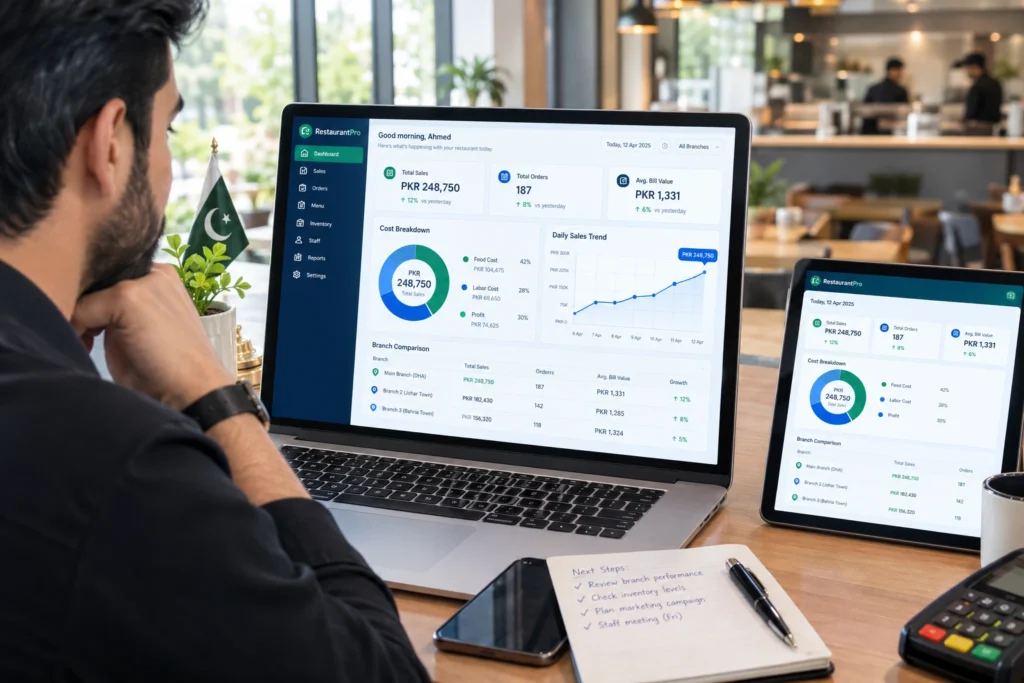
Restaurant management in Pakistan means handling dozens of moving parts every single day. Sales tracking, supplier payments, staff salaries, ingredient costs, and tax compliance—it all needs to work together, or your profit numbers become guesswork. Most restaurant owners still rely on manual spreadsheets or basic billing machines that only capture part of the picture. We build custom accounting software for restaurants that connects your POS, inventory, suppliers, and financial reports into one system. Every transaction flows into your ledger automatically. You see real profit, not just cash received. Whether you run a single café or a multi-branch chain, our software is built specifically for how restaurants actually operate in Pakistan. Let’s explore how the right software transforms your business from guessing to knowing. Restaurant Accounting Software Built by TecVeq We build custom accounting software designed specifically for restaurants operating in Pakistan. Not adapted from generic business software. Built from the ground up to handle daily sales, ingredient tracking, supplier payments, and FBR compliance exactly the way your restaurant works. Complete Accounting Control for Your Restaurant Your restaurant generates hundreds of transactions every single day. Every sale needs to be tracked. Every ingredient consumed needs to be logged. Every supplier payment needs to be recorded. Every expense needs to be categorized. Traditional accounting happens weeks later when you collect receipts and manually enter them into spreadsheets. Our software captures everything in real-time. The moment a customer pays, the sale is logged. The moment an ingredient is used, inventory is updated. The moment a supplier delivers, the invoice is recorded. Your financial position updates automatically throughout the day, not weeks later when it’s too late to make decisions. Billing, Sales, and Daily Closing in One System The end of day at your restaurant means counting cash, reconciling the register, and hoping the numbers match. Usually they don’t. You spend 30 minutes searching through receipts trying to find the discrepancy. Our software eliminates that chaos. Every bill is logged automatically. Cash and card payments are tracked separately. Tips are recorded with the transaction. At close of business, you run one report, and the system shows exactly what was sold, what was paid, and whether your cash matches the system. Discrepancies are flagged immediately with the reason why. You are done in minutes instead of spending half an hour chasing numbers that do not add up. ⚡ GET IN TOUCH Stop Manual Spreadsheets. Get Real-Time Restaurant Accounting Today. 💬 Chat on WhatsApp 📞 Call 0307 3319555 Problems We Solve for Restaurants in Pakistan Daily Sales Mismatch and Cash Handling Errors You close the register at PKR 50,000 in cash. Your billing machine shows PKR 51,200 in sales. The difference sits in your head as a mystery until closing day when you finally give up and write it off as loss. This happens at thousands of restaurants because cash handling and sales tracking are separate. You never see the full picture until it is too late. We connect everything so discrepancies are obvious immediately. Every sale links to a payment method. Every payment is reconciled to your actual cash. The system flags cash handling errors on the same day they happen, not weeks later when you are filing taxes. Supplier Credit and Unpaid Invoices Suppliers deliver on credit. You promise to pay in 15 days. But after a month you are not sure how much you actually owe each supplier, which invoices are overdue, or when you can pay next. You keep invoices in a folder, and the supplier calls asking for payment that you did not realize was due. Late payments cost you credibility with suppliers and sometimes carry penalties. Our software tracks every supplier invoice with due dates and payment status. You see at a glance who you owe, how much, and what is overdue. You can schedule payments before they become problems and avoid losing supplier relationships over missed deadlines. Unclear Food Cost and Profit Per Dish You think your biryani is profitable because you are selling 50 plates a day. But you do not know if that biryani actually costs PKR 250 or PKR 400 to make. You do not know if the selling price covers your ingredient costs and labor. You might be losing money on your bestseller without realizing it. Most restaurants operate on gut feel instead of data. We connect your recipes to ingredient costs so the system calculates automatically how much every dish costs to make. When a customer orders biryani, the software knows the exact ingredient cost. You see immediately whether that price point is profitable or if you need to adjust. This is the difference between running a restaurant and running a business that makes money. Multi-Branch Reporting Problems You own 3 branches. Every branch has a separate register and a different manager. At the end of the month you want to know total sales across all branches, which branch is most profitable, the combined food cost percentage, and consolidated profit. You call each manager, collect their numbers, enter them into a spreadsheet, and hope nobody made a data entry error. One dashboard in our software shows all your branches in real-time. You see sales, costs, profit, and trends for each location and the business as a whole. Branch A’s food cost is 32%, but Branch B’s is 35%. You can see that immediately and investigate why. No more waiting. No more spreadsheet updates. No more hidden problems at one location while profits look good overall. Features of Our Restaurant Accounting Software POS and KOT Integration Your point of sale is where every customer transaction starts. Your kitchen order ticket system is where every order gets prepared. Both systems have valuable data about what sold and what was used. But most restaurants never connect them to accounting. We integrate your POS and KOT with your accounting system so every order becomes a financial transaction automatically. The moment the customer pays, that sale is logged to the ledger. The moment the kitchen fulfills an order,
Custom iPad Application Development Company

TecVeq is a software development company that builds custom iPad applications for businesses. Our team delivers native Swift apps with Apple Pencil, split view and keyboard support, secure API integration, and App Store launch for startups, agencies, and enterprises. Custom iPad Apps Built for Your Business Most businesses we meet think iPad app development is expensive and takes months. It doesn’t have to be either. We build custom iPad applications that solve real business problems. Whether you need a point-of-sale system for retail, a patient management app for healthcare, or a field service tool for your team, we design and launch apps that work the way your business actually operates. The process is straightforward. You tell us what your team needs. We design it, build it, test it, and get it on the App Store. Then we support it. No surprises. No delays we haven’t explained upfront. Ready to move forward? Request a free quote or call us at [phone number]. We’ll walk you through exactly how this works. iPad App Development Services We handle everything from the first sketch to the day your app launches and beyond. Custom iPad App Design and Development This is where most of our work happens. You have a business problem. We design an iPad app that solves it, build it with native Swift code, integrate it with your systems, test it thoroughly, and launch it on the App Store. Custom iPad application development means we build specifically for the iPad. Not a stretched phone app. Not a generic solution. An app designed for how your business actually works. We handle the full cycle so you have one team accountable for the result. Enterprise iPad App Development Enterprise iPad app development is for larger organizations that need security, scalability, and integration with existing systems. We build apps that connect to your CRM, ERP, backend databases, and cloud infrastructure. We handle enterprise-grade requirements like user authentication, data encryption, offline functionality, and compliance standards. Your app works on day one and grows with your business. iPhone-to-iPad App Conversion You have an iPhone app that works well. Now you want it on iPad. We don’t just stretch the phone layout across a bigger screen. Our custom mobile app development services include cross-device optimization. We redesign it for the iPad. Split View support. Multi-column layouts. Better use of the larger screen. Sometimes this means rethinking the interface entirely so your users actually benefit from working on a bigger device. iPad App UI/UX Design The interface is where users form their first impression. We design iPad apps that are intuitive, professional, and built around how people actually work. Our design team starts with your user. We prototype, test, and refine until the interface feels natural. Then we hand it off to development with clear specifications so nothing gets lost in translation. API Integration and Backend Development Your iPad app needs to talk to your servers, databases, and third-party services. Our custom API integration services connect your app to existing systems, third-party platforms, and cloud infrastructure securely and reliably. Real-time data sync. Secure authentication. Cloud storage. Payment processing. Whatever your app needs on the backend, we build it to handle the load and protect your data. iPad App Testing and App Store Launch Before your app goes live, we test it on real iPad devices across multiple iOS versions. We catch bugs, performance issues, and user experience problems before your customers see them. Then we handle the App Store submission. We make sure your app passes Apple’s review process, meets all their requirements, and launches without delays. We’ve done this hundreds of times. App Maintenance and 24/7 Support Your app launches. Then the real work begins. We monitor it, fix bugs that come up, release updates for new iOS versions, and add features based on how your users actually use it. We offer 24/7 support. If something breaks you, call us. If you need a new feature, we build it. Your app stays current and reliable for as long as you need it. iPad App Features We Build Around Most development companies build for generic tablets. We build specifically for iPad. That means taking advantage of features that make iPad apps powerful. Large-Screen and Multi-Column Layouts The iPad has a 10-inch screen. That’s not a phone stretched larger. It’s a different device that works better with a different interface. We design apps that use the full-screen space. Master-detail layouts. Side-by-side panels. Navigation that doesn’t require constant back-and-forth tapping. Your users see more information and accomplish more in fewer taps. Split View, Slide Over, and Stage Manager Support The iPad supports multitasking. Your app can run alongside other apps on the same screen. Users can drag documents between your app and others. They can have multiple windows of your app open at once. Not every app needs this. But when your users work with multiple tools at the same time, supporting multitasking makes your app indispensable. ⚡ GET IN TOUCH Ready to build a custom iPad app? Get a free consultation and project estimate. 💬 Chat on WhatsApp 📞 Call 0307 3319555 Apple Pencil Integration If your users sketch, annotate, or input precise data, Apple Pencil integration changes everything. We build apps that respond to pressure, tilt, and precision touch from the Apple Pencil. Drawing apps. Design tools. Form capture systems. Whiteboarding applications. When you need pencil support, we handle it properly. Keyboard and Trackpad Support The iPad supports external keyboards and trackpads. For users who need productivity, this matters. We build apps with full keyboard shortcuts, trackpad navigation, and keyboard-first workflows where they make sense. Your users type faster. They navigate without lifting their fingers. They work like they’re on a computer but with the benefits of a tablet. Offline Mode and Secure Data Sync Not every location has reliable internet. We build iPad apps that work offline. Your users work without a connection. When the connection comes back, data syncs automatically. Secure sync. No data loss. No confusion