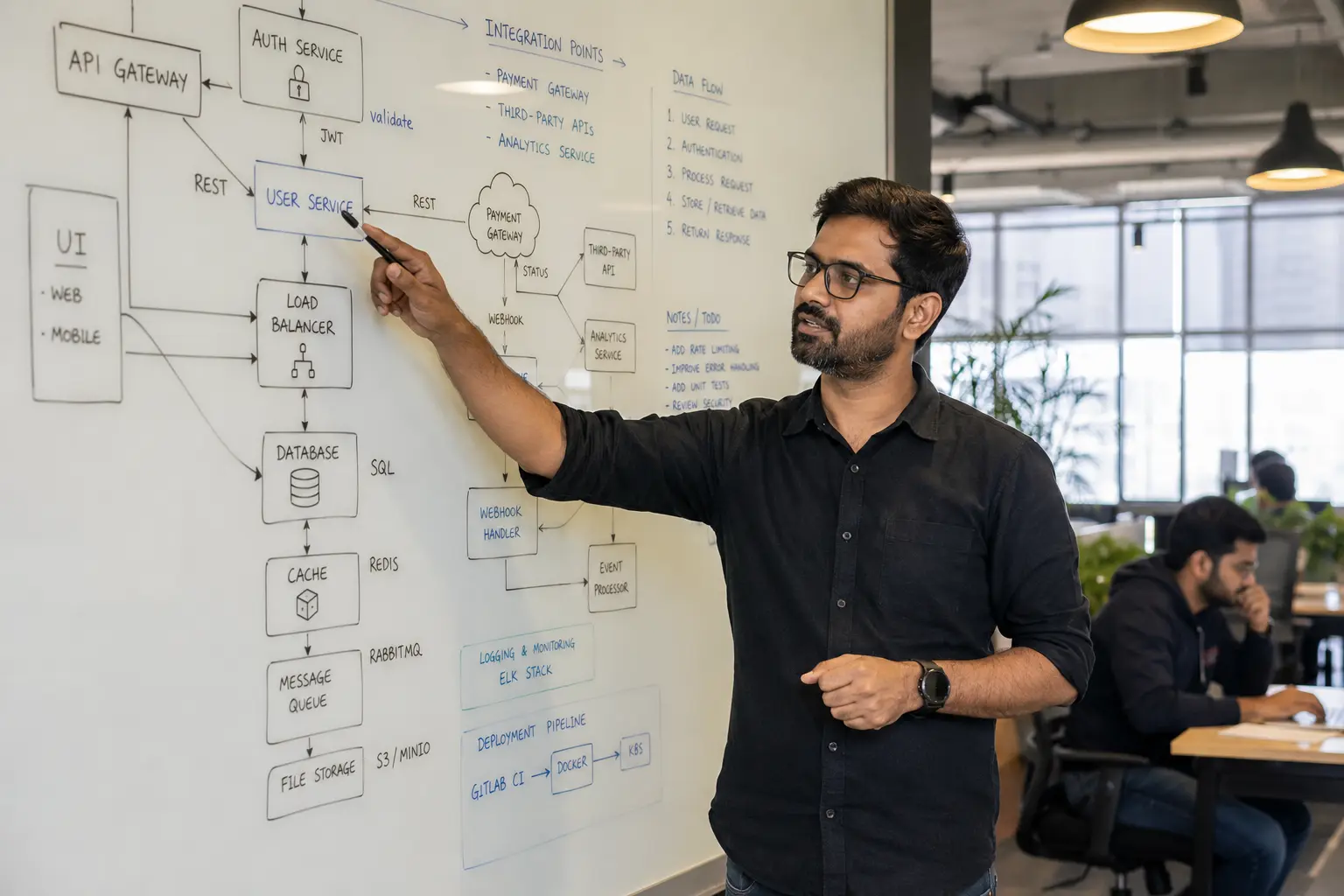
andWhat Makes a Software Project Complex And Why It Needs the Right Partner
Most software problems are simple on the surface and messy underneath. A project becomes complex the moment it touches more than one system, more than one team, or more than one point of failure. That’s the line where a general-purpose developer starts guessing and a specialized team starts architecting.
We define a complex software project as one where the code is only part of the challenge. The harder work is everything around it: legacy systems that can’t go down during migration, regulatory requirements that change what “correct” means, or a data pipeline where one bad assumption breaks five other things downstream.
That’s where AI features are only as useful as the data pipeline behind them. We build that foundation first, because a model trained on incomplete or inconsistent data can produce confident but unreliable results.
For projects involving generative AI, machine learning, or data analytics, that means designing the data collection, validation, storage, and processing layers before choosing the technology that sits on top of them.
become valuable—not simply for writing code, but for designing the architecture, integrations, security, and workflows that allow the software to work reliably within a specific business.
Here’s what that looks like in practice. A retail client needing a new checkout flow is not complex. The same client needing that checkout flow to sync inventory across three warehouses, two currencies, and a legacy ERP built in 2011 that’s complex. Same industry. Completely different engagement.
Project management is what keeps all of those technical pieces moving in the same direction. On complex builds, that means keeping requirements, development, QA, security, infrastructure, dependencies, timelines, and stakeholder decisions visible throughout the project. Our delivery team uses sprint planning, regular reviews, milestone tracking, and ongoing communication so technical problems don’t quietly become project delays.
GET IN TOUCH
Ready to build it right the first time? Start with a free project assessment honest scope, realistic timeline, no guesswork.
Signs your project requires specialized complex-systems expertise
You’ll usually know it’s complex before a single line of code gets written. A few honest signals:
- Your project touches more than one existing system that already works and can’t be broken
- You need the software to scale from a handful of users to thousands without a rebuild
- There’s a compliance or data-security requirement attached (healthcare, finance, government)
- Multiple teams or departments will use the same system differently
- Nobody on your side can fully describe the current process end to end
If two or more of these apply, you’re not looking for a freelancer or a small dev shop working solo. You’re looking for a team that can do solution architecture before touching a keyboard.
We ask a blunt question early in every complex engagement: what happens if this breaks at 2 AM and nobody’s watching? If the client can’t answer that, we build the answer together before we scope the build.
Common risks of choosing the wrong partner for complex builds
Here’s what actually goes wrong. We’ve inherited enough half-finished projects to know the pattern.
phase,The most common mistake is hiring based on speed instead of architecture. A team that promises a fast timeline on a complex system is usually skipping the discovery phase and discovery is exactly where complexity gets identified and planned for, not avoided.
The second mistake is worse: no documentation. We’ve taken over systems where the only person who understood how three modules talked to each other had already left the company. Nobody could touch the code without breaking something invisible.
it andAnd the third one costs the most money. Teams that don’t design for scale from day one end up rebuilding the same system twice: once to launch it, and once to fix it when it can’t handle real usage.
documentation,None of these are hypothetical. They’re the reason enterprise software development for complex systems needs a different process than a standard build: heavier discovery, clearer documentation and architecture decisions made before deadlines start driving them.
Tecveq Company & Services Table
| Company Name | Tecveq |
|---|---|
| Address | M3CH+JG7, Farid Town, Sahiwal, 57000 |
| Phone | 0307 3319555 |
| info@tecveq.com | |
| Website | tecveq.com |
| Services | Custom Software Development, Enterprise Software Development, Legacy System Modernization, API Integration, AI & Data Applications, Cloud Infrastructure, Healthcare App Development, ERP Software Development, CRM Development, Mobile App Development (React Native & Flutter), Ecommerce App Development, Shopify Development, Next.js Development, Web App Development, Logistics Software, AI Chatbot Development, WhatsApp Automation, LMS Development, SEO Services, Digital Marketing, Graphic Design & Web Design |
| Best For | Complex, Large-Scale & Mission Critical Software Projects |
Our Complex Software Development Services
Our custom application development work covers business platforms, enterprise applications, internal tools, mobile applications, customer-facing systems, and software that needs to integrate with existing infrastructure.
Complex projects rarely fail because of bad code. They fail because nobody mapped the dependencies before building started. Here’s how we handle the six areas that come up most often when a project outgrows a simple build.
Depending on the project, we are a top custom software development company that may include web platforms, enterprise systems, mobile applications, internal business tools, or software that connects multiple existing systems.
Enterprise Software Development
Enterprise software has to work for hundreds of people at once, not just look good in a demo. According to Gartner’s research on enterprise application trends, scalability and multi-user architecture are among the top factors that differentiate enterprise systems from standard applications.
We build systems where different departments use the same platform for completely different jobs, and every one of those jobs still has to run without stepping on the others.
That means role-based access controls done properly, not bolted on after launch. It means an architecture that can add a new department’s workflow without touching what the last department already relies on. Most enterprise failures we’ve seen trace back to one thing: the system was designed for the first fifty users, not the next five hundred.
Legacy System Modernization & Migration
Migrating off an old system while it’s still running the business is one of the riskiest jobs in software. We treat legacy modernization as a live-wire project, because that’s exactly what it is.
We don’t rip and replace on day one. Legacy ERP systems present some of the most challenging modernization scenarios we encounter. If you’re running outdated accounting or resource planning software, our guide on custom ERP software development services explains the migration approach we use to move businesses off legacy platforms without disrupting daily operations.
Then we migrate in stages, with rollback points built in at every phase, so a mistake in week six doesn’t undo the progress made in weeks one through five.
This is where a lot of vendors cut corners. Not us.
Multi-System Integration & API Architecture
If your business runs on more than one platform, something has to make them talk to each other correctly, and that something is API architecture. We design integration layers that connect your CRM, your ERP, your payment processor, and whatever else your business depends on, without creating a tangle nobody can maintain a year later.
API integration becomes especially critical when you’re connecting disparate business systems. Our custom API integration services cover the specific patterns we use to connect CRMs, ERPs, payment gateways, and legacy platforms without creating technical debt.
AI-Powered & Data-Intensive Applications
AI features are only as useful as the data pipeline behind them. We build that foundation first, because a model trained on incomplete or inconsistent data can produce confident but unreliable results. For projects involving generative AI, machine learning, or data analytics, that means designing the data collection, validation, storage, and processing layers before choosing the technology that sits on top of them.
Our approach starts with the actual business question the client needs answered, not with picking a model and hoping it fits. From there we design data collection, cleaning, and validation steps that hold up under real production volume, not just a test dataset.
Data analytics can also become a core part of a complex software solution when businesses need more than raw data storage. We can build analytics capabilities that turn operational data into dashboards, reports, performance indicators, and decision-support tools, giving teams a clearer view of what is happening across the business rather than forcing them to work from disconnected spreadsheets and systems.
The right software solution isn’t necessarily the one with the most features. It’s the one that fits the specific business process, integrates with the systems already in place, and can continue to support the business as those requirements change.
Cloud-Native & Scalable Infrastructure
Cloud-native doesn’t just mean “hosted on AWS.” It means the system is built to scale up and down automatically as demand changes, without an engineer manually adjusting servers at midnight.
needs.Moving to cloud infrastructure is often the first step in modernizing a complex system. We’ve detailed our approach to cloud application development services, including when to choose AWS, Azure, or Google Cloud based on your specific architecture needs
This matters most in the moments nobody plans for. A traffic spike, a seasonal surge, a viral moment. Systems we build are designed to absorb that instead of falling over.
Regulated Industry Software (Fintech, Healthcare, Compliance-Driven)
Regulated software has a second client nobody sees in the room: the regulator. We build with that requirement present from day one, not added as a patch before an audit.
For fintech, that means secure transaction handling and audit trails that hold up under scrutiny. For healthcare, that means data privacy built into the architecture, not just a checkbox in a policy document. Getting this wrong doesn’t just delay a launch. It can shut a product down entirely, which is why we treat compliance as a design constraint, not a final review step.
Large-ScaleWhy Choose Tecveq for Complex, Large Scale Projects
Complex software requires technical expertise across architecture, development, infrastructure, security, testing, and integrations. That expertise matters most when those areas overlap, because a decision that looks correct in one layer can create problems somewhere else.
Deep Solution Architecture & Discovery Process
We don’t quote a price or a timeline until we understand what’s actually underneath your project. Discovery comes first, always, because guessing at architecture on a complex build is how six-month projects turn into eighteen-month ones.
Our discovery process maps your existing systems, your data flows, and the constraints nobody thinks to mention until week three. We ask about the boring stuff early. What breaks if this integration goes down? Who touches this data and when? What’s the real deadline, not the one written in the brief?
That’s not a formality. It’s the difference between a system that fits how your business actually runs and one that fits how we assumed it runs.
Multidisciplinary Delivery Teams (Full-Stack, QA, DevOps, Security)
A complex project needs more than one kind of expertise in the room, and we staff for that from day one instead of adding specialists after something breaks. Our teams combine full-stack developers, dedicated QA, DevOps engineers, and security-focused reviewers working on the same project simultaneously, not in a handoff chain where each person only sees their slice.
This matters most in testing. Security review that happens after development is finished catches problems too late to fix cheaply. We build QA and security checks into every sprint, not as a final gate before launch.
Different roles. Same project. Working in parallel, not in sequence.
A complex project needs more than one kind of expertise in the room. Depending on the product, that can include full-stack developers, UI/UX designers, QA engineers, DevOps specialists, security reviewers, and project management. These roles work around the same requirements and architecture rather than operating as disconnected handoffs.
Proven Track Record on Enterprise Grade Builds
We’ve built enterprise systems that connect multiple departments, migrated legacy platforms without taking the business offline, and delivered software under real regulatory requirements, not simulated ones. What we won’t do is throw numbers at you that we can’t stand behind in a conversation.
If you want specifics, ask us. We’ll walk you through recent work relevant to your industry and your scale of project, including what went right and what we’d do differently next time. That’s a more honest answer than a stat on a webpage, and it’s the one we’d actually give in a sales call.
Our Development Process for Complex Software Projects
Every complex project we’ve taken over from another vendor had the same root problem. Someone skipped a step to hit a deadline, and that shortcut showed up months later as a much bigger, much more expensive fix. Our process exists to stop that pattern before it starts.
Discovery & Requirements Engineering
We spend real time understanding your business before we write a single requirement, because requirements gathered too fast are usually wrong in ways nobody notices until development is halfway done. This phase is where we map your existing workflows, talk to the people who actually use the systems day to day, and document the edge cases that never make it into the initial brief.
Not every client loves this step. It takes longer than a quick kickoff call.
But it’s exactly why the next five phases go smoother. A project scoped properly at the start doesn’t need a painful renegotiation in month four.
Solution Architecture & System Design
Architecture decisions made in the first two weeks of a project affect everything for the next two years, so we treat this phase as its own dedicated stage rather than something that happens informally while coding starts. We design the data model, the system boundaries, and the integration points before any feature gets built, because retrofitting architecture around code that’s already written is one of the most expensive mistakes in custom software development.
This is also where we make the scalability decisions that matter most. How the system handles ten times its current load. What happens when a third-party integration fails? Which parts of the system need to be replaceable without touching everything else.
Agile Development & Sprint Delivery
We build in two-week sprints, and you see working software at the end of every single one, not a status report describing progress you can’t actually test. This keeps a complex project honest. If something’s drifting off course, we catch it in two weeks instead of two months.
next andEach sprint starts with a planning session where we agree on what’s getting built next, and ends with a demo where you see it running. Daily check-ins catch blockers before they cost real time. This isn’t a formality we skip when things get busy. It’s the mechanism that keeps a complex build predictable instead of chaotic.
Quality Assurance & Security Testing
Testing happens inside every sprint, not as a scramble before launch. We run automated tests alongside manual QA on every feature as it’s built, and security review happens in parallel with development rather than as a final gate that either passes or blows up your timeline.
For complex systems specifically, this means testing integration points under real conditions, not just individual components in isolation. A payment gateway that works perfectly on its own can still fail when it’s talking to three other systems at once. We test for that scenario, not just the easy one.
Deployment & Zero-Downtime Launch
Launch day for a complex system is not a single dramatic switch. We deploy in stages, with rollback points built into every stage, so if something unexpected happens, we can reverse it without taking your business offline.
We plan the deployment sequence weeks before launch, not the week of. That includes exactly what gets monitored in the first 48 hours, who’s watching it, and what the response plan looks like if something needs immediate attention.
Post-Launch Support & Continuous Optimization
Launch is not the finish line. It’s the point where real usage starts revealing things a test environment never could, and we stay engaged through that adjustment period instead of considering the project closed the day it goes live.
We monitor performance after launch, track how the system behaves under actual traffic, and address issues as they surface rather than waiting for a scheduled check-in. Systems evolve as your business does. The support relationship should too.
Technologies We Use for Complex Software Engineering
The right technology stack for a complex project isn’t the newest one. It’s the one that matches your actual scale, your team’s long-term maintainability needs, and the specific problem you’re solving. Here’s what we work with and why we reach for each one.
Backend & Architecture (Node.js, Python, Laravel, Microservices)
We choose backend technology based on what the project needs to do, not what’s trending. Node.js handles high-concurrency systems well, which matters for platforms processing lots of simultaneous requests. Python fits data-heavy work and anything touching machine learning. Laravel gives us a fast, structured foundation for content-driven or admin-heavy applications.
For genuinely complex systems, we lean on microservices architecture instead of a single monolithic codebase. That means breaking a large system into smaller independent services that can be updated, scaled, or replaced without touching everything else.
This isn’t the right call for every project. A small application with one team maintaining it often runs better as a simpler monolith. We’ll tell you honestly which approach fits your situation instead of defaulting to whatever sounds more advanced on paper.
Frontend & Frameworks (React, Angular, Vue.js, Next.js)
React is our default choice for most complex frontend work, mainly because its component structure scales well as an interface grows more features over time. Angular fits large enterprise applications where a stricter, more opinionated structure actually helps keep a big team consistent. Vue.js works well for teams that want something lighter without sacrificing structure.
Next.js earns its place when performance and search visibility matter together. Server-side rendering loads pages faster and gives search engines content they can index properly, which is something a purely client-rendered application struggles with.
None of these frameworks fix a bad architecture underneath them. We pick the framework after we understand the problem, not before.
Cloud & DevOps (AWS, Docker, Kubernetes, CI/CD)
Complex systems need infrastructure that scales without someone manually intervening every time traffic changes, and that’s what this stack is built for. AWS gives us the infrastructure flexibility to host anything from a small application to a system serving thousands of concurrent users.
Docker packages an application so it runs the same way in development, testing, and production, which eliminates one of the most common causes of last-minute launch problems. Kubernetes manages those containers at scale, restarting failed services automatically and distributing load across your infrastructure.
CI/CD pipelines mean every code change gets tested and deployed through the same automated process, not a manual routine someone might skip when they’re in a hurry. Automated deployment removes human error from one of the highest-risk moments in any project.
Data & AI/ML (PostgreSQL, MongoDB, TensorFlow, LangChain)
The database decision shapes everything built on top of it, so we make it early and deliberately. PostgreSQL fits structured data with clear relationships, like financial records or anything requiring strict data integrity. MongoDB handles flexible, less structured data better, which suits applications where the data shape changes as the product evolves.
For projects involving machine learning, TensorFlow gives us the tools to build and train models suited to the specific prediction or classification problem at hand.
Generative AI is useful when a software product needs capabilities such as natural-language interaction, document processing, intelligent search, content generation, or AI-assisted workflows.
LangChain can support applications built around large language models, particularly where a client needs an AI feature that works with their own business data rather than producing generic responses.
We don’t add AI to a project because it sounds impressive on a homepage. We add it when there’s a real question the data can answer better than a human reviewing it manually would.
Integration & APIs (REST, GraphQL, Webhook Architectures)
Most complex projects don’t exist in isolation. They need to talk to your CRM, your payment processor, or a client’s existing internal systems, and that connection lives or dies on the API layer. We build RESTful APIs for most standard integration needs, since the pattern is well understood and easy for any developer joining the project later to work with.
GraphQL comes into play when a client’s frontend needs to pull very specific, often nested data without over-fetching information it doesn’t need. Webhook architectures handle real-time events, like triggering an action the moment a payment clears or a form gets submitted, instead of forcing your system to constantly check for updates that haven’t happened yet.
Every integration we build gets documented as part of the delivery, not left for someone to reverse-engineer later.
Industries We Serve for Complex, Mission-Critical Systems
Different industries break in different places. What causes a healthcare platform to fail an audit has nothing to do with what causes a logistics system to lose a shipment in transit. We build with the specific failure points of each industry in mind, not a generic template stretched across five verticals.
Healthcare & Regulated Data Systems
Healthcare software carries a weight most other projects don’t. A bug in a retail app is an inconvenience. A bug in a patient records system can affect someone’s care.
We build healthcare platforms with data privacy treated as a design requirement from the first architecture decision, not a compliance checklist reviewed before launch. That means encrypted patient data at rest and in transit, strict access controls tied to actual clinical roles, and audit logging that records who accessed what and when.
Interoperability matters just as much. A patient record system that can’t exchange data cleanly with labs, pharmacies, or other providers creates the exact kind of fragmentation healthcare organizations are trying to eliminate. We design integration points early so the system connects to what your organization already runs, instead of becoming one more isolated tool nobody wants to use.
Fintech & Financial Platforms
Financial software has almost no tolerance for ambiguity. A transaction either processed correctly or it didn’t, and there’s no middle ground where “mostly working” is acceptable.
We build fintech systems around transaction integrity first. That means atomic operations that either complete fully or roll back cleanly, detailed audit trails for every financial event, and encryption standards that meet what regulators actually expect, not what’s convenient to implement. Fraud detection gets built into the transaction flow itself rather than bolted on as a separate monitoring layer reviewed after the fact.
Regulatory requirements shift by market and by product type. We factor that into the architecture early, since retrofitting compliance into a financial system after launch is far more expensive than designing for it from the start.
Manufacturing & Industrial Automation
Manufacturing software has to survive contact with a factory floor, and factory floors are unforgiving environments for technology. Inconsistent internet connections. Legacy machinery running decades-old protocols. Operators who need an interface simple enough to use in the middle of a shift, not one that requires training.
We build manufacturing systems that account for this reality instead of assuming ideal conditions. That includes offline-capable interfaces that keep working during connectivity gaps and sync automatically once connection returns, and integration layers that bridge modern software with older industrial equipment already on the floor.
Predictive maintenance is where this work pays off most visibly. A system that flags a machine’s abnormal vibration pattern before it fails saves far more than the cost of an emergency repair. It saves the production time lost while that machine sits broken.
E-Commerce & Multi-Tenant SaaS
Multi-tenant platforms have one job that sounds simple and rarely is: serve many customers from one codebase without any of them seeing each other’s data. Getting that isolation wrong isn’t a minor bug. It’s a trust-ending event for whoever’s data leaked.
We architect multi-tenant systems with data isolation enforced at the database level, not just in application logic that a future code change could accidentally bypass. Each tenant gets their own secure boundary while still sharing the underlying infrastructure that keeps hosting costs reasonable as the platform grows.
Traffic spikes are the other real test. A flash sale or a seasonal surge can push traffic to many times its normal level in minutes. We design for auto-scaling infrastructure specifically so a busy weekend doesn’t take the platform down for every merchant relying on it at once.
Logistics & Real-Time Operations
wrong;Logistics software runs on one currency: real-time accuracy. A dispatch system with stale location data isn’t slightly wrong, it’s actively misleading the people making decisions based on it.
We build logistics platforms around live data streams, whether that’s GPS tracking, inventory counts, or delivery status updates, so the information decision-makers see reflects what’s actually happening right now. Route optimization only works if it’s calculating against current conditions, not a snapshot from twenty minutes ago.
The other piece that matters here is graceful degradation. A logistics system will eventually lose a connection to a tracker or a warehouse feed. We plan for that upfront, so a temporary data gap flags itself clearly instead of quietly showing outdated information as if it were current.
How We Approach Complex Projects
We don’t have a library of case studies to point you to yet. What we can show you is exactly how we’d approach a project like yours, because the process matters more than a highlight reel, and it’s the part you’re actually trusting us with.
Here’s what that looks like in practice, using a scenario close to the kind of complex work we take on most often.
A Multi-System Integration Scenario
Picture a mid-sized business running separate systems for inventory, customer records, and billing, none of which talk to each other. Staff re-enter the same data three times a day. Nobody trusts the numbers because two systems never agree.
This is one of the most common complex-project patterns we see. And it’s rarely a coding problem first. It’s a mapping problem.
We’d start by documenting what each system actually does, not what the org chart says it should do. That means sitting with the people using these tools daily, because the workaround someone built eighteen months ago is often more important than the official process. From there we’d design an integration layer that connects the three systems without forcing any of them to be rebuilt from scratch, since ripping out a working billing system just to connect it to inventory is a much bigger risk than the client actually needs to take.
The build would happen in stages, with each integration tested against real data before the next one starts. Not everything gets connected in week one. That’s deliberate.
What We’d Actually Deliver
By the end of a project like this, the client should have one accurate source of data instead of three disagreeing ones, staff who stop re-entering the same information manually, and a system architecture documented well enough that a different developer could maintain it without calling us first.
That last point matters more than it sounds. A lot of complex builds create dependency on the original team. We design against that on purpose.
Want to see how this applies to your specific situation? Tell us what systems you’re working with and what’s breaking down between them, and we’ll walk you through exactly how we’d approach it, no commitment required.
Engagement Models for Complex Software Projects
Every complex project needs a different kind of commitment. A clearly scoped system needs a fixed price and a defined end date. An evolving product needs a team that can shift priorities as you learn what your users actually need. We offer three ways to work together, and we’ll tell you honestly which one fits before you sign anything.
Fixed-Price / Defined-Scope Projects
If you already know exactly what needs to be built, we scope it, price it, and deliver it against that plan. This model works best when the requirements are clear from the start and the client wants budget certainty above flexibility.
We document the full scope before development begins, including what’s included and what isn’t. That documentation matters more on complex projects than simple ones, because scope creep on an enterprise system can quietly turn a defined project into an open-ended one.
Milestones get built into the timeline so you see progress at set points, not just at the finish line. If something in the scope needs to change once we’re underway, we’ll tell you before it happens, not after, along with what that change means for timeline and budget.
This isn’t the right fit for every complex project. If your requirements are still evolving, or the system needs to respond to user feedback as it’s built, a dedicated team model usually serves you better.
Dedicated Development Teams
Some complex projects need a team that’s fully embedded in your priorities, working in sprints, adjusting as your product evolves. That’s what a dedicated team model gives you.
We assign developers, QA, and project management specifically to your project, running in agile sprint cycles with regular check-ins so you always know what’s being built and why. Scope stays flexible here on purpose. If user testing reveals the feature you planned for sprint six isn’t what your users actually need, we adjust the roadmap instead of forcing you to finish building something that’s no longer right.
This model suits ongoing products more than one-time builds. A SaaS platform that keeps evolving after launch, or an internal enterprise system that grows alongside your business, both fit this structure better than a fixed scope ever could.
Full Outsourced / Enterprise Partnership
For organizations that need more than a project team, this model functions as an extension of your technical operations. We take on architecture strategy, DevOps and infrastructure management, and ongoing development across multiple initiatives, not just one defined build.
This is the right fit when a business needs continuous technical capacity without building an internal engineering department from scratch. We work as your technology partner across projects, which means we carry context from one initiative to the next instead of starting from zero every time something new comes up.
Not every business needs this level of commitment, and we’ll say so directly if a smaller engagement model actually fits your situation better.
Project:How to Choose a Software Partner for a Complex Project A Buyer’s Checklist
Picking the wrong partner on a complex project doesn’t usually show up in week one. It shows up in month four, when the architecture can’t handle what you actually need it to do, and by then you’ve already spent the budget that could have gone to doing it right the first time. Here’s what we’d tell a friend evaluating vendors for a project like this.
Technical Depth vs. Generalist Agencies
“reasonably well”A generalist agency can build almost anything reasonably well. That’s exactly the problem when your project is genuinely complex, because reasonably well isn’t the bar for a system where one integration failure cascades into three others.
Look for a team that can talk specifics about your type of problem, not just general software development. Ask a fintech question and see if they understand transaction integrity, or ask about healthcare and see if they know what interoperability actually requires. A vague answer to a specific question tells you more than a confident answer to a general one.
The size of the agency matters less than the depth of the people actually assigned to your project. A large firm can still put junior developers on a complex build if you don’t ask who’s staffed on it.
When comparing custom software development companies, look beyond the number of developers or the list of technologies on the website. The more important question is whether the people assigned to your project have the technical expertise to understand your architecture, integrations, security requirements, and long-term operational needs.
Questions to Ask Before Signing
Ask these before you sign anything, and pay attention to how directly they’re answered.
Who exactly will be working on my project, and what’s their experience with systems like mine? Vague answers about “our team” instead of specific people are a signal worth noticing.
What does your discovery process actually look like, and how long does it take? If a vendor skips straight to a quote without asking detailed questions about your existing systems, they’re guessing at complexity they haven’t actually assessed yet.
What happens if requirements change halfway through? Complex projects almost always evolve as you learn more. A vendor with no clear process for handling that is setting you up for conflict later.
Who owns the code and the documentation when the project ends? This should be an easy yes. If it isn’t, that’s worth pausing on.
What does support look like after launch, and what does it cost? A system that works on day one and gets abandoned on day two isn’t actually finished.
Red Flags in Vendor Proposals
A proposal that skips architecture and jumps straight to a fixed price is one of the clearest warning signs on a complex project. If nobody’s mapped your systems yet, that price is a guess, and guesses on complex builds tend to be wrong in the client’s favor at first and their own favor later, through change orders.
Watch for vague technology descriptions. “We use modern technologies” tells you nothing. A team that actually understands your project will name specific tools and explain why those tools fit your specific problem.
Be cautious of a proposal with no mention of testing, security review, or post-launch support built into the plan. On a simple project, that might be forgivable. On a complex one, skipping those steps is how six-month projects turn into year-long ones, quietly, one missed edge case at a time.
And if a vendor won’t give you a straight answer about who owns the code when the engagement ends, that’s not a detail to negotiate later. That’s a reason to keep looking.
Security, Compliance & IP Ownership
away?Trust in a complex software project comes down to three questions clients rarely ask out loud until something goes wrong. Who can see my data? What happens if I need to walk away. And who actually owns what gets built. We’d rather answer these upfront than have a client wonder about them halfway through a project.
Data Security & Testing Practices
Security isn’t something we add before launch. It’s something we build against from the first architecture decision, because retrofitting security into a finished system is far more expensive than designing for it from the start.
We encrypt sensitive data both at rest and in transit, and we build role-based access controls so people only see the information relevant to their part of the system. Security testing happens throughout development, not as a single review the week before launch. That means checking for common vulnerabilities as features get built, not discovering them after the system is already live.
For projects with specific compliance needs, whether that’s healthcare data handling, financial transaction security, or another regulated area, we design the architecture around those requirements from day one instead of treating compliance as a final checklist. Tell us what regulatory standards apply to your project, and we’ll walk you through exactly how we build for them.
NDA & Confidentiality Policy
We understand that discovery means sharing details about your systems, your data, and sometimes your business strategy before any contract is signed. We’re glad to sign a non-disclosure agreement before that conversation goes deep, so you can speak openly about your systems without worrying about where that information goes.
Confidentiality doesn’t end when the project does. We treat client information as private throughout the engagement and after it, whether that’s your source code, your business logic, or the operational details we learn along the way.
If your organization has its own standard NDA template, we’re happy to work from that instead of asking you to sign ours.
Code & IP Ownership Terms
The code we write for you is yours. Once a project is paid for according to the terms in your contract, you own the source code, the documentation, and the intellectual property that comes out of the work, with no ongoing licensing fees or usage restrictions on our end.
This matters more than it might seem at first. Some vendors quietly retain rights to reusable components or frameworks built during your project, which limits what you can actually do with your own system later. We don’t do that. What we build for you is built for you, not for our next client’s convenience.
Exact ownership terms, timing of transfer, and any project-specific details get spelled out clearly in your contract before work begins, not left ambiguous until a dispute forces the question.
Frequently Asked Questions
How much does custom software development cost for a complex project?
Cost depends entirely on scope, so we won’t quote a number before understanding your project. What we can tell you is what drives the price: the number of systems being integrated, the complexity of the data involved, and how much custom architecture the project actually needs versus what can be handled with existing patterns. We give you an honest estimate after discovery, not before
Do you charge a fixed price or bill hourly?
Both, depending on the engagement model that fits your project. Fixed-price works when requirements are clearly defined upfront. A dedicated team model, billed monthly, fits projects where scope needs to stay flexible as you learn from user feedback.
Are there hidden costs I should know about?
The costs that catch clients off guard are usually scope changes and unplanned integrations discovered mid-project, not padding on our end. We flag those the moment we spot them, along with what they’ll cost, so you’re deciding with full information instead of finding out after the invoice arrives.
What’s included in the initial project cost?
Discovery, architecture design, development, testing, and deployment are part of every project scope we quote. Post-launch support is typically a separate line item, since ongoing maintenance needs vary widely depending on how the system gets used after launch.
How long does a complex software development project take?
It depends on what’s being built, but most complex projects run anywhere from three to nine months from discovery to launch. A multi-system integration or an enterprise platform with several departments involved sits at the longer end of that range. We give you a realistic timeline after discovery, not a guess before we’ve seen your actual requirements.
Ready to Start Your Complex Software Project?
You’ve read through the process, the technologies, and the questions worth asking any software partner. At this point you probably know whether Tecveq is the right fit for what you’re building. If you’re still weighing options, that’s a reasonable place to be.
Here’s what happens if you reach out. Send us a description of your project, including what systems are involved and what’s not working today. We’ll review it and set up a discovery call to walk through your actual requirements, not a generic sales pitch. From there, we’ll give you a straight answer about scope, a realistic timeline, and what the project would actually cost, along with whether we’re genuinely the right team for it.
No pressure to sign anything on that first call. If we’re not the right fit, we’ll tell you that too.
GET IN TOUCH