
Best Software House in Bahrain: Why Tecveq Leads in 2026

Bahrain’s Software Industry in 2026: What’s Driving Demand For businesses looking to turn an idea into a working product, choosing among the software development companies in Bahrain can be just as important as defining the product itself. The right development partner should bring technical expertise, a clear development process, reliable project management, and an understanding of Bahrain’s regulatory and business environment. Fintech Growth & Open Banking in Bahrain Bahrain was the first country in the region to launch an open banking framework, and that head start still shows. The Central Bank of Bahrain runs a regulatory sandbox that lets fintech companies test technology-based solutions for up to a year under direct supervision before going live. That single decision back in 2017 changed what “building software in Bahrain” actually means today. The numbers back this up. Bahrain now hosts more than 100 fintech firms and digital financial service providers, a four-fold increase from the 25 companies in the sandbox four years earlier. And this growth isn’t slowing down. The fintech market itself is projected to grow from $1.4 billion to $5 billion by 2033, spanning payments, digital banking, and wealthtech. We build with this regulatory reality in mind, not around it. A payments feature that works in most markets can still fail a CBB compliance review if the data flow isn’t structured correctly from day one. Bahrain’s software industry is expanding as fintech, government digital transformation, and startups create demand for new digital products. For businesses planning a new platform, application, or internal system, the challenge is not simply finding developers. It is choosing a software development company that understands the local market, can manage the development process properly, and can build software that is secure, scalable, and practical to operate. We see this in our conversations with founders and businesses in Bahrain. Many already know what they want to build; the harder part is turning that idea into a properly scoped development project with the right technology, timeline, and team. Government Digital Transformation (iGA Initiatives) Bahrain’s government has made digital delivery a national priority, not a side project. Non-oil sectors reached 85% of GDP in 2026, with financial services accounting for 17% of that output, driven partly by the Kingdom’s unified oversight model and early-mover advantage in open banking. That kind of economic shift creates real work. Government-adjacent projects, licensing portals, and digital identity systems all need software teams who understand the compliance layer, not just the code layer. We’ve had more of these conversations in the past year than in the three before it combined. Rising Startup Ecosystem in Manama & Seef Startups in Manama and Seef aren’t waiting around for perfect conditions anymore. They’re building now, with smaller teams and tighter runways than five years ago. The country’s appeal lies in a single regulator, fast approvals, and a supportive ecosystem, which lets companies move from pilot to production quickly. That speed matters more to a founder than almost anything else we hear in early calls. Slow approval cycles kill momentum. Bahrain’s structure is built to avoid that trap, and it’s part of why we see so many MVP requests coming out of Seef specifically. Key Regulations Every Business Should Know Before Hiring a Software House Most businesses hiring a software house in Bahrain never ask about compliance until something breaks. We ask about it in the first call. Bahrain runs three separate regulatory layers that touch software projects, and skipping any one of them can turn a working product into a legal problem after launch. Central Bank of Bahrain (CBB) Compliance for Fintech Software If your software touches payments, banking data, or customer financial information, the CBB has a say in how it’s built. The Central Bank of Bahrain runs a regulatory sandbox that lets fintech companies test technology-based solutions for up to a year under direct supervision before going live. That’s not a formality. It’s the actual path most fintech products in Bahrain go through before launch. Bahrain was also the first country in the region to roll out an open banking framework, back in 2018. What that means for you: any software handling customer bank data needs to work within API standards. the CBB already set, not standards we invent on the fly. We map this out before writing a single line of code. Not after. iGA Data Residency & Security Standards Bahrain’s government follows a Cloud First Policy, which means public sector agencies must evaluate cloud solutions first for any ICT procurement, weighing security, cost, and fitness for purpose. If you’re building software for a government client, or even just working near one, this policy shapes what infrastructure choices are acceptable from day one. The policy treats security as shared responsibility. The Information and eGovernment Authority sets the security controls, the contracting agency aligns to them, and the cloud provider handles the underlying infrastructure security. Practically, this means most Bahrain-facing workloads run best on infrastructure with an in-country presence, such as AWS’s Bahrain region, rather than being routed through servers with no local footprint. This isn’t a box to check at the end. Get the hosting decision wrong early and you’ll be migrating later, on someone else’s timeline. NCSC Cybersecurity Requirements Bahrain’s National Cyber Security Center sets the baseline every organization in the Kingdom is expected to meet, and that baseline has been getting stricter each year. The NCSC’s current national strategy, running through 2028, is built around active risk management and continuous compliance, not a one-time audit. Organizations working in regulated sectors, financial services, healthcare, and government services, among them, are expected to follow documented, evidence-backed security practices, not just written policies. If a breach happens and there’s no proof the controls were actually working in practice, documentation alone won’t protect you. We build with these controls in mind from the architecture stage. Not bolted on afterward as a patch. Tecveq Company Profile Our projects are supported by a team of experts across software development, AI, cloud infrastructure, and compliance. That combination allows us to
Custom Software Development Company for Complex Projects
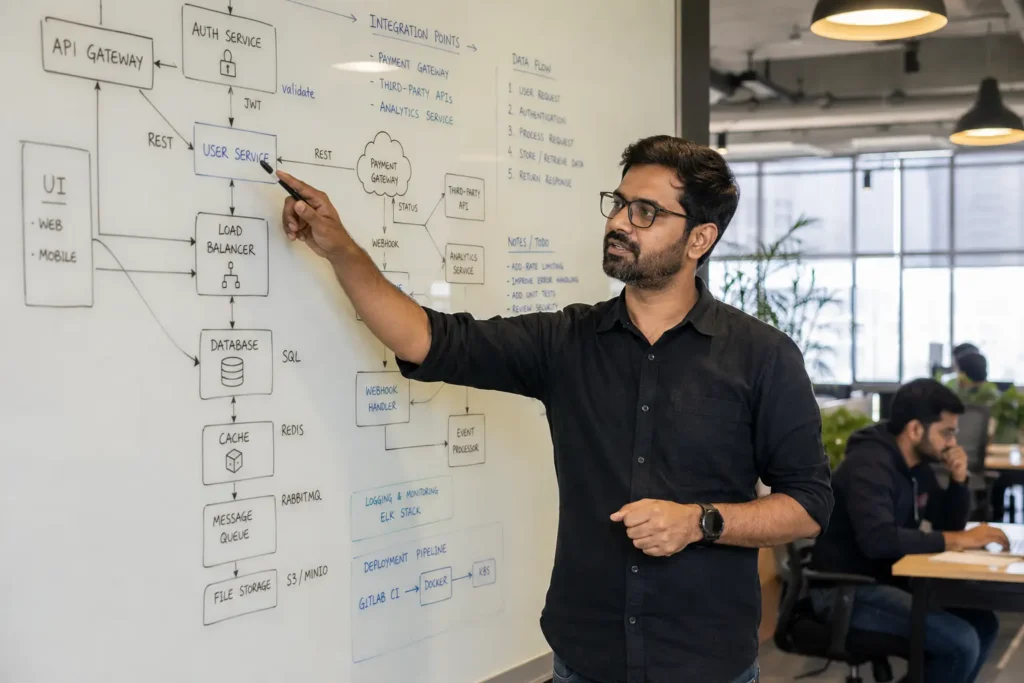
andWhat Makes a Software Project Complex And Why It Needs the Right Partner Most software problems are simple on the surface and messy underneath. A project becomes complex the moment it touches more than one system, more than one team, or more than one point of failure. That’s the line where a general-purpose developer starts guessing and a specialized team starts architecting. We define a complex software project as one where the code is only part of the challenge. The harder work is everything around it: legacy systems that can’t go down during migration, regulatory requirements that change what “correct” means, or a data pipeline where one bad assumption breaks five other things downstream. That’s where AI features are only as useful as the data pipeline behind them. We build that foundation first, because a model trained on incomplete or inconsistent data can produce confident but unreliable results. For projects involving generative AI, machine learning, or data analytics, that means designing the data collection, validation, storage, and processing layers before choosing the technology that sits on top of them. become valuable—not simply for writing code, but for designing the architecture, integrations, security, and workflows that allow the software to work reliably within a specific business. Here’s what that looks like in practice. A retail client needing a new checkout flow is not complex. The same client needing that checkout flow to sync inventory across three warehouses, two currencies, and a legacy ERP built in 2011 that’s complex. Same industry. Completely different engagement. Project management is what keeps all of those technical pieces moving in the same direction. On complex builds, that means keeping requirements, development, QA, security, infrastructure, dependencies, timelines, and stakeholder decisions visible throughout the project. Our delivery team uses sprint planning, regular reviews, milestone tracking, and ongoing communication so technical problems don’t quietly become project delays. ⚡ GET IN TOUCH Ready to build it right the first time? Start with a free project assessment honest scope, realistic timeline, no guesswork. 💬 Chat on WhatsApp 📞 Call 0307 3319555 Signs your project requires specialized complex-systems expertise You’ll usually know it’s complex before a single line of code gets written. A few honest signals: If two or more of these apply, you’re not looking for a freelancer or a small dev shop working solo. You’re looking for a team that can do solution architecture before touching a keyboard. We ask a blunt question early in every complex engagement: what happens if this breaks at 2 AM and nobody’s watching? If the client can’t answer that, we build the answer together before we scope the build. Common risks of choosing the wrong partner for complex builds Here’s what actually goes wrong. We’ve inherited enough half-finished projects to know the pattern. phase,The most common mistake is hiring based on speed instead of architecture. A team that promises a fast timeline on a complex system is usually skipping the discovery phase and discovery is exactly where complexity gets identified and planned for, not avoided. The second mistake is worse: no documentation. We’ve taken over systems where the only person who understood how three modules talked to each other had already left the company. Nobody could touch the code without breaking something invisible. it andAnd the third one costs the most money. Teams that don’t design for scale from day one end up rebuilding the same system twice: once to launch it, and once to fix it when it can’t handle real usage. documentation,None of these are hypothetical. They’re the reason enterprise software development for complex systems needs a different process than a standard build: heavier discovery, clearer documentation and architecture decisions made before deadlines start driving them. Tecveq Company & Services Table Company Name Tecveq Address M3CH+JG7, Farid Town, Sahiwal, 57000 Phone 0307 3319555 Email info@tecveq.com Website tecveq.com Services Custom Software Development, Enterprise Software Development, Legacy System Modernization, API Integration, AI & Data Applications, Cloud Infrastructure, Healthcare App Development, ERP Software Development, CRM Development, Mobile App Development (React Native & Flutter), Ecommerce App Development, Shopify Development, Next.js Development, Web App Development, Logistics Software, AI Chatbot Development, WhatsApp Automation, LMS Development, SEO Services, Digital Marketing, Graphic Design & Web Design Best For Complex, Large-Scale & Mission Critical Software Projects Our Complex Software Development Services Our custom application development work covers business platforms, enterprise applications, internal tools, mobile applications, customer-facing systems, and software that needs to integrate with existing infrastructure. Complex projects rarely fail because of bad code. They fail because nobody mapped the dependencies before building started. Here’s how we handle the six areas that come up most often when a project outgrows a simple build. Depending on the project, we are a top custom software development company that may include web platforms, enterprise systems, mobile applications, internal business tools, or software that connects multiple existing systems. Enterprise Software Development Enterprise software has to work for hundreds of people at once, not just look good in a demo. According to Gartner’s research on enterprise application trends, scalability and multi-user architecture are among the top factors that differentiate enterprise systems from standard applications. We build systems where different departments use the same platform for completely different jobs, and every one of those jobs still has to run without stepping on the others. That means role-based access controls done properly, not bolted on after launch. It means an architecture that can add a new department’s workflow without touching what the last department already relies on. Most enterprise failures we’ve seen trace back to one thing: the system was designed for the first fifty users, not the next five hundred. Legacy System Modernization & Migration Migrating off an old system while it’s still running the business is one of the riskiest jobs in software. We treat legacy modernization as a live-wire project, because that’s exactly what it is. We don’t rip and replace on day one. Legacy ERP systems present some of the most challenging modernization scenarios we encounter. If you’re running outdated accounting or resource planning