
The B2B SEO Agency That Turns Search Into Your Highest-Performing Lead Channel
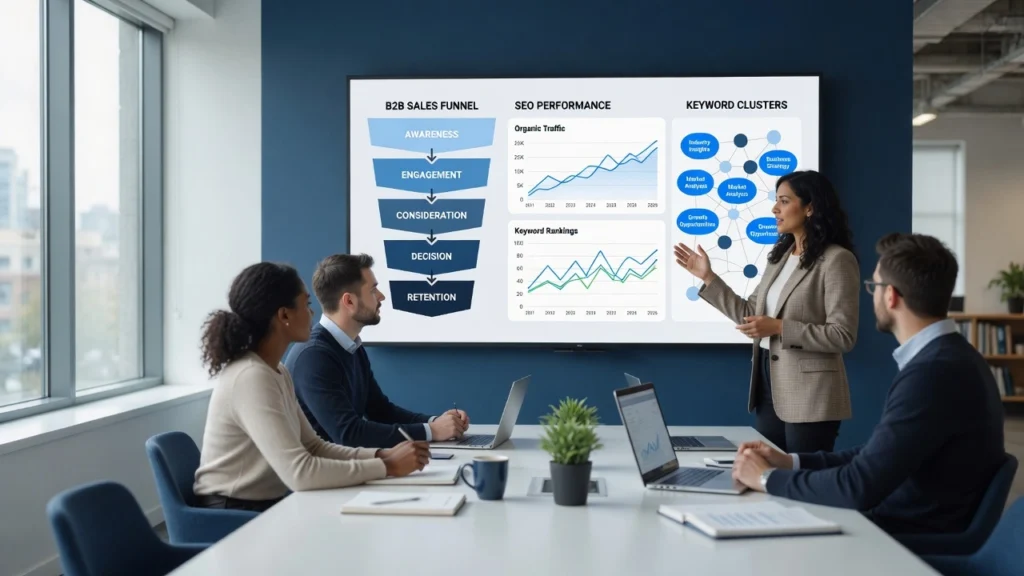
B2B SEO Agency That Turns Organic Search Into Qualified Pipeline Many B2B companies don’t have a traffic problem. They have a strategy and agency-fit problem. They hire a generalist agency, brief them on their goals, and wait. Six months later, organic traffic is up. Rankings are moving. The monthly report looks polished. But the sales team has not seen a single qualified lead come through from organic search. Not one. The traffic is real. The pipeline is not. This happens because the agency took an eCommerce or B2C playbook and applied it to a completely different kind of business. And the two couldn’t be more different. B2C SEO targets individual buyers who make fast decisions. Someone searches, someone clicks, someone buys. The cycle from search to sale can be hours. B2B organic search traffic doesn’t work that way. Your buyers are committees. A CFO is weighing ROI. A technical lead is evaluating integrations. A procurement manager is comparing vendors against a shortlist. That process takes months sometimes closer to a year or more. And each stakeholder is running completely different searches at completely different points in the evaluation. Generalist agencies miss this almost every time. They target high-volume keywords without asking who is actually searching them. They build content calendars without mapping to your sales stages. They report on traffic and rankings while your pipeline stays empty. SEO for long sales cycles requires a fundamentally different approach. B2B lead generation SEO isn’t about generating clicks. It’s about getting the right person, in the right role, at the right stage of their buying journey, to find you and trust you before they ever speak to your sales team. That is the gap between what most agencies sell and what B2B companies actually need. And it is the gap we built this agency to close. We’re a specialist B2B SEO agency that works exclusively with companies that have complex sales cycles, multiple buying stakeholders, and a need for organic search to generate real pipeline — not just traffic. We don’t apply generic frameworks to B2B problems. Every engagement starts by understanding your buying committee, your sales cycle length, and how your best clients actually research and evaluate solutions like yours. Then we build MQL pipeline from SEO by mapping your keyword strategy to how buyers at each stakeholder level actually behave across a months-long evaluation. If you’ve tried SEO before and ended up with traffic but no qualified leads, you didn’t try the wrong channel. You tried it with the wrong partner. [Book a free strategy call — we’ll show you what your buying committee is actually searching for ⚡ GET IN TOUCH Book a free strategy call we’ll show you what your buying committee is actually searching for 💬 Chat on WhatsApp 📞 Call 0307 3319555 Our B2B SEO Strategy: Built Around Your Buying Committee, Not Just Your Keyword List Most agencies open a new client engagement by pulling keyword data. We open ours by talking to your sales team. That single difference changes everything that follows. According to Google’s Search Quality Guidelines, search engines prioritize content that demonstrates genuine understanding of user intent over high-volume keyword targeting. The keywords that matter most for your pipeline are the ones your CFO types into Google at 10pm when building a business case, the ones your technical evaluator searches when comparing integrations, and the ones your procurement manager uses when shortlisting vendors As a specialist B2B SEO agency, our keyword research starts there: identifying the searches that matter to each stakeholder and making sure your business can be discovered at every stage of the evaluation. Step 1: Buying Committee Search Mapping (Before Any Keyword Research) Before we open a single research tool, we spend time understanding who actually makes the buying decision for your product or service. That means sitting down with your sales team not just exchanging briefs. We want to know what questions prospects ask in the first meeting, what objections come up at month four of the sales cycle, and what searches the technical evaluator runs the night before a demo. From those conversations we build a stakeholder search map showing what each role in the buying committee searches at the awareness stage, the consideration stage, and the decision stage. Only then do we move into the keyword research phase, because by that point we know exactly whose attention we are trying to earn and what they need to find when they land on your site. Buyer intent keywords mean nothing without first knowing whose intent you are trying to match. Buying Committee Role What They Care About Typical Search Intent Recommended Content CFO / Economic Buyer ROI, cost, risk, business impact Commercial and evaluation searches ROI calculators, cost comparisons, business cases Technical Evaluator Integrations, security, functionality Technical and solution-specific searches Integration guides, technical documentation, feature comparisons Procurement Pricing, compliance, implementation Vendor evaluation searches Vendor comparisons, compliance resources, implementation timelines Business Sponsor Outcomes, efficiency, strategic fit Solution and category searches Case studies, solution pages, outcome-focused content Technical SEO for B2B: Enterprise Platforms and Complex Site Structures Your developers may tell you the site is fine. Technically, they may be right. But Google finding your site and Google being able to rank your best content are two completely different things. Technical SEO for B2B companies comes with specific challenges that consumer sites rarely face. Gated content that search engines cannot crawl. Product and solution pages buried five levels deep in site architecture. Multiple subdomains running on different platforms. Resource centres that generate strong organic interest but pass no authority back to your core service pages. Our B2B SEO audit covers every layer of your technical setup and identifies exactly what is blocking your B2B website traffic from reaching the people actively searching for what you offer. This is not a surface-level crawl report. It is a technical diagnosis with prioritised fixes and clear reasoning behind every recommendation. B2B Content Strategy: Serving Every Stakeholder in the Buying Committee The biggest content mistake
Shopify SEO Agency That Grows Your Store Revenue, Not Just Rankings
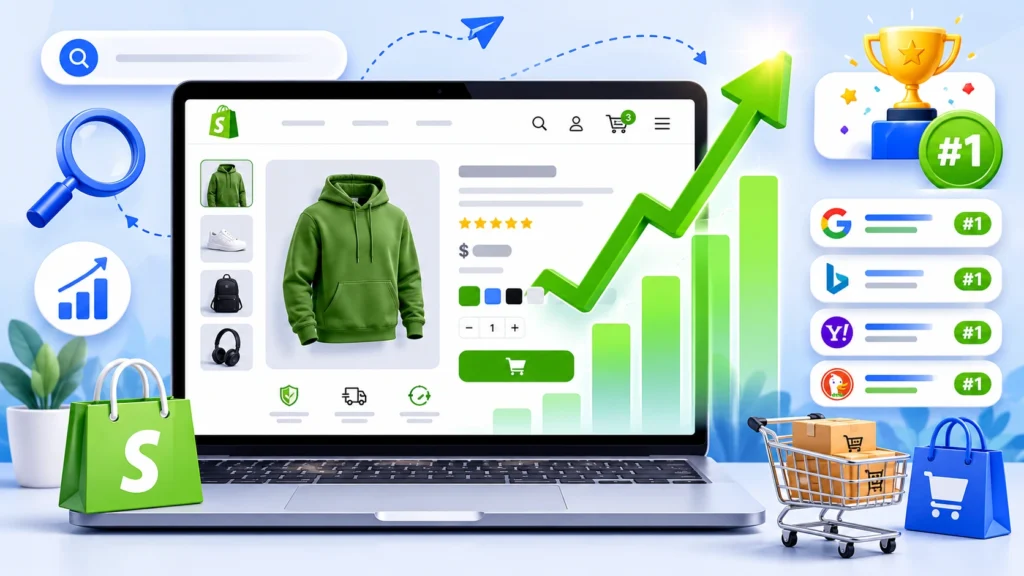
Shopify SEO Services That Turn Search Visibility Into Sale You built a beautiful Shopify store with great products, but something’s wrong. Your Google Analytics shows visitors coming to your site, but they’re not buying anything. Or worse—barely anyone finds your store at all. We see this frustrating situation every week. Store owners pour money into Facebook ads and Google Ads just to get traffic, while their competitors somehow rank at the top of Google search results for the exact same products. Your potential customers are searching for what you sell, but they’re finding other stores instead of yours. The problem isn’t your products or your prices. It’s that Google can’t properly understand and rank your Shopify store. Without strong organic traffic for Shopify stores, you’re stuck paying for every single visitor through ads. And that’s not sustainable for long-term growth. Here’s what we hear from frustrated store owners every day: “I know people are searching for my products because I see the search volume in Google Ads. But when I search for those same terms, my store is nowhere to be found. My competitors are ranking on page one while I’m invisible.” This happens because most Shopify stores have technical SEO problems they don’t even know about. Duplicate content issues, poor site structure, missing optimization—these invisible problems prevent Google from showing your products to customers who are ready to buy. You shouldn’t have to choose between paying for ads forever or watching competitors steal your potential customers. Shopify SEO is a specialized form of search engine optimization focused on improving your store’s visibility across product, collection, category, and informational searches that can lead to sales. We’ve helped dozens of Shopify store owners break free from ad dependency and increase Shopify sales with SEO that actually works. Most see their first organic sales within 60 days, and many cut their ad spending in half within six months while growing total revenue. But first, let us show you exactly how we make Shopify stores visible to customers who are ready to buy. ⚡ GET IN TOUCH Why do competitors rank while your store stays invisible? Find out free 💬 Chat on WhatsApp 📞 Call 0307 3319555 Why Choose Our Shopify SEO Agency? Most Shopify SEO agencies will show you charts of keyword rankings and traffic increases. We show you revenue growth and actual sales numbers. Here’s the difference. Other agencies get excited when your store ranks #3 for a keyword that brings 500 visitors who never buy anything. We focus on getting your products found by customers who are ready to purchase right now. Rankings without sales don’t pay your bills. We’re completely transparent about our process and pricing. While other agencies make you call for a quote or sit through a sales pitch to learn what they actually do, we tell you upfront exactly what our Shopify SEO services cost and what happens in your first 90 days. No hidden fees. No surprise charges after you sign. And here’s what most e-commerce SEO agencies miss entirely: Shopify stores have unique technical challenges that generic SEO companies don’t understand. Collection pages that create duplicate content issues. Apps that slow down your site. Product variants that confuse Google. Theme limitations that hurt your rankings. We’ve worked exclusively with Shopify stores since 2019. Not WordPress sites. Not custom e-commerce platforms. Just Shopify. Which means we know exactly how to fix the platform-specific problems that keep your store invisible in search results. Most agencies will promise you “more traffic” without caring if that traffic converts into customers. We promise you more qualified organic visitors who actually buy your products. Because what good is doubling your website traffic if your sales stay the same? Our Shopify SEO expert team tracks revenue per organic visitor, conversion rates by traffic source, and total organic sales growth. Not just keyword positions and page views. We care about the metrics that matter to your business. When you work with us, you get honest timelines, realistic expectations, and clear communication about what’s working and what isn’t. No fluff reports full of vanity metrics. Just straight talk about how we’re growing your organic sales. Other Shopify SEO agencies won’t tell you this upfront because they want you to call first. We’ll tell you right here: most stores see their first increase in organic sales within 60 to 90 days, with significant growth happening in months 4 through 6. That’s the kind of transparency that separates real professionals from agencies that just want your monthly retainer fee. Our Complete Shopify SEO Services for Growing Stores Our Shopify SEO services cover everything needed to turn your store into an organic sales machine. Not just basic optimization that every agency offers. We handle the complete Shopify store optimization process, from technical fixes that help Google find your products to content strategies that bring in customers who are ready to buy. Every service we offer has one goal: increasing your organic revenue, not just your website traffic. Most store owners don’t realize their biggest SEO problems are invisible. Duplicate URLs from collection filters. Apps that slow down page loading. Missing structured data that prevents rich snippets in search results. We fix these technical issues first because they’re blocking everything else from working properly. But technical fixes alone won’t grow your business. You need product pages that rank for buying-intent searches and collection pages that capture customers looking for specific product categories. We optimize both to turn search visibility into actual sales. Here’s exactly what our Shopify SEO services include and what each one does for your bottom line. Shopify Technical SEO and Store Health We start by fixing the technical problems that prevent Google from properly crawling and indexing your store. Many Shopify stores have technical SEO issues that can limit crawling, indexing, page performance, or search visibility without the owner realizing it Our Shopify technical SEO audit identifies duplicate content from collection pages, slow-loading product images, missing canonical tags, and broken internal links. We
Construction ERP Software That Actually Works for Your Business
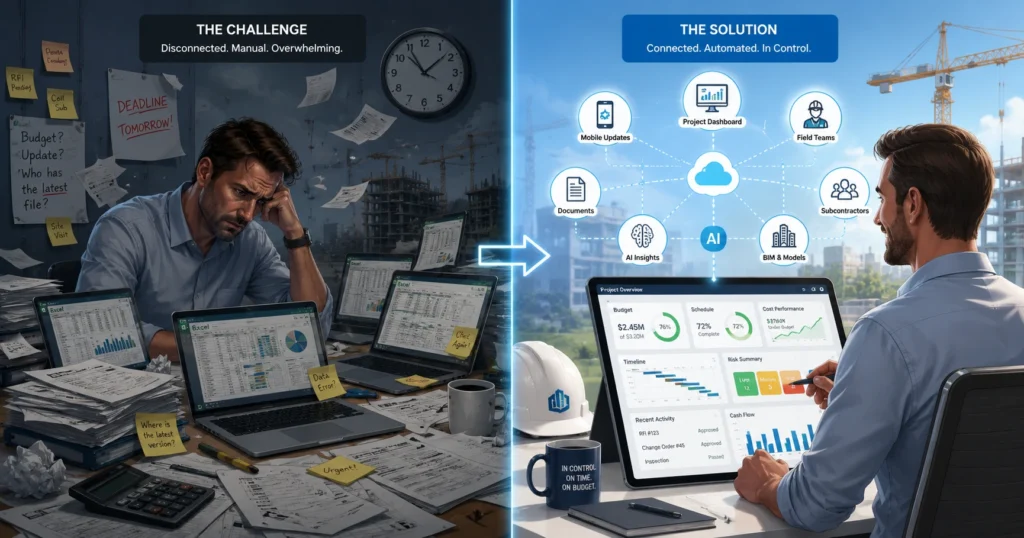
How Construction ERP Software Stops Spreadsheets and Disconnected Tools From Costing You Money We see this every day across construction companies of every size. Project data scattered across five different systems, none of them connected, none of them current. Your project manager updates costs in one spreadsheet. Your accountant tracks expenses in a separate system. Your field supervisor fills out paper time forms that sit in a pile for two weeks before anyone touches them. Meanwhile, you’re trying to determine whether Project A is genuinely profitable or quietly draining cash, and you won’t have a clear answer until the damage is already done Last month, you probably discovered a cost overrun that should have been caught three weeks earlier. Or found out a subcontractor submitted an invoice that doesn’t match what your project manager approved. These construction project management challenges aren’t just frustrating – they’re expensive. Here is what construction companies tell us changes first when they move from disconnected tools to an integrated ERP system. The key benefits are clearer project visibility, less duplicate data entry, faster financial updates, and more organized compliance management. Instead of relying on separate systems and manual processes, teams can work from the same current information across the business. ‘I have no real-time visibility into project costs. By the time I see the numbers, they’re already two weeks old and I’m reacting to problems instead of preventing them.’ That’s a project director at a mid-sized general contractor. He was running six active jobs when he said it. ‘We’re entering the same data into three different systems. My team spends hours every week on duplicate entry that contributes nothing to actually managing projects.’ We hear this constantly from companies that have patched together construction project management software with accounting tools and field apps that were never designed to connect. ‘Compliance documentation is everywhere. When regulators show up, it’s a scramble to find safety training records and permit files before the auditor loses patience.’ For companies managing multiple active sites, construction compliance management handled manually isn’t a system it’s a liability ⚡ GET IN TOUCH Your Cost Overruns Are Already Happening. You Just Don’t Know It Yet. 💬 Chat on WhatsApp 📞 Call 0307 3319555 Why Construction Companies Choose ERP Software Over Disconnected Tools Construction ERP software connects your project data, financial information, and field operations inside one system so you can see what is actually happening across every active job in real time, without calling three people to get a number. Your project costs, your subcontractor commitments, your change orders, your compliance records all of it lives in one place and updates automatically as your team works. No more scattered spreadsheets. No more field reports buried in email chains. If you are still evaluating whether to build, buy, or outsource your software solution, our guide on build vs buy vs outsource software breaks down exactly what that decision costs you long term. . No more compliance documentation that nobody can find when an auditor walks in. Here is what construction companies tell us changes first when they move from disconnected tools to an integrated ERP system. Project visibility stops being a phone call. Instead of tracking down three people to find out if Project B is on budget, you open one dashboard and see current costs, committed expenses, change order impacts, and projected final numbers — all updated as of this morning, not two weeks ago. Duplicate data entry disappears. When your foreman submits a daily report from the job site, that single entry automatically updates project costs, feeds into construction payroll software calculations, and logs equipment usage hours. Your team enters information once. Everything else updates itself. Compliance stops being a crisis. Safety training records, permit documentation, and regulatory certifications update in real time as your team documents normal daily work. When an auditor arrives, the records are already organized. Construction compliance management stops being a scramble and starts being a standard outcome. This is what enterprise resource planning construction software is designed to do. It takes all the separate pieces of running a construction business and connects them so information flows naturally from the field to the office to your financial reports. According to the Associated General Contractors of America, construction productivity has declined over the past decade despite technological advances, largely due to fragmented data systems and inefficient project coordination. The biggest concern we hear before implementation is always the same: ‘We can’t afford to disrupt operations while we’re in the middle of active projects.’ That’s a legitimate concern, and it’s exactly why we built our implementation process around maintaining operational continuity. ERP for construction companies is not a rip-and-replace exercise. We work around your active project schedule and build the new system while your existing operations continue without interruption. Most of our clients are running real-time cost tracking within the first month. By month two, duplicate data entry is largely eliminated and field teams are submitting reports digitally without paper. The manual work your team currently handles re-entering data, chasing down approvals, assembling weekly reports doesn’t have to be part of your operation. It’s something you can stop doing. How StrategicERP’s Construction ERP Software Solves Real Industry Problems StrategicERP’s construction ERP software connects your entire operation estimating, procurement, field reporting, project accounting, and compliance through one platform built from the ground up for construction workflows. Not adapted from generic business software. Not retrofitted with construction modules after the fact. Built specifically for the way construction companies manage projects, people, and costs from bid to closeout We have implemented construction ERP software for over 1,100 construction companies general contractors, EPC firms, MEP contractors, civil engineering companies, and real estate developers. The pattern we see in every engagement is the same: the problem isn’t that your teams aren’t working hard enough. The problem is that your tools were never designed to work together the way a construction operation actually runs. Construction ERP systems solve that disconnect by bringing project, financial, field, procurement, and compliance information into
Custom ERP Software Development Company – Built for Your Business

Your Business Has Outgrown Its Current Systems Here Is What That Actually Costs You Your finance team is working from one spreadsheet. Your warehouse is tracking stock in another. And when the operations manager asks for a sales report by end of day, someone spends three hours pulling numbers from four different places and still gets it wrong. That is not a technology problem. That is a growth problem. Most mid-sized businesses reach a point where the tools that got them here start holding them back. The spreadsheets multiply. The disconnected software stacks up. And every time a new person joins the team, onboarding them means introducing them to a maze of logins, workarounds, and “ask Sarah because she knows how we do it” processes that exist nowhere in writing. The cost of staying on disconnected systems is real — and most businesses underestimate it badly. Manual data re-entry between departments is not just slow. It introduces errors that ripple through your reporting, your invoicing, and your decision-making. When your finance and inventory systems do not talk to each other, you end up ordering stock you already have or missing orders because availability data is three days out of date. When managers wait days for reports that should take minutes, decisions get delayed or made on gut instinct instead of live data. And the longer this goes on, the harder it gets to fix. This is exactly the problem that enterprise resource planning software exists to solve. A custom ERP system — built specifically for how your business operates — connects every department into one platform, replaces the manual handoffs with automated workflows, and gives everyone who needs data access to it in real time. But not every business is ready for it. And not every ERP company will tell you that honestly upfront. We will. What Our Custom ERP Software Development Company Actually Builds for You We build one system that replaces all of them. That is the simplest way to describe what custom ERP development does for a growing business. Instead of your team switching between separate tools for finance, inventory, HR, and operations — each with its own login, its own data, and its own version of the truth — a custom-built ERP system brings everything into a single platform designed around how your business actually works. Not how a software vendor thinks businesses should work. How yours does. This is where custom ERP development is fundamentally different from buying an off-the-shelf platform. Generic ERP software is built for an average business. Your business is not average. Your workflows, your approval processes, your reporting needs, and your integrations are specific to how your team operates. A system built around those specifics gets used. A system that forces your team to adapt to it gets abandoned or worked around — which is how you end up back where you started. What a well-built custom ERP system gives your business is straightforward. One source of accurate data that every department works from. Automated workflows that handle the manual handoffs between teams without someone chasing emails or re-entering the same numbers twice. Real-time reporting that managers can pull themselves in minutes, not days. And a scalable ERP solution that grows with your headcount and your operations without needing to be replaced every three years. As an ERP software development company, we handle the full build from mapping your requirements and designing the architecture through development, testing, and getting your team up and running on launch day. We build custom ERP solutions for growing businesses, mid-sized manufacturers, logistics operators, and service companies that need more than off-the-shelf software can give them. Not sure yet what your system would need to include? Book a free discovery call and we will walk through your current setup, identify the gaps, and tell you honestly what makes sense to build and what does not. No obligation. Is Custom ERP the Right Choice for Your Business? (And When Off-the-Shelf Makes More Sense) Not every business needs a custom-built ERP system. Some are better served by an established platform, and we will tell you that upfront if your situation calls for it. Understanding what enterprise resource planning actually means for your specific business size and workflow complexity is the first step toward choosing the right path. Custom ERP development makes sense when your business operates in ways that standard software cannot accommodate. If your workflows, approval chains, or reporting needs are specific to your industry or your company — and forcing your team to adapt to generic processes would slow things down rather than speed them up — custom-built is the right path. The same applies if you are in a regulated industry with compliance requirements that off-the-shelf platforms do not handle natively, or if you need the system to integrate tightly with proprietary internal tools that a SaaS ERP platform cannot connect to easily. Custom also wins when you are thinking long-term about total ownership cost. Off-the-shelf platforms charge per user per month, forever. A custom build has a higher upfront ERP software development cost, but no recurring licensing fees. Over five or ten years, that math changes significantly in favor of building your own system. But if your business processes are relatively standard, your budget is constrained right now, or you need a system live in weeks rather than months, an off-the-shelf platform may be the smarter move. ERP vendor selection in that case becomes about finding the platform that fits your needs with the least customization required. Here is what we do differently during ERP vendor selection conversations. We walk through your workflows, your integration needs, and your budget realities. Then we give you an honest recommendation even if that recommendation is to go with an established platform instead of building custom. A business that chooses the wrong ERP path wastes six figures and a year of their team’s time. We would rather lose a sale than watch that happen to someone who called us
Custom ERP Software Development Services Built Around Your Business

What Are Custom ERP Software Development Services and Who Needs Them? Custom ERP software development services are exactly what the name says we design and build enterprise resource planning systems from the ground up, built specifically around how your business operates. Not generic platforms like SAP or Microsoft Dynamics that require you to restructure your workflows to match their templates. We build the system around you instead. Here’s what that looks like on the ground. Finance stops spending 14 hours pulling data from four different systems to close the books every month. Warehouse inventory updates in real time the moment a sale happens no more relying on spreadsheets that were already outdated the day someone created them. And your operations manager finally has a dashboard showing what’s actually happening across departments right now, not reports that were compiled two weeks ago from data that was already wrong. We’ve built custom ERP systems for manufacturers whose production scheduling requirements are too complex for any off-the-shelf platform to handle properly. For distributors managing vendor relationships across five, ten, or fifteen warehouses who can’t get the inventory visibility they need from generic enterprise resource planning software. For healthcare companies that need HIPAA-compliant patient data integration built into every module from the start. And for growing businesses that have already spent $80,000 trying to customize SAP or Oracle and are still fighting the system every single day You’re in the right place if your business has outgrown spreadsheets and disconnected tools. If your workflows are different enough from standard business templates that forcing them into generic software creates more problems than it solves. If you need industry-specific compliance FDA lot tracking, SOX financial controls, HIPAA patient data requirements that most platforms handle poorly or expensively. Or if you’ve already gotten quotes for off-the-shelf ERP system customization and discovered you’d be spending nearly custom development prices for a system you still don’t own or fully control We’ve completed over 200 ERP implementations in the past 12 years for companies ranging from $10 million manufacturing operations to $500 million distribution businesses. Most of our clients come to us after getting burned by providers who promise unrealistic timelines or disappear after launch. We position ourselves as an ERP development partner rather than simply a vendor, staying involved from discovery and implementation through ongoing support and future system improvements. Most of our clients reach us after spending months sometimes years and significant budget trying to make SAP or Dynamics work for operations those platforms weren’t designed to handle. What they needed wasn’t more customization of a platform that wasn’t built for them. They needed business management software designed around how their business actually runs. If you’re running a company with 50 to 500 employees and your current systems genuinely can’t keep pace with your growth, contact us for a free consultation. If your team is spending more time working around the software than actually using it to run the business that’s the exact problem custom ERP development exists to solve. Not every business needs custom development, and we’ll be the first to tell you that. Sometimes NetSuite or Microsoft Dynamics genuinely is the right answer for where your company is right now and we’ll tell you honestly in our first conversation rather than push you toward a solution that doesn’t fit. But when your operations are genuinely complex, your industry has specific compliance requirements, or you’re scaling past what standard platforms were built to handle, custom ERP development stops being optional. That’s what we build. Custom ERP software designed around how your business actually works not the other way around. Is Custom ERP Right for Your Business? (When It Makes Sense and When It Doesn’t) Most ERP development companies won’t say this, but custom development isn’t always the right answer. We’ll tell you honestly in our first conversation which path actually fits your situation, even when the answer costs us the project Sometimes buying NetSuite or Microsoft Dynamics makes more sense for your business right now. And we’ll tell you honestly which path fits your situation even if it means you don’t hire us today. Here’s the framework we use when a company calls us asking whether they should build custom or buy off-the-shelf. When Off-the-Shelf ERP Makes More Sense Choose SAP, Oracle ERP, Microsoft Dynamics, or NetSuite if your budget is under $50,000 total. Custom ERP development starts making strong financial sense around $75,000 and up. In that $50,000 to $75,000 range, the decision comes down to how unique your workflows are if you can adapt your processes to standard templates, off-the-shelf is fine; if you can’t, you’ll end up spending more on platform customization than you expected anyway. Go with off-the-shelf if you need the system running in under three months. Custom development for even a small ERP takes four to six months minimum, and that’s not a timeline we can compress without cutting corners we won’t cut. If speed matters more than fit right now, a pre-built platform gets you operational faster — and we’ll say that even though it means you don’t hire us today. Team under 25 users with standard workflows? ERP software for small business operations usually works fine with NetSuite or Dynamics configured to industry standard settings. Small teams running straightforward processes don’t need the customization depth that justifies building from scratch. And here’s the advice most companies never hear before they spend money they didn’t need to spend. If your business is still working out its permanent processes still evolving how departments hand off work, still deciding which metrics actually matter, still growing into a stable operational model start with off-the-shelf now and come back to custom development in 18 to 24 months. Building a custom ERP system around workflows that are still changing is the most expensive way to learn what your business needs. When Custom ERP Development Is the Right Investment Build custom when your business processes genuinely don’t fit standard templates and forcing them into SAP