How Construction ERP Software Stops Spreadsheets and Disconnected Tools From Costing You Money
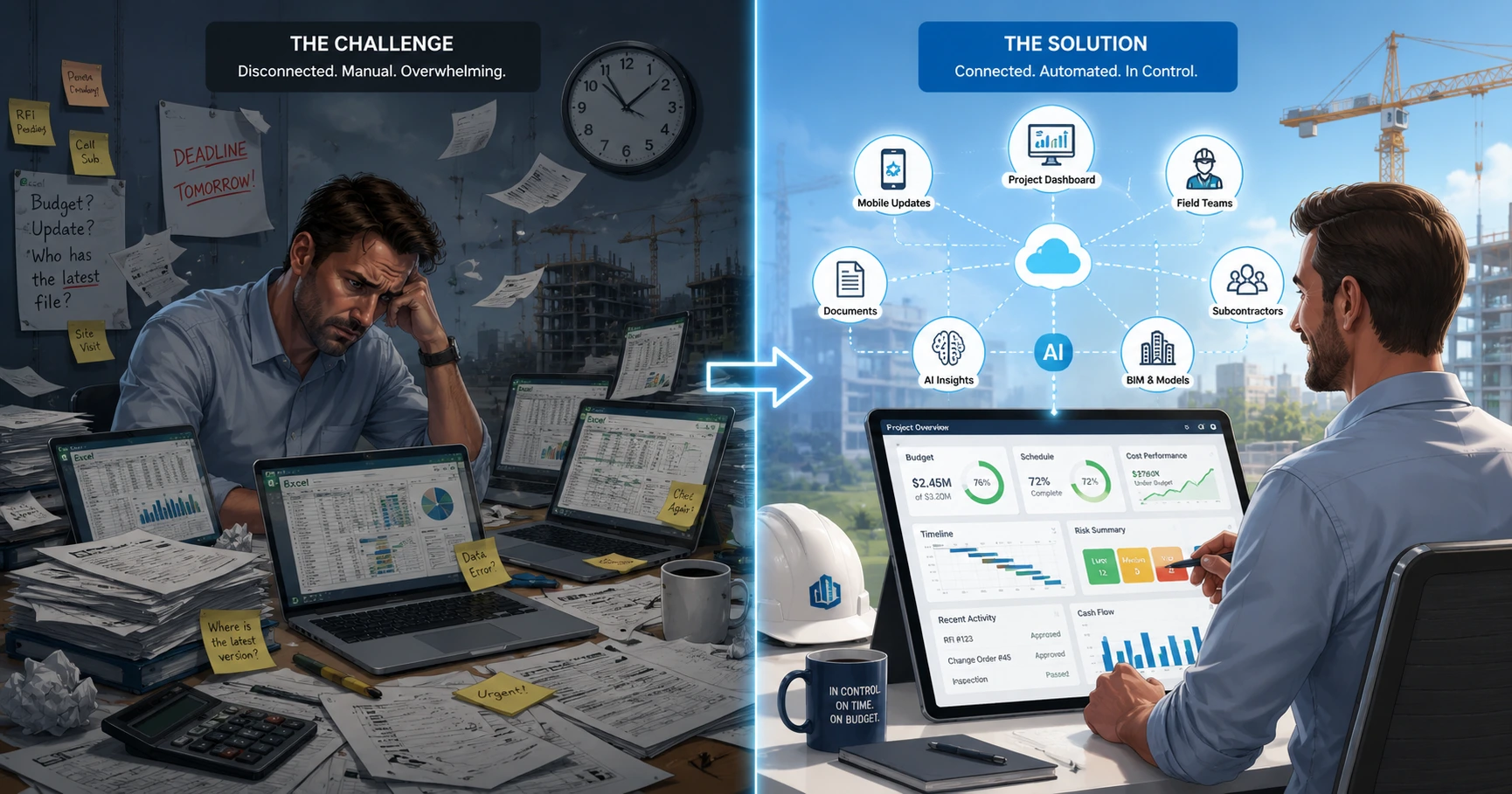
We see this every day across construction companies of every size. Project data scattered across five different systems, none of them connected, none of them current. Your project manager updates costs in one spreadsheet. Your accountant tracks expenses in a separate system.
Your field supervisor fills out paper time forms that sit in a pile for two weeks before anyone touches them. Meanwhile, you’re trying to determine whether Project A is genuinely profitable or quietly draining cash, and you won’t have a clear answer until the damage is already done
Last month, you probably discovered a cost overrun that should have been caught three weeks earlier. Or found out a subcontractor submitted an invoice that doesn’t match what your project manager approved. These construction project management challenges aren’t just frustrating – they’re expensive.
Here is what construction companies tell us changes first when they move from disconnected tools to an integrated ERP system. The key benefits are clearer project visibility, less duplicate data entry, faster financial updates, and more organized compliance management. Instead of relying on separate systems and manual processes, teams can work from the same current information across the business.
‘I have no real-time visibility into project costs. By the time I see the numbers, they’re already two weeks old and I’m reacting to problems instead of preventing them.’ That’s a project director at a mid-sized general contractor. He was running six active jobs when he said it.
‘We’re entering the same data into three different systems. My team spends hours every week on duplicate entry that contributes nothing to actually managing projects.’ We hear this constantly from companies that have patched together construction project management software with accounting tools and field apps that were never designed to connect.
‘Compliance documentation is everywhere. When regulators show up, it’s a scramble to find safety training records and permit files before the auditor loses patience.’ For companies managing multiple active sites, construction compliance management handled manually isn’t a system it’s a liability
GET IN TOUCH
Your Cost Overruns Are Already Happening. You Just Don’t Know It Yet.
Why Construction Companies Choose ERP Software Over Disconnected Tools
Construction ERP software connects your project data, financial information, and field operations inside one system so you can see what is actually happening across every active job in real time, without calling three people to get a number.
Your project costs, your subcontractor commitments, your change orders, your compliance records all of it lives in one place and updates automatically as your team works. No more scattered spreadsheets. No more field reports buried in email chains. If you are still evaluating whether to build, buy, or outsource your software solution, our guide on build vs buy vs outsource software breaks down exactly what that decision costs you long term.
. No more compliance documentation that nobody can find when an auditor walks in.
Here is what construction companies tell us changes first when they move from disconnected tools to an integrated ERP system.
Project visibility stops being a phone call. Instead of tracking down three people to find out if Project B is on budget, you open one dashboard and see current costs, committed expenses, change order impacts, and projected final numbers — all updated as of this morning, not two weeks ago.
Duplicate data entry disappears. When your foreman submits a daily report from the job site, that single entry automatically updates project costs, feeds into construction payroll software calculations, and logs equipment usage hours. Your team enters information once. Everything else updates itself.
Compliance stops being a crisis. Safety training records, permit documentation, and regulatory certifications update in real time as your team documents normal daily work. When an auditor arrives, the records are already organized. Construction compliance management stops being a scramble and starts being a standard outcome.
This is what enterprise resource planning construction software is designed to do. It takes all the separate pieces of running a construction business and connects them so information flows naturally from the field to the office to your financial reports.
According to the Associated General Contractors of America, construction productivity has declined over the past decade despite technological advances, largely due to fragmented data systems and inefficient project coordination. The biggest concern we hear before implementation is always the same: ‘We can’t afford to disrupt operations while we’re in the middle of active projects.’
That’s a legitimate concern, and it’s exactly why we built our implementation process around maintaining operational continuity.
ERP for construction companies is not a rip-and-replace exercise. We work around your active project schedule and build the new system while your existing operations continue without interruption. Most of our clients are running real-time cost tracking within the first month. By month two, duplicate data entry is largely eliminated and field teams are submitting reports digitally without paper.
The manual work your team currently handles re-entering data, chasing down approvals, assembling weekly reports doesn’t have to be part of your operation. It’s something you can stop doing.
How StrategicERP’s Construction ERP Software Solves Real Industry Problems
StrategicERP’s construction ERP software connects your entire operation estimating, procurement, field reporting, project accounting, and compliance through one platform built from the ground up for construction workflows. Not adapted from generic business software. Not retrofitted with construction modules after the fact. Built specifically for the way construction companies manage projects, people, and costs from bid to closeout
We have implemented construction ERP software for over 1,100 construction companies general contractors, EPC firms, MEP contractors, civil engineering companies, and real estate developers. The pattern we see in every engagement is the same: the problem isn’t that your teams aren’t working hard enough.
The problem is that your tools were never designed to work together the way a construction operation actually runs. Construction ERP systems solve that disconnect by bringing project, financial, field, procurement, and compliance information into an integrated environment built specifically for construction. Instead of spending years adapting generic business software, construction companies can use one platform designed around the workflows their teams already follow.
Most ERP systems were built for manufacturing or retail and then modified with add-on modules for construction. The problem is the underlying logic job costing, subcontractor management, change order workflows doesn’t exist in those systems. This is exactly the gap that custom ERP software development is designed to close for businesses that have outgrown generic platforms.
Construction companies end up building workarounds on top of workarounds. Our construction ERP software was designed from the ground up for construction workflows, with AI capabilities that monitor project patterns and flag cost and schedule risks three to four weeks before they show up in standard reports.
Here’s what makes our approach different. Instead of forcing your construction workflows into generic business processes, we built every module around how construction projects actually run. From estimating through project closeout, our system follows the natural flow of construction work.
Our clients consistently see meaningful improvement in three areas within the first 60 days. Project cost visibility shifts from two-week-old reports to real-time dashboards. Financial tracking moves from manual entry and reconciliation to automatic updates from field data. And compliance documentation safety records, certifications, regulatory reports is maintained by the system as your team works, not assembled in a rush before an audit
The AI ERP for construction capabilities in our platform do something most construction software cannot. The system analyzes your historical job data labor productivity rates, material cost patterns, subcontractor performance, equipment utilization and identifies which active projects are trending toward cost overruns or schedule slippage before those problems appear in standard reporting.
Construction executives using our platform typically see risk alerts three to four weeks earlier than they would through traditional cost tracking. That window is enough time to take corrective action instead of documenting a loss.
Most importantly, we built this as construction accounting software and construction procurement software that actually understands construction workflows. Your field teams can use it easily, your project managers get the visibility they need, and your financial team gets accurate real-time reporting.
Unified Project and Financial Visibility
Real-time project tracking for construction gives your team real time visibility into every cost entry, timesheet submission, and equipment log from the field as soon as the information is entered. Project managers can track costs, committed expenses, change order impacts, and projected final costs from one dashboard instead of relying on a spreadsheet built from data that was already three days old. This gives construction teams a current financial picture while there is still time to act on problems.
Our clients tell us they stop doing their weekly spreadsheet reconciliation within the first month. Project costing, timesheet data, and equipment usage flow directly into construction financials and reporting without manual transfer, giving project managers a clearer view of actual spending against the budget. Month-end is no longer a scramble to reconcile what happened because the numbers are already captured throughout the project.
AI-Powered Insights and Automation
Every construction company has its own cost patterns, productivity benchmarks, and project rhythms. Our AI-powered software maps those patterns during your first few months on the platform, then monitors every active job against your own historical performance. These are key features of the platform because they connect operational data with financial management, allowing your team to identify unusual costs, productivity changes, and project risks using benchmarks based on your own construction history rather than generic industry assumptions.
When material costs on a specific job type start drifting above your historical norms, you get an alert. When labor productivity on a project drops below the baseline your past jobs established, you see it flagged before it compounds into a budget problem. When a schedule delay on one job is about to create a resource conflict on another, the system catches it.
AI ERP for construction in our platform means catching cost overruns early enough to take corrective action, not early enough to write a better loss report.
Industry-Specific Modules and Workflows
Every module in our construction ERP platform was built around actual construction workflows not retrofitted from a manufacturing or retail system. Subcontractor management, construction equipment management, safety compliance, and change order approvals work the way your project managers and foremen already expect them to work.
ERP modules for construction in our platform include job costing that tracks actual versus estimated costs as work happens, construction procurement software that prevents material delays by flagging long-lead items early, and compliance tracking that documents safety training and certifications during normal daily operations.
Generic business software asks your team to translate construction work into software logic that was never designed for it. Our system starts from how construction projects actually run.
Specialized Solutions for Every Construction Vertical
Different construction sectors have fundamentally different workflows, compliance structures, and project challenges. A MEP contractor scheduling certified tradespeople across six active sites manages their operation nothing like a road construction company tracking equipment utilization across a 40-mile corridor.
An EPC firm coordinating multi-year engineering, procurement, and construction phases has needs that turnkey project management software must handle completely differently than software designed for residential development.
Most ERP vendors sell the same platform to every construction type and rely on configuration to bridge the gap. That gap never fully closes. We built vertical-specific modules for each major construction sector because the differences are too fundamental to solve with configuration alone.
We developed specialized configurations for each construction vertical based on working with hundreds of companies in each industry. Our system adapts to how your specific type of construction business actually operates instead of forcing you to change your proven workflows.
Here’s how we address the unique challenges in each major construction sector.
MEP (Mechanical, Electrical, Plumbing) Contractors
MEP ERP software handles challenges that generic construction platforms aren’t built for. Scheduling a certified electrician for work that requires a specific license classification, across three different active sites, while tracking which certification expires at the end of the month that’s a workforce management problem most ERP systems can’t solve cleanly.
Our construction workforce management module schedules electricians, plumbers, and HVAC technicians against project requirements and regulatory compliance needs simultaneously. Material tracking follows specialized equipment from order to installation, with lead-time alerts that prevent the delays that happen when a long-lead mechanical component isn’t ordered early enough.
The system monitors certification expiration for every technician and alerts you before someone’s credentials lapse on an active job. No paper checklists. No last-minute scrambles. The compliance documentation is maintained as a natural output of how your team works.
EPC and Turnkey Project Management
EPC project management software has to do something most construction platforms can’t: hold the relationship between engineering decisions, procurement timelines, and construction schedules in real time across projects that span years, not months.
Our turnkey project management software handles the specific challenge of design changes that ripple through procurement and construction simultaneously.
When an engineering modification changes a material specification, the system updates procurement requirements and flags the construction schedule impact before the procurement team has even opened their inbox. Contract management tracks performance milestones, payment schedules, and delivery commitments across all project phases across every subcontractor, every vendor, every regulatory checkpoint.
When you’re managing projects that involve dozens of subcontractors over multiple years, the cost of a missed milestone or a procurement delay that wasn’t flagged early is measured in months of rework, not hours.
Civil Engineering and Infrastructure
ERP for civil engineering projects carries requirements that most construction software never encounters. Equipment utilization tracking across multiple active sites. Environmental impact documentation that meets regulatory standards and holds up in government audits.
Progress reporting structured exactly the way public sector clients require it not exported and reformatted from a generic report template every month.
Our road and railway project software includes specialized modules for materials testing documentation, environmental compliance tracking, and the progress reporting formats that government contracts specify. Infrastructure project management in our platform is built around the reality that your client is a government agency, your compliance requirements are statutory, and your reporting obligations don’t bend to what’s convenient for your office team.
Real Estate Development and Construction
ERP for real estate and construction connects your sales commitments to your construction reality. When a buyer asks your sales team for a completion date, that date should come from live construction progress data — not from a schedule your project manager updated last Tuesday. Our system keeps sales timelines and construction progress synchronized so your customer communications reflect where the project actually stands.
Change order management flows from customer requests through construction impact analysis to updated delivery commitments without manual handoffs between teams. Multi-project construction management gives executives visibility across every active development — which phases are ahead, which have resource conflicts, and how decisions on one project ripple into delivery timelines on others.
For real estate developers managing multiple projects across different phases simultaneously, that portfolio-level visibility is the difference between proactive management and constant firefighting.
Our Proven Implementation Process – From Planning to Success
ERP implementation for construction companies takes 8 to 12 weeks from contract to full operation when the process is managed correctly. Most implementations that drag on for months — or fail outright — run into the same three problems: data migration that wasn’t planned properly, user training that happened after go-live instead of before, and workflow disruption that stopped operations during a critical project period.
We have structured our implementation process specifically to prevent all three. Data migration is mapped and tested in weeks three through six while your existing operations continue without interruption. Training happens by role, before go-live, so your team is ready on day one. And we schedule go-live around your active project cycle — not our deployment calendar.
Construction companies that have watched an ERP implementation derail a competitor’s operation are right to be cautious. The projects that fail do so in predictable ways and those patterns are visible in the planning phase for anyone who knows what to look for.
Our four-phase implementation process was built around the failure modes we’ve seen across hundreds of construction ERP engagements. We prevent disruption by building your new system while operations continue, not by asking your team to stop mid-project and switch systems on a Monday morning.
We prevent budget overruns by scoping implementation precisely in phase one. We prevent user resistance by training your team on how the system makes their specific job easier before they ever log in on a live project.
Our construction ERP implementation process is built around one priority: getting your team operational on core functionality fast, then improving the system based on how you actually use it in real projects. We do not try to configure every module perfectly before go-live. We get project cost tracking, field reporting, and financial integration running in the first eight weeks. Everything else gets refined in phase four based on real usage patterns from your own team not theoretical workflows we designed in a conference room
Here’s exactly what happens during each phase. No surprises, no delays, no disruption to your current projects.
The biggest difference in our approach is transparency. We tell you exactly what to expect, when to expect it, and how we handle problems before they impact your business. Most companies skip this level of detail because it requires real implementation expertise.
Phase 1 – Discovery and Planning (Weeks 1-2)
We start every ERP implementation for construction companies with a detailed analysis of your current workflows, data systems, and specific business requirements. No generic templates. No assumptions about how construction companies should work in theory.
Phase one maps your existing processes, identifies every data source that needs to migrate or integrate, and designs system configurations around how your team actually manages projects day-to-day. We plan ERP integration with Tally, QuickBooks, or whatever accounting system your team currently uses so your financial workflows survive the implementation without disruption.
The most important work in phase one is identifying the problems that would have derailed go-live data quality issues, workflow conflicts, integration gaps while there’s still time to solve them in planning rather than during a live deployment.
Phase 2 – Configuration and Migration (Weeks 3-6)
System configuration and data migration run in parallel during weeks three through six so your existing operations continue without interruption. We build the new system while your team runs current projects on existing tools. No operational disruption during the build phase.
Data integration in this phase includes migrating historical project data, configuring connections to your existing accounting and scheduling tools, and setting up the workflow rules that match how your team actually operates. Every integration is tested against real data before we move to training.
The AI modules are configured during this phase using your historical project data. By week six, the system has enough information from your past projects to establish your company’s baseline patterns cost benchmarks, productivity norms, typical project durations by type.
The predictive alerts that catch cost overruns early start generating from real data, not generic industry assumptions.
Phase 3 – Training and Go-Live (Weeks 7-8)
Training in weeks seven and eight happens by role, not by feature list. Your project managers learn the dashboards and cost tracking tools they will use every day. Your accounting staff work through financial reporting and payroll integration specific to their workflows. Field supervisors train on the mobile construction mobile ERP app — including offline functionality, because real job sites don’t always have reliable cell service.
Go-live is scheduled around your active project cycle, not our deployment calendar. If you have a major project milestone in week nine, we schedule go-live before or after it, not during it.
Our team provides on-site support during the first full week of live operation. Not remote support. On-site. Because the first week is when real questions emerge from real work, and the fastest way to answer those questions is to be there.
Phase 4 – Optimization and Support (Ongoing)
Phase four doesn’t have a scheduled end date. After go-live, we monitor how your team is actually using the platform against the performance benchmarks we established in phase one. Data entry time, report accuracy, user adoption rates by department when any of those metrics show an opportunity to streamline workflows or expand functionality, we bring that recommendation to you rather than waiting for you to file a support ticket.
Most construction software vendors hand you a support phone number after implementation and consider their work done. We stay in the engagement because a construction ERP system that isn’t actively optimized for how your company grows stops delivering full value within 12 to 18 months.
When your operation changes new project types, new subcontractors, new compliance requirements your system should adapt to match it. That’s what we manage in phase four.
Why 1,100+ Construction Companies Trust StrategicERP
Construction companies that implement StrategicERP stay on the platform. Our retention rate across clients reflects what companies discover after implementation: the ROI shows up faster than expected, the adoption is higher than they planned for, and the operational improvements compound over time rather than plateauing after the first year.
The companies working with us range from 12-person MEP contractors managing a handful of active jobs to EPC firms running multi-year infrastructure projects across multiple countries. What they share is a need for project data that’s accurate, current, and accessible to the people who need to make decisions and the results we deliver consistently across that range is what earns the long-term relationships.
Most ERP vendors measure their success by completed implementations. We measure ours by whether clients’ project profitability, cost visibility, and compliance operations actually improved within the first six months. We publish case studies that show specific before-and-after results not testimonials about how easy the system is to use, but documented improvements in cost overrun rates, report accuracy, and administrative time.
The difference shows up in how we approach a sales conversation. We don’t lead with feature lists. We ask about your specific operational problems and show you documented results from companies with similar challenges.
The best construction erp software proves its value through client success, not marketing claims. Our clients see real improvements in project profitability, construction compliance management, and operational efficiency within the first few months of implementation.
Here’s the proof that validates our approach.
Client Success Stories and ROI Results
Our clients typically reach measurable return on investment within 6 to 12 months. The ROI comes from three sources that our clients consistently identify: reduced administrative overhead as manual data entry and report assembly time drops, fewer cost overruns as real-time cost tracking surfaces budget problems weeks earlier, and improved project delivery as better resource visibility prevents the scheduling conflicts that push completion dates back.
Project managers in our client companies report spending significantly less time assembling project status information — time that shifts toward actual project management. Field teams complete reporting faster because mobile submission eliminates the paper-to-office transfer step. Executives get financial reporting that reflects current project reality rather than last month’s reconciled numbers.
The most consistent result our clients report involves construction cost control software capabilities and stronger financial control. Companies that previously discovered cost overruns at month-end reporting now catch the same issues three to four weeks earlier — while there’s still time to adjust labor allocation, renegotiate material pricing, or have an honest conversation with the project owner about scope. That earlier visibility gives managers more control over project spending before a small variance becomes a significant financial problem.
That timing difference changes the financial outcome completely. Catching a $40,000 budget variance with four weeks remaining gives you options. Catching it at month-end gives you paperwork.
Construction compliance management changes character entirely once the system is handling it. Companies that previously spent weeks before an audit pulling together safety training records, certification documentation, and regulatory filings now walk into audits with records that are already organized and current — because the system maintains them as a natural output of daily operations. The audit preparation that consumed two weeks of staff time every quarter now takes an afternoon.
Project managers tell us they spend 60% less time gathering project status information because real-time dashboards show current costs, progress, and resource allocation instantly. Which means they focus on managing projects instead of chasing down data.
Field teams report faster project completion because mobile access eliminates the delays that happen when approvals, change orders, and material requests get stuck in office-based systems.
Industry Recognition and Awards
StrategicERP has earned recognition from construction industry associations and technology organizations for innovation in construction-specific ERP solutions and successful client implementations.
Our technology partnerships with leading construction software providers validate our integration capabilities and industry expertise. These partnerships ensure our platform works seamlessly with the other tools construction companies rely on.
Third-party technology reviewers consistently rate our construction ERP platform highly for ease of use, implementation success, and ongoing client support. Which is why we’re recognized as best construction erp software by organizations that evaluate business technology solutions.
The recognition matters because it comes from independent sources who evaluate actual client outcomes, not vendor marketing claims.
GET IN TOUCH
1,100+ Construction Companies Ditched Spreadsheets. See Why
Advanced Technology Built for Modern Construction
Cloud-based ERP eliminates the technology problems that have plagued construction companies for decades while giving teams access to current project information from the office or job site. No more losing project data when laptops crash, no more waiting until you get back to the office to update costs, and no more manual data entry between systems that don’t talk to each other. A cloud-based ERP gives project managers, field teams, and executives a shared system that keeps information available and updated as work happens.
Our AI-powered software learns from your project patterns to predict problems before they become expensive. While your competitors are still reacting to cost overruns weeks after they happen, our system alerts you to budget risks three weeks earlier so you can take corrective action.
Most construction software vendors bolt modern features onto outdated technology. We built our cloud ERP platform from the ground up for how construction teams actually work. Field crews get real-time access to everything they need, project managers see live project status, and executives get accurate financial reporting that updates automatically.
The difference shows up in daily operations. Your team spends less time fighting technology and more time building projects.
Mobile-First for Field Teams
Our construction mobile ERP app works completely offline so field teams can update project data, capture photos, and submit reports even when cell service is spotty. Everything syncs automatically when connectivity returns.
Field supervisors use mobile field access to approve timesheets, track equipment usage, and document safety compliance without paper forms or office visits. Project managers get real-time updates from multiple job sites on one dashboard.
The mobile platform handles the reality of construction work. Dusty conditions, dropped phones, and inconsistent internet don’t stop data collection because the system was designed for construction environments from day one.
Seamless Integrations with Your Existing Tools
ERP integration with Tally and other accounting systems means you don’t lose your existing financial workflows during implementation. Our platform connects to the tools your accounting team already knows instead of forcing them to learn completely new software.
Data integration extends to scheduling software, BIM tools, and project management systems your teams currently use. We connect existing tools instead of replacing everything at once, which reduces implementation risk and user resistance.
The integration approach eliminates the duplicate data entry that wastes hours every week. When field teams submit daily reports, that information automatically updates project costs, equipment tracking, and payroll calculations across all connected systems.
Ready to Transform Your Construction Operations?
You’ve seen how construction erp software can eliminate the data chaos, cost overruns, and project visibility problems that cost construction businesses money every day. StrategicERP delivers the AI-powered solution that over 1,100+ construction companies trust to run their operations efficiently, bringing project, financial, field, and compliance information together in one system.
We’re the best construction erp software choice for construction companies because we understand your industry challenges and have the implementation expertise to deliver results fast. Our 8-12 week implementation process gets you operational quickly with minimal disruption to current projects.
The question isn’t whether ERP will improve your construction operations. The question is how much longer you’ll accept the inefficiencies of disconnected systems when a proven solution is ready to implement.
Choose the engagement option that fits where you are in your decision process:
Schedule a Personalized Demo
See exactly how our platform handles your specific construction workflows. We’ll show you real project scenarios and demonstrate the AI features that catch problems before they become expensive. Takes 45 minutes and you’ll walk away knowing exactly what the system can do for your business.
Get a Free Construction ERP Assessment
Not ready for a demo yet? Our assessment identifies your biggest operational pain points and shows you where ERP delivers the most impact. No obligation, no sales pressure. Just an honest evaluation of how our platform addresses your specific challenges.
Call for Immediate Consultation
Have urgent questions or time-sensitive decisions? Call us directly. We answer construction ERP questions from business owners and project managers every day. You’ll speak with someone who understands construction operations, not a generic sales rep.
Download Our Implementation Guide
Want to understand the complete process before engaging? Our implementation guide covers timeline, best practices, and what to expect during each phase. It’s the same planning document we use with clients, available immediately.
Stop losing money to preventable project problems. Contact us today using whichever option makes sense for your timeline and decision process.
Common Questions About Construction ERP Implementation
How long does construction ERP implementation typically take, and what can go wrong?
Most construction ERP implementations take 8 to 12 weeks from contract signing to full operation. Common challenges include data migration delays, user resistance, and workflow disruption. We prevent these issues through proven four-phase methodology, dedicated training, and on-site support during go-live. Our implementation success rate stays high because we plan for problems before they happen.
Can your construction ERP integrate with Tally and our existing accounting software?
Yes, ERP integration with Tally is standard, along with QuickBooks, Sage, and most accounting systems construction companies use. The integration maintains your existing financial workflows while adding project visibility. Your accounting team keeps familiar processes while gaining real-time project data automatically.
What happens if our team resists using the new ERP system?
User resistance is normal and expected. Our training shows each person how the system makes their specific job easier, not harder. We implement gradually – field teams start with simple mobile reporting, office teams begin with basic project tracking. Advanced features come after everyone is comfortable with core functionality.
How much should we budget for construction ERP software and implementation?
Investment depends on company size, project volume, and customization needs. Most mid-sized construction companies invest between the cost of one project manager and one superintendent annually for complete system and support. We provide detailed pricing during consultation because every construction company has different requirements.
Is your construction ERP mobile-friendly for our field teams?
Our construction mobile ERP app works completely offline so field teams can update projects, capture photos, and submit reports without cell service. Everything syncs automatically when connectivity returns. Field supervisors approve timesheets, track equipment, and document compliance without paper forms or office visits.