B2B SEO Agency That Turns Organic Search Into Qualified Pipeline
Many B2B companies don’t have a traffic problem. They have a strategy and agency-fit problem.
They hire a generalist agency, brief them on their goals, and wait. Six months later, organic traffic is up. Rankings are moving. The monthly report looks polished. But the sales team has not seen a single qualified lead come through from organic search. Not one. The traffic is real. The pipeline is not.
This happens because the agency took an eCommerce or B2C playbook and applied it to a completely different kind of business. And the two couldn’t be more different.
B2C SEO targets individual buyers who make fast decisions. Someone searches, someone clicks, someone buys. The cycle from search to sale can be hours. B2B organic search traffic doesn’t work that way. Your buyers are committees. A CFO is weighing ROI. A technical lead is evaluating integrations. A procurement manager is comparing vendors against a shortlist.
That process takes months sometimes closer to a year or more. And each stakeholder is running completely different searches at completely different points in the evaluation.
Generalist agencies miss this almost every time. They target high-volume keywords without asking who is actually searching them. They build content calendars without mapping to your sales stages. They report on traffic and rankings while your pipeline stays empty.
SEO for long sales cycles requires a fundamentally different approach.
B2B lead generation SEO isn’t about generating clicks. It’s about getting the right person, in the right role, at the right stage of their buying journey, to find you and trust you before they ever speak to your sales team.
That is the gap between what most agencies sell and what B2B companies actually need. And it is the gap we built this agency to close.
We’re a specialist B2B SEO agency that works exclusively with companies that have complex sales cycles, multiple buying stakeholders, and a need for organic search to generate real pipeline — not just traffic.
We don’t apply generic frameworks to B2B problems. Every engagement starts by understanding your buying committee, your sales cycle length, and how your best clients actually research and evaluate solutions like yours. Then we build MQL pipeline from SEO by mapping your keyword strategy to how buyers at each stakeholder level actually behave across a months-long evaluation.
If you’ve tried SEO before and ended up with traffic but no qualified leads, you didn’t try the wrong channel. You tried it with the wrong partner.
[Book a free strategy call — we’ll show you what your buying committee is actually searching for
GET IN TOUCH
Book a free strategy call we’ll show you what your buying committee is actually searching for
Our B2B SEO Strategy: Built Around Your Buying Committee, Not Just Your Keyword List
Most agencies open a new client engagement by pulling keyword data. We open ours by talking to your sales team.
That single difference changes everything that follows. According to Google’s Search Quality Guidelines, search engines prioritize content that demonstrates genuine understanding of user intent over high-volume keyword targeting. The keywords that matter most for your pipeline are the ones your CFO types into Google at 10pm when building a business case, the ones your technical evaluator searches when comparing integrations, and the ones your procurement manager uses when shortlisting vendors
As a specialist B2B SEO agency, our keyword research starts there: identifying the searches that matter to each stakeholder and making sure your business can be discovered at every stage of the evaluation.
Step 1: Buying Committee Search Mapping (Before Any Keyword Research)
Before we open a single research tool, we spend time understanding who actually makes the buying decision for your product or service.
That means sitting down with your sales team not just exchanging briefs. We want to know what questions prospects ask in the first meeting, what objections come up at month four of the sales cycle, and what searches the technical evaluator runs the night before a demo.
From those conversations we build a stakeholder search map showing what each role in the buying committee searches at the awareness stage, the consideration stage, and the decision stage.
Only then do we move into the keyword research phase, because by that point we know exactly whose attention we are trying to earn and what they need to find when they land on your site. Buyer intent keywords mean nothing without first knowing whose intent you are trying to match.
| Buying Committee Role | What They Care About | Typical Search Intent | Recommended Content |
|---|
| CFO / Economic Buyer | ROI, cost, risk, business impact | Commercial and evaluation searches | ROI calculators, cost comparisons, business cases |
| Technical Evaluator | Integrations, security, functionality | Technical and solution-specific searches | Integration guides, technical documentation, feature comparisons |
| Procurement | Pricing, compliance, implementation | Vendor evaluation searches | Vendor comparisons, compliance resources, implementation timelines |
| Business Sponsor | Outcomes, efficiency, strategic fit | Solution and category searches | Case studies, solution pages, outcome-focused content |
Technical SEO for B2B: Enterprise Platforms and Complex Site Structures
Your developers may tell you the site is fine. Technically, they may be right.
But Google finding your site and Google being able to rank your best content are two completely different things.
Technical SEO for B2B companies comes with specific challenges that consumer sites rarely face. Gated content that search engines cannot crawl. Product and solution pages buried five levels deep in site architecture. Multiple subdomains running on different platforms. Resource centres that generate strong organic interest but pass no authority back to your core service pages.
Our B2B SEO audit covers every layer of your technical setup and identifies exactly what is blocking your B2B website traffic from reaching the people actively searching for what you offer. This is not a surface-level crawl report. It is a technical diagnosis with prioritised fixes and clear reasoning behind every recommendation.
B2B Content Strategy: Serving Every Stakeholder in the Buying Committee
The biggest content mistake B2B companies make is writing for one type of reader when three or four different people are involved in the purchase. It is a mistake we see constantly, and it is entirely fixable.
Your CFO needs ROI calculators, total cost of ownership breakdowns, and case studies with clear revenue impact numbers. Your technical lead needs integration guides, security documentation, and honest feature comparison content. Your procurement manager needs vendor evaluation frameworks, compliance credentials, and implementation timelines. A B2B content strategy that only serves one of these stakeholders leaves the other three searching your competitors instead.
We build content plans that map directly to each role in your buying committee. Every piece of high quality content has a defined audience, a specific stage in the sales funnel, and a clear purpose in moving that reader closer to a conversation with your sales team. That means creating useful resources for technical evaluators, commercial decision-makers, procurement teams, and executive stakeholders rather than producing generic articles simply to increase organic traffic.
For SaaS content marketing specifically, that also means content supporting self-serve evaluation paths and freemium conversion sequences that most agencies never think to build.
E-E-A-T for B2B content matters more than most agencies acknowledge, because your buyers are sophisticated professionals who will leave immediately if your content does not demonstrate genuine expertise. We build topical authority across your entire category so that both Google and your buyers treat your brand as the credible source in your space.
What High-Quality B2B Content Looks Like
High-quality content for B2B buyers does more than answer a keyword query. It addresses the specific questions, objections, risks, and decisions that arise during a complex buying process. A technical evaluator may need implementation details, while an executive may need evidence of business impact. Procurement may care about compliance, pricing structure, and implementation requirements.
The strongest B2B content brings those details together without becoming generic or overly broad. It uses first-hand expertise, clear examples, useful evidence, and a structure that allows each stakeholder to quickly find the information relevant to their role.
SEO Reporting for B2B: Pipeline Metrics, Not Vanity Rankings
Your CEO does not care that you rank first for your brand name. Your board does not want to see a chart of session growth. What both of them want to know is how much of your pipeline came from organic search last quarter.
That is what our reporting tells you. We track MQLs generated from organic channels, the pipeline value those leads represent, which pages and keyword clusters are driving qualified traffic versus casual browsing, and how your stakeholder coverage is improving over time. We integrate directly with your CRM so that MQL pipeline from SEO is attributed properly and your sales team can see exactly which organic touchpoints influenced each deal. SEO reporting for B2B teams should make the case for continued investment at every board meeting, not create more questions about whether any of it is working
SEO Reporting for B2B Teams: Pipeline Metrics, Not Vanity Rankings
B2B buying does not happen in a straight line. Prospects enter at different stages, disappear for months, and re-enter the process when internal priorities shift. Your SEO strategy needs to be present at every stage.
At the top of the funnel, we create content for buyers who are just becoming aware they have a problem… Demand generation SEO at this stage builds the audience that becomes your pipeline six months later.
In the middle of the funnel, we target buyers who are actively evaluating options… Inbound marketing for B2B works at this stage because the buyer is doing serious research and your content shapes how they think about the category.
At the bottom of the funnel, we focus on the searches that happen right before a decision… Most agencies focus on the top. We build all three layers, because the funnel only works when every stage is covered.
SEO Mapped to Your B2B Sales Funnel
B2B buying does not happen in a straight line. Prospects enter at different stages, disappear for months, and re-enter the process when internal priorities shift. Your B2B SEO strategy needs to be present at every stage, not just the top.
At the top of the funnel, we create content for buyers who are just becoming aware they have a problem. Educational articles, industry trend pieces, and challenge-focused content that brings the right audience to your site before they know they need a solution like yours. Demand generation SEO at this stage builds the audience that becomes your pipeline six months later.
In the middle of the funnel, we target buyers who are actively evaluating options. Comparison guides, feature breakdowns, ROI calculators, and solution-specific content that helps your prospect build the internal business case they need to get sign-off. Inbound marketing for B2B works at this stage because the buyer is doing serious research and your content shapes how they think about the category.
At the bottom of the funnel, we focus on the searches that happen right before a decision. Implementation guides, case studies from similar companies, product-specific queries, and content that answers the final objections standing between your prospect and a signed contract.
Most agencies focus on the top. We build all three layers, because the funnel only works when every stage is covered. [Speak to us about your funnel coverage — book a free 30-minute strategy call]
GET IN TOUCH
Speak to us about your funnel coverage book a free 30-minute strategy call
CRM and Marketing Platform Integration
SEO data sitting in a separate dashboard that nobody connects to your pipeline is a missed opportunity every single month. We fix that from day one.
We integrate your organic search performance directly into the platforms your marketing and sales teams already use. Whether your team runs on HubSpot, Salesforce, or another marketing automation platform, we set up the tracking and attribution so that every organic lead is captured, sourced correctly, and visible inside the tools your team works from every day.
Closed-loop reporting means you can see which content pieces influenced specific deals and which organic touchpoints accelerated pipeline not just which pages got traffic. That connection between organic lead generation activity and real sales outcomes is what separates B2B digital marketing agency work that earns its budget from work that gets cut at the next quarterly review.
What to Expect: Our B2B SEO Process from First Call to First MQL
One of the most common frustrations we hear from B2B marketing directors is that their previous SEO agency felt like a black box. Monthly reports arrived. Rankings moved around. But nobody could explain what was actually happening, why specific decisions were made, or when results were realistically going to appear.
We work differently.
Every stage of our process has clear deliverables, honest timelines, and defined points where we need your input. You will always know what we are doing, what you will receive, and what to expect next. Here is exactly how our B2B SEO engagements run from the first conversation to the first qualified lead from organic search.
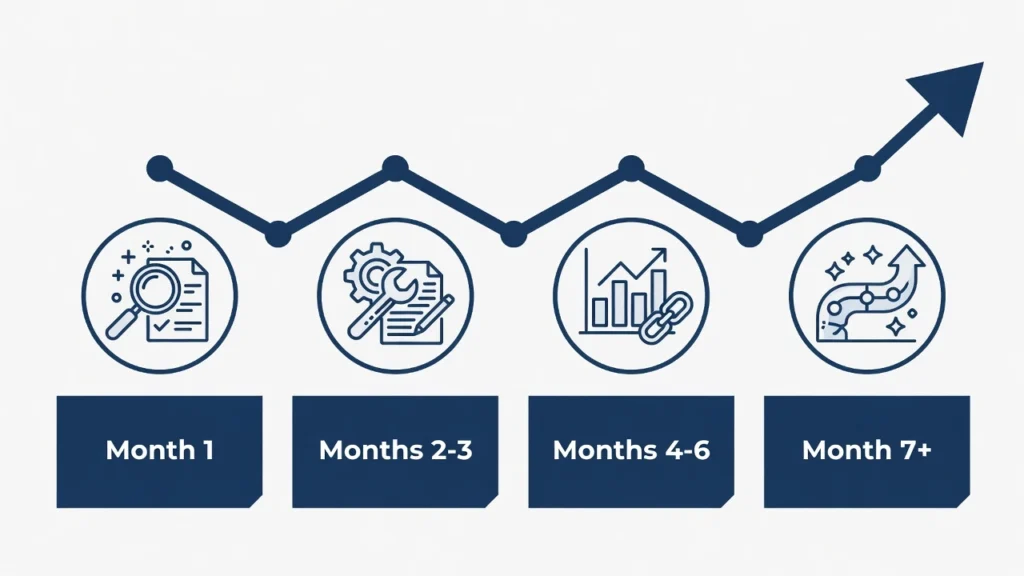
Month 1: Discovery, Audit, and Buying Committee Mapping
The first month is entirely about understanding before acting. We do not start writing content or making site changes in week one. That is how agencies make expensive mistakes.
We begin with a full B2B SEO audit covering your technical setup, existing content, backlink profile, and how your site currently performs for the searches your buying committee runs. At the same time we conduct competitor analysis to understand which gaps you can exploit and where the real organic opportunity sits in your category.
But the most important work in month one happens away from the tools. We spend two hours with your sales team asking the questions that keyword research alone cannot answer: What do prospects say in the first meeting? What objections come up at month four of the sales cycle? What searches does the technical evaluator run before a demo? The answers to those questions become the foundation of your buyer intent keyword strategy and the buying committee search map that guides everything we build.
What we deliver in month one: A prioritised audit report with specific issues and recommended fixes, a buying committee search map showing stakeholder queries at each sales stage, and a 90-day roadmap with clear milestones.
What we need from you: Analytics and Search Console access, CRM data showing lead sources, two hours with your sales team, and input from at least one person who speaks directly to prospects.
Month 2 to 3: Foundation Building and Quick Wins
Month two is when the work becomes visible. We start with the highest-priority technical fixes identified in the audit, because there is no point building content on a site that Google cannot properly crawl and index. Technical SEO for B2B sites often involves fixing crawl issues on gated content, correcting internal linking structures, and resolving page speed problems that are quietly suppressing rankings you should already have.
Once the technical foundation is stable, we move into on-page SEO optimisation for your highest-value existing pages. These are the pages closest to ranking well for commercial queries but being held back by thin content, poor keyword alignment, or weak internal authority. Fixing these pages delivers the fastest early movement.
We also begin creating the first pieces of bottom-of-funnel content targeting the high-intent searches your buyers run when they are close to a decision. And we open the first outreach conversations for authority building.
What we deliver in months two and three: Critical technical fixes implemented, three to five key pages optimised, two to four new bottom-of-funnel content pieces published, and the first backlinks secured from relevant sources.
What we need from you: Sign-off on content briefs, subject matter expert access for at least one interview per content piece, and technical access for development changes where needed.
Month 4 to 6: Scale and Authority Building
This is the phase where momentum builds. Rankings that started moving in months two and three begin to consolidate. New content starts attracting organic traffic from qualified audiences. And the first MQL pipeline from organic search begins to appear.
We scale content production across all three funnel stages during this period, publishing consistently against the editorial plan built from your buying committee research. Digital PR for B2B runs in parallel, earning links from the trade publications and industry sources your prospects actually read. We run continuous optimisation on content sitting on page two or three — pushing it onto page one where the organic search traffic actually lives.
Not every month will show dramatic jumps. We will tell you that honestly upfront. But the trend line moves consistently upward, and by the end of month six most clients are seeing qualified organic leads arriving on a regular basis.
We scale content production across all three funnel stages during this period, publishing consistently against the editorial plan built from your buying committee research. Digital PR for B2B runs in parallel, earning links from the trade publications and industry sources your prospects actually read. We also run continuous optimisation on content that is ranking on page two or three, pushing it onto page one where the traffic actually lives.
What we deliver in months four to six: A steady volume of new content pieces each month across all funnel stages, quality backlinks from relevant industry sources each month, and monthly performance reports with MQL tracking showing organic lead volume and pipeline attribution.
What you will see: Rankings improving across your target keyword clusters, organic traffic growing from qualified audiences, and the first MQLs arriving from organic search. Not every month will show dramatic jumps. But the trend line moves consistently upward.
Month 7 and Beyond: Optimisation and Pipeline Growth
By month seven the strategy has real performance data behind it. We know which content is driving qualified traffic and which pieces need further development. We know which backlink sources are moving authority and which outreach channels perform best in your category. We use all of that to make sharper decisions.
This phase focuses on expanding into adjacent keyword clusters your buying committee searches but your competitors have not covered, displacing competitor content that sits between you and the organic lead generation volume you are targeting, and building the advanced funnel optimisation that turns strong organic traffic into consistent MQL flow.
SEO is a long term growth channel, particularly for B2B companies with complex sales cycles. Search visibility, topical authority, and qualified organic leads typically build progressively rather than appearing overnight. Our focus is therefore on creating a sustainable organic acquisition channel that becomes more valuable as your content, authority, and conversion data compound over time.
Search rankings for B2B companies in competitive categories take time to build because authority compounds gradually rather than arriving all at once. But when it arrives, organic lead generation delivers qualified pipeline at a cost per acquisition that paid channels struggle to match over any 24-month period.
What you will see: A consistent and growing flow of qualified leads from organic search, clear pipeline attribution showing the revenue influence of your SEO investment, and competitive keywords captured that bring your ideal buyers directly to you before they speak to anyone else.
Table:
| Phase | Primary Focus | Key Deliverables | Expected Direction |
|---|---|---|---|
| Month 1 | Discovery and strategy | SEO audit, buying committee map, 90-day roadmap | Clear priorities |
| Months 2–3 | Technical and content foundation | Technical fixes, page optimisation, BOFU content | Early ranking movement |
| Months 4–6 | Scale and authority | Funnel content, digital PR, ongoing optimisation | Qualified organic traffic and initial MQLs |
| Month 7+ | Optimisation and growth | Expansion, CRO, content refinement, attribution | Increasing qualified pipeline |
Real B2B SEO Results: Pipeline Growth, Not Just Traffic Increases
Traffic numbers are easy to grow. Qualified pipeline is not.
Any agency can point to a chart showing sessions doubling over twelve months. But if your sales team is not seeing more qualified conversations, the chart means nothing to your business. The B2B SEO results we focus on are the ones your CFO and VP Sales actually care about: how many MQLs came from organic search, how much pipeline those leads represent, and what return on investment the organic channel delivered against the budget it consumed.
The case studies below show exactly what that looks like in practice. Each one includes the challenge the client brought to us, the specific approach we took, and the business outcomes we can point to. Not traffic graphs. Pipeline numbers.
Case Study 1: B2B SaaS Company: 340% Increase in MQLs from Organic Search in 12 Months
The situation: This B2B SaaS client operated in a competitive category with a sales cycle running close to nine months from first touch to signed contract. When they came to us, organic search was producing zero MQLs. Paid advertising was their only lead source, and the cost per acquisition was climbing every quarter as competition for ad placements increased. They ranked for their brand name and almost nothing else.
What we did: We started by mapping the buying committee for their product. Three distinct stakeholder roles were involved in every purchase decision, and each role was searching for completely different things. We built a middle-of-funnel and bottom-of-funnel content strategy around those stakeholder queries, fixed the technical issues blocking their product pages from ranking, and began a targeted authority-building programme focused on the publications their buyers actually read.
The outcome: Within twelve months, MQL pipeline from organic search increased by 340%. Organic search moved from producing no qualified leads at all to becoming their second highest performing lead source after paid search. The pipeline value attributed directly to organic in year one justified the entire engagement cost several times over.
“We spent two years assuming SEO just would not work for our sales cycle. Within six months of working with this team we were seeing qualified demos booked from organic. By month twelve it had become a channel we actually rely on.”
[Head of Marketing, B2B SaaS, [Industry])
Case Study 2: B2B Technology Company: From Zero Organic Leads to 67 Qualified Leads Per Month
The situation: This B2B technology client had a complex product sold to a technical buying committee in a market dominated by established players with significantly larger marketing budgets. When organic lead generation started, the number was exactly zero. Their website received modest traffic but none of it converted into leads because the content was not reaching the right people with the right information at the right stage of their evaluation process.
What we did: We built a technical content strategy designed specifically for the evaluator roles involved in purchase decisions for their product category. Stakeholder-specific landing pages addressed the distinct concerns of each role in the buying committee. We earned backlinks from industry publications that appeared in their buyers’ regular reading, which both built domain authority and put the client’s name in front of prospects during the research phase. SEO for technology companies with complex products requires getting very specific about who is searching and why. Generic content does not convert technical buyers.
The outcome: Within eight months, organic lead generation reached 67 qualified leads per month. The lead-to-opportunity conversion rate came in at 12%, which reflects the quality of the audience organic search was delivering rather than just raw volume. The client displaced three established competitors for key product category searches during that period.
“We were invisible in organic search against competitors who had been in the market for ten years. The buying committee mapping approach changed how we thought about content entirely. The leads we get from organic now are some of our best.”
Marketing Director, B2B Technology, tecveq)
Case Study 3: B2B Professional Services Firm: 580% Qualified Traffic Growth and a 12% Visitor-to-Lead Conversion Rate
The situation: This client had the opposite problem from the previous two. Traffic was not the issue. Their site received a reasonable volume of organic visitors but almost none of them converted.
The problem was that the wrong audience was finding them. Broad keyword targeting was pulling in researchers, students, and people at the very earliest stages of awareness who were years away from becoming buyers. The sales team was not seeing any meaningful leads from a channel the business was investing in regularly.
What we did: We rebuilt the keyword strategy from the ground up using buyer intent signals rather than search volume as the primary filter. Every keyword cluster we targeted had to reflect the specific search behaviour of someone actively evaluating a professional services provider, not someone casually researching a topic.
We then worked through the conversion rate optimisation for B2B on the pages receiving the most organic traffic, aligning content to the questions buyers ask at the consideration stage rather than the awareness stage. Sales funnel content mapping replaced the broad educational approach that had been pulling the wrong visitors.
The outcome: Qualified organic traffic grew by 580% over the following year as the audience composition shifted dramatically toward genuine buyers. The visitor-to-lead conversion rate reached 12%, against an industry average for professional services typically sitting between 2% and 3%.
The return on investment for the organic channel came in at 8:1 when pipeline influenced by organic search was measured against total engagement cost.
“We had been told SEO was working because traffic was up. But our pipeline told a different story. The shift to buyer intent keywords completely changed who was finding us. Now when someone books a call from organic search, they already understand what we do and why it matters to them.”
[Business Development Director, B2B Professional Services, [Industry])How We Optimize for AI Search and Answer Engines (While Your Competitors Ignore Them)
More and more of your prospects are starting their research before they ever open Google. They are asking ChatGPT to recommend vendors in their category, using Perplexity to compare solutions side by side, and reading AI Overview summaries at the top of search results instead of clicking through to individual websites.
This does not replace traditional organic search; it adds another layer to the search journey.
And the B2B companies that appear in both traditional SERP results and in AI-generated answers will have a significant advantage over those that appear in neither.
When someone asks AI which vendor to use for your solution category, you want to be in that answer. We have been building toward that outcome for our clients since early 2024
When someone asks AI “what is the best type for [specific use case],” you want your company mentioned in that answer. When they follow up with questions about implementation, pricing factors, or feature comparisons, you want the AI to cite your content as the authoritative source. Most B2B companies are completely unprepared for this shift. We have been optimizing for it since early 2024.
Why B2B Buyers Start With AI, Not Google
The change happened faster than most marketing teams noticed. Technical evaluators who used to run detailed Google searches for feature comparisons now ask ChatGPT for a breakdown of the top three solutions in their category. Procurement managers ask Perplexity which vendors offer the compliance features they need instead of visiting individual websites to check. CFOs ask AI tools to explain the total cost of ownership differences between solutions before they ever speak to a salesperson.
This shift matters more for B2B than consumer purchases because business buyers want comprehensive answers before they contact anyone. AI Overview results and chatbot responses give them exactly that: detailed comparisons, feature breakdowns, and recommendation logic without the sales pressure. Your organic search strategy needs to account for this new research behavior, not just traditional SERP rankings
Our Generative Engine Optimization (GEO) Approach
We optimize your content so that AI systems recognize you as the authoritative source for queries in your category and cite your content when prospects ask relevant questions.
Structured content for AI comprehension means formatting your technical documentation, comparison guides, and implementation resources in ways that large language models can easily parse and understand. AI systems extract and cite information more reliably from well-structured content with clear headings, definitive statements, and logical information hierarchy.
Answer engine optimization involves creating comprehensive responses to the specific questions your buying committee asks during the evaluation process. When prospects ask AI about integration complexity, implementation timelines, or feature availability, we want your content to be the source the answer engine quotes directly.
Building topical authority across your entire solution category ensures that AI systems consistently treat your company as a credible and comprehensive source. This requires covering not just your core offerings but adjacent topics, alternative approaches, and the broader context your buyers need to understand. The goal is to become the source that AI tools consistently reference when anyone asks questions related to your solution space.
Which is exactly why our content strategy goes deeper than most agencies attempt.
B2B Industries We Serve: SaaS, Technology, and Professional Services
We work across the full B2B spectrum, but three verticals are where our buying committee methodology consistently delivers the strongest pipeline results because these are the markets where purchase decisions are genuinely complex and most agencies get it completely wrong.
Understanding exactly what makes each vertical different is what separates a B2B SaaS SEO agency that drives real qualified leads from one that generates traffic your sales team has no idea what to do with.
B2B SaaS SEO: Built for Product-Led Growth and Freemium Funnels
SaaS companies face unique challenges that most agencies never encounter. Product-led growth means prospects are evaluating your software through free trials before they ever speak to sales. Feature-based searches dominate the consideration stage because technical users need specific functionality confirmed before recommending your solution internally. Integration queries are critical because your software needs to work with their existing stack.
Our B2B SaaS marketing experience includes optimizing for self-serve conversion paths, building content that supports freemium funnels, and creating the comparison frameworks that help prospects justify switching from their current solution. SaaS content marketing requires understanding both the end user searching for features and the economic buyer searching for ROI proof. Most agencies focus on one or the other. We cover both.
B2B Tech and Enterprise Software SEO
Complex technology products involve longer evaluation cycles, more stakeholders, and deeper technical validation than almost any other B2B category. The technical evaluator needs integration specifications and security documentation. The business sponsor needs implementation timelines and training requirements. The procurement team needs compliance credentials and vendor stability proof.
SEO for technology companies requires building content for each evaluation stage and each stakeholder role without overwhelming any single reader. Technical documentation SEO is often overlooked but critical because engineers and IT directors frequently start their research with specific implementation questions rather than broad solution searches. Our b2b tech seo agency approach accounts for both technical depth and business justification content in the same strategy.
Professional Services and Consultancies
Professional services face a different challenge: demonstrating expertise and building trust before prospects are ready to have a sales conversation. The purchase decision is often about the people behind the service, not just the service description. For businesses looking to establish this digital authority, our bespoke AI automation for small businesses UK services help create sophisticated lead nurturing systems that build trust before sales conversations. Thought leadership content and credential optimization become more important than they are for product companies.
Consultative sales require content that shows both broad category expertise and specific experience with situations similar to what the prospect faces. Local and national presence optimization matters because professional services often serve both regional and remote clients. Case study optimization and professional credential SEO are essential trust-building elements that many specialist B2B SEO agency providers skip because they focus on product companies rather than service businesses.
Why Choose Us as Your B2B SEO Partner: What Makes Us Different
Most agencies will tell you they are experienced, reliable, or results-focused. Every search engine optimisation agency in the market makes identical claims. What actually separates one B2B digital marketing agency from another is not what they say about themselves but what they do differently in the day-to-day work.
Here is what makes us different as a specialist B2B SEO agency: our methodology starts where most agencies never go, and our reporting focuses on what matters to your business instead of what makes our dashboards look good.
We Start With Your Sales Team, Not Your Keyword List
The first call we schedule is not with your marketing team. It is with your sales director.
We spend our first two hours asking about the conversations that happen at month three of your sales cycle, the objections that come up when prospects talk to procurement, and the questions technical evaluators ask during demos. Most agencies open keyword research tools on day one. We interview the people who speak to your buyers every day. Buyer intent keywords mean nothing if you do not understand whose intent you are trying to match and what questions they are actually asking. The sales funnel content that converts B2B visitors into qualified leads comes from understanding real prospect behavior, not from search volume data alone.
This is why our clients often say they felt understood before they even saw a strategy. And that makes all the difference.
We Report to Your Revenue Goals, Not Our SEO Metrics
Your CEO does not care about keyword positions. Your board does not celebrate traffic increases. What they want to know is how much qualified pipeline came from organic search last quarter and whether that channel will hit its lead generation targets next quarter.
Our reporting focuses on metrics that matter to business decision-makers: MQL pipeline from SEO generated each month, the pipeline value those qualified leads represent, cost per acquisition compared to paid channels, and return on investment tracked through to closed deals. We integrate directly with your CRM so that revenue attribution is accurate and SEO reporting for B2B teams shows real business impact rather than vanity metrics. When you present our reports to executive stakeholders, the conversation is about growth opportunities and budget allocation, not about why you need more time for rankings to improve
Our Tool Stack and Platform Expertise
Professional B2B SEO requires professional infrastructure. We use the same platforms and tools that enterprise marketing teams rely on, and we integrate our work directly into the systems you already use.
Our SEO platform stack includes Ahrefs for competitive analysis and keyword research, Screaming Frog for technical auditing, Google Analytics 4 and Search Console for performance measurement, and specialized B2B tools for content optimization and link prospecting. But tools are only as good as the platforms they connect to. As a B2B digital marketing agency, we integrate seamlessly with HubSpot, Salesforce, Marketo, and other marketing automation platforms so that organic search data flows directly into your lead scoring, nurture sequences, and sales attribution tracking.
This integration capability means your organic leads are handled exactly the same way as leads from other channels. No manual work. No data gaps. No excuse for organic search to be treated as a separate initiative rather than a core part of your demand generation engine.
B2B SEO Agency FAQs: Pricing, Timelines, and How to Choose
What is a B2B SEO agency and how is it different from a general SEO agency?
A B2B SEO agency specializes in reaching buying committees, not individual consumers. We understand that your sale involves multiple stakeholders over months, not impulse purchases. Specialist b2b seo agency work focuses on lead quality and pipeline metrics rather than traffic volume and conversion rates. Generalist agencies apply eCommerce tactics that fail for complex B2B sales cycles.
How much does a B2B SEO agency cost?
Most B2B SEO engagements start from £3,500 to £7,000 per month depending on company size, competitive landscape, and scope. Enterprise companies with complex needs typically invest £10,000+ per month. Cost drivers include content volume needed, technical complexity, authority building requirements, and international market coverage. The return on investment for organic search usually justifies the engagement cost within the first twelve months.
How long does B2B SEO take to generate leads?
Month 1-2: Foundation building and audit completion. Month 3-4: First ranking improvements and traffic growth. Month 4-6: First organic MQLs appear from optimized content. Month 7-12: Consistent lead flow and pipeline growth. Month 12+: Organic search becomes a top-3 lead channel. Timeline depends on current site state, competitive intensity, sales cycle length, and content production pace. Organic lead generation compounds over time rather than delivering immediate results.
How do I choose the best b2b seo agency for my company?
Ask the three questions from our earlier section: Do they map keywords to buying committees? Can they measure lead quality? Do they have long sales cycle case studies? Also check if they understand your industry, verify their process transparency, and confirm CRM integration capability. How to find a reliable b2b seo agency uk means finding one that treats SEO as part of your demand generation strategy, not a separate channel.
Should I hire a B2B SEO agency, freelancer, or build in-house?
Agency: Best for companies needing full-service strategy, content, technical, and link building with accountability. Investment: £4k-£15k/month. Freelancer or B2B SEO consultant: Best for single-focus work with tight budgets. Investment: £2k-£5k/month. Risk: capacity limits. In-house: Best for enterprises with existing marketing teams. Investment: £60k-£90k/year plus tools. Risk: 6-12 months to build capability.