
Ecommerce SEO Services That Actually Grow Your Store’s Revenue in Pakistan
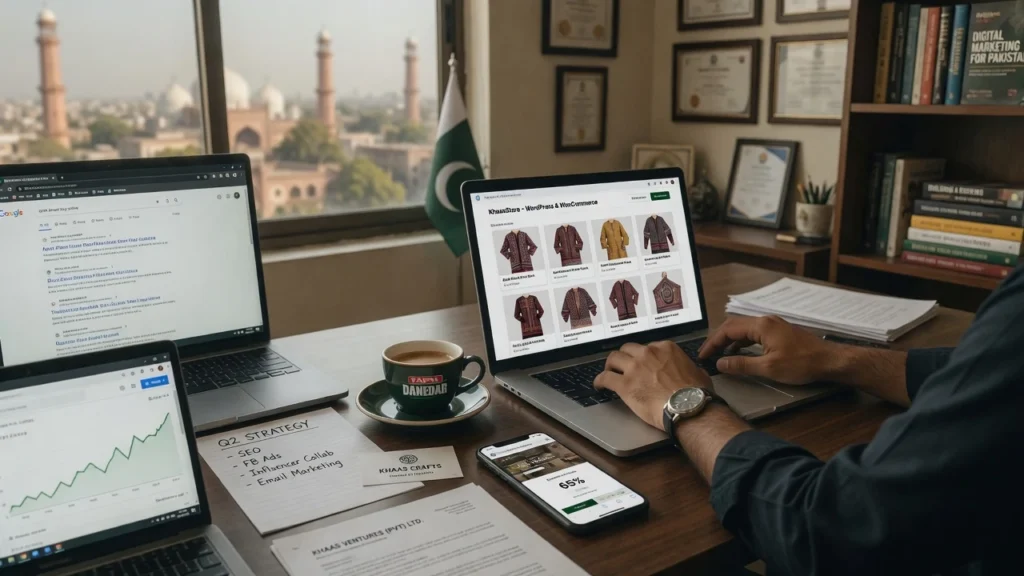
Why Your Ecommerce Store Isn’t Ranking And How Our Ecommerce SEO Services Fix It You’ve done everything the ecommerce SEO guides tell you to do. Installed the plugins, written meta descriptions for your top products, maybe even paid an agency to optimize your store. But when you search for the exact products you sell, your competitors show up on page one and you’re buried on page three or worse. And the frustrating part? You’re spending more on Facebook and Google ads every month just to maintain the same sales. The cost per click keeps going up. For most Pakistani ecommerce stores, ad spend is eating 20 to 30 percent of every sale. You know organic traffic would fix this. But your store just won’t rank no matter what you try. There is a reason for that and it is fixable Here’s why generic SEO doesn’t work for ecommerce stores. Your store isn’t a blog with 50 articles. It’s a catalog with hundreds or thousands of product pages, category pages, filter pages, and variant pages that all look similar to Google. Most SEO strategies are built for service websites or content sites. They completely ignore the technical complexity that makes ecommerce SEO services different from everything else in digital marketing. Your products might be using the exact same descriptions your supplier gave you. So are ten other stores selling the same items. Your products might be using the exact same descriptions your supplier gave you. So are ten other stores selling the same items. When product pages contain little original or useful information, it becomes harder for them to differentiate themselves in search results. Your site might load fast on your office WiFi but take significantly longer on a mobile connection. That’s why we look at product content, page experience, technical SEO, and search intent together instead of treating rankings as a keyword-only problem. Or maybe your category pages have no real content, just product grids. Google has nothing to rank. Your internal linking might send all the authority to your homepage while your actual product and category pages stay invisible. Your product schema might be missing or broken, so Google can’t show your prices and star ratings directly in search results and you lose clicks to competitors whose listings look richer ⚡ GET IN TOUCH Stop Paying for Every Customer – Start Ranking for Free Traffic 💬 Chat on WhatsApp 📞 Call 0307 3319555 This is exactly what real ecommerce SEO services fix. We don’t just install a plugin and hope for the best. We audit your entire store first, identify the specific technical, content, and structural problems holding your products back, then fix them in the right order for fastest ranking impact. We’ve optimized WooCommerce, Shopify, and custom-built stores across fashion, electronics, and B2B catalogs in Pakistan. We know what actually moves ecommerce rankings because we’ve done this work across stores ranging from 20 products to 5,000-SKU catalogs Not sure where your store is falling short? Request your free ecommerce SEO audit. We’ll show you exactly what’s holding your rankings back, which fixes will have the biggest impact, and what realistic organic traffic growth looks like for your specific catalog. What’s Included in Our Ecommerce SEO Services Ecommerce SEO isn’t a single task you check off a list. It’s a coordinated combination of technical fixes, content optimization, and authority building that all work together to get your products ranking and your store generating consistent organic revenue. We built this approach specifically for online stores because the SEO that works for service websites or blogs fails completely when applied to product catalogs. Here’s exactly what we do for every ecommerce client. Ecommerce SEO Strategy Customized to Your Catalog We don’t use the same marketing strategies for every store. A 50-product boutique needs a completely different approach than a 500-product wholesale site or a 5,000-SKU marketplace. We analyze your catalog size, your competition level, your profit margins, and your platform before we recommend anything. Then we map keywords to your actual product hierarchy so every category page and product page targets the right search terms for your specific business not just the terms with the highest volume. The stores on page one didn’t get there by accident. They got there because someone built a strategy specifically around their catalog instead of following a generic SEO checklist. That’s how we work too Technical SEO for Ecommerce: Speed, Mobile & Indexing Fixes Most ecommerce ranking problems are technical. Google can’t rank pages it can’t crawl properly. We fix the foundational issues that keep your products invisible: site speed problems that make visitors leave before your page loads, crawlability errors that prevent Google from finding your pages, duplicate content generated by filter and variant URLs, and missing or broken schema markup that hides your prices and reviews from search results. We optimize your Core Web Vitals scores following Google’s official guidelines so your store meets the speed and user experience standards that directly impact search rankings on mobile networks. And here’s the part most agencies miss completely. Faceted Navigation & URL Management Filters for size, color, brand, price and other attributes can create hundreds or thousands of URL variations from a relatively small product catalog. We review which filtered URLs should be crawlable and indexable, which should remain accessible to users without competing for search visibility, and how canonicalization and internal linking should be handled. The goal is to make useful pages discoverable without allowing low-value URL variations to overwhelm your crawl and indexing signals. Mobile Optimization for Pakistani 4G Networks Your store might load in two seconds on your office WiFi. But most of your visitors are on mobile using Jazz, Zong, or Ufone 4G connections that load pages significantly slower than the US or European broadband connections most international agencies test on. We test your site on real Pakistani mobile network conditions and optimize specifically for those speeds. We compress images without losing visual quality, lazy load everything below the fold, minimize code
The B2B SEO Agency That Turns Search Into Your Highest-Performing Lead Channel
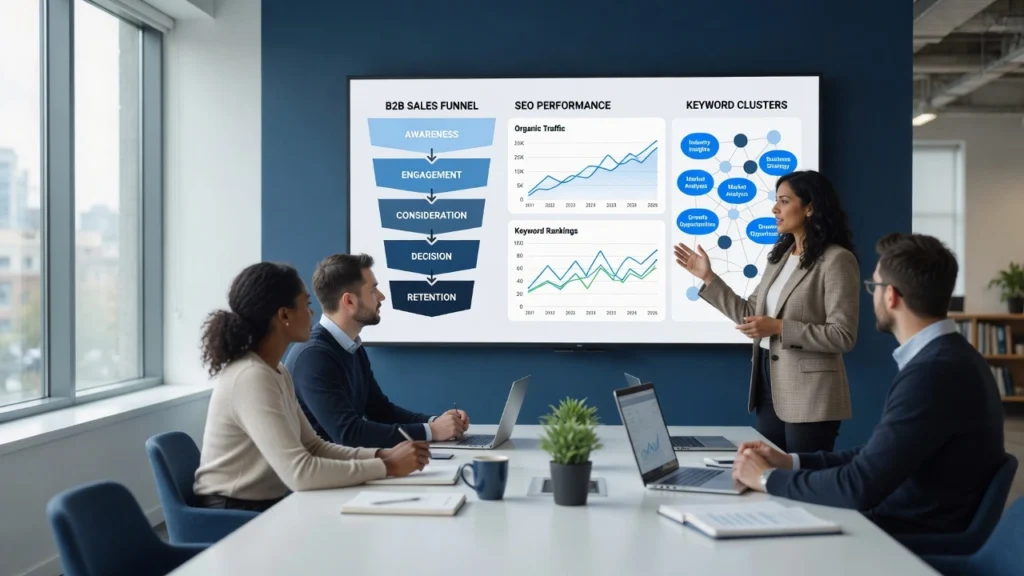
B2B SEO Agency That Turns Organic Search Into Qualified Pipeline Many B2B companies don’t have a traffic problem. They have a strategy and agency-fit problem. They hire a generalist agency, brief them on their goals, and wait. Six months later, organic traffic is up. Rankings are moving. The monthly report looks polished. But the sales team has not seen a single qualified lead come through from organic search. Not one. The traffic is real. The pipeline is not. This happens because the agency took an eCommerce or B2C playbook and applied it to a completely different kind of business. And the two couldn’t be more different. B2C SEO targets individual buyers who make fast decisions. Someone searches, someone clicks, someone buys. The cycle from search to sale can be hours. B2B organic search traffic doesn’t work that way. Your buyers are committees. A CFO is weighing ROI. A technical lead is evaluating integrations. A procurement manager is comparing vendors against a shortlist. That process takes months sometimes closer to a year or more. And each stakeholder is running completely different searches at completely different points in the evaluation. Generalist agencies miss this almost every time. They target high-volume keywords without asking who is actually searching them. They build content calendars without mapping to your sales stages. They report on traffic and rankings while your pipeline stays empty. SEO for long sales cycles requires a fundamentally different approach. B2B lead generation SEO isn’t about generating clicks. It’s about getting the right person, in the right role, at the right stage of their buying journey, to find you and trust you before they ever speak to your sales team. That is the gap between what most agencies sell and what B2B companies actually need. And it is the gap we built this agency to close. We’re a specialist B2B SEO agency that works exclusively with companies that have complex sales cycles, multiple buying stakeholders, and a need for organic search to generate real pipeline — not just traffic. We don’t apply generic frameworks to B2B problems. Every engagement starts by understanding your buying committee, your sales cycle length, and how your best clients actually research and evaluate solutions like yours. Then we build MQL pipeline from SEO by mapping your keyword strategy to how buyers at each stakeholder level actually behave across a months-long evaluation. If you’ve tried SEO before and ended up with traffic but no qualified leads, you didn’t try the wrong channel. You tried it with the wrong partner. [Book a free strategy call — we’ll show you what your buying committee is actually searching for ⚡ GET IN TOUCH Book a free strategy call we’ll show you what your buying committee is actually searching for 💬 Chat on WhatsApp 📞 Call 0307 3319555 Our B2B SEO Strategy: Built Around Your Buying Committee, Not Just Your Keyword List Most agencies open a new client engagement by pulling keyword data. We open ours by talking to your sales team. That single difference changes everything that follows. According to Google’s Search Quality Guidelines, search engines prioritize content that demonstrates genuine understanding of user intent over high-volume keyword targeting. The keywords that matter most for your pipeline are the ones your CFO types into Google at 10pm when building a business case, the ones your technical evaluator searches when comparing integrations, and the ones your procurement manager uses when shortlisting vendors As a specialist B2B SEO agency, our keyword research starts there: identifying the searches that matter to each stakeholder and making sure your business can be discovered at every stage of the evaluation. Step 1: Buying Committee Search Mapping (Before Any Keyword Research) Before we open a single research tool, we spend time understanding who actually makes the buying decision for your product or service. That means sitting down with your sales team not just exchanging briefs. We want to know what questions prospects ask in the first meeting, what objections come up at month four of the sales cycle, and what searches the technical evaluator runs the night before a demo. From those conversations we build a stakeholder search map showing what each role in the buying committee searches at the awareness stage, the consideration stage, and the decision stage. Only then do we move into the keyword research phase, because by that point we know exactly whose attention we are trying to earn and what they need to find when they land on your site. Buyer intent keywords mean nothing without first knowing whose intent you are trying to match. Buying Committee Role What They Care About Typical Search Intent Recommended Content CFO / Economic Buyer ROI, cost, risk, business impact Commercial and evaluation searches ROI calculators, cost comparisons, business cases Technical Evaluator Integrations, security, functionality Technical and solution-specific searches Integration guides, technical documentation, feature comparisons Procurement Pricing, compliance, implementation Vendor evaluation searches Vendor comparisons, compliance resources, implementation timelines Business Sponsor Outcomes, efficiency, strategic fit Solution and category searches Case studies, solution pages, outcome-focused content Technical SEO for B2B: Enterprise Platforms and Complex Site Structures Your developers may tell you the site is fine. Technically, they may be right. But Google finding your site and Google being able to rank your best content are two completely different things. Technical SEO for B2B companies comes with specific challenges that consumer sites rarely face. Gated content that search engines cannot crawl. Product and solution pages buried five levels deep in site architecture. Multiple subdomains running on different platforms. Resource centres that generate strong organic interest but pass no authority back to your core service pages. Our B2B SEO audit covers every layer of your technical setup and identifies exactly what is blocking your B2B website traffic from reaching the people actively searching for what you offer. This is not a surface-level crawl report. It is a technical diagnosis with prioritised fixes and clear reasoning behind every recommendation. B2B Content Strategy: Serving Every Stakeholder in the Buying Committee The biggest content mistake