We’re a SaaS SEO agency that specializes in one thing: helping software as a Service companies turn organic search into their most profitable customer acquisition channel. Not another generalist agency that treats your B2B product like an e-commerce store or plasters “SaaS” on generic blog strategies.
We focus on what actually matters to your business. Demo requests. Free trial signups. Pipeline growth. Monthly recurring revenue increases that you can show your board.
product-qualifiedMost SEO agencies chase vanity metrics. They’ll send you reports filled with traffic numbers and keyword rankings while your actual lead quality stays flat. We measure success differently. Our SaaS clients track organic leads through to closed revenue, and we optimize for the metrics that matter: cost per acquisition, product qualified leads, and how much of your pipeline comes from organic search instead of paid ads that get more expensive every quarter.
Here’s what that looks like in practice. When you work with us, we map every piece of content to your sales funnel stages. We build comparison pages that capture bottom-of-funnel searches when prospects are choosing between you and competitors. We create product-led content that explains your features as solutions, not technical specifications. We optimize the pages that actually convert visitors into trials, not just the blog posts that generate research traffic from students and job seekers.
And we prove ROI. Our reporting connects organic traffic directly to your CRM data so you can see exactly how many demos came from organic search, how many converted to customers, and what your true customer acquisition cost is for the SEO channel compared to paid ads.
Ready to see how this works for your SaaS? Book a free 30-minute strategy call and we’ll show you exactly where your competitors are ranking, what keywords are driving their demo requests, and how we’d approach growing your organic pipeline in the first 90 days.
GET IN TOUCH
Ready to outrank your SaaS competitors? Get your free 30-minute strategy call today.
Why Isn’t Your SaaS Ranking on Google? (And Why Generic SEO Agencies Keep Failing You)
one,Your SaaS product solves real problems. Your website explains what it does. You’ve published blog content. But when potential customers search for solutions in your category, your competitors show up on page one and you’re buried on page three or not ranking at all.
Here’s what’s actually happening.
Generic SEO agencies treat every client the same way. They build blog content around high-volume informational keywords, optimize your homepage for your product category, and send you monthly reports showing traffic increases. What they don’t tell you is that the traffic they’re generating comes from job seekers researching your industry, students writing papers, and overseas users who will never buy a B2B software product that costs $5,000 per year.
They don’t understand the B2B SaaS marketing funnel. SaaS buyers don’t search for generic category terms and convert immediately. They research for three to six months. They compare your product against five competitors. They download comparison guides. They read review sites. They search for specific feature terms and integration questions. Then, after weeks of internal evaluation, they finally request a demo.
Your content needs to be mapped to each stage of that SaaS sales funnel. Awareness stage content that explains the problem. Consideration stage content that positions your product as the solution. Decision stage content like comparison pages and alternative pages that capture prospects who are actively choosing between you and named competitors right now.
Most agencies skip the bottom-of-funnel content entirely. Why? Because it’s harder to scale than generic blog posts, and it requires actual understanding of how your product works and who your competitors are.
Why B2B SaaS SEO Is Different From Every Other Industry
We’ve worked with B2B SaaS companies long enough to know exactly where generic strategies fall apart.
First, your sales cycle is long. Effective SaaS growth marketing requires content that nurtures prospects over months, not content that tries to close a sale in one visit. Your blog can’t just attract traffic. The content has to educate, build trust, and keep prospects engaged until they’re ready to talk to sales.
Second, you’re targeting multiple personas. The end user who will actually use your software searches differently than the VP who approves the budget. Generic agencies optimize for one keyword set. We build SEO strategies that support your demand generation engine by creating content for every decision maker in the buying committee.
Third, your competitive landscape is fundamentally different from that of a local service business.You’re competing against funded SaaS companies with $500K annual content budgets and enterprise brands that have been publishing for a decade. A generic SEO approach that works for a local service business will never move the needle when you’re trying to outrank companies with domain authority three times higher than yours.
Which is exactly why you need a B2B SaaS SEO agency that understands these challenges and knows how to win in competitive markets without requiring you to match your competitors’ content budgets dollar for dollar.
We do it by being smarter about keyword targeting, more strategic about content types, and more focused on the content that actually converts trials and demos instead of just generating traffic that looks good in a report but contributes nothing to your pipeline.
Who Is SaaS SEO Best Suited For?
SaaS SEO works best when organic search can influence a meaningful part of the buying journey. Our approach is particularly suited to B2B SaaS companies with a defined product category, an identifiable target audience, and enough customer value to justify investing in long-term organic acquisition.
This can include early-stage SaaS companies building their first organic acquisition channel, growth-stage companies looking to reduce dependence on paid acquisition, and established software businesses competing for high-value commercial searches.
How SaaS SEO Actually Works (The 5 Tactical Differences That Matter)
A true SaaS SEO strategy addresses long sales cycles, multiple buyer personas, and competitive markets where your direct competitors have been publishing content for years. Generic SEO strategies ignore all three. Here’s exactly what we do differently and why each tactical choice moves the needle for B2B software companies.
SaaS Content Strategy: Beyond Generic Blog Posts
Our SaaS keyword research focuses on bottom-of-funnel comparison terms that generic agencies never touch. While most agencies build content calendars around high-volume informational keywords like “what is project management” or “benefits of CRM software,” we start by identifying every search where a prospect is actively choosing between you and a named competitor right now.
That means comparison pages. Alternative pages. Versus pages. Integration searches. Feature-specific searches that only someone evaluating your exact product category would ever type into Google.
B2B buyers research for months before purchasing, but they make their shortlist in week one based on which three to five products they find when searching for solutions. If your competitor ranks for “Asana alternative for remote teams” and you don’t, you’re not even being considered. You’ve lost the deal before your sales team knows the prospect exists.
ConsiderWe map content to each stage of your sales funnel. Awareness content that explains the problem your product solves. Consideration content that positions your product as the solution. Decision content that captures prospects comparing specific features, pricing models, and integrations between you and competitors. And retention content that helps existing users get more value so they don’t churn.
Generic agencies publish 20 blog posts per month and hope something ranks. We publish eight pieces of strategic content per quarter and make sure every single one targets a search that directly impacts your demo request volume or trial signups.
Product-Led Content That Converts Trials, Not Just Traffic
We use product-led SEO to create content that showcases your features as solutions to specific problems your target customers search for. Not technical documentation. Not feature lists. Content that explains what someone can actually accomplish with your product and why that matters to their business.
developer,”Here’s what that looks like. If you sell marketing automation software and one of your features is email segmentation, we don’t write a blog post titled “What is email segmentation?” We write “How to send targeted email campaigns to different customer segments without hiring a developer” and we show exactly how your product solves that problem in the content. The reader learns something valuable and sees your product as the natural solution.
Unlike generic content marketing that treats every business the same way, SaaS content marketing must educate both technical and business buyers simultaneously. The marketing director searching for your product needs to understand ROI and implementation timeline. The technical evaluator needs to understand integrations and data security. Your content has to address both personas or you’ll rank but never convert.
sales-qualifiedAnd this is where most agencies fail. They optimize for traffic. We optimize for qualified traffic that converts into product-qualified leads and sales qualified leads your team actually wants to talk to.
Competitive Intelligence That Finds Ranking Gaps
We conduct deep SaaS competitor analysis to identify ranking gaps your competitors haven’t filled yet. Not just “what keywords do they rank for.” We analyze what buyer-intent searches they’re missing, what content formats they’re not using, and where their content is shallow enough that we can outrank them with better depth in 90 days instead of 12 months.
terms,Most of your competitors publish generic thought leadership content. They rank for broad category terms but they’re nowhere to be found on bottom-of-funnel comparison searches because they’re afraid to acknowledge competitors exist. That creates an opportunity to compete for commercially valuable searches with more focused content.
We build comparison content, alternative pages, and head-to-head feature breakdowns that capture prospects at the exact moment they’re making a purchasing decision. Many competitors avoid this type of comparison content because it requires a more direct approach to commercial search intent. Which means you can own those searches with a fraction of the content investment it would take to outrank them on generic high-volume terms where they’ve been publishing for five years.
Content for Every Person in the Buying Committee
SaaS teams often have multiple stakeholders involved in growth, buying, implementation, and customer success. Your SEO strategy needs to account for those different audiences. The end user may search for workflows and features, while a department head cares about business outcomes and the VP or finance team needs clear ROI. Technical stakeholders may focus on integrations, security, and implementation requirements.
decision-makerGeneric SEO strategies optimize for one keyword set and hope that attracts the right person. We create content for every decision maker in the buying committee.
That means technical content for the implementers. ROI-focused content for the budget approvers. Use case content for the department heads who need to see how your product solves their specific problem. Compliance and security content for the IT evaluators who have veto power over every software purchase.
B2B software deals don’t close because one person found your blog. These deals close because every stakeholder found content that answered their specific concerns and made them confident your product is the right choice. We build that content ecosystem while your competitors are still writing generic “top 10 tips” posts that speak to no one.
Long Sales Cycle Content That Nurtures Over Months
SaaS sales cycles run three to six months for mid-market deals and longer for enterprise. Your content can’t just attract a visitor and hope they convert that day. We build content clusters that nurture prospects through every stage of a long evaluation process.
Someone finds your awareness-stage blog post in month one. They come back and read your product comparison guide in month two. They download your buyer’s guide in month three. They attend your webinar in month four. By month five, when they’re finally ready to request a demo, they already see you as the category expert and your product as the obvious choice.
We structure our SaaS content strategy to keep prospects engaged across multiple visits instead of treating every page as a one-time conversion opportunity. That’s how SEO works for complex B2B purchases where the customer needs to build confidence over time, not make an impulse decision based on one article.
Our SaaS SEO Process: What to Expect From Month 1 to Month 12
Most SaaS companies hire an SEO agency and then wait six months wondering what’s actually happening behind the scenes. We do the opposite. You’ll know exactly what we’re working on each month, what deliverables you’ll receive, and when you should start seeing results.
work,Our SaaS SEO process follows four stages that we’ve refined over dozens of client engagements. Each stage builds on the previous one. Skip a stage or rush through the foundation work and the entire strategy falls apart. That’s why generic agencies fail. They jump straight to content creation without understanding your competitive landscape or mapping keywords to your actual sales funnel.
Here’s exactly what happens when you work with us.
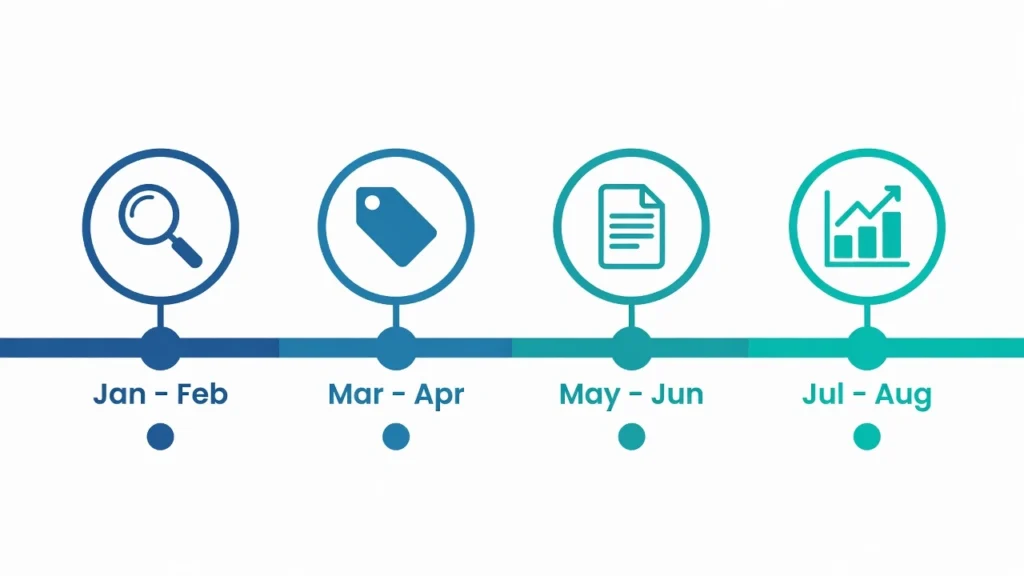
Stage 1: SaaS Website Audit & Competitive Benchmarking (Month 1)
Our comprehensive SEO audit covers more than 50 technical factors, but we focus on the issues that actually impact SaaS companies. Not generic site speed problems that affect every website. The technical barriers that prevent SaaS products from ranking in competitive software categories.
We analyze your product pages, pricing pages, and feature pages to identify indexing issues, conversion barriers, and content gaps. Most SaaS websites have strong homepage optimization but weak product page SEO. Your feature pages should rank for specific capability searches. Your pricing page should capture bottom-of-funnel comparison searches. Your integration pages should target “software X integrations” searches that drive high-intent trial signups.
We use Ahrefs for competitive research and backlink analysis to understand exactly what your direct competitors are doing to outrank you. Not just which keywords they’re targeting. Which content formats are working for them, which backlinks are driving their domain authority, and where they’re vulnerable to a focused attack on specific search terms.
SaaS competitor analysis reveals the ranking gaps that generic audits miss. We identify the comparison searches your competitors haven’t built content for yet. The integration keywords they’re ignoring. The alternative searches where you could rank on page one in 90 days instead of waiting 12 months to compete on broad category terms where they’ve been publishing for years.
Month 1 Deliverables: Technical audit report with prioritized fixes, competitive benchmark analysis, and ranking opportunity assessment showing your 20 highest-impact quick wins.
Stage 2: Keyword Strategy & Content Architecture (Month 1-2)
We build your keyword strategy around buyer-intent searches, not blog topic ideas. Your prospects don’t search for generic category terms and convert immediately. They search for specific problems, compare named alternatives, evaluate integrations, and research feature capabilities across multiple sessions over several months.
Our keyword research maps every stage of your sales funnel. Awareness-stage keywords that explain the problems your product solves. Consideration-stage keywords that position your product as the solution. Decision-stage keywords that capture prospects actively choosing between you and named competitors. And retention-stage keywords that help existing users get more value so they don’t churn.
wrong,This stage determines everything else we do. Get the keyword targeting wrong and even perfect execution won’t move the needle on demo requests or trial signups. We prioritize keywords based on search volume, competition level, and proximity to conversion. Not just what’s easy to rank for.
Content architecture planning starts here. We map which pages need to be created, which existing pages need optimization, and how each piece of content connects to your product funnel. Every content piece serves a specific purpose. Drive awareness. Build consideration. Capture decision-stage searches. Support customer retention.
Month 2 Deliverables: Complete keyword strategy with 200+ mapped terms, content roadmap for next 12 months, and page-by-page optimization plan for existing content.
SaaS Website Architecture and Internal Linking
SaaS websites often have multiple layers of commercial content, including product, feature, use-case, integration, comparison, pricing, and educational pages. These pages should form a logical architecture rather than existing as isolated URLs. We organize internal links so relevant authority flows between supporting content and high-value commercial pages while making important pages easy for both users and search engines to discover.
Stage 3: Content Creation & Technical Implementation (Months 2-6)
Strategic content marketing production begins in Month 2, but we don’t publish 20 generic blog posts and hope something works. Every piece of content targets a specific keyword cluster and serves a specific stage in your sales funnel.
We create comparison pages that capture “Your Product vs. Competitor” searches. Alternative pages that rank for “Competitor alternative” searches when prospects are looking for different options. Feature-specific pages that explain what someone can actually accomplish with your product. Our approach combines strategic keyword targeting with professional SEO content writing to ensure every piece converts readers into prospects
Technical implementation happens parallel to content creation. We fix site speed issues that prevent your product pages from ranking. We implement schema markup that helps Google understand your software features and pricing. We optimize internal linking to pass authority from your high-traffic blog content to your conversion-focused product pages.
But here’s what most agencies get wrong. They treat content creation and technical SEO as separate projects. We coordinate both simultaneously because a technically perfect website with weak content won’t convert and great content on a slow website won’t rank.
Months 2-6 Deliverables: 12-16 pieces of strategic content, technical optimization implementation, and monthly progress reports showing keyword ranking improvements and organic traffic growth.
Stage 4: Monthly SEO Reporting & Optimization (Ongoing)
We track progress using Google Search Console, Ahrefs, and your CRM data to connect SEO activity directly to business results. Not just keyword rankings and organic traffic. Demo requests that came from organic search. Trial signups that converted from specific landing pages. Customer acquisition cost for the SEO channel compared to paid advertising.
Monthly reports pull data from Google Analytics 4, your CRM, and search console to show exactly how organic search contributes to your pipeline. We follow Google’s measurement best practices to ensure accurate attribution across multiple touchpoints in your SaaS buyer’s journey. Which content pieces are driving qualified leads? Which keywords are bringing in researchers versus buyers. How your organic conversion rate compares to paid traffic conversion rates.
SEO reporting for SaaS companies requires different metrics than e-commerce or local service businesses. We track product qualified leads, not just website visitors. We measure cost per acquisition, not just cost per click. We analyze multi-touch attribution because B2B software buyers interact with multiple content pieces before requesting a demo.
Optimization happens based on what the data shows. If comparison pages are driving demos but awareness-stage content isn’t converting, we double down on bottom-of-funnel keyword targeting. If technical users are converting but business buyers aren’t, we adjust our content strategy to address both personas more effectively.
The goal isn’t just to rank higher. The goal is to build an organic acquisition channel that scales more cost-effectively than paid advertising and brings in customers with higher lifetime value because they discovered you through helpful content instead of interruption advertising.
Monthly Deliverables: Performance dashboard with business metrics, ranking progress report, content performance analysis, and next month’s optimization priorities.
What Our SEO Agency for SaaS Companies Delivers
Each service is designed to grow qualified organic traffic that converts into trials, demos, and paying customers. Not just traffic that looks good in reports but contributes nothing to your pipeline. We focus on the specific technical, content, and authority-building needs that SaaS companies face when competing against established software brands with bigger budgets and older domains.
Here’s exactly what you get when you work with us.
Technical SEO for SaaS Platforms
Most SaaS websites have complex technical architecture that generic SEO agencies don’t know how to optimize. Single-page applications. Dynamic product pages. Gated content behind user logins. Pricing calculators that search engines can’t crawl properly.
We fix the technical SEO issues that specifically prevent SaaS products from ranking in competitive software categories. Site speed optimization for feature-heavy product pages. Schema markup for software pricing and features. Internal linking structures that pass authority from your high-traffic blog content to your conversion-focused product pages.
We optimize high-intent pages like pricing, features, and comparison pages that actually drive demo requests. These pages often have technical barriers that prevent them from ranking. Slow load times because of pricing calculators. Poor mobile usability because of complex feature tables. Missing meta descriptions on dynamically generated comparison pages.
Every page is built with conversion rate optimization in mind. Technical fixes aren’t just about rankings. When your product pages load faster and display properly on mobile devices, your organic traffic converts at higher rates. We track technical improvements through to business metrics like trial signup rates and demo request volume.
SaaS Content Strategy & Creation
We build your content around buyer-intent searches, not generic blog topic ideas that generate research traffic from the wrong audience. Our content targets the specific searches that SaaS buyers make when they’re actively evaluating solutions in your category.
We optimize existing blog content and create new assets that target bottom-of-funnel comparison terms. “Your Product vs. Competitor” pages that capture prospects choosing between specific options. ” Competitor Alternative” pages that rank when prospects are looking for different solutions. Integration guides that target “Software A and Software B” searches that drive high-intent signups.
SaaS blog content optimization focuses on nurturing prospects through long sales cycles instead of trying to convert on the first visit. We create content clusters that keep prospects engaged across multiple sessions. Awareness-stage content that explains problems. Consideration-stage content that positions your product as the solution. Decision-stage content that addresses specific objections and feature questions.
Content strategy for SaaS companies requires understanding both technical and business buyer personas. The marketing director needs ROI information. The technical evaluator needs integration and security details. We create content that speaks to every decision maker in the buying committee, not just one person.
SaaS Link Building & Authority Growth
Our link building combines digital PR outreach with strategic content partnerships to acquire backlinks from SaaS publications and industry sites that actually influence your target audience. Not generic business directories or low-quality link farms that hurt more than they help.
We acquire high-quality backlinks from software review sites, industry publications, and complementary SaaS companies that share your target audience. Links from G2, Capterra, TechCrunch, SaaStr, and category-specific publications that software buyers actually read when researching solutions.
SaaS link building requires different tactics than e-commerce or local service businesses. We create data studies that software publications want to reference. We build strategic partnerships with complementary SaaS tools. We get your executives quoted in industry articles about software trends and best practices.
Link building for software companies focuses on building authority for competitive commercial terms, not just increasing domain authority scores. We target backlinks that help your product pages rank for high-intent searches like “project management software for remote teams” or “CRM with advanced automation features.
| SaaS SEO Service | What We Optimize | Business Goal |
|---|---|---|
| Technical SEO | Crawling, indexing, performance, architecture | Improve search accessibility |
| Content Strategy | Topic clusters, BOFU content, product-led content | Attract qualified prospects |
| Competitor Analysis | Ranking gaps, comparison opportunities | Capture missed commercial searches |
| Link Building | Relevant industry authority | Strengthen page authority |
| Page Optimization | Product, pricing, feature and landing pages | Increase conversions |
| Performance Tracking | Organic leads, demos, trials and revenue | Measure business impact |
Conversion-Focused Page Optimization
Our optimization process goes beyond traffic acquisition. We evaluate whether product pages, pricing pages, comparison pages, and content assets are moving visitors toward meaningful actions such as trial signups, demo requests, and qualified leads.
Every page we work on goes through conversion rate optimization analysis to ensure organic traffic actually contributes to your sales pipeline.
We optimize product pages, pricing pages, and feature pages to convert visitors who found you through organic search. Clear value propositions that explain what your product does in terms buyers understand. Benefit-focused copy that connects features to business outcomes. Strategic placement of demo request forms and trial signup buttons.
Landing page optimization for SaaS companies requires understanding how software buyers make decisions. They need social proof from similar companies. They want to see specific use cases and results. They need answers to security, integration, and implementation questions before they’ll request a demo.
Conversion optimization connects directly to your sales funnel. We track which organic traffic sources generate the highest-quality leads. Which content pieces drive the most trial-to-customer conversions. Which pages have the best demo request rates so we can apply those insights to new content.
Performance Tracking & Business Metrics Integration
We track organic traffic performance through to closed revenue, not just keyword rankings and website visits. Our reporting connects SEO activity to the business metrics that matter to SaaS companies: customer acquisition cost, trial-to-customer conversion rates, and pipeline contribution from organic search.
Performance tracking for software companies requires integration with your CRM and marketing automation tools. We measure which blog posts generate the most product-qualified leads. Which landing pages have the highest demo request rates? How organic search traffic compares to paid advertising in terms of customer lifetime value.
Monthly reporting includes the SEO metrics you need to track progress and the business metrics your board wants to see. Keyword ranking improvements alongside trial signup increases. Organic traffic growth alongside pipeline contribution percentages. Content performance analysis that shows which topics drive the highest-quality prospects.
We connect organic search performance to your sales funnel so you can see exactly how SEO contributes to revenue growth. Which keywords bring in customers with the highest lifetime value? How much your organic customer acquisition cost compares to paid channels. What percentage of your new customers discovered you through content we created?
Ongoing Strategy & Competitive Intelligence
SaaS markets change fast. New competitors launch. Feature sets evolve. Buyer behavior shifts. We provide ongoing competitive intelligence and strategy updates to keep your SEO approach ahead of market changes.
Competitive monitoring tracks what your direct competitors are doing with their SEO strategies. New content they’re publishing. Keywords they’re starting to target. Backlinks they’re acquiring. Product page changes that might affect their ranking performance.
Strategy refinement happens based on what the data shows about your market and what’s working for your specific audience. If decision-stage content is driving more demos than awareness content, we adjust content production accordingly. If certain competitor comparison pages are performing exceptionally well, we create similar content for other competitor matchups.
SaaS search behavior is also expanding beyond traditional Google results. Buyers increasingly discover software through AI-powered search experiences, where visibility depends on how clearly your company, product, expertise, use cases, and supporting content can be understood and surfaced.
We incorporate AI search visibility into the broader SaaS SEO strategy by strengthening the information architecture, entity relationships, product information, comparison content, and expert-led resources that help search systems understand what your company offers and who it serves.
The goal isn’t to chase every new AI search feature or create content specifically for machines. It’s to build a strong, well-structured information ecosystem that makes your SaaS brand easier to understand across traditional search and emerging AI-powered discovery experiences.
GET IN TOUCH
Turn organic search into your #1 acquisition channel. Book your free SaaS SEO audit now.
Proven Results for SaaS Companies Like Yours
We measure success by impact on your MRR, not just keyword rankings. While other agencies send reports full of vanity metrics, we track organic search performance through to closed revenue and customer acquisition cost.
Case Studies: Real Results for Real SaaS Companies
We helped a project management SaaS company achieve 112% SaaS organic traffic growth in eight months by targeting bottom-of-funnel comparison keywords their competitors ignored. More importantly, that traffic converted. The campaign contributed to 23% MRR growth in 12 months because we focused on searches that prospects make when they’re actively choosing between solutions.
Our content strategies are proven to increase SaaS free trial conversion rates by addressing the specific objections software buyers have before starting trials. We track conversion rate at every funnel stage, from visitor to MQL to SQL, so you can see exactly how organic search contributes to your sales pipeline.
We’ve helped SaaS companies in competitive categories like HR tech, marketing automation, and project management build organic acquisition channels that scale more cost-effectively than paid advertising. Our clients often tell us we’re the best rated SEO agency for SaaS they’ve worked with because we understand their business model and measure what actually matters.
We position organic search as your most profitable acquisition channel by focusing on long-term compounding growth instead of short-term traffic spikes that don’t convert.
SaaS SEO Agency FAQs
What makes a SaaS SEO agency different from a standard SEO agency — and does it actually matter?
Yes, it matters significantly. Generic agencies build blog posts for traffic while specialists build comparison pages and alternative content that captures prospects actively choosing between solutions. We also understand SaaS technical challenges like JavaScript rendering and product page indexing that break standard SEO approaches, plus we track demo requests and MRR growth instead of just keyword rankings.
How much does SaaS SEO typically cost, and what should I expect to pay for specialist services?
Specialist SaaS SEO agencies typically charge $3,000-$8,000/month depending on market competition and content volume required. Compare that to the $15,000-$30,000/month most SaaS companies spend on Google Ads for results that compound over years instead of disappearing when you stop paying.
How long before I see results from SaaS SEO — and what should I expect in the first 3, 6, and 12 months?
Month 1 covers strategy and technical fixes with no ranking changes yet, months 2-3 bring early ranking movements for lower-competition terms, months 4-6 show meaningful organic traffic increases and first demo requests, and months 7-12 establish organic search as a measurable pipeline contributor. We’ll show you realistic milestone projections for your specific market on our free strategy call.
Should I hire a SaaS SEO agency or a freelance SaaS SEO consultant? What is the difference?
Freelancers work well for early-stage SaaS needing one specific area like technical SEO on a tight budget, while agencies make sense for growth-stage companies needing full-stack technical, content, and link building simultaneously. We’re happy to assess your situation and recommend the right approach on a free call, even if that means suggesting a consultant over our services.
How do you measure SEO success for a SaaS company, and how will I know it’s actually working?
We track organic pipeline contribution, demo requests from organic visitors, and organic customer acquisition cost compared to paid channels through CRM integration. Monthly reports show which content drives qualified leads and how your organic conversion rates compare to paid traffic, not just keyword ranking tables.
Which SEO deliverables help a SaaS company book more demos this quarter?
Tecveq’s SaaS SEO service focuses on deliverables built for conversions, not just traffic—targeted bottom-funnel keyword content, landing page optimization, technical SEO fixes, and conversion-focused on-page structure that turns organic visitors into demo bookings within a quarter, not just rankings over a year.