
Inventory Management Software for Ecommerce in Pakistan | Custom-Built by Tecveq
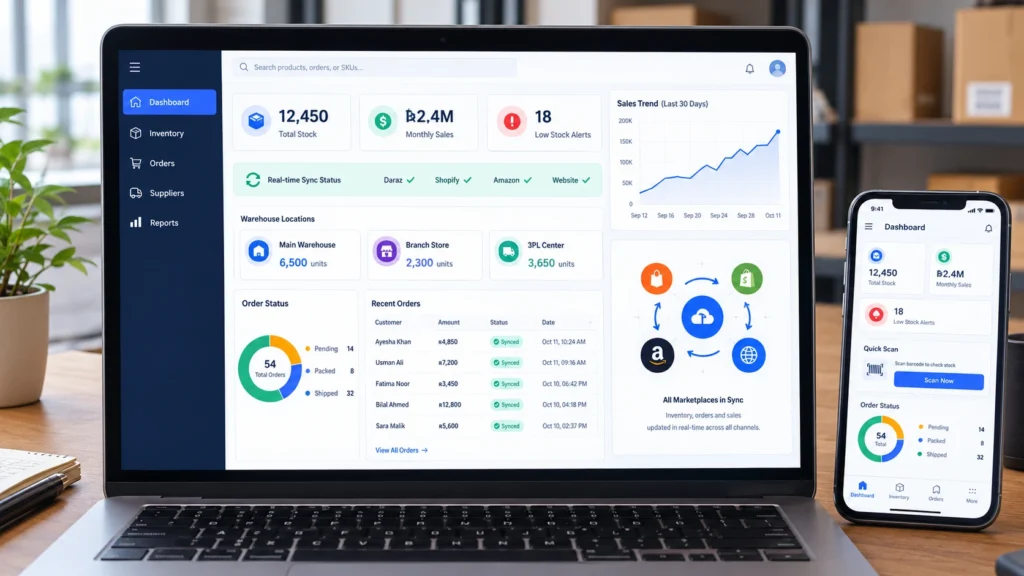
Running an online store across multiple channels is chaotic without the right inventory management software for ecommerce. Your stock counts do not match reality. Orders pile up faster than you can process them. And when you finally check your warehouse, half your inventory is stuck in spreadsheets nobody understands. We build custom ecommerce inventory software that syncs your stock, orders, suppliers, and accounts in one dashboard so you actually know what you have, what you owe, and what you need to reorder. The result is less overselling, fewer stockouts, and customers who get their orders on time. Let us show you how a system built specifically for your business works differently than generic off-the-shelf software. Custom Inventory Management Software for Ecommerce Businesses in Pakistan We do not sell you a templated software package that forces your business into a standard box. We build inventory management software designed around how your store actually operates. Your products. Your sales channels. Your warehouse workflow. Your suppliers. One Dashboard for Stock, Orders, and Suppliers Everything lives in one place. You log in and immediately see your current stock across all warehouses, pending orders from every sales channel, and purchase orders to your suppliers. No jumping between tabs or systems. No outdated spreadsheets that nobody updates. When an order comes in, the system automatically deducts stock. When you receive new inventory, one scan updates everything. Your team sees the same numbers in real time, so there are no surprises mid-shift. Built Around Your Products, Variants, and Workflow Your products are not all the same. You have SKUs with multiple colors, sizes, bundles, and combinations. You have suppliers in different countries. You ship from different warehouses. You sell on your website, Daraz, Amazon, and maybe a physical store. A generic system treats all of this as extra complexity. We build it as your core workflow. The software knows your variants, your warehouse locations, your sales channels, and your suppliers. It moves stock the way you move it. Not the other way around. Where to Get Ecommerce Inventory Software Built in Pakistan Most ecommerce businesses in Pakistan either struggle with manual spreadsheets or pay international SaaS companies monthly fees for features they do not use. We are based in Pakistan. We understand your suppliers, your marketplaces, your couriers, and your payment methods. We build inventory software that integrates with the tools you actually use. Local support. No language barriers. No timezone delays. Just a development team that understands your business and answers your phone. Inventory Problems We Solve for Online Sellers You are probably running into one or more of these problems right now. If any of them sound familiar, that is exactly why custom inventory software exists. Overselling and Stockouts You sell the same product on your website, Daraz, and your WhatsApp catalog. You get orders from all three channels. But your inventory counts do not sync. One customer gets a refund because the item already sold out. Another waits two weeks for a restock that is already in your warehouse but marked sold. This costs you money, customer trust, and time explaining why orders are delayed. Real-time inventory sync across all channels stops this completely. When one channel sells the last unit, all channels immediately know it is gone. Stock Mismatch Between Your Website and Marketplaces Your Shopify store says you have 50 units. Daraz shows 12. Your Google Sheet says 38. None of these numbers are right because nobody updated them simultaneously. You manually adjust numbers at night and hope it sticks. Then a bulk order comes in at 2 AM, and you promise delivery you cannot keep. This is the most expensive inventory mistake you can make. We sync your inventory across every sales channel every time a sale happens. No manual updates. No guessing. No overpromising. Manual Spreadsheets and Data Entry Errors You track orders in one spreadsheet, stock in another, and supplier costs in a third. Every week someone enters data wrong. A digit gets missed. An order gets duplicated. A SKU gets misspelled. By month-end your numbers are off by hundreds of units, and nobody knows where the error is. You waste hours hunting through spreadsheets. We move all of this into a system where data flows automatically. No re-entry. No typos. No wasted time playing detective at the end of the month. Dead Stock and Poor Reorder Planning You have units that have not sold in six months taking up warehouse space. Meanwhile, your bestsellers are constantly running out. You reorder based on gut feeling, not data. Sometimes you order too much, and the stock ties up cash you need elsewhere. Sometimes you order too little and lose sales. Smart inventory forecasting shows you exactly what is moving, what is not, and when you actually need to reorder. You stop throwing money at slow products and start investing in what actually sells. ⚡ GET IN TOUCH Stop Overselling. Start Syncing Stock Automatically 💬 Chat on WhatsApp 📞 Call 0307 3319555 Key Features of Our Ecommerce Inventory Software Every feature we build serves one purpose: give you complete control over your inventory so you can grow without the chaos. Real-Time Inventory Tracking Across All Platforms The moment an order is placed on any channel, your central inventory updates. Daraz sold three units? Your website quantity drops to reflect it. Got a return? Stock goes back up across every system that sells that product. You never have to wonder what your actual stock is. The system always knows. And because it updates in real time, your team can make decisions based on current numbers, not numbers from this morning. Automatic Low-Stock Alerts Set a reorder point for each product. When stock drops below that number, the system alerts you automatically. You get an email. Your team gets a notification. You can even set it to trigger a purchase order to your supplier without manual approval. This means you never run out of bestsellers by accident. Your fastest-moving items always stay
Social Media Marketing Agency for Small Business Growth

Signs Your Small Business Needs Dedicated Social Media Support Most small business owners start by managing social media themselves. You post when you have time, respond to comments between meetings, and run an ad whenever you need a quick boost. At first, that can be enough. But as your business grows, social media management becomes another job competing with sales, operations, customers, and everything else on your plate. And for a while, it works. But at some point, posting whenever you remember stops driving results. Your audience stops growing. Engagement drops. You’re spending time on social media without seeing any real return. We’ve worked with small businesses that reached this exact point: social media was taking more time to manage but wasn’t producing the consistency or results they needed. Here are the signs that told them it was time to bring in dedicated support. Your posts get inconsistent because operations come first. Client issues, inventory, payroll, and social media get pushed to tomorrow. Inconsistent posting can make it harder to maintain audience engagement and learn what content performs best. Your audience notices the inconsistency too, especially when competitors are publishing useful content regularly. You’re posting but have no idea what’s actually working. No tracking. No analysis. Just guessing and hoping something sticks. You’re spending money on ads with no clear strategy. Boosting random posts burns budget. Real results require audience research, proper targeting, and conversion tracking. You can’t respond to messages and comments fast enough. Every delayed response is a lost sale. Your competitor answers in an hour. You see it four days later. If three or more of these signs describe your situation, you’ve outgrown DIY social media. We can take this entire load off your plate. Call us for a free consultation. What a Full Service! Social Media Marketing Agency Should Offer Not all social media agencies offer the same level of service. Some just schedule posts. Others only run ads. A true full-service agency handles every piece of your social media presence so nothing falls through the cracks. Here’s what complete social media management actually includes. These social media management services cover the strategy, content, advertising, community engagement, and reporting required to manage your presence consistently. Social Media Service What It Includes Business Benefit Strategy & Audience Research Audience research, platform selection, content strategy, campaign planning Gives every activity a clear business purpose Content Creation Graphics, captions, short-form video, reels, stories and platform-specific content Keeps your brand consistent and visible Paid Social Advertising Audience targeting, ad creative, budget management, testing and conversion tracking Helps turn paid reach into measurable opportunities Community Management Comment monitoring, message responses, mentions and audience engagement Improves responsiveness and customer experience Reporting & Optimization Performance tracking, analysis, reporting and ongoing adjustments Shows what is working and where to improve Social Media Strategy & Audience Research We start by understanding who you’re trying to reach. Your ideal customer’s age, location, income level, pain points, and which platforms they actually use. Then we build a strategy around that data, not guesses. Your strategy maps out content themes, posting frequency, campaign timing, and how social media connects to your bigger business goals. Everything we post has a purpose tied directly to growth. Content Creation & Creative Design We handle all content production. Graphics, captions, videos, reels, stories—everything your audience sees comes from us. Content is designed specifically for each platform because what works on LinkedIn doesn’t work on TikTok. Every post is branded, on-message, and built to stop the scroll. We don’t recycle generic templates. We create content that reflects your business and speaks directly to your audience. Paid Social Advertising Organic reach only goes so far. We run targeted ad campaigns on Facebook, Instagram, LinkedIn, and TikTok to put your business in front of the right people at the right time. We handle audience targeting, ad creative, budget management, A/B testing, and conversion tracking. Every dollar spent is measured against the outcomes that matter to your business, whether that’s leads, sales, website visits, or another defined conversion goal. ⚡ GET IN TOUCH Ready to grow? Get a free social media strategy consultation for your small business no commitment required. 💬 Chat on WhatsApp 📞 Call 0307 3319555 Community Management & Engagement We monitor your accounts daily. Your dedicated account manager keeps communication organized while our social media team handles comments, messages, mentions, and engagement. Fast response times build trust and help turn social media conversations into genuine sales opportunities. We also engage proactively with your audience and industry conversations to keep your brand visible and top of mind. Performance Reporting & Optimization You get clear monthly reports showing exactly what’s working. Follower growth, engagement rates, website traffic, lead generation, and ROI on ad spend. No jargon. Just real numbers tied to real business outcomes. We use that data to optimize constantly. If something’s not performing, we adjust. If something’s working, we scale it. Social media management isn’t set-it-and-forget-it. It’s continuous improvement based on what the data tells us. This is what full-service looks like. At Tecveq, we handle all five areas so your social media runs like a system, not a series of random posts. You stay focused on your business. We make sure your social media actually drives growth. Tecveq Company Information Table Company Details Information Company Name Tecveq Email info@tecveq.com Phone ++44 7721 716507 Address Sahiwal, Punjab, Pakistan Website https://tecveq.com Founded 2025 Team Size 15+ Professionals Business Hours Monday – Friday, 9:00 AM – 6:00 PM (PKT) Primary Services Social Media Marketing, Custom Software Development, Mobile App Development, Web Development, AI & Automation, SEO Services Specialization Small Business Solutions Project Timeline 2-4 weeks (Simple Projects) to 12-24 weeks (Custom Software) Industries Served Restaurants, Retail, E-commerce, Healthcare, Education, Construction, Real Estate, Manufacturing, Professional Services Geographic Reach Pakistan, Bahrain, International (Remote Services) Key Technologies React, Node.js, Flutter, WordPress, AI/ML, Cloud Solutions Languages English, Urdu Free Consultation Available for all potential clients Support 24/7 for critical systems, 2-hour response time Platforms a Small Business Social Media Agency Should Manage
Techveq, the AI company, Pakistan businesses trust to build real results.

Why Businesses in Pakistan Bring Tecveq In for AI Projects We build artificial intelligence systems that solve real business problems. Not consulting decks. Not proof-of-concept demos that go nowhere. Working AI applications that automate tasks, analyze data, and handle customer interactions without constant supervision. Our service lines cover the full AI build cycle. AI Consulting to map your automation roadmap and identify where machine learning actually fits your operations. And AI development for custom applications built on your data and workflow. AI chatbot development for 24/7 customer support that doesn’t sound robotic, including specialized solutions like WhatsApp chatbots for small businesses. ML Ops Consulting to keep your models running reliably after launch. RPA services to automate repetitive manual tasks. Computer vision for visual recognition and quality control. ML development for predictive models and intelligent decision systems. We’ve completed over 200 digital projects since we started, and AI work has become the core of what we build for clients today. Most of those projects are in Pakistan, with clients in Bahrain and the UK as well. We’re not the biggest top AI company in Pakistan by headcount. But we’ve built enough working systems to know what actually works in production and what falls apart under real user load. If you’re evaluating artificial intelligence companies in Pakistan and want to talk to a team that has actually built and deployed working AI systems, contact Tecveq directly. We name the services. We show the track record. And we start every project by asking what problem you’re trying to solve, not what buzzword you want to chase. Why Startups in Pakistan Need a Practical AI Development Partner Most AI agencies pitch like they’re selling enterprise contracts to Fortune 500 companies. Big promises. Big budgets. Big timelines. And for startups in Pakistan trying to automate one part of their workflow or test an AI feature before committing serious money, that approach doesn’t work. Bilal Ahmed, founder of a growing tech startup in Karachi, put it this way: “We needed affordable AI development services in Pakistan that deliver real results, not just another proposal that sits in our inbox for six months while the agency waits for us to match their enterprise pricing.” That’s the gap we see all the time. Startups need AI work that fits their actual budget and timeline. Not a six-month discovery phase. Not a $50,000 minimum engagement. A clear scope, a realistic price, and a working system they can actually launch and test with real users. We’ve worked with enough early-stage companies to know what affordable AI development in Pakistan actually means. Our approach mirrors our custom software development for startups methodology—we scope the MVP version first, not the full vision. It means we build in phases so you’re not locked into paying for features you haven’t validated yet. And it means we show you working progress every two weeks, not a final handoff six months later. If you’re evaluating AI companies for your startup and tired of agencies that ghost you after the first call because your budget doesn’t hit their minimum, we built our process specifically to avoid that. ⚡ GET IN TOUCH Ready to work with a top AI company in Pakistan that delivers working systems, not endless proposals? 💬 Chat on WhatsApp 📞 Call 0307 3319555 AI Development Services Tecveq Builds for Businesses in Pakistan Many AI companies list a long range of services without explaining what they actually build or which type of business problem each service solves. We take a more practical approach: here is exactly what Tecveq builds across eight service lines. You scroll through six buzzwords and still have no idea what they actually build or whether your project fits. Here is exactly what Tecveq builds across 8 artificial intelligence and automation service lines, from AI consulting and chatbot development to computer vision, machine learning, RPA, and generative AI. AI Service What Tecveq Builds Best For AI Consulting AI roadmaps, technology assessment, data, and automation strategies Businesses planning their first AI project AI Chatbot Development Conversational AI, NLP integration, and customer-support systems Customer service and support teams Computer Vision Visual recognition, defect detection, and classification systems Manufacturing, e-commerce, and quality control Machine Learning Development Predictive models, forecasting, and anomaly detection Businesses working with historical operational data RPA Services Automated data entry, document processing, and workflow tasks Businesses with repetitive manual processes AI App Development Custom AI applications built around business data and workflows Startups, SMEs, and enterprises needing tailored applications ML Ops Consulting Monitoring, benchmarking, retraining, and model reliability Businesses with AI systems already in production Generative AI Development LLM integration, document processing, knowledge search, and AI workflows Businesses looking to integrate generative AI into operations AI Consulting Automation Roadmaps, ML Frameworks, Data Strategies Before writing a single line of code, we map where AI actually fits your business. That means identifying which processes are worth automating, which data you already have that machine learning can work with, and which frameworks make sense for your team to maintain after we hand over the system. AI consulting in Pakistan is often sold as strategy decks with no implementation path. Ours ends with a buildable roadmap your team can actually execute. Is Your Business Data Ready for AI? The quality of an AI system depends heavily on the data behind it. Before development begins, businesses need to understand what data is available, where it is stored, how complete it is, and whether it is suitable for the intended use case. This assessment can reveal data gaps early and prevent businesses from investing in an AI system before the underlying information is ready. That’s why data assessment is part of the early AI consulting and discovery process. It helps define what can realistically be built and which approach makes sense for the business. AI Chatbot Development 24/7 Support, Conversational Intelligence, NLP Integration We build AI chatbots that handle real customer conversations, not just keyword-triggered FAQ responses. Our AI chatbot development work covers natural language processing integration so the chatbot understands context,
Software Development Company in Bahrain, Tecveq
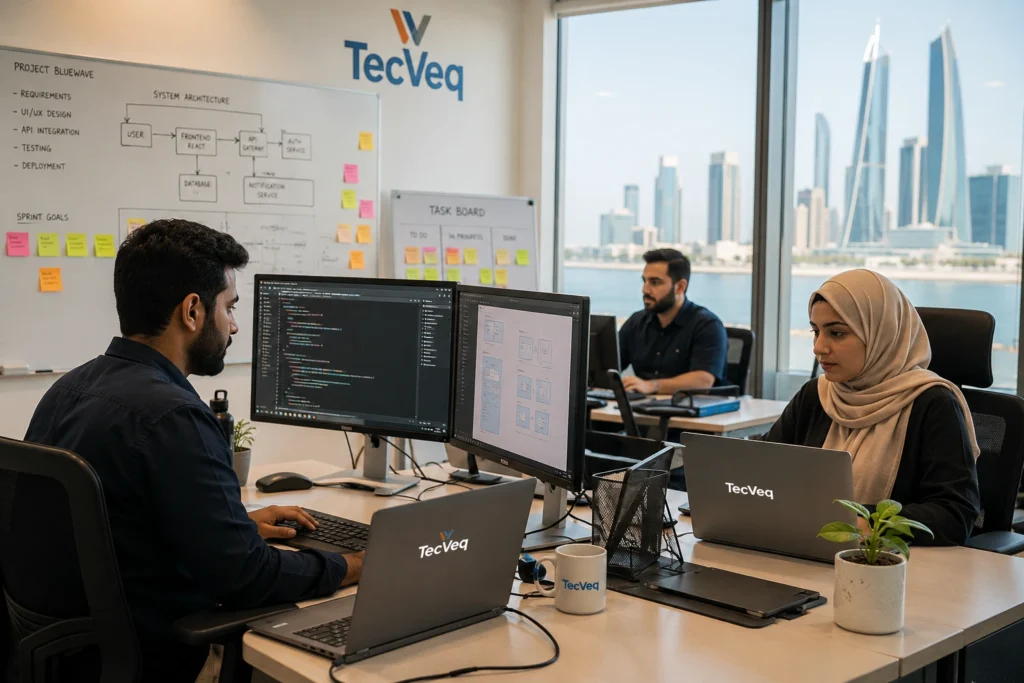
Custom Software, Built and Delivered by a Bahrain-Based Team Many software development companies in Bahrain operate with development teams elsewhere, which can make communication, requirements gathering, and accountability harder to manage. You send feedback through a ticket system, wait for a response, and hope the people building your product have understood what you actually need. We work differently. You send feedback into a ticket system, wait 24 hours for a response, and hope the people actually building your product understand what you need. We work differently. At TecVeq, our development team is based in Bahrain. The people writing your code, reviewing your requirements, and testing your software before delivery are the same people you can call, meet, and hold accountable locally. That is not a small thing when your project hits a difficult phase and you need fast answers, not a time zone delay. Tecveq is a custom software development company in Bahrain for businesses that need systems built around the way they actually operate. Instead of adapting an off-the-shelf platform to fit your processes, we design and develop software around your workflows, users, integrations, and business goals. The result is a digital solution built for your operation rather than a generic product with your logo added to it. And because we are local, we understand the market you are operating in. GCC payment gateways, Arabic and English interface requirements, Bahrain commercial registration processes, and compliance considerations that offshore teams rarely know to ask about. These are things we account for from the start, not problems we discover halfway through a build. Custom software development in Bahrain should mean a real local team, real accountability, and a product that works the way your business actually runs. That is what we deliver. As a custom software development company, TecVeq works directly with businesses to define requirements, design the solution, build the software, test it, and support the delivered system. Our Bahrain-based development team stays involved throughout the process, giving clients a clear point of contact from initial scoping through launch. Where Software Projects in Bahrain Usually Break Down Most software projects do not fail because of bad code. They fail long before a single line of code gets written. The problem usually starts with scope. A business owner explains what they need in a 30-minute call, the vendor nods along, and both sides walk away with completely different pictures of what is being built. Nothing gets written down in enough detail. Then development starts, and the gap between what the client expected and what is actually being built becomes impossible to ignore. By that point, fixing it costs money, time, and usually a difficult conversation about who is responsible. Scope creep is the most common budget killer we see in software projects across Bahrain. A feature gets added here, a requirement changes there, and a fixed-price quote that looked reasonable at the start quietly doubles by the time the project is done. Not because anyone acted in bad faith. Because the project scope and requirements were never documented precisely enough to hold either side accountable. Then there is the communication problem. A vendor goes quiet between milestones. You send a follow-up email and get a vague reply. Two weeks pass. You have no idea if the project is on track, running late, or sitting untouched while your vendor works on something else. By the time the silence becomes a serious concern, you are already behind schedule. We have seen these patterns repeat across projects of every size. Which is exactly why our process starts with a written scope document before any development begins, regular progress updates on a fixed schedule, and a clear agreement on what happens if requirements change. Not because we assume problems will happen. Because preventing them requires structure, not good intentions. ⚡ GET IN TOUCH Get your free TecVeq project estimate – Bahrain’s local development team. 💬 Chat on WhatsApp 📞 Call 0307 3319555 Services Built Around Your Project Stage, Not a Fixed Package Where you are in your project determines what you actually need from a software development company. A business with a rough idea needs something completely different from a business with a live system that is slowing down under growth. We structure our services around that reality rather than pushing every client into the same package. Custom Enterprise and Business Systems Some business problems cannot be solved with off-the-shelf software. When your operations involve specific workflows, multi-branch processes, or reporting requirements that standard tools cannot handle, we build the system around how your business actually runs. This covers CRM platforms, inventory management systems, booking and scheduling tools, internal operations software, and business management systems built specifically for your processes rather than adapted from a generic template. Data security also needs to be considered when business software handles customer records, employee information, financial data, or internal operations. We account for access permissions, authentication, data handling, and system-level security requirements during the planning and development process so security is considered as part of the architecture rather than treated as a final-stage add-on. For established businesses, custom software can also support a broader digital transformation by replacing disconnected spreadsheets, manual processes, and separate systems with one connected workflow. The goal is not to introduce technology for its own sake but to remove operational friction and give teams better visibility into the work they already perform. Web and Mobile Application Development We build web applications that run in the browser and mobile applications for iOS and Android, depending on where your users actually spend their time. Web application development suits internal tools, client portals, and platforms where desktop access is the norm. Mobile app development makes sense when your users need the application on the go, require offline access, or when the product itself is the app. We assess which direction fits your users before recommending one, because building the wrong type costs time and budget that cannot be recovered. SaaS and Product Development If you are
Social Media Agency in Bahrain Data-Driven Strategy, Content & Growth

What TecVeq Does as Your Social Media Agency in Bahrain Running a business in Bahrain means your customers are already on Instagram, Facebook, TikTok, and LinkedIn. The question is whether your brand is showing up in a way that actually makes them stop scrolling. At TecVeq, we handle every part of your social media, from building the strategy to posting the content to managing your ad spend, so you get a consistent online presence that drives real business results. Social Media Strategy & Audience Research Most businesses post content and hope something works. That’s not a strategy. That’s guesswork. Before we write a single caption or run a single ad, we study your audience, your competitors, and your market position in Bahrain. We look at who your ideal customers are, which platforms they actually use, what content stops them from scrolling, and where your competitors are falling short. That research shapes everything: your content themes, your posting schedule, your ad targeting, and your messaging. Your social media strategy is built around your business goals, not just follower counts. If you want leads, we build toward leads. If you want foot traffic to a Manama location, we build toward that. Every decision connects back to what actually grows your business. Content Creation for Instagram, Facebook, TikTok & LinkedIn Good content does not happen by accident. It takes planning, platform knowledge, and an understanding of what Bahrain audiences actually respond to. We create content specifically built for each platform because what works on LinkedIn does not work on TikTok, and what performs on Instagram Stories is different from what drives engagement on Facebook. Each piece of content we produce is designed for the platform it lives on, the audience it reaches, and the goal it needs to achieve. Our content creation service covers graphics, captions, short-form video, and full content calendars planned weeks in advance. You always know what’s going out and when. No last-minute scrambling. No off-brand posts. Just consistent, professional content that reflects your brand every single time it goes live. ⚡ GET IN TOUCH Get Your Social Media Agency Bahrain Quote Free Strategy Session Included 💬 Chat on WhatsApp 📞 Call 0307 3319555 Paid Social Advertising & Campaign Management Organic reach alone will not grow your business fast enough. Paid social advertising puts your brand directly in front of the right people—the ones most likely to buy from you, visit your location, or contact you today. We run paid campaigns across Meta Ads Manager, TikTok Ads Manager, and LinkedIn Campaign Manager. Every campaign starts with proper audience targeting based on location, interests, behavior, and demographics relevant to your Bahrain market. We set up the campaign, write the ad copy, design the creatives, and manage the budget so your ad spend goes toward results, not wasted impressions. And we do not just set it and forget it. We monitor campaign performance continuously, adjusting targeting, creatives, and budgets based on what the data tells us. Your ad spend is always working as hard as possible. Community Management & Response Handling A comment left unanswered is a potential customer lost. A DM ignored is a lead that went to your competitor instead. We monitor your social media accounts and respond to comments, messages, and mentions on your behalf. Every interaction is handled professionally and in line with your brand voice—whether that’s a customer asking about your services, a complaint that needs careful handling, or a positive review that deserves a real response. Fast response times matter more than most businesses realize. When someone reaches out on Instagram or Facebook and hears back quickly, it builds trust before they’ve even spoken to you directly. We make sure that first impression is always a good one. The Problem With Managing Social Media In-House (or With the Wrong Agency) Social media looks simple from the outside. Post something, get likes, and get customers. The reality is very different. Most businesses in Bahrain that manage social media in-house or hand it to the wrong agency end up with the same problems: inconsistent content, a wasted ad budget, and an online presence that quietly works against them instead of for them. Inconsistent Posting Kills Organic Reach Posting three times one week and going silent for two weeks is one of the fastest ways to destroy your organic reach. Social media algorithms reward consistency. When you post regularly, platforms push your content to more people. When you go quiet, they stop showing your content even to people who already follow you. This is the most common problem we see with in-house social media management. The person responsible has a full-time job on top of it. Content creation gets pushed back, deadlines get missed, and suddenly your page looks abandoned. Customers notice. And once your reach drops, rebuilding it takes time you do not have. Consistent posting is not just about showing up. It is about signalling to the algorithm and to your audience that your business is active, professional, and worth following. Ad Spend Wasted on the Wrong Audience Running Facebook or Instagram ads without proper audience targeting is the same as printing flyers and handing them to random people on the street. Some might be interested. Most won’t be. Bad targeting is expensive. We have seen businesses in Bahrain spend hundreds of dinars every month on paid social advertising that reaches the wrong age group, the wrong location, or people with no interest in what they sell. The campaigns look active. The results never come. Proper paid social advertising starts with understanding exactly who your customer is—their location, their behavior, their interests, and what makes them ready to buy. Without that foundation, every ad you run is a guess. And guessing with your ad budget is a cost your business should not have to carry. No One Responding to Comments or DMs in Time Someone sees your Instagram post, likes what they see, and sends a DM asking about your pricing. They wait. No reply comes.