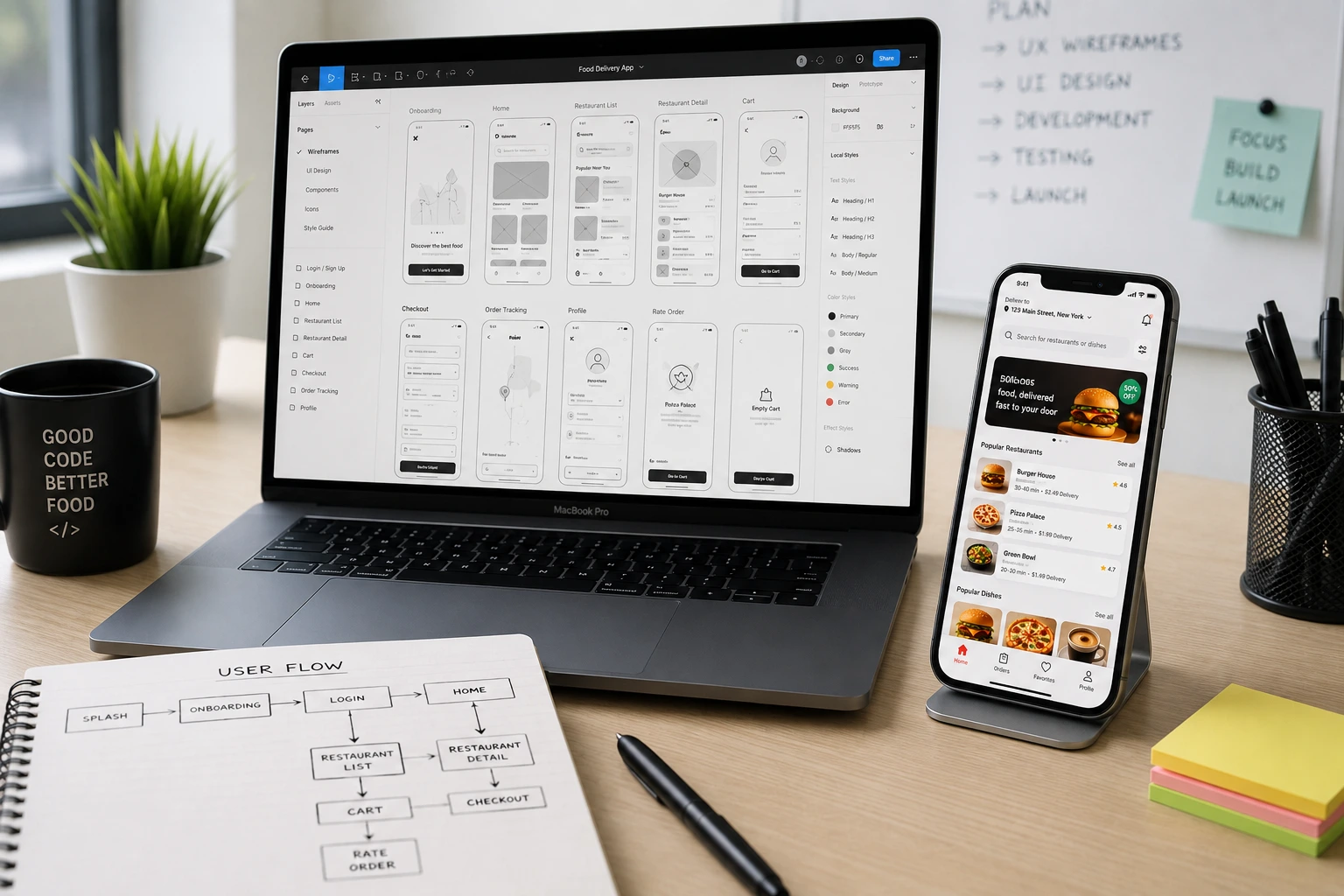
We Build Food Delivery Apps That Scale From 10 Orders to 10,000
Most food delivery apps work fine until the orders actually come in.
You launch with 10 orders a day, and the app feels fast. Three months later, you hit 500 orders, and customers start reporting slow load times. Six months in, you are processing 2,000 daily orders, and the system goes down during the Friday dinner rush. We have seen this happen to food-tech startups that hired developers who built beautiful demos but never properly stress-tested the backend for real-world order volume.
food delivery app development company build app for restaurants, cloud kitchens, and food-tech startups. Our on-demand food delivery app development work starts with a single question: where does this business need to be in 12 months? Then we design the backend architecture around that answer from the first line of code, not as an afterthought.
when you are already losing customers to slow load times. Not apps that pass demos but collapse under real order volume. Real infrastructure, built for the traffic you plan to have, not just the traffic you have right now.
We are not a general app agency that builds everything from e-commerce stores to fitness trackers. We work exclusively on delivery platforms: food delivery apps, grocery delivery systems, and on-demand logistics apps.
That focus means we have already solved the integration problems that catch other developers off guard: payment gateways that break during checkout peaks, GPS tracking that drains mobile batteries, and driver dispatch logic that falls apart when 50 orders come in simultaneously. We know where the shortcuts are because we have seen what they cost clients who hired agencies that took them.
Here is what food delivery app scalability actually means in practice. When you go from 50 restaurants to 500, the app still loads in under 2 seconds. When order volume doubles overnight because you ran a promotion, the system absorbs the spike without any slowdown.
When you expand to three new cities next year, you add them to the platform without rebuilding the backend. And when your platform grows from 20,000 monthly transactions to significantly higher volumes, your reporting, payouts, and payment infrastructure scale with the revenue instead of becoming bottlenecks.
Want to see how we would approach your specific food delivery app? Schedule a free 30-minute call. We will ask about your business model, your target market, and the scale you are planning for and then walk you through exactly what we would build and why. No pitch. Just an honest technical conversation.
GET IN TOUCH
Ready to build your food delivery app? Get transparent pricing and realistic timelines – free project estimate in 24 hours.
Which Custom Food Delivery App Model Does Your Business Actually Need?
The first question we ask every potential client is this: what kind of food delivery business are you actually building? Most people who contact us know they need an app.
But they have not thought through whether they need a simple restaurant ordering system, a full marketplace platform, or something built specifically for delivery-only kitchens. That decision changes everything: the features you need, the timeline to launch, and what the project will actually cost.
A food tech startup with venture funding building the next regional UberEats competitor needs a completely different platform than a single restaurant owner who is tired of handing 30% of every order to DoorDash.
And both of those are completely different from someone running three cloud kitchens under five different brand names out of one location. We have built more than 25 projects across these three models, including restaurant apps, aggregator platforms, and cloud kitchen systems.
Single-Restaurant Food Delivery App
This restaurant delivery app model is for independent restaurants or small chains that want a branded ordering platform they own outright; no commission fees are paid to third-party marketplaces on every transaction. You get a customer-facing ordering app where people browse your menu and place orders directly with you.
You get an admin dashboard to manage incoming orders, update menu items in real time, and track daily sales by location. That is the full scope. No driver marketplace to manage. No multi-restaurant complexity to maintain. Just direct ordering between your restaurant and your customers, with you keeping the full margin.
Cost range: PKR 15,000 to 20,000. Timeline: 8 to 12 weeks from kickoff to launch. This is the fastest path to your own ordering platform because we build specifically for one restaurant model with a focused, proven feature set—nothing unnecessary.
In our experience, restaurant owners who move to direct ordering typically recover the development investment within 6 to 9 months from the commission fees they stop paying to DoorDash and UberEats alone.
Independent restaurants, small chains with 2 to 5 locations, cafes, and bakeries. Anyone who wants to own the customer relationship and stop splitting revenue with third-party platforms. If you’re specifically a restaurant owner in Pakistan, check out our detailed guide on restaurant app development in Pakistan for market-specific insights and local considerations.
Aggregator Platform (UberEats or DoorDash Clone)
This model is for entrepreneurs building a multi-restaurant marketplace where customers order from dozens or hundreds of restaurant partners through one unified app. You need all four panels built and fully integrated: a customer ordering app, a restaurant partner dashboard, a delivery driver app, and a central admin system to run the entire marketplace.
The backend has to handle commission splits, real-time driver assignments, automated restaurant payouts, and surge pricing during peak hours simultaneously and reliably. This is the most technically demanding food delivery app development project we deliver, and it is the one where backend architecture decisions matter most.
Cost range: PKR 25,000 to 30,000. Timeline: 4 to 6 months depending on how many custom features you need beyond the core UberEats clone app functionality. The higher investment covers building a true on-demand delivery platform with precise geolocation tracking, intelligent dispatch logic, and financial systems that handle thousands of daily transactions across multiple restaurants and driver partners.
Best for: Venture-backed startups, regional delivery platforms, and entrepreneurs entering markets where the major platforms have not yet launched. This is particularly relevant if you are targeting cities or countries where Uber Eats and DoorDash have limited presence. You are not competing with them; you are filling the gap they left.
Cloud Kitchen / Ghost Kitchen App
This model is built for delivery-only kitchen operations with no dine-in space. You run one physical kitchen but operate it under three or four different restaurant brands simultaneously: different menus, different branding, and different customer bases, all coming out of the same cooking space.
Our cloud kitchen app development work focuses on the specific problems that make this model operationally hard: high-volume order management, kitchen display systems that route each order to the right cooking station automatically, and multi-brand management so customers see completely separate restaurant names even though their food comes from the same address.
We also build inventory tracking across all your brands and real-time order throttling, which means the system automatically slows incoming orders when your kitchen queue hits capacity, so you are not taking orders you physically cannot fulfill in time.
That feature alone prevents the negative reviews that kill ghost kitchen ratings in the first few months. Cost range: 20,000 to 30,000. Timeline: 10 to 16 weeks.
This sits between single-restaurant and full aggregator complexity. You are managing multiple brands, but you typically do not need a driver marketplace if you are using third-party delivery services, which most cloud kitchens do at launch. Best for: Cloud kitchen operators, virtual restaurant brands, and delivery-only concepts testing multiple cuisines from one location.
White Label Food Delivery Solution
This option is for businesses that need to launch fast without waiting 3 to 5 months for custom development. Our white label food delivery app is a pre-built SaaS food delivery solution with all core ordering features included, a clean, tested UI, and the ability to customize branding, colors, and key functionality to match your business. The platform is ready to configure and launch in 2 to 4 weeks.
The honest trade-off: limited deep customization compared to a fully bespoke build. You can apply your branding and adjust key features, but the core architecture stays as built.
This works best as a market validation tool — launch fast, acquire your first customers, and use real order data to decide whether and when to invest in a fully custom platform. Cost range: PKR 10,000 to 20,000 upfront setup plus PKR 10,000 to 15,000 monthly licensing based on order volume. Timeline: 2 to 4 weeks from contract signing to launch-ready app.
You are licensing the platform rather than owning the source code outright—which is the correct trade for a business testing a new market before committing six figures to custom development. Best for: Entrepreneurs validating a new market, businesses with immediate launch requirements, or anyone who wants real customer data before deciding on a full custom food delivery app investment.
Not sure which model fits where your business is right now? Schedule a free consultation and we will walk through your goals, budget, and launch timeline to recommend the right starting point. No sales pressure, no upselling to a tier you do not need. Just direct advice from a team that has built all four of these models and knows which one actually makes sense for your specific situation.
3 Mistakes That Kill Food Delivery App Development Projects (And How We Prevent Each One)
We have watched more than a dozen food delivery app development projects collapse after six-figure investments.
Not because the developers were incompetent. Not because the market was not there. Because of three preventable mistakes that end apps before they ever reach real customers. Most development agencies will not tell you about these problems.
Explaining what can go wrong does not help them close deals, so they stay quiet and let you find out later. We would rather tell you upfront. Here are the three mistakes that destroy food delivery apps and exactly how we prevent them.
Mistake #1: Building Too Many Features at Once
The biggest killer is scope creep dressed up as ambition. Clients look at UberEats and want every feature built from day one. Advanced search filters, subscription meal plans, loyalty points, social sharing, multiple payment options, driver heat maps, restaurant analytics dashboards, and promotional campaign tools. The project timeline stretches from 3 months to 9 months.
The budget climbs from 20,000 to well over 25,000. And by the time the app finally launches, competitors who moved faster have already claimed the market. How we prevent this: We recommend MVP food delivery app development first for almost every project.
Launch with the core features that actually generate revenue: order placement, payment processing, real-time tracking, and basic admin controls.
Get paying customers using the app within 8 to 12 weeks. Then use real usage data to decide which features to build next, not planning meeting assumptions about what users might want. This approach gets you to market fast, generates early revenue, and ensures every subsequent feature decision is backed by real customer behavior.
Mistake #2: Choosing the Cheapest Developer Who Disappears After Launch
Plenty of clients have hired overseas development agencies promising full food delivery platforms for PKR 8,000 to 15,000. The app gets built, submitted to the app stores, and then the problems start. Apple rejects the submission for payment flow policy violations.
Android users report crashes on specific devices. The payment system breaks during peak hour traffic. When the client requests fixes, the agency has already moved on to the next project or simply stops responding to messages.
How we prevent this: Every project includes a 30-day post-launch bug fix period at no additional cost and a clear food delivery app post-launch support plan for ongoing maintenance. We have delivered post-launch support for clients running 400+ daily orders.
When something breaks in production and something always does eventually, we fix it the same day. We do not disappear after the final invoice. Our ongoing client relationships and the referrals they generate are the actual source of our business growth, and that only works if the apps we build keep working.
Mistake #3: Ignoring Restaurant and Driver Experience
Most clients spend 80% of the design budget on the customer app and treat the restaurant and driver interfaces as afterthoughts. The result is predictable: restaurants get a clunky vendor dashboard that requires five clicks to accept a single order.
Drivers get a GPS system that sends them to the wrong entrance of an apartment building. Restaurants start rejecting orders because the process is too slow during rush hours. Drivers finish one shift and never log back in. The platform fails — not because customers did not want it, but because the operational side was too broken to deliver.
How we prevent this: We design and test all four components with the same level of care. Customer app, restaurant management system, delivery partner app, and admin panel all go through dedicated UX review and real-user testing sessions before launch.
We typically run 2 to 3 test cycles per interface before any component ships to production. When restaurants can accept an order in two taps and drivers can complete a delivery without switching apps, the platform operates efficiently and efficiency is what generates sustainable revenue
The common thread in all three mistakes is taking shortcuts that seem smart during development but destroy the business later. We have learned these lessons the hard way by seeing what happens when projects cut corners. Which is exactly why our food delivery app development process focuses on getting the fundamentals right from the start.
Must-Have Features in Every Food Delivery App We Build
We build food delivery apps with four interconnected systems: customer ordering app, restaurant panel, driver app, and admin dashboard. Each panel has specific food delivery app features that directly affect how much revenue you generate, how many customers come back, and how much your operations cost to run. Most developers send you a checklist.
We build each feature with a specific business outcome in mind and explain exactly what it does for your numbers. Knowing what to build is only half the job. Understanding how each feature drives real business results, orders, retention, and cost per delivery is what separates an app that works from one that actually makes money.
Customer App Features
The customer app needs to make ordering effortless and keep customers informed from the moment they place an order to the moment food arrives at their door.
We build location-based restaurant discovery so customers see nearby options ranked by distance and live delivery time estimates. Real-time GPS tracking lets them watch their order move toward them on a live map. In our experience, this one feature dramatically cuts inbound support requests about order status because customers who can see their food moving do not call to ask where it is. In-app payment processing supports Stripe, PayPal, Apple Pay, and Google Pay.
One-tap reorder lets returning customers skip menu browsing entirely and repeat their last order in seconds. Push notifications update customers at every status change: order confirmed, being prepared, picked up, and arriving. Promo codes and a loyalty points system encourage repeat orders.
Ratings and reviews let customers share feedback and give new users the social proof they need to order for the first time. The food delivery app GPS tracking component runs in the background without heavy battery drain. We build it this way specifically because customers check order status an average of 3 to 4 times per delivery—and we want every check to happen in your app, not on your support phone line.
Restaurant/Vendor Panel Features
The restaurant management system we build gives restaurant partners full control over their menu, live orders, and kitchen workflow from one dashboard. Every incoming order appears in real time with both audio and visual alerts — no orders missed during a busy Friday service.
Restaurant owners can update menu items, change pricing, and mark items as unavailable instantly without calling anyone. Out of a key ingredient at 7pm? Mark it unavailable in 10 seconds before customers order it. Prep time controls let restaurants set realistic cook times based on how busy the kitchen actually is right now. This is one of the most important features in any food delivery platform.
When kitchens can adjust their stated prep time dynamically, customers get accurate delivery estimates, drivers are not arriving 15 minutes before the food is ready, and your platform ratings stay consistent. We integrate with kitchen display systems, digital screens at the cooking line that display incoming orders directly, replacing printed tickets and manual communication.
Sales and revenue analytics show which menu items generate the most revenue, what your peak ordering hours are, and what your average ticket size looks like across different days and times.
Customer feedback management gives restaurant owners access to reviews so they can respond directly and adjust their operations. In our experience working with restaurant clients, accurate prep time management cuts order cancellations significantly during peak service hours—because restaurants stop accepting orders they cannot realistically fulfill.
Delivery Driver App Features
The delivery partner app we build is built around three things drivers actually care about: knowing the most efficient route, seeing what they are earning in real time, and having all the tools they need in one place. Route optimization calculates the fastest path from restaurant to customer using live traffic data.
Drivers see real-time turn-by-turn navigation inside the app without switching to Google Maps or Waze. Order details appear before acceptance so drivers can decide whether to take a job based on distance and estimated earning.
A simple online/offline toggle lets them control when they are available without calling dispatch. The earnings tracker shows today’s total, weekly trends, and a projected monthly figure. Drivers know exactly where they stand financially at any point during their shift.
Delivery history logs every completed order with timestamps and customer ratings. Proof of delivery lets drivers capture a photo or request a signature so there is never a dispute about whether an order was delivered. In-app calling and SMS connect drivers to customers without either party sharing their real phone number. Both sides keep their privacy, and you retain a complete communication record for any disputes.
In our experience, drivers stay with platforms longer when they can see their earnings clearly and trust the routing system to get them where they need to go efficiently. Driver retention is one of the most underestimated factors in food delivery app success.
Admin Dashboard Features
Your food delivery app admin panel is the control room for your entire operation. We build real-time order monitoring so you can see every active delivery across all restaurant partners on a single screen: order status, estimated delivery time, driver location, and any flagged issues that need your attention.
Commission and payment management automates the financial side of running a marketplace. You set your commission percentage per restaurant, we track every transaction, and the system generates automated payout reports for each restaurant partner weekly or monthly.
No manual calculations. No spreadsheet reconciliation. Restaurant and driver approval workflows let you verify new vendors and delivery partners before they access the live platform.
Analytics and reporting surface total revenue, your highest-performing menu items, peak ordering periods, busiest delivery zones, and customer return rates. Dispute and refund management gives you the tools to resolve complaints, issue refunds, and track how long resolution takes so you can improve support response times. Promotional campaign management lets you create discount codes, target specific customer segments, and measure which campaigns generate the most orders versus the most revenue.
We build every admin panel around three questions: How much are we making right now? What is actually working? What needs to be fixed immediately? Every report, every dashboard screen, every data display is structured to answer those three questions in as few clicks as possible.
How We Build Your Food Delivery App: The Complete Development Timeline and Process
Most development agencies send a proposal and then go quiet for months. You send check-in emails that take days to get responses. You cannot tell if the project is on track or three weeks behind.
You find out something changed when the timeline slip arrives. We run our food delivery app development process differently. Every step has a defined timeline, specific deliverables, and an approval gate where you review what we have built before we move to the next phase.
Our agile development process gives you visibility into real progress every week — not a status update email once a month. You stay involved in the decisions that affect your business without being pulled into every technical discussion that does not
Step 1: Discovery and Requirements (Weeks 1-2)
We start with a detailed discovery call to understand your business model, target market, and revenue structure.
Are you connecting restaurants to customers directly? Building a multi-vendor marketplace? Launching in one city or nationwide? These decisions shape every feature we build. We document your must-have features versus nice-to-have additions, map out user flows for each app panel, and identify which third-party services you need integrated.
Our team creates a complete requirements document that outlines technical specifications, feature prioritization, and a realistic food delivery app development timeline.
What you do: Answer questions about your business goals, target audience, and competitors. Review the requirements document and tell us what we missed or misunderstood.
What you get: A written requirements document and detailed project roadmap with milestones. No guessing what happens next.
Step 2: UI/UX Design and Prototyping (Weeks 3-5)
Our designers create wireframes for all four panels: customer app, restaurant dashboard, driver app, and admin panel.
We focus the food delivery app UI/UX design on intuitive ordering flow and quick task completion. Customers should find restaurants and place orders in under 60 seconds. Drivers should accept deliveries and start navigation in two taps. If the interface requires instructions, we redesigned it wrong.
We build clickable prototypes so you can test the entire app flow before we write a single line of code. Tap through the ordering process. Try the driver acceptance workflow. See how restaurant owners will manage menus.
What you do: Review wireframes, request design changes, and test the interactive prototype on your phone. Approve the final design before development starts.
What you get: High-fidelity designs for all screens plus an interactive prototype you can click through and share with potential partners.
Step 3: App Development and Backend Setup (Weeks 6-14)
We build the food delivery app’s Android and iOS versions using either React Native for cross-platform development efficiency or fully native code when your performance requirements demand it. Our custom Android app development services ensure your app performs optimally across all Android devices and versions. We discuss which approach fits your project during discovery—the answer depends on your feature complexity and target audience, not a preference we default to for every client
Our developers create the food delivery app backend development infrastructure, including API architecture, database design, and cloud hosting setup on AWS or Google Cloud. We integrate Stripe for payment processing, Google Maps for GPS tracking and route optimization, Twilio for SMS notifications, and Firebase for push notifications.
Every integration gets tested individually before we connect the pieces. We deploy everything to a staging environment so you can test features as we finish them. Weekly check-ins keep you updated on progress without requiring you to attend daily standups.
What you do: Join weekly progress calls, test completed features on the staging server, and flag anything that does not work as expected.
What you get: Working apps on staging servers with all core features functional and integrated with payment gateways, maps, and notification systems.
Step 4: Testing and Quality Assurance (Weeks 15-16)
Our QA team tests the apps on over 15 real devices covering different iOS and Android versions.
We simulate real-world scenarios: peak traffic loads, payment failures, GPS signal loss, simultaneous orders from multiple restaurants, and driver app performance in low-signal areas. Every user role gets tested separately, then we test how they interact together when a customer orders, a restaurant prepares, and a driver delivers.
Security testing covers payment processing, user data protection, and API authentication. We document every bug with screenshots and steps to reproduce. Then we fix them.
What you do: User acceptance testing. Try to break the app. Order food as a test customer. Accept deliveries as a test driver. Report anything that feels wrong.
What you get: A bug report showing what we found and fixed, plus a final stable build ready for app store submission.
Step 5: App Store Launch and Deployment (Week 17)
We prepare complete App Store and Google Play listings, including descriptions, screenshots, app previews, and privacy policies that meet current guidelines.
Both stores have strict review processes outlined in Apple’s App Store Review Guidelines and Google’s policies. We submit the apps, monitor review status, and handle any feedback or rejection notices. Most food delivery apps get flagged for payment flow documentation or location permission explanations. We know what reviewers look for and address issues fast
Once approved, we deploy the backend to production servers and configure analytics tools like Firebase and Mixpanel so you can track user behavior from day one.
What you do: Approve store listings and prepare your restaurant partners and drivers for onboarding. Start your marketing plan.
What you get: Live apps on the App Store and Google Play, production servers running, analytics configured and tracking.
Step 6: Post-Launch Support and Iteration (Week 18+)
We monitor app performance closely for the first 30 days after launch.
Crashes, payment issues, GPS bugs, or server overload during your first big promotion all get fixed immediately at no additional cost during this period. We gather user feedback from reviews and support tickets, then recommend which features to prioritize based on real usage data, not assumptions.
Our post-launch support plans cover ongoing maintenance, OS updates when Apple and Google release new versions, server management, and new feature development as your user base grows.
What you do: Collect customer and restaurant feedback. Decide which features to add next based on our recommendations and your business priorities.
What you get: A stable app in the market, usage analytics showing what is working, and a maintenance plan that keeps everything running smoothly.
Ready to map out your project timeline and get real cost numbers? Schedule a free consultation. We will ask about your feature requirements, your launch target, and your budget range—then give you a written timeline and cost estimate within 24 hours. No vague ranges. Actual numbers based on your actual project.
How Much Does Food Delivery App Development Cost? (Real Numbers)
Nobody else will tell you this upfront. Most developers make you fill out a contact form, sit through a sales call, and wait days for a vague estimate.
We break down food delivery app development costs into three clear tiers based on features, platforms, and complexity. These are real project ranges from apps we have built. Your exact cost depends on what you need, but these tiers help you budget before you contact anyone.
Basic MVP Food Delivery App: pkr15,000 – 20,000
This MVP food delivery app development package works for single restaurants or small businesses testing the market before committing to a full platform.
You get a customer app plus restaurant management panel. No separate driver app because you are using your existing delivery staff. Core features include menu browsing, cart and checkout, payment processing through Stripe, basic order tracking, and a simple admin dashboard to manage orders and view sales data.
We build for one platform only, either iOS or Android depending on where your customers are. The design uses proven templates with your branding applied. Standard integrations only.
Timeline: 8 to 12 weeks from requirements to app store launch.
Who this is for: A restaurant owner tired of paying 30% commission to third-party platforms. You want your own ordering system but need to keep the investment reasonable while you build your customer base.
Mid-Level Full-Feature App: pkr 15,000 – 20,000
This on-demand food delivery app development tier includes all four panels: customer app, restaurant dashboard, driver app, and admin control center.
We build native apps for both iOS and Android so you reach the entire market. Advanced features include real-time GPS tracking with live map updates, in-app chat between customers and drivers, ratings and reviews, a promo code system, loyalty rewards, a detailed analytics dashboard, and push notifications for every order status change.
Custom UI design tailored to your brand. All standard integrations: Stripe for payments, Google Maps for GPS and routing, Twilio for SMS notifications. Cloud hosting on AWS or Google Cloud with room to scale.
Timeline: 3 to 5 months from kickoff to launch.
Who this is for: Serious startups launching a multi-restaurant aggregator platform or small restaurant groups building a competitive food delivery mobile app to serve their local market.
Advanced Multi-Restaurant Platform: pkr 20,000 – 25,000
Complete marketplace platform at the level of established competitors.
Everything from the mid-tier plus AI-powered restaurant recommendations based on order history, multi-language and multi-currency support, advanced analytics with predictive insights, automated commission calculation and restaurant payouts, franchise and multi-city management tools, a digital wallet system, subscription meal plans, and white-label options for reselling the platform.
Fully custom architecture designed for your specific business model. Scalable backend infrastructure that handles peak traffic without crashing. Custom integrations with POS systems, accounting software, and marketing automation tools.
Timeline: 4 to 7 months depending on customization requirements.
Who this is for: Well-funded startups building an Uber Eats clone app or DoorDash-like app development project. Restaurant chains creating a branded ordering ecosystem across multiple locations.
What Affects the Final Cost?
The food delivery app development cost depends on six main factors.
Platform choice makes a big difference. Building for iOS only costs less than iOS plus Android. The number of integrations adds up because each third-party service requires custom API work and testing. Custom design costs more than template-based UI but gives you a unique brand presence.
Advanced features like AI recommendations, subscription systems, or multi-city franchise management require specialized development work. Backend complexity increases when you add cloud kitchen management, dynamic pricing algorithms, or real-time analytics dashboards.
The food delivery app tech stack you choose affects both initial cost and long-term maintenance. We recommend scalable solutions that grow with your business rather than cheap shortcuts that require expensive rebuilds later.
Post-launch maintenance plans run 800 to 15,000 monthly depending on your user base, feature update schedule, and support requirements.
Ready to get specific numbers for your project? Request a free detailed cost estimate and we will break down exactly what your specific feature list, platform requirements, and timeline will cost. No sales pressure, no obligation, just honest numbers so you can budget properly.
| Package | Best For | Platforms | Core Scope | Timeline | Price |
|---|---|---|---|---|---|
| Basic MVP | Single restaurants / market validation | iOS or Android | Customer app, restaurant panel, payments, basic admin | 8–12 weeks | PKR 15,000–20,000* |
| Mid-Level | Multi-restaurant startups | iOS + Android | Four panels, GPS, payments, analytics, notifications | 3–5 months | PKR 15,000–20,000* |
| Advanced Platform | Larger marketplaces | iOS + Android | Advanced marketplace, analytics, multi-city tools, integrations | 4–7 months | PKR 20,000–25,000* |
Real Food Delivery Apps We’ve Built (Portfolio)
We have built food delivery apps for restaurant chains, cloud kitchen startups, and multi-vendor marketplace platforms. Each one solved a different business problem.
Here are three recent projects that show the range of what we deliver.
Regional Restaurant Chain App
A restaurant group with 12 locations was losing 30% of every order to third-party platform fees. They wanted their own restaurant delivery app to bring customers back to direct ordering.
We built native iOS and Android apps with menu management across all locations, real-time order tracking with GPS, integrated payment processing through Stripe, and a centralized admin dashboard showing sales by location. The backend handled location-based restaurant discovery so customers automatically saw their nearest branch.
Tech stack: React Native for the mobile apps, Node.js backend, PostgreSQL database, AWS hosting. The launch timeline was 14 weeks from kickoff to app stores.
The result: They reduced their dependency on third-party platforms for their regular customers and now control their own customer data and relationships.
Cloud Kitchen Aggregator Platform
A startup launching a cloud kitchen app needed to handle multiple virtual restaurant brands operating from the same kitchen facility. Complex order routing was the challenge because different brands shared kitchen equipment and delivery staff.
We built a multi-vendor food delivery mobile app with smart order batching, driver route optimization, separate branding per virtual restaurant, real-time kitchen display system integration, and automated commission tracking. Payment integration supported both card and digital wallet options.
The platform handled over 400 orders daily from week one without performance issues. Scalable cloud infrastructure meant they could add new kitchen locations without rebuilding anything.
Single Restaurant MVP
An independent restaurant needed a direct ordering app to test whether their existing customers would use it before committing to a full platform. Basic features only — we agreed that adding scope would slow launch and inflate the budget unnecessarily.
We delivered the MVP food delivery app in 9 weeks: customer ordering app, restaurant order management panel, Stripe payment integration, basic order status tracking, and simple analytics. iOS only to control initial cost while validating customer adoption.
After three months of live orders, the restaurant had enough real data to make a confident decision about which features to add next and came back to us with a clear list based on what their actual customers asked for, not what we assumed they would want
What Happens After Your App Goes Live?
We do not hand you the app and vanish. Too many developers do exactly that.
Our food delivery app post-launch support starts the moment your apps hit the App Store and Google Play, and it continues for as long as you need us involved. Here is exactly what that looks like.
30-Day Bug Fix Guarantee
Any bug that appears in the first 30 days after launch gets fixed at no additional cost. Payment processing errors, GPS tracking failures, order notification issues, and crashes on specific devices. We fix them.
What counts as a bug? Anything that prevents a feature from working as we documented and demonstrated during testing. What does not count: new feature requests or changes to how something works because you decided you want it different. Those are scope changes, and we discuss them separately.
App Store Compliance and Updates
Apple and Google change their requirements constantly. New privacy rules, updated payment guidelines, and security protocol changes. When your app needs updating to stay compliant with App Store or Google Play policies, we handle the updates and resubmission.
We monitor compliance changes that affect food delivery apps specifically and notify you when action is required.
Server Monitoring for 90 Days
We actively monitor your backend server performance, API response times, database health, and uptime for the first 90 days after launch. If response times spike or error rates climb above the threshold, we get an automated alert and investigate before your customers notice anything wrong.
If server issues appear during this period, we diagnose the problem and implement fixes as part of our post-launch commitment.
Ongoing Maintenance Plans
After the initial 90 days, ongoing food delivery app maintenance runs 8,000 to 15,000 monthly depending on your app complexity and user volume.
Maintenance plans cover OS compatibility updates when Apple and Google release new iOS and Android versions, security patches for backend vulnerabilities, minor feature adjustments based on user feedback, server management and performance optimization, and priority support response.
Clients on maintenance plans get priority response for urgent issues. Something breaks on a Friday night? You are not waiting until Monday.
What We Do Not Cover
New features beyond the original scope require separate development time. Scaling server capacity when you grow beyond the initial infrastructure plan incurs additional hosting costs. Third-party service fee increases from Stripe, Google Maps, or Twilio are passed through at cost.
We are transparent about what is included and what costs extra. No surprise invoices months after launch.
Ready to Build Your Food Delivery App? Get Your Free Cost Estimate
We build food delivery apps that scale from day one. With transparent pricing, realistic timelines, and post-launch support you can count on.
Whether you are launching an MVP or building a full marketplace platform, we help you get to market fast without the usual development headaches that waste your time and budget.
Get Your Free Project Cost Estimate
Tell us about your project, and we will send you a detailed cost breakdown within 24 hours. No obligation, 100% confidential.
What we need to know:
- Your name and email
- Business type (restaurant, startup, enterprise)
- Project budget range
- Brief description of what you want to build
What you get:
- Customized cost estimate based on your specific requirements
- Free 30-minute consultation to discuss your project
- Timeline and feature recommendations
Prefer to talk first?
Book a consultation: Schedule a free 30-minute call to discuss your food delivery app development needs before filling out any forms
As a food delivery app development company, we know that choosing the right development partner is a big decision. The team you choose affects your architecture, user experience, launch timeline, scalability, and long-term maintenance costs. That is why we make our process transparent from the first conversation. You get clear recommendations about what your project needs, what can wait until after launch, and what the development will realistically cost.
GET IN TOUCH
Stop comparing vague quotes. Get your detailed food delivery app development cost breakdown and free consultation today.
Common Questions Before Hiring a Food Delivery App Development Company
How long does it really take to build a food delivery app from start to launch?
MVP apps take 8 to 12 weeks, mid-level apps need 3 to 5 months, and advanced marketplace platforms require 4 to 7 months. We provide a detailed timeline in week 1 so you always know where we are in the process and can plan your restaurant outreach and marketing around the launch date.
Can I start with an MVP and add features later, or do I need everything built at once?
We strongly recommend an MVP-first approach for many new platforms because it reduces initial scope and lets you validate demand before investing in advanced features. Once real customers are using the app, you can prioritize future development based on actual behavior and feedback.
What’s included in your post-launch support and how much does it cost?
In the first 30 days after launch, all bugs are fixed free of charge. After that, monthly maintenance plans start at 5000 and cover app store compliance updates, minor feature tweaks, server monitoring, and priority support.
Do you build for both iOS and Android, or do I need to choose one?
We recommend launching on both platforms using cross-platform development, which costs 30% to 40% less than separate native apps. If the budget is tight, start with iOS for higher-spending users or Android for a larger user base, then add the second platform once you have revenue.
How much does it cost if I just want a white label solution instead of custom development?
Our white label food delivery platform starts at 10,000 to 15,000 for monthly licensing setup based on order volume. You get a pre-built app with your branding, ready to launch in 2 to 4 weeks, perfect for testing market demand before investing in full custom development.