
Healthcare App Development in Pakistan—Custom, Compliant & Cost-Effective Solutions
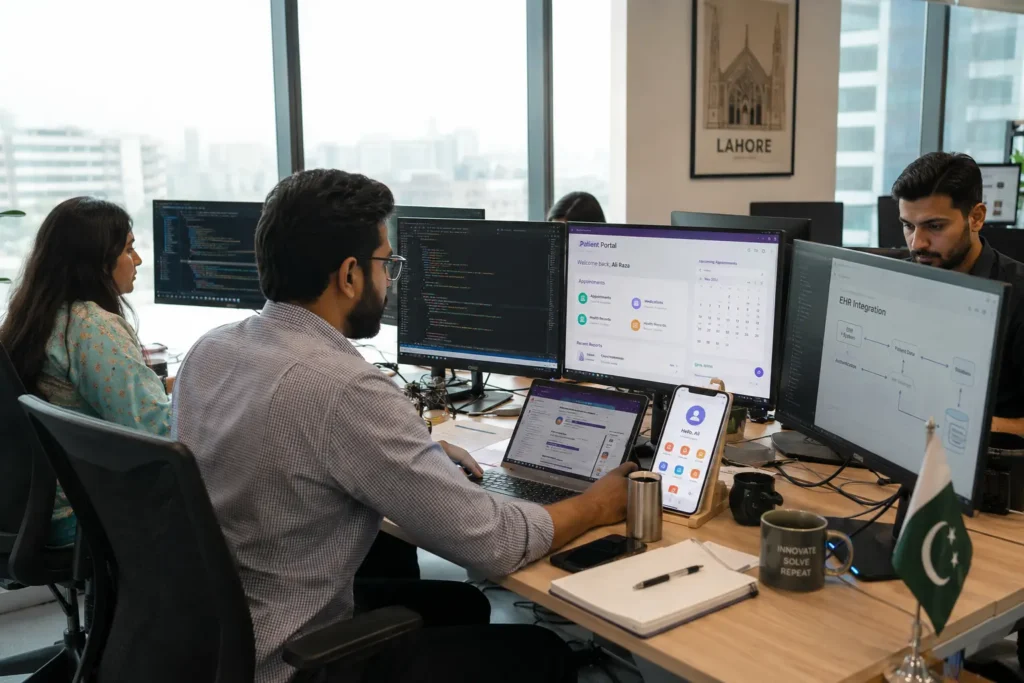
Why Choose Healthcare App Development in Pakistan Healthcare startups and hospital procurement teams consistently underestimate what Pakistani development teams deliver until they see the first working demo. The gap between expectation and reality surprises almost every new client we work with, and it comes down to one thing: the assumption that lower cost means lower quality. Pakistani healthcare app developers charge PKR 7,000–14,500 per hour. US teams doing identical compliance work bill PKR 28,000–58,000 for the same hours. That 40–60% cost difference does not come from reduced output, shorter timelines, or lighter compliance requirements. It comes from Pakistan’s lower operational costs, which our clients receive as direct project savings. Three operational factors determine whether an offshore development partnership actually works day-to-day. Communication comes first. Our senior developers and project managers completed their computer science education in English and have handled international client communication for multiple years. Requirements documents, technical specifications, and change requests get written, reviewed, and actioned without translation delays or interpretation gaps. Timezone coverage comes second. Pakistan Standard Time overlaps with UAE and UK morning business hours and connects directly with US East Coast evening hours. When a compliance issue surfaces at 2 PM London time, our team is mid-workday and can respond in the same hour. Technical depth comes third. Pakistan graduates over 25,000 software engineers annually. A meaningful portion of our team specifically studied and now works in healthcare technology. We built our first healthcare app in 2017. The HIPAA compliance work, the EHR integration patterns, and the clinical workflow research—this is not new territory for us. ⚡ GET IN TOUCH Save 60% on Healthcare Apps – Same Quality, Pakistani Pricing 💬 Chat on WhatsApp 📞 Call 0307 3319555 Here’s what makes Pakistani healthcare app development different from other offshore options. The compliance gap is the real risk in offshore healthcare app development. Most development teams understand either HIPAA requirements for US clients or local regulatory frameworks—rarely both. Our team has worked across US HIPAA environments, European GDPR requirements, and Pakistani PMDC healthcare standards. When a Pakistani clinic needs an app that handles international patient data, we do not have to choose which compliance framework to apply. We build for both from the start. Our own project portfolio reflects this expansion. We have delivered EMR integrations for US hospital clients, built telemedicine platforms for European clinical networks, and developed patient management applications for healthcare organizations across the Middle East. Each of these projects required a different compliance framework. Each one passed its respective regulatory audit. The tools are identical. The security protocols follow the same HIPAA implementation guidelines. The testing phases run the same compliance verification steps. What differs is the cost of the development hours behind them—Pakistan’s operational environment makes our rates 40–60% lower, and that difference passes directly into your project budget. Whether you are a funded health-tech startup building your first patient-facing app or a hospital network expanding its digital infrastructure, our development capacity and compliance expertise scale to fit the project. The first milestone deliverable is where offshore quality hesitation either disappears or gets confirmed. We schedule a working demo at the end of week seven, not a slide deck, not a status report. An actual functioning prototype showing your core features and compliance architecture. Most clients tell us that the first demo session is when they stopped thinking of us as an offshore vendor and started thinking of us as their development team. Healthcare App Development Cost in Pakistan—Transparent Pricing We quote exact project costs upfront before discovery calls become sales calls. Most healthcare app development companies deflect on pricing until you have already spent three meetings with their sales team and feel obligated to continue. We break that pattern. Your first conversation with us ends with a realistic cost range for your specific project type, not a promise to ‘get back to you with numbers. Not us. Healthcare app development costs in Pakistan range from PKR 8,000 for basic appointment booking apps to PKR 20,000 or more for full EHR integration platforms, assuming the figures are in full rupee amounts. The pricing gap reflects the actual complexity difference: A simple patient portal requires 200–300 development hours, while a clinical-grade EHR integration with compliance documentation can run 800–1,200 hours. Every project quote we produce breaks down into the same cost categories. Feature complexity accounts for roughly 40% of total development cost. A basic appointment scheduler takes 200–300 hours. An AI-powered diagnostic tool with machine learning components runs 800–1,200 hours—that fourfold difference is where most budget surprises come from when clients get quotes from developers who underestimate the complexity. Compliance work adds 25–35% to any healthcare app budget. HIPAA encryption, audit logging, and secure authentication are not standard mobile app features. They require specialized implementation, documentation, and verification testing that most app developers do not routinely perform. We do it on every project because healthcare data cannot be protected retroactively. Custom healthcare app development in Pakistan costs 60% less than equivalent US development while maintaining identical security and compliance standards. We use the same development tools, follow the same testing protocols, and deliver the same documentation as expensive US teams. Integration complexity affects final pricing more than almost any other factor. Apps that connect to existing hospital systems, pharmacy networks, or insurance databases require custom API development and extensive testing phases that cannot be templated. We identify all integration points during discovery and include them in the initial quote—integration surprises after development starts are one of the most common causes of healthcare app budget overruns, and our discovery process specifically exists to prevent that. We itemize every cost component before a contract is signed: development hours by feature, compliance work broken out separately, testing phases with hour estimates, and post-launch support options with clear pricing. You review that breakdown, ask questions, and only proceed when the numbers make sense to you. No bundled totals. No vague ‘additional costs may apply’ language When you develop a healthcare app with our Pakistan-based team, you
Food Delivery App Development Company That Builds Apps Startups Actually Use
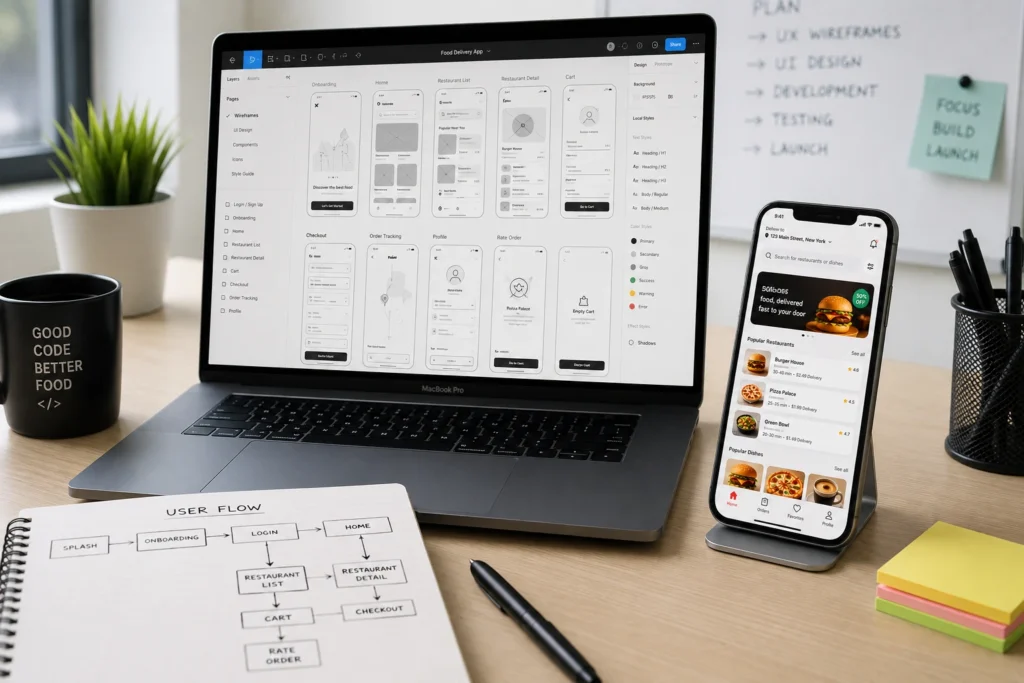
We Build Food Delivery Apps That Scale From 10 Orders to 10,000 Most food delivery apps work fine until the orders actually come in. You launch with 10 orders a day, and the app feels fast. Three months later, you hit 500 orders, and customers start reporting slow load times. Six months in, you are processing 2,000 daily orders, and the system goes down during the Friday dinner rush. We have seen this happen to food-tech startups that hired developers who built beautiful demos but never properly stress-tested the backend for real-world order volume. food delivery app development company build app for restaurants, cloud kitchens, and food-tech startups. Our on-demand food delivery app development work starts with a single question: where does this business need to be in 12 months? Then we design the backend architecture around that answer from the first line of code, not as an afterthought. when you are already losing customers to slow load times. Not apps that pass demos but collapse under real order volume. Real infrastructure, built for the traffic you plan to have, not just the traffic you have right now. We are not a general app agency that builds everything from e-commerce stores to fitness trackers. We work exclusively on delivery platforms: food delivery apps, grocery delivery systems, and on-demand logistics apps. That focus means we have already solved the integration problems that catch other developers off guard: payment gateways that break during checkout peaks, GPS tracking that drains mobile batteries, and driver dispatch logic that falls apart when 50 orders come in simultaneously. We know where the shortcuts are because we have seen what they cost clients who hired agencies that took them. Here is what food delivery app scalability actually means in practice. When you go from 50 restaurants to 500, the app still loads in under 2 seconds. When order volume doubles overnight because you ran a promotion, the system absorbs the spike without any slowdown. When you expand to three new cities next year, you add them to the platform without rebuilding the backend. And when your platform grows from 20,000 monthly transactions to significantly higher volumes, your reporting, payouts, and payment infrastructure scale with the revenue instead of becoming bottlenecks. Want to see how we would approach your specific food delivery app? Schedule a free 30-minute call. We will ask about your business model, your target market, and the scale you are planning for and then walk you through exactly what we would build and why. No pitch. Just an honest technical conversation. ⚡ GET IN TOUCH Ready to build your food delivery app? Get transparent pricing and realistic timelines – free project estimate in 24 hours. 💬 Chat on WhatsApp 📞 Call 0307 3319555 Which Custom Food Delivery App Model Does Your Business Actually Need? The first question we ask every potential client is this: what kind of food delivery business are you actually building? Most people who contact us know they need an app. But they have not thought through whether they need a simple restaurant ordering system, a full marketplace platform, or something built specifically for delivery-only kitchens. That decision changes everything: the features you need, the timeline to launch, and what the project will actually cost. A food tech startup with venture funding building the next regional UberEats competitor needs a completely different platform than a single restaurant owner who is tired of handing 30% of every order to DoorDash. And both of those are completely different from someone running three cloud kitchens under five different brand names out of one location. We have built more than 25 projects across these three models, including restaurant apps, aggregator platforms, and cloud kitchen systems. Single-Restaurant Food Delivery App This restaurant delivery app model is for independent restaurants or small chains that want a branded ordering platform they own outright; no commission fees are paid to third-party marketplaces on every transaction. You get a customer-facing ordering app where people browse your menu and place orders directly with you. You get an admin dashboard to manage incoming orders, update menu items in real time, and track daily sales by location. That is the full scope. No driver marketplace to manage. No multi-restaurant complexity to maintain. Just direct ordering between your restaurant and your customers, with you keeping the full margin. Cost range: PKR 15,000 to 20,000. Timeline: 8 to 12 weeks from kickoff to launch. This is the fastest path to your own ordering platform because we build specifically for one restaurant model with a focused, proven feature set—nothing unnecessary. In our experience, restaurant owners who move to direct ordering typically recover the development investment within 6 to 9 months from the commission fees they stop paying to DoorDash and UberEats alone. Independent restaurants, small chains with 2 to 5 locations, cafes, and bakeries. Anyone who wants to own the customer relationship and stop splitting revenue with third-party platforms. If you’re specifically a restaurant owner in Pakistan, check out our detailed guide on restaurant app development in Pakistan for market-specific insights and local considerations. Aggregator Platform (UberEats or DoorDash Clone) This model is for entrepreneurs building a multi-restaurant marketplace where customers order from dozens or hundreds of restaurant partners through one unified app. You need all four panels built and fully integrated: a customer ordering app, a restaurant partner dashboard, a delivery driver app, and a central admin system to run the entire marketplace. The backend has to handle commission splits, real-time driver assignments, automated restaurant payouts, and surge pricing during peak hours simultaneously and reliably. This is the most technically demanding food delivery app development project we deliver, and it is the one where backend architecture decisions matter most. Cost range: PKR 25,000 to 30,000. Timeline: 4 to 6 months depending on how many custom features you need beyond the core UberEats clone app functionality. The higher investment covers building a true on-demand delivery platform with precise geolocation tracking, intelligent dispatch logic, and financial systems that handle
Ecommerce App Development Company: iOS, Android & Web Apps That Convert Browsers into Buyers
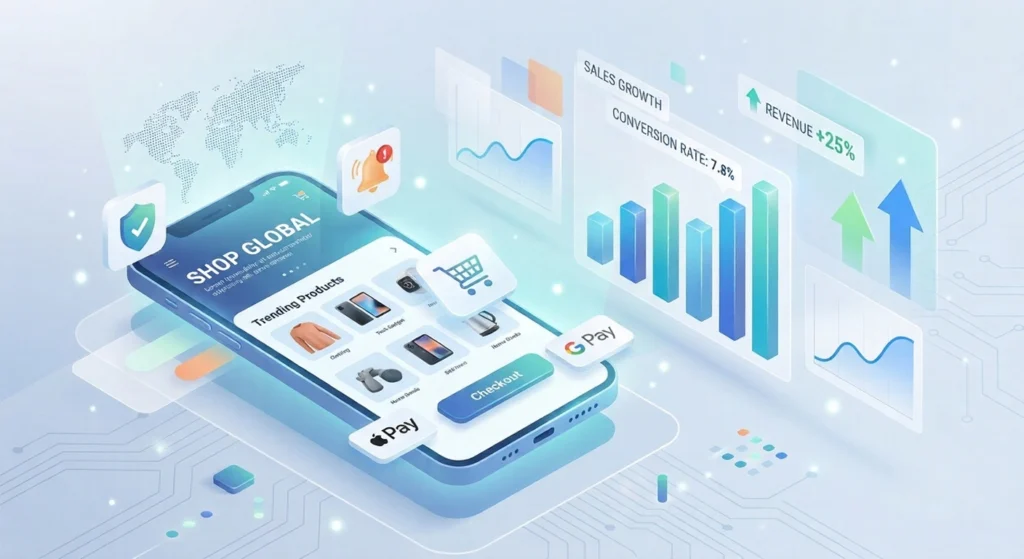
What We Build: E-commerce App Development Services That Drive Revenue We’ve built 150+ e-commerce mobile apps for retailers, DTC brands, and B2B marketplaces across 12 industries. Our apps don’t just look good. They convert. On average, our clients see a 28% lift in mobile checkout conversions within the first 90 days of launch, cart abandonment drops by 20-40%, and customers who download the app spend 3x more than web-only shoppers. Whether you’re running a $2M Shopify store or a $50M multi-vendor marketplace, we build e-commerce applications that turn browsers into buyers, with the features and workflows needed to support your specific business model. Here’s what we specialize in as an ecommerce app development company: Custom Native iOS & Android Ecommerce Apps For brands that need maximum performance and full control. We build separate apps in Swift for iOS and Kotlin for Android, which means you get the fastest load times, native features like AR virtual try-on and Apple Pay, and seamless integration with device hardware. Best for companies with the budget to invest in premium mobile experiences and brands where performance is make-or-break. Shopify & Magento Mobile App Development Already running an online store on Shopify or Magento? We build native mobile apps that connect directly to your existing backend. Same inventory, same admin panel, better mobile experience. Your customers get push notifications, offline browsing, and checkout flows that convert 30% higher than mobile web. Faster to launch than a fully custom build because we’re building on proven infrastructure you already use. Multi-Vendor Marketplace App Development For platforms where multiple sellers list and sell products, like Etsy, eBay, or our client Vici Sneakers. We build vendor dashboards, commission management systems, automated order routing, payment splitting between sellers, and review systems. As a marketplace app development company, we’ve launched 25+ multi-vendor platforms, and we know exactly how to handle the complexity of managing hundreds of sellers in one app. B2B Ecommerce & Procurement Platforms Wholesale ordering works differently than retail. We build B2B ecommerce apps with bulk pricing tiers, multi-level approval workflows (so managers can approve purchases before they process), recurring order automation for repeat clients, and direct integration with your ERP or inventory management system. Built for distributors, manufacturers, and wholesalers who need more than a standard shopping cart. Apps We’ve Built That Made Our Clients Money Here’s the proof. Real clients, real challenges, real results. We track conversion rates, customer engagement, user engagement, and revenue impact for every ecommerce app development project we launch. Not just “the client was happy” testimonials. Actual numbers that show our apps drive measurable business growth and keep customers actively interacting with the brand. Case Study: Vici Sneaker Marketplace — 5,000+ Users in First Quarter The Challenge: A sneaker startup wanted to build a marketplace where users could buy, sell, and trade new and used sneakers. But they also needed live raffles for limited-edition drops and community features that kept sneakerheads engaged beyond just transactions. Our Solution: We built a native iOS and Android marketplace app with size-based product listings, a ticket-based raffle engine for limited releases, integrated Apple Pay and Stripe for instant checkout, and personalized feeds using collaborative filtering algorithms. The app learned what brands and sizes each user preferred and surfaced relevant sneakers automatically. The Results: 5,000+ active users signed up within the first 90 days after launch. The raffle feature generated over 2,000 entries per month for limited drops. Thousands of sneakers got listed across all categories. Seller conversion rates jumped 40% higher than their previous web-only platform because the detailed size filtering helped buyers find exactly what they needed. Technology: React Native for cross-platform development, Node.js backend with MongoDB, Stripe payments, AWS hosting with CloudFront CDN. Case Study: B2B Construction Commerce Platform — 35% Faster Delivery The Challenge: A construction supply company needed to handle bulk orders with custom material specifications, coordinate site-specific deliveries across multiple job sites, and sync inventory in real-time across 12 warehouse locations. Their existing system couldn’t handle the complexity. Our Solution: We built a B2B e-commerce app with web and mobile components. Real-time inventory sync so out-of-stock items disappeared instantly. Admin panel for multi-location management. Driver communication system via push notifications. Secure payment gateway with NET-30 terms for established contractors. The Results: Project delivery times improved by 35% because contractors could see exactly what materials were available at which locations. User engagement increased 32% as contractors started placing orders through the app instead of phone calls. All stakeholders gained real-time visibility into order status from placement to job site delivery. Technology: Custom PHP backend, native iOS and Android apps, MySQL database with real-time sync, and custom API integrations with the existing ERP system. Case Study: Price Comparison App — Live Data Across Major Retailers The Challenge: A client wanted to launch a price comparison app for consumer electronics, but major retailers had closed their APIs to prevent price comparison. Standard data feeds weren’t available, but customers still needed accurate, up-to-date pricing. Our Solution: We built a custom web scraping system to pull live pricing data directly from retailer websites, paired with automated monitoring that flagged price changes within hours. The mobile commerce app included cashback rewards, referral bonuses, and price drop alerts to drive user retention. The Results: Real-time price comparison across 15 major US electronics retailers. Users could compare prices on thousands of products without manually checking each store. The rewards program generated 25% higher user return rates compared to basic comparison apps. Technology: Python-based web scraping with rotating proxies, React Native mobile app, PostgreSQL database, and automated price monitoring system. Want a similar e-commerce app ROI for your business? Let’s discuss what we can build for your specific market and customer base. Shopify vs Magento vs Custom Build: Which Platform is Right for Your Business? Most businesses ask us this question before they build anything. Should I go with Shopify for quick setup? Build on Magento for more control? Or create something completely custom? The answer depends on your business model, revenue size, and growth timeline. We’ve built apps on all three approaches, and each works best for specific situations. Here’s the honest breakdown