Your Business Has Outgrown Its Current Systems Here Is What That Actually Costs You
Your finance team is working from one spreadsheet. Your warehouse is tracking stock in another. And when the operations manager asks for a sales report by end of day, someone spends three hours pulling numbers from four different places and still gets it wrong.
That is not a technology problem. That is a growth problem.
Most mid-sized businesses reach a point where the tools that got them here start holding them back. The spreadsheets multiply. The disconnected software stacks up. And every time a new person joins the team, onboarding them means introducing them to a maze of logins, workarounds, and “ask Sarah because she knows how we do it” processes that exist nowhere in writing.
The cost of staying on disconnected systems is real — and most businesses underestimate it badly. Manual data re-entry between departments is not just slow. It introduces errors that ripple through your reporting, your invoicing, and your decision-making. When your finance and inventory systems do not talk to each other, you end up ordering stock you already have or missing orders because availability data is three days out of date. When managers wait days for reports that should take minutes, decisions get delayed or made on gut instinct instead of live data.
And the longer this goes on, the harder it gets to fix.
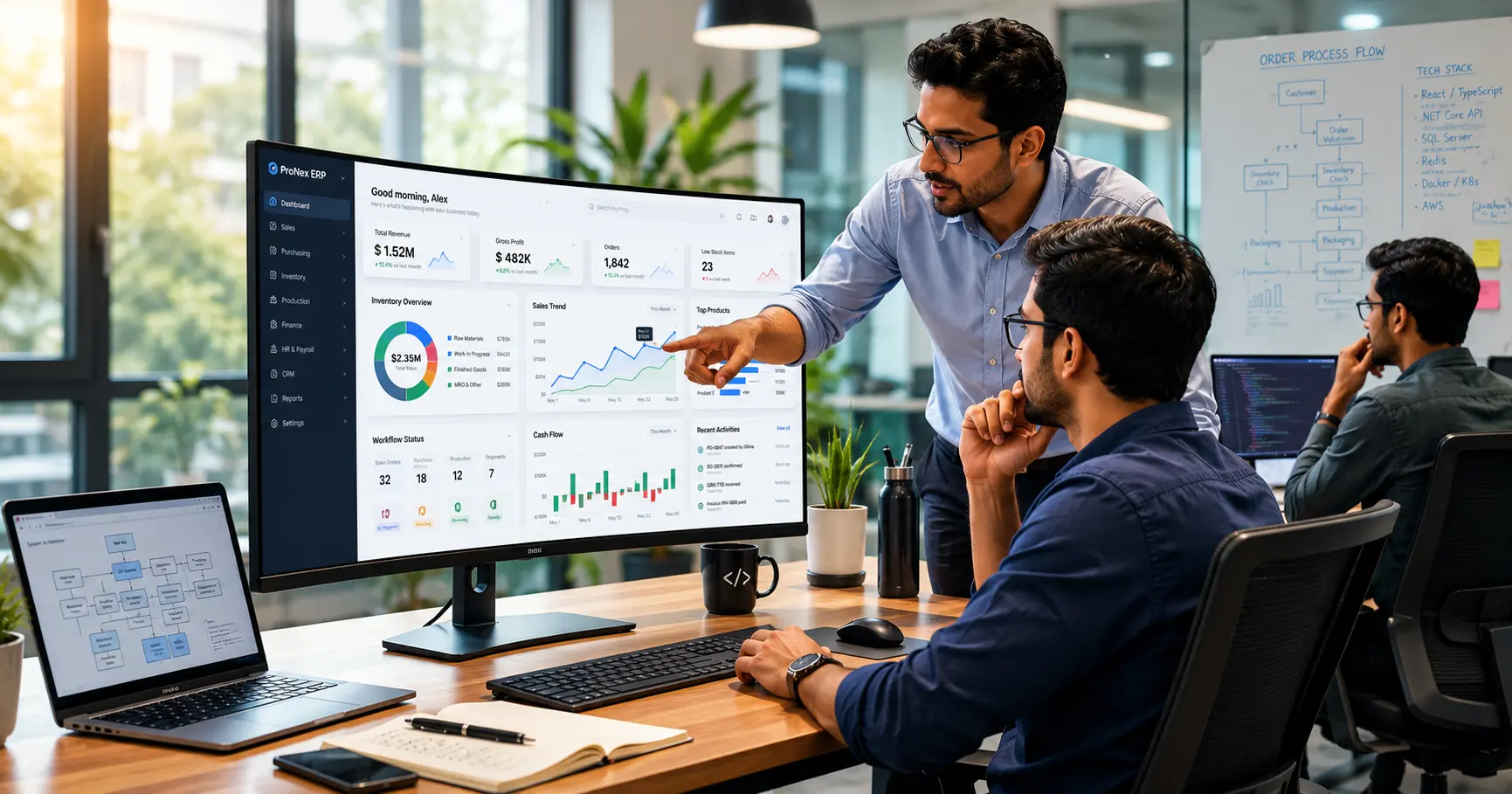
This is exactly the problem that enterprise resource planning software exists to solve. A custom ERP system — built specifically for how your business operates — connects every department into one platform, replaces the manual handoffs with automated workflows, and gives everyone who needs data access to it in real time.
But not every business is ready for it. And not every ERP company will tell you that honestly upfront.
We will.
What Our Custom ERP Software Development Company Actually Builds for You
We build one system that replaces all of them.
That is the simplest way to describe what custom ERP development does for a growing business. Instead of your team switching between separate tools for finance, inventory, HR, and operations — each with its own login, its own data, and its own version of the truth — a custom-built ERP system brings everything into a single platform designed around how your business actually works.
Not how a software vendor thinks businesses should work. How yours does.
This is where custom ERP development is fundamentally different from buying an off-the-shelf platform. Generic ERP software is built for an average business. Your business is not average. Your workflows, your approval processes, your reporting needs, and your integrations are specific to how your team operates. A system built around those specifics gets used. A system that forces your team to adapt to it gets abandoned or worked around — which is how you end up back where you started.
What a well-built custom ERP system gives your business is straightforward. One source of accurate data that every department works from. Automated workflows that handle the manual handoffs between teams without someone chasing emails or re-entering the same numbers twice. Real-time reporting that managers can pull themselves in minutes, not days. And a scalable ERP solution that grows with your headcount and your operations without needing to be replaced every three years.
As an ERP software development company, we handle the full build from mapping your requirements and designing the architecture through development, testing, and getting your team up and running on launch day.
We build custom ERP solutions for growing businesses, mid-sized manufacturers, logistics operators, and service companies that need more than off-the-shelf software can give them.
Not sure yet what your system would need to include? Book a free discovery call and we will walk through your current setup, identify the gaps, and tell you honestly what makes sense to build and what does not. No obligation.
Is Custom ERP the Right Choice for Your Business? (And When Off-the-Shelf Makes More Sense)
Not every business needs a custom-built ERP system. Some are better served by an established platform, and we will tell you that upfront if your situation calls for it. Understanding what enterprise resource planning actually means for your specific business size and workflow complexity is the first step toward choosing the right path.
Custom ERP development makes sense when your business operates in ways that standard software cannot accommodate. If your workflows, approval chains, or reporting needs are specific to your industry or your company — and forcing your team to adapt to generic processes would slow things down rather than speed them up — custom-built is the right path. The same applies if you are in a regulated industry with compliance requirements that off-the-shelf platforms do not handle natively, or if you need the system to integrate tightly with proprietary internal tools that a SaaS ERP platform cannot connect to easily.
Custom also wins when you are thinking long-term about total ownership cost. Off-the-shelf platforms charge per user per month, forever. A custom build has a higher upfront ERP software development cost, but no recurring licensing fees. Over five or ten years, that math changes significantly in favor of building your own system.
But if your business processes are relatively standard, your budget is constrained right now, or you need a system live in weeks rather than months, an off-the-shelf platform may be the smarter move. ERP vendor selection in that case becomes about finding the platform that fits your needs with the least customization required.
Here is what we do differently during ERP vendor selection conversations. We walk through your workflows, your integration needs, and your budget realities. Then we give you an honest recommendation even if that recommendation is to go with an established platform instead of building custom. A business that chooses the wrong ERP path wastes six figures and a year of their team’s time. We would rather lose a sale than watch that happen to someone who called us for advice.
Not sure which route is right for you? Book a free 30-minute call and we will tell you honestly including if we think off-the-shelf is the better answer for your situation.
The ERP Modules We Build And What Each One Does for Your Operations
ERP modules development covers the functional areas of your business finance, inventory, HR, sales, production, and reporting. Each module handles a specific part of operations, and together they give you a complete view of everything happening across the company in real time.
Here is what we build and what each module actually does for your team.
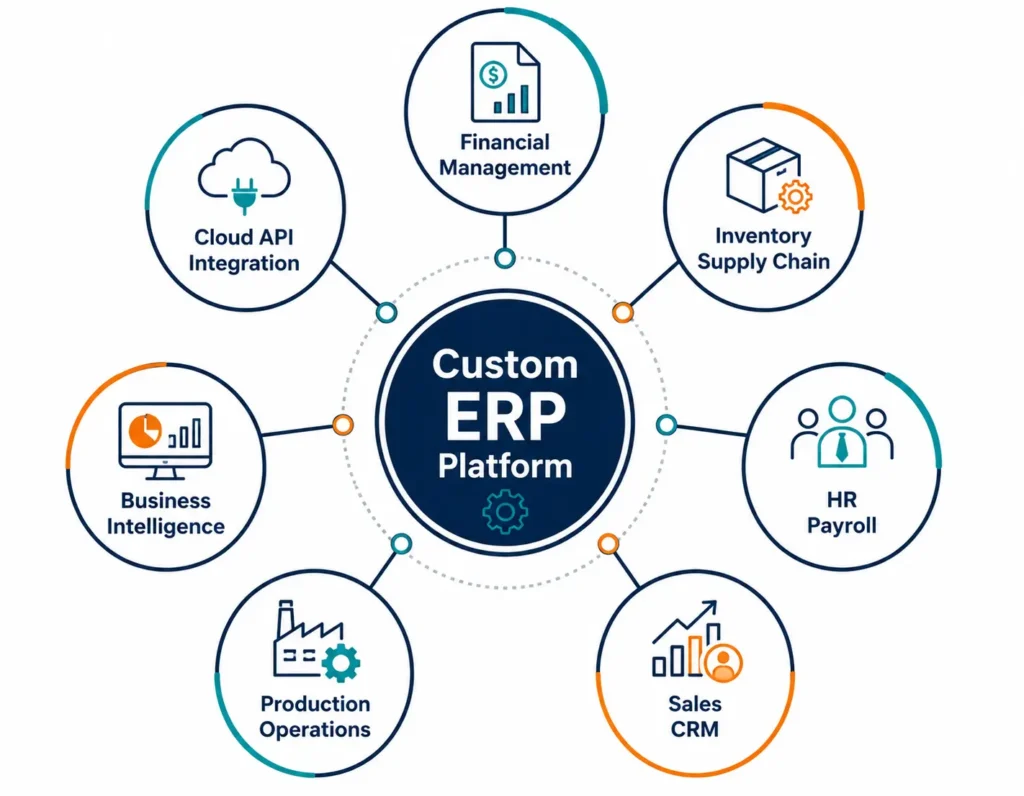
Financial Management and Reporting
Your finance team gets real-time visibility into cash flow, cost centers, and profitability without pulling numbers from three different spreadsheets and hoping the formulas still work.
The financial module tracks accounts payable and receivable, general ledger, budgeting, and expense management in one place. Business intelligence ERP reporting means your CFO or accountant can generate a P&L statement, balance sheet, or cash flow report in minutes instead of waiting until month end closeout.
When financial data feeds directly from sales and inventory modules, the numbers stay accurate and your team stops reconciling discrepancies manually.
Inventory and Supply Chain Management
Stock levels, supplier management, reorder automation, and shipment tracking all run from a single dashboard. For manufacturing ERP implementations, this module connects raw material inventory to production schedules so your team knows exactly what is on hand, what is in transit and what needs to be ordered before a production line stalls.
Retail and distribution businesses use the same module to track SKU-level inventory across multiple warehouses and trigger automatic reorder points when stock hits minimum thresholds. Manual inventory counting becomes a verification step instead of the primary tracking method.
HR, Payroll, and Workforce Management
Employee records, payroll processing, attendance tracking, time-off requests, and performance reviews move out of separate HR tools and into the ERP system where they connect to the rest of your operations data. When HR and payroll data integrate with project management and production modules, you can track labor costs per project, per product, or per department in real time. Onboarding a new employee means entering their information once not filling out the same details in four different systems.
Sales, CRM, and Customer Management
CRM ERP integration connects your sales pipeline to your operations and fulfillment workflows. Lead tracking, quote management, order processing and customer history live in the same system that handles inventory and production. When a salesperson closes a deal and creates an order, the system checks inventory availability, reserves stock, triggers production if needed, and updates delivery timelines automatically.
Your sales team stops sending “let me check with the warehouse” emails because the data is already in front of them. Customer service reps can pull a complete order history and account status in seconds instead of switching between tools or waiting for someone in another department to dig up the information.
Production and Operations Management
Production planning, scheduling, work order management, quality control checkpoints, and machine utilization tracking are built for manufacturers and service operations that need to coordinate resources across jobs or production runs. This module tells your production manager which orders are scheduled for which machines, what materials are allocated, and where bottlenecks are forming before they delay deliveries. Manufacturing ERP builds include real-time shop floor visibility so supervisors can see job status, material usage, and labor hours as they happen.
Business Intelligence and Custom Reporting
Real-time dashboards, automated reports, and KPI tracking mean decisions get made on live data instead of last month’s exported spreadsheet. Managers build custom reports that pull exactly the metrics they need without waiting for IT or learning SQL. When every module feeds into the business intelligence ERP layer, you can track performance across departments, compare actual results to budget targets, and spot trends before they become problems. The ERP software ROI on better reporting alone often justifies the build cost because faster decisions based on accurate data prevent expensive mistakes.
Cloud Deployment, API Integration, and System Connectivity
We deploy ERP systems on-premise, in the cloud, or as a hybrid depending on your data security requirements and IT infrastructure. Cloud-based ERP solutions give your team access from anywhere without maintaining local servers. API integration connects the ERP to your existing tools accounting software, ecommerce platforms, CRM systems, POS terminals, or legacy databases that still hold critical business data.
For businesses that need a cost-effective modular starting point, we also offer Odoo development services. Odoo is an open-source platform that covers core ERP functions with a lower upfront investment than a fully custom build, and we can extend it with custom modules as your needs grow.
You do not need to build every module at once. We design the system so you can start with your most pressing operational need — usually finance and inventory for most businesses — and expand from there as budget and priorities allow.
How We Build Your ERP — From First Conversation to a System Your Team Actually Uses
Here is exactly what happens when you decide to move forward with a custom ERP build. Every step, who does what, and how long each phase takes.
We follow agile ERP development practices throughout the software development lifecycle — which means you see working modules regularly, give feedback that shapes the next sprint, and never wonder what is being built behind the scenes. This is structured ERP project management designed to prevent the budget overruns and timeline surprises that give enterprise software projects a bad reputation.
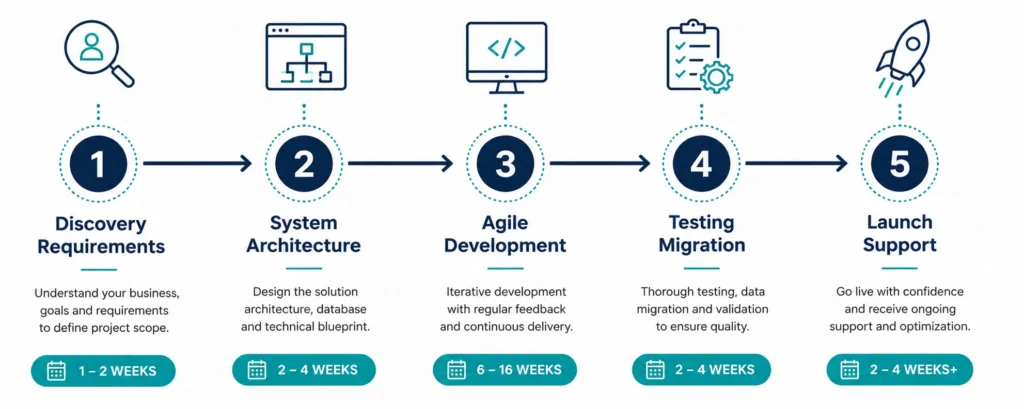
Step 1 — Discovery and Requirements Mapping (Week 1–2)
We meet with your team to map your current workflows, identify where systems connect or should connect, and document exactly what the ERP needs to do for each department. This is not a sales meeting. Our developers and business analysts sit down with the people who will actually use the system — your finance manager, warehouse supervisor, HR lead, operations team — and ask how they work now and what is breaking or slowing them down.
You leave this phase with a clear system blueprint that lists every module, every integration point, and every major feature the build will include. Not a vague proposal. A requirements document both sides agree on before any code gets written.
Step 2 — System Architecture and Design (Week 3–4)
Our architects design the database structure, user interface flows, module connections, and integration architecture based on the requirements document from Step 1. You review wireframes and data models before development starts. This approval gate is where we catch misunderstandings early — when they cost hours to fix instead of weeks. If your team looks at the proposed design and says “that workflow does not match how we actually process orders,” we change the design now, not after the module is already built.
Step 3 — Agile Development in Sprints (Months 1–4+)
Development happens in two-week sprints. Each sprint delivers a working piece of the system — a completed module, a functional integration, a user dashboard — that you can test and give feedback on. You see progress every two weeks, not a completed system delivered four months later with no opportunity to course-correct along the way. Each sprint ends with a demo. Your feedback from that demo shapes what we prioritize in the next sprint. This is where agile ERP development eliminates the black-box fear that comes with traditional software projects.
Timeline varies by project size. A straightforward 4-module ERP for a mid-sized business typically runs 3 to 5 months of active development. Larger enterprise builds with complex integrations can run 9 to 12 months.
Step 4 — Testing, Security Review, and Data Migration (Weeks Before Launch)
Functional testing, performance testing, security testing, and user acceptance testing all run before the system goes live. We test how the ERP handles peak transaction loads, how it responds when someone enters bad data, and whether the security model actually restricts access the way it should. ERP system testing is not an optional add-on. It is built into every project timeline because launching a broken system costs more to fix than testing it properly the first time.
ERP data migration happens here too. Your existing data from spreadsheets, old databases, or legacy systems gets cleaned, mapped to the new structure, and imported into the ERP. We run test migrations first so you can verify the data landed correctly before go-live.
Nothing launches until both sides sign off.
Step 5 — Launch, Training, and Ongoing Support (Month 1 After Go-Live)
We train your team before launch day. Role-based training sessions cover how admins configure the system, how daily users enter and retrieve data, and how managers pull reports and dashboards. We stay on call during the go-live period — the first few days when your team is using the system in production for the first time and questions always come up. ERP go-live support includes a defined hypercare window where response times are faster and our team is monitoring system performance closely.
You are not handed a system and left to figure it out. ERP user training and ERP support and maintenance are part of the engagement, not upsells you find out about later.
Want to know how this process applies to your specific project and what your timeline would realistically look like? Book a free 30-minute discovery call and we will walk through it with you.
What Happens After Your ERP Goes Live — Support, Training, and Long-Term Partnership
Most ERP projects end with a successful launch. Then the vendor disappears and your team is left figuring out the new system on their own. We stay.
For the first 30 days after your ERP goes live, a dedicated team member is available for questions, fixes, and system adjustments within 24 hours. This is our hypercare period. Your staff is still learning the new workflows. Small issues come up. Reports need tweaking. We expect this and we plan for it.
We also provide role-specific user training before and after launch. Your warehouse staff needs different training than your finance manager. We do not run one generic session and call it done. Admins get deep system training. Daily users get task-focused walkthroughs. Managers get reporting and oversight training. Everyone learns what they actually need to do their job in the new system.
You get complete documentation. Not a 200-page manual nobody reads. Clear process guides, video walkthroughs, and quick reference sheets your team can actually use when they forget a step three months later.
And here is the part most ERP companies skip completely. We help your team adopt the system instead of resisting it. ERP failure almost never comes from bad technology. It comes from staff who hate the new system and find workarounds to avoid using it. We work with your managers during implementation to get buy-in early, address concerns before launch, and show your team how the new system makes their jobs easier instead of harder.
After the first 30 days, you are not on your own. We offer ongoing support contracts, software update management, and system optimization as your business grows. Most of our clients stay with us for years because they know we will answer the phone when something breaks or they need to add new functionality.
Call us to discuss what post-launch support looks like for your specific project. We will walk you through the hypercare timeline, training schedule, and ongoing maintenance options before you commit to anything.
Why Growing Businesses Choose Our Custom ERP Development Team Over Larger Firms
You need an ERP development partner who actually answers your calls and treats your project like it matters. Not a company that puts your $200K project at the bottom of their queue behind enterprise contracts worth millions.
We work with mid-market companies that enterprise IT outsourcing firms ignore or overcharge. Whether you need a complete system overhaul or specific custom ERP software development services tailored to individual departments, we build solutions that fit your actual workflow.
Our custom ERP development projects typically range from $75K to $500K. That puts you right in our sweet spot. Not too small to care about. Not so large that you need layers of account managers between you and the people building your system.
You work directly with the developers and project managers who build your ERP software. No rotating teams of offshore contractors who disappear halfway through your project. We assign a dedicated team at the start and that same team stays with you through launch and beyond. When you email a question, the person who answers actually knows your business and your system.
We have delivered custom ERP solutions for manufacturing, distribution, professional services, and healthcare companies since 2015. Most of our clients come to us after getting quotes from larger enterprise software development firms and realizing those companies want $800K minimums and 18-month timelines for projects we can deliver in 6 to 9 months at half the cost.
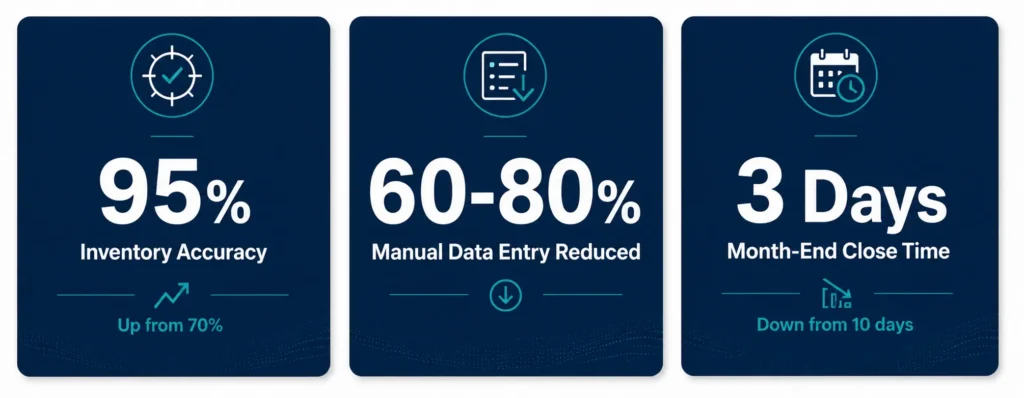
Here is what the ERP software ROI looks like for our typical clients. Inventory accuracy improves from 70% to 95% or better. Manual data entry drops by 60% to 80%. Month-end close time goes from 10 days to 3 days. These are real outcomes from real projects, not marketing promises.
And this matters. Large firms position themselves as the best ERP software development company for Fortune 500 budgets. We position ourselves as the right fit for growing businesses that need enterprise-level functionality without enterprise-level budgets or timelines.
We also start smaller when it makes sense. If you need to prove ROI in one department before rolling out company-wide, we build that way. Most larger firms will not take a phased project because their minimum engagement sizes do not allow it.
Our clients tell us the difference comes down to access and accountability. You get both here.Why Growing Businesses Choose Our Custom ERP Development Team Over Larger Firms
You need an ERP development partner who actually answers your calls and treats your project like it matters. Not a company that puts your $200K project at the bottom of their queue behind enterprise contracts worth millions.
We work with mid-market companies that enterprise IT outsourcing firms ignore or overcharge. Our custom ERP development projects typically range from $75K to $500K. That puts you right in our sweet spot. Not too small to care about. Not so large that you need layers of account managers between you and the people building your system.
You work directly with the developers and project managers who build your ERP software. No rotating teams of offshore contractors who disappear halfway through your project. We assign a dedicated team at the start and that same team stays with you through launch and beyond. When you email a question, the person who answers actually knows your business and your system.
We have delivered custom ERP solutions for manufacturing, distribution, professional services, and healthcare companies since 2015. Most of our clients come to us after getting quotes from larger enterprise software development firms and realizing those companies want $800K minimums and 18-month timelines for projects we can deliver in 6 to 9 months at half the cost.
Here is what the ERP software ROI looks like for our typical clients. Inventory accuracy improves from 70% to 95% or better. Manual data entry drops by 60% to 80%. Month-end close time goes from 10 days to 3 days. These are real outcomes from real projects, not marketing promises.
And this matters. Large firms position themselves as the best ERP software development company for Fortune 500 budgets. We position ourselves as the right fit for growing businesses that need enterprise-level functionality without enterprise-level budgets or timelines.
We also start smaller when it makes sense. If you need to prove ROI in one department before rolling out company-wide, we build that way. Most larger firms will not take a phased project because their minimum engagement sizes do not allow it.
Our clients tell us the difference comes down to access and accountability. You get both here.
Industries We Have Built Custom ERP Solutions For
We build custom ERP software for small business and mid-market companies across multiple industries. Each sector has unique workflow challenges that off-the-shelf systems miss.
Manufacturing ERP clients use our systems to connect production scheduling, raw material inventory, and quality control in one dashboard, cutting production planning time from days to hours. Distribution companies get real-time visibility into warehouse locations, order status, and shipping costs so they can promise accurate delivery dates and catch inventory shortages before stockouts happen.
Retail and ecommerce businesses need inventory that syncs across online stores, physical locations, and marketplaces while tracking customer purchase history and preferences in one cloud-based ERP solution. Healthcare clinics and medical practices streamline patient scheduling, insurance billing, and compliance reporting while maintaining HIPAA security requirements.
Construction and real estate firms track project costs, labor hours, and material usage against budgets in real time so they know if a job is profitable before the final invoice.
Professional services companies automate time tracking, project billing, and resource allocation to eliminate the manual spreadsheets that cause billing errors and missed revenue. And if you need content that ranks your ERP services higher in search results, our SEO content writing services help software companies attract qualified leads organically.
Logistics and transportation companies optimize delivery routes, track fleet maintenance, and manage driver scheduling to reduce fuel costs and improve on-time delivery rates.
Most of these clients came to us after discovering that generic ERP software for small business either costs too much or misses the specific workflows that make their industry different.
Do not see your industry listed here? We have worked in more sectors than we can list on one page. Tell us about your business and the workflow problems you need to solve. We will let you know if custom ERP development makes sense for your situation.
What Custom ERP Development Costs — Honest Ranges and What Affects Your Price
ERP software development cost varies widely based on scope, but most of our projects fall into three clear ranges. Here are the real numbers so you can budget appropriately before you call.
Entry-level custom ERP projects typically run $75,000 to $150,000. These cover 3 to 5 core modules like inventory, accounting, and basic reporting for single-location companies with up to 50 users. Most small manufacturers and distributors start here.
Mid-sized custom ERP systems cost $150,000 to $400,000 and include 6 to 10 modules with multi-location support, advanced reporting, and integrations with existing tools. These scalable ERP solutions handle up to 200 users and typically serve growing companies that have outgrown QuickBooks but do not need enterprise-level complexity.
Enterprise custom ERP projects range from $400,000 to $800,000 and include full module suites, complex third-party integrations, advanced workflow automation, and support for 200+ users across multiple locations and departments.
But size alone does not determine cost. Several factors push your ERP implementation services price up or down. Integration complexity matters most. Connecting to 2 existing systems costs far less than connecting to 10. Level of customization versus configuration makes a huge difference. Building entirely custom workflows costs more than adapting standard business processes.
Team size affects training and onboarding costs. A 20-person company needs different ERP consulting and change management than a 200-person company. Deployment model impacts cost too.
Cloud hosting generally costs less upfront than on-premise infrastructure. Many of our clients start with cloud-based solutions similar to how we approach WordPress SEO services scalable, cost-effective, and performance-focused from day one.
Most companies get sticker shock from enterprise vendors who quote $800K minimums for projects we deliver at $300K. And enterprise firms often pad timelines to 18+ months for systems we implement in 6 to 9 months.
The best way to get an accurate number for your specific project is a free 30-minute discovery call. We give you a ballpark estimate in the first conversation, not after weeks of back-and-forth meetings and proposal processes.
Start With a Free Discovery Call — We Will Tell You Exactly What Your ERP Build Needs
We build custom ERP systems that actually solve your workflow problems instead of creating new ones.
Our discovery call takes 30 minutes. No obligation. No sales script. Just an honest conversation about what you need and whether we are the right custom ERP software development company for your project.
We respond to all inquiries within 24 business hours.
Here is what you will know when we finish the call. First, a clear picture of what your ERP build would include based on your specific workflows and pain points. Second, a ballpark cost range so you can budget appropriately. Third, our honest opinion on whether custom ERP development is the right path for you or if you should consider other options.
Some companies need custom builds. Others can solve their problems with configuration and integrations. We tell you which one fits your situation.
Our ERP consulting and ERP implementation services start only when you are ready to move forward.
No long-term contracts required until you are ready to proceed. Most discovery calls happen within 2 to 3 business days of your initial contact.
Frequently Asked Questions
How much does it cost to build a custom ERP system?
Entry-level custom ERP systems cost $75,000 to $150,000, mid-sized builds range from $150,000 to $400,000, and enterprise systems run $400,000 to $800,000. Cost depends on module count, integration complexity, user numbers, and deployment model. We give you a specific range for your project in the discovery call.
How long does custom ERP software development take from start to go-live?
Simple 3 to 5 module systems take 3 to 5 months, mid-sized multi-module builds require 5 to 9 months, and complex enterprise systems need 9 to 18 months. Timeline depends on module count, integration complexity, and data migration requirements. You see working modules every month with our agile development approach.
Should we build a custom ERP or implement SAP, Microsoft Dynamics, or NetSuite?
Off-the-shelf platforms work better when your processes are standard, you need fast deployment, or budget is tight. Custom ERP wins when your workflows are unique, you need complex integrations, or long-term total cost matters more than upfront savings. We help you decide which path fits your situation in the discovery call.
Can you integrate the new ERP with the software we already use — our CRM, accounting system, or legacy tools?
Yes, we connect your custom ERP to existing systems through APIs and direct database connections. We regularly integrate with Salesforce, QuickBooks, Shopify, legacy databases, and proprietary systems. Integration complexity affects cost and timeline, which is why we assess your current software stack in the discovery phase.
What happens if there are bugs or problems after the ERP launches?
You get 30 days of hypercare support with 24-hour response time, a 6-month bug-fix warranty, and a dedicated support contact who knows your system. All critical bugs are fixed at no cost during the warranty period. Ongoing support contracts are available after the warranty expires.