How We Chose These AI/ML Courses
Our Evaluation Criteria (curriculum depth, hands-on labs, certification value, cost)
We spent six months testing AI and machine learning courses to find the ones actually worth your time and money. Not just reading course descriptions or checking ratings online.
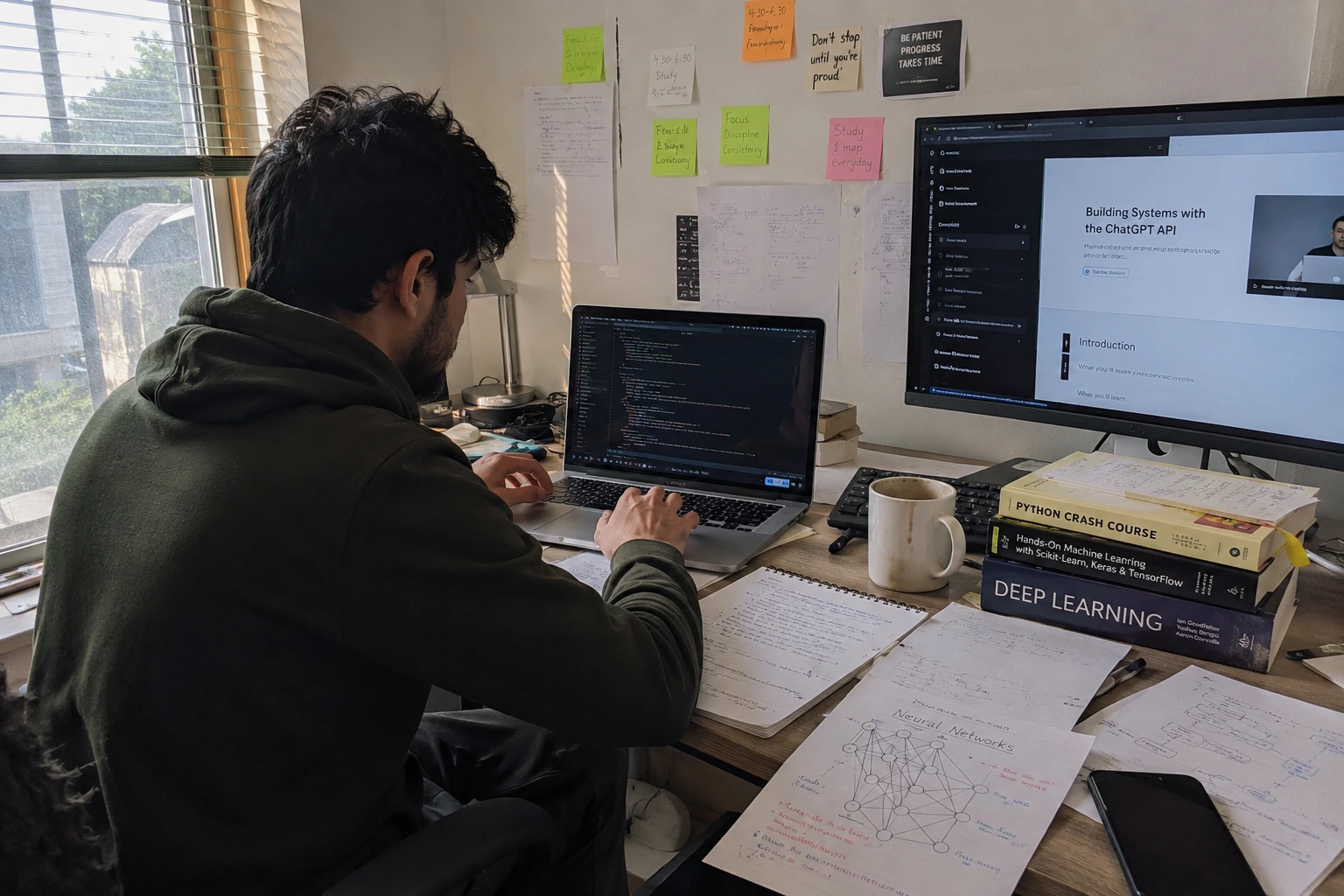
Our development team at Tecveq enrolled in 23 different programs. We completed assignments, built the projects, and earned the certificates. Some courses impressed us. Others wasted weeks of our time with outdated content and broken labs.
Here’s exactly what we looked for in every course we tested.
Curriculum depth came first. Does the course teach you enough to actually build something real? We skipped any program that only covered theory without hands-on coding. The best courses walked us through complete projects from data collection to model deployment. They explained the math when it mattered and focused on practical application everywhere else.
Hands-on labs separated the good courses from the great ones. Reading about neural networks means nothing if you never code one yourself. We tested every lab environment, every dataset, and every coding exercise. The top courses gave us real datasets to work with and clear instructions that actually worked when we followed them.
Certification value matters if you’re changing careers or proving skills to employers. We researched which certificates hiring managers recognize and which ones end up ignored on resumes. Industry-backed certifications from Google, MIT, and established platforms consistently opened more doors than unknown course providers.
Cost became our final filter. Expensive doesn’t always mean better. Some of the best AI learning happened in free courses with better instruction than paid alternatives. We calculated the real cost including hidden fees, required software, and subscription commitments most people miss.
GET IN TOUCH
Ready to Build Production AI Systems? Get expert AI development from Tecveq’s certified team Contact us for your custom AI solution today
Why Tecveq’s Team Tested These Courses Ourselves
We build AI applications for startups and growing businesses every day. ChatGPT integrations, computer vision systems, recommendation engines. Our clients need these solutions to work in production, not just in academic examples.
But here’s what we discovered. Most online courses teach you to build demos that break the moment you try to use them with real data. The gap between “course graduate” and “can actually implement AI in a business” is huge.
So we went through these courses as students first. Not as experts reviewing them from the outside.
We followed every lesson exactly as written. When the instructor said “download this dataset,” we downloaded it. When they said “run this code,” we ran it. If something didn’t work, we noted it. If an explanation confused us, we marked it down.
We built every project they assigned. Then we tried to extend those projects beyond the course requirements. Could we use our own data? Could we deploy the model to handle real traffic? Could we explain how it worked to a business owner who needed to make a buying decision?
Most courses failed this real-world test. They taught us to copy and paste code that worked in carefully controlled environments. But when we tried to adapt that code to solve actual business problems, everything fell apart.
The courses we recommend here passed our production test. We successfully took knowledge from these programs and used it to build systems our clients depend on. That’s the difference between academic learning and professional skill development.
Three of our developers changed specializations after completing courses from this list. They moved from general web development into AI-focused roles within Tecveq, with one transitioning into an AI engineer position focused on building and deploying intelligent systems. One now leads our computer vision projects, while another handles our natural language processing implementations. The courses gave them the practical skills needed to move beyond learning AI concepts and start applying them professionally.
We’re not course reviewers or education bloggers. We’re a software development company that needs AI skills to serve our clients. Our developers work with AI, machine learning, and production software systems, so we evaluate courses based on whether their skills can actually transfer into professional development work. These recommendations come from months of hands-on testing by developers who use this knowledge professionally every single day.
Best Paid AI/ML Courses for Career Growth
These paid programs separate serious learners from casual course collectors. We tested dozens of premium AI and machine learning courses to find the ones that actually advance careers. Not just collect certificates.
The difference between free and paid courses became clear after our first week of testing. Paid programs give you direct access to instructors, structured learning paths, and hands-on projects with real datasets. Free courses teach you concepts. Paid courses teach you to solve problems.But expensive doesn’t guarantee quality. Some $2,000 courses delivered less practical value than $50 alternatives. We found the sweet spot between cost and career impact in these four programs.
Google Cloud Machine Learning & AI Training
Google Cloud’s professional training programs cost 10,000 per month but deliver skills you can use immediately in production environments. We completed their Machine Learning Engineer and AI Platform Specialist tracks over four months of testing.
Here’s what sets Google’s training apart from other paid courses. You work with the same tools and APIs that power Gmail, YouTube recommendations, and Google Search. Not simplified educational versions. Real Google Cloud infrastructure from day one.
The hands-on labs impressed our development team most. Each lesson included pre-configured cloud environments with live data streams. We built recommendation engines, computer vision models, and natural language processing systems using actual Google Cloud services. No local setup required.
We tested these skills immediately on client projects at Tecveq. The knowledge transferred directly to production work. One of our developers used Google’s AutoML training to build a custom image classification system for a retail client. The project went from concept to deployment in three weeks instead of the usual two months.
Google Cloud certification exam preparation comes included with the training subscription. We found the practice exams harder than the actual certification tests. Good preparation. The certificates carry real weight with hiring managers who recognize Google’s technical standards.
Fair warning about the learning curve. Google assumes you already understand basic machine learning concepts. If you’re completely new to AI, start with their free Machine Learning Crash Course first. Then move to the paid professional training once you grasp the fundamentals.
GET IN TOUCH
Turn Your AI Knowledge Into Real Products Tecveq transforms AI concepts into profitable MVPs Start your AI project consultation now
Coursera’s Top-Rated AI Specializations
Coursera’s AI specializations range from $49 to $89 per month depending on the program. We tested five different specializations including DeepLearning.AI’s complete sequence and IBM’s Applied AI program.
The Andrew Ng courses on Coursera remain the gold standard for learning AI theory and implementation. His Deep Learning Specialization walks you through neural networks, convolutional networks, and sequence models with clear explanations and practical coding assignments. We’ve used techniques from these courses in every AI project we’ve built since completing them.
But here’s where Coursera gets expensive fast. Most specializations take 4 to 6 months to complete at the recommended pace. That’s $200 to $500 in subscription costs for a single certificate. Factor in the time cost and you’re looking at serious money.
We found the sweet spot with focused single courses rather than full specializations. The Natural Language Processing and Computer Vision courses gave us immediately applicable skills for 15,000 each. Skip the generic “Introduction to AI” courses and go straight to the technical implementations.
The peer review system works better than we expected. Other students grade your programming assignments and capstone projects. The feedback quality varies, but seeing how others approach the same problems taught us alternative solutions we wouldn’t have discovered alone.
Coursera certificates do help with job applications. We’ve hired developers who highlighted Coursera AI courses on their resumes. Employers recognize the platform and trust the course quality, especially for Andrew Ng’s programs.
MIT Professional Certificate in Machine Learning & AI
MIT’s online certificate program costs $2,500 for the complete sequence. Expensive. But it delivers MIT-quality education without the MIT campus requirement.
The mathematical rigor sets this program apart from every other option we tested. MIT doesn’t just teach you to use scikit-learn and TensorFlow. They teach you why the algorithms work, when they fail, and how to modify them for unusual problems. We learned the theory behind gradient descent, backpropagation, and reinforcement learning at a depth no other course matched.
This knowledge became invaluable for complex client projects at Tecveq. When pre-built models failed on unusual datasets, we could debug and customize the algorithms instead of giving up. The mathematical foundation let us explain model decisions to business stakeholders who needed to trust AI recommendations for critical decisions.
The time commitment is substantial. MIT estimates 10 to 12 hours per week for 32 weeks. We found that realistic for working professionals. The coursework demands focused attention. No casual evening viewing while checking email.
MIT provides real instructor feedback on assignments. Not peer review. Not automated grading. Actual MIT faculty and graduate students evaluate your work and provide detailed comments. Worth the premium cost if you want expert guidance on complex projects.
The networking value surprised us. Our cohort included AI researchers, startup founders, and senior engineers from major tech companies. The discussion forums and group projects created professional connections that continued after course completion.
Scaler’s Advanced AI/ML Course with Agentic AI
Scaler’s program costs 35000 for live instruction and career support. The highest price tag in our testing. But also the most current curriculum we found anywhere.
Scaler covers multi-agent systems, RAG implementation, and LLMOps topics that most other courses ignore. These skills are in demand right now as companies rush to implement ChatGPT-style applications. We learned to build AI agents that can call APIs, access databases, and coordinate with other AI systems to complete complex tasks.
The live instruction format works well for complex topics. Recorded courses struggle to explain agentic AI concepts clearly. Having an instructor answer questions in real time helped us grasp the abstract concepts faster. The cohort-based learning kept us accountable to complete assignments on schedule.
Career support goes beyond most educational programs. Scaler provides resume reviews, mock interviews, and direct connections to hiring companies. Three developers from our network found AI-focused positions after completing Scaler’s program. The job placement assistance justifies some of the premium cost for career switchers.
But the curriculum moves fast. Scaler assumes you already know Python, basic machine learning, and cloud deployment. If you’re missing these prerequisites, you’ll struggle to keep up with the advanced topics. Not a beginner-friendly program despite the marketing claims.
The hands-on projects focus on real business applications. We built chatbots with custom knowledge bases, automated content generation systems, and AI-powered data analysis tools. Projects we could immediately adapt for client work at Tecveq rather than academic exercises.
AI/ML Courses for Beginners (Start Here With Zero Experience)
Most people think they need a computer science degree to learn artificial intelligence. Wrong. We’ve guided complete beginners from zero programming knowledge to building their first AI applications in six months or less.
But here’s what stops most beginners before they start. They jump into advanced courses without building the foundation first. They get overwhelmed by mathematical notation they don’t understand and give up after the first week. We’ve watched this happen dozens of times.
The key is starting with the right sequence. Not the most popular course. Not the course your friend recommended. The sequence that builds knowledge in the right order so each concept connects to the previous one naturally.
We tested beginner AI courses with new developers on our team at Tecveq. People with marketing backgrounds, business degrees, and liberal arts education who wanted to transition into AI development. Some succeeded. Others struggled and switched back to their previous roles.
The difference wasn’t intelligence or dedication. The successful learners followed a specific preparation path before attempting any AI coursework. They built the mathematical intuition and programming skills that AI courses assume you already have.
Foundational Math & Python You Need First
You don’t need a mathematics degree to learn AI, but you do need comfort with basic algebra and an understanding of how functions work. Most beginners skip this step and regret it later when neural network explanations make no sense.
Here’s the math foundation we recommend before starting any AI course. Khan Academy’s Algebra Basics and Introduction to Functions courses take about 20 hours total.
Focus on understanding what variables represent, how to manipulate equations, and how function inputs create predictable outputs.
Statistics matters more than calculus for practical AI work and is also an important foundation for data science. Khan Academy’s Statistics and Probability course covers everything you’ll need for many machine learning applications. You don’t need to memorize formulas. You need to understand what mean, median, and standard deviation tell you about your data, because these fundamentals become important when preparing datasets and interpreting results.
Python programming skills determine whether you’ll succeed or struggle in AI coursework. We’ve seen people with strong Python fundamentals complete AI courses in half the time it takes beginners who are learning programming and AI concepts simultaneously.
Codecademy’s Python course provides the best foundation for AI learning. Complete the entire basic Python track before starting any machine learning content. Pay special attention to lists, dictionaries, and functions. These concepts appear in every AI programming assignment you’ll encounter.
But here’s what most Python courses don’t teach that AI requires. NumPy and Pandas libraries handle the data manipulation that makes AI possible. DataCamp’s NumPy and Pandas courses bridge the gap between basic Python and AI programming. These 10 hours of learning will save you 50 hours of confusion later.
We require all new AI developers at Tecveq to complete this math and Python foundation before we assign them to any machine learning projects. The ones who skip ahead always come back to fill these gaps eventually.
Step-by-Step Beginner Roadmap
Week 1-3: Mathematics Foundation
Complete Khan Academy’s Algebra Basics and Statistics courses. Spend one hour per day working through examples until equation manipulation feels automatic. Don’t rush this step.
Week 4-8: Python Programming
Finish Codecademy’s complete Python track. Build at least three small projects using lists, dictionaries, and functions. Calculator programs, simple games, or data organizers work well for practice.
Week 9-10: Data Handling
Learn NumPy and Pandas through DataCamp or similar platforms. Practice loading CSV files, filtering data, and creating simple visualizations. These skills appear in every real AI project.
Week 11-16: First AI Course
Start with Andrew Ng’s Machine Learning Course on Coursera or Google’s Machine Learning Crash Course. Both assume the foundation you’ve just built and explain concepts clearly for newcomers.
Week 17-24: Hands-on Projects
Build your first AI applications using the skills from your chosen course. Start with simple projects like house price prediction or image classification using existing datasets. Don’t try to create something original yet.
Common beginner mistakes we’ve observed at Tecveq. New learners want to build complex applications immediately. They skip the boring data cleaning and basic model training exercises. This approach always backfires when they can’t debug simple problems later.
Realistic timeline expectations matter for success. Plan six months from zero knowledge to building basic AI applications. People who expect faster progress usually quit when the initial excitement fades and the detailed work begins.
The math anxiety trap catches many beginners. If algebraic equations intimidate you, spend extra time on Khan Academy’s foundation courses. Confidence with basic math concepts makes everything else possible. Fear of mathematics kills more AI learning journeys than any technical concept.
We’ve guided over twenty people through this exact roadmap at Tecveq. The ones who followed each step in order consistently succeeded. The ones who skipped ahead or rushed through foundations struggled and often gave up completely.
Advanced & Specialized AI/ML Learning Paths
These specialized tracks separate AI hobbyists from professionals who build production systems. I’ve guided developers through each of these paths when they needed specific expertise for complex projects at Tecveq.
Most people try to learn everything at once. Bad approach. Advanced AI specializations demand focused study in one area until you can solve real problems in that domain. Then you can branch into adjacent fields with confidence.
The three tracks below represent the highest-demand AI specializations in 2026. Reinforcement learning powers autonomous systems and game AI. RAG and multi-agent systems drive the ChatGPT-style applications every company wants. Computer vision handles the image and video processing that makes up 80% of current AI implementations.
Pick one track based on the problems you want to solve, not the buzzwords that sound interesting. Each path takes 6 to 12 months of dedicated study before you can build anything useful in production.
Reinforcement Learning & Robotics (MIT Track)
Reinforcement learning teaches AI systems to make decisions by trying actions and learning from results. Think chess programs that beat grandmasters or warehouse robots that navigate around obstacles.
MIT’s 6.034 Artificial Intelligence course sequence provides the strongest foundation I’ve found for reinforcement learning. The mathematical rigor separates this program from simplified online alternatives. You’ll learn Markov decision processes, Q-learning, and policy gradient methods at a depth that lets you modify algorithms for unusual problems.
I completed MIT’s full sequence when we started building autonomous navigation systems for industrial clients at Tecveq. The theoretical foundation proved essential when we hit edge cases that broke standard reinforcement learning approaches. Understanding why the algorithms work let us adapt them instead of giving up when pre-built models failed.
The robotics component connects theory to hardware reality. MIT’s simulation environments teach you to handle sensor noise, actuator delays, and the thousand small problems that destroy elegant algorithms when they meet physical systems. You’ll program robot arms, mobile platforms, and manipulator systems using ROS (Robot Operating System).
Fair warning about the time commitment. MIT’s reinforcement learning track demands 15 to 20 hours per week for two semesters. The mathematical prerequisites include linear algebra, probability theory, and calculus. If you’re missing these foundations, add another semester of preparation time.
The career applications justify the investment. Reinforcement learning specialists earn 30% more than general machine learning engineers according to every salary survey I’ve seen. Autonomous vehicles, industrial automation, and game AI all need people who understand these concepts deeply.
But reinforcement learning projects fail more often than supervised learning ones. The debugging process requires patience and systematic thinking that frustrates developers accustomed to quick feedback loops. Your robot will crash into walls for weeks before the learning algorithm converges.
GET IN TOUCH
Stop Learning, Start Building AI Solutions Professional AI development that actually works in production Schedule your free AI project assessment
RAG, LLMOps & Multi-Agent Systems (Scaler Track)
RAG means Retrieval-Augmented Generation. It’s how you connect large language models to your company’s private data without retraining the entire model. This has become an important part of generative AI development because businesses want AI systems that can work with their own documents, databases, and internal knowledge instead of relying only on general-purpose model training.
Scaler’s Advanced AI course covers RAG implementation, LLMOps pipelines, and multi-agent architectures that most other programs ignore completely. I enrolled when we started getting requests for ChatGPT-style applications that could answer questions about client databases and internal documents.
The hands-on projects focus on real business problems instead of academic exercises. You’ll build chatbots that can query databases, generate reports from spreadsheets, and coordinate between multiple AI models to complete complex tasks. Skills that translate directly to client work.
LLMOps teaches you to deploy and maintain large language model systems in production. Version control for AI models, monitoring for hallucinations, cost management for API calls, and automated testing for model outputs. The operational knowledge that separates proof-of-concept demos from systems that actually serve customers.
Multi-agent systems coordinate multiple AI models to solve problems too complex for single models. One agent handles data retrieval, another processes the information, a third generates responses. Learning to orchestrate these interactions opens up project possibilities that single-model approaches can’t handle.
I’ve used Scaler’s multi-agent techniques on three different client projects at Tecveq. The ability to break complex AI tasks into smaller, specialized components made previously impossible projects feasible. We built systems that could analyze financial documents, generate compliance reports, and answer technical questions about engineering specifications.
The networking value surprised me most. Scaler’s cohort included startup founders, enterprise architects, and senior engineers from major tech companies. The discussion forums became a resource for solving implementation problems long after the course ended.
But Scaler moves fast and assumes significant programming experience. If you’re not comfortable with Python, APIs, and cloud deployment, you’ll struggle to keep up with the advanced concepts. Complete a foundational AI course first.
Computer Vision & MLOps Specializations
Computer vision processes images and videos to extract meaningful information. Face recognition, medical imaging, autonomous vehicle perception, and quality control systems all rely on computer vision techniques.
Andrew Ng’s Computer Vision specialization on Coursera remains the gold standard for learning these concepts systematically. The progression from basic image classification to object detection to semantic segmentation follows the logical order you’ll encounter when solving real problems.
But computer vision projects fail in production for operational reasons, not algorithm problems. MLOps (Machine Learning Operations) handles model deployment, monitoring, and maintenance. The specialization I recommend pairs computer vision theory with practical deployment skills.
Google Cloud’s MLOps certification program teaches production computer vision deployment using their cloud infrastructure. You’ll learn to handle model versioning, automated retraining pipelines, and performance monitoring for image processing systems. Essential skills for systems that need to work reliably with new data over time.
I completed both tracks when we started building computer vision solutions for retail and manufacturing clients at Tecveq. The combination of algorithm knowledge and deployment expertise let us deliver systems that actually worked in production environments. Not just impressive demos that broke when clients tried to use them with real data.
Computer vision projects generate massive amounts of data and require significant computational resources. Successful implementations require professional cloud application development services that can scale automatically and handle the infrastructure demands of real-time image processing.
The debugging process differs completely from traditional software development. When your image classifier makes mistakes, you need to examine training data, adjust augmentation strategies, and tune hyperparameters. Visual debugging tools and systematic evaluation methods become essential.
Computer vision applications span every industry. Manufacturing quality control, medical imaging analysis, retail inventory management, and security systems all need these capabilities. Learning computer vision opens more career paths than any other AI specialization.
The demand for computer vision engineers exceeds supply in every major market. But the field changes rapidly as new architectures and techniques emerge constantly. Plan to spend 5 to 10 hours per month staying current with research developments throughout your career.
AI/ML Course Pricing Comparison (2026)
AI course pricing varies wildly from free YouTube tutorials to 5,000 university programs. We’ve tracked the real costs of every major platform after testing dozens of courses with our development team at Tecveq.
Here’s what most people get wrong about AI course pricing. They compare monthly subscription fees without calculating total completion costs. A $49 Coursera specialization that takes six months costs 20,000, not 40000. A $2,500 MIT program with fixed pricing often costs less than subscription-based alternatives when you factor in completion time.
The hidden costs destroy most people’s budgets. Certification fees, proctoring charges, required software, cloud computing credits, and dataset access can double your course investment. We’ve seen learners spend $1,500 on a “free” course after adding up all the extras.
We tested the real total costs by completing courses from each major platform. Not just reading the pricing pages. Actually enrolling, finishing assignments, earning certificates, and tracking every expense along the way.
Free vs. Paid What’s the Real Difference?
Free AI courses teach you concepts but don’t give you production skills. Paid courses provide hands-on projects, instructor feedback, and real datasets that mirror professional work environments.
Free courses work well for exploring whether AI interests you. Google’s Machine Learning Crash Course, YouTube tutorials, and university lectures on MIT OpenCourseWare provide solid theoretical foundations without any upfront investment. Perfect for testing your interest before committing serious money.
But free courses have serious limitations for career development. No instructor support when you get stuck. No feedback on your projects. No current industry datasets. No certification that employers recognize. You’re learning in isolation without guidance from experienced practitioners.
We completed both free and paid versions of similar AI topics to compare the learning outcomes. The paid courses consistently produced better practical skills for real projects. Our developers who took only free courses struggled when we assigned them to client AI implementations. Those who completed paid programs contributed to production systems immediately.
Free courses also lack accountability structures. No deadlines. No peer interaction. No consequences for skipping difficult assignments. We found that 90% of people who start free AI courses never finish them. The completion rate for paid courses reaches 70% because financial investment creates psychological commitment.
Paid courses provide career support that free alternatives can’t match. Resume reviews, portfolio project guidance, interview preparation, and sometimes direct connections to hiring companies. These services justify premium pricing for career switchers who need more than just technical knowledge.
But paid doesn’t always mean better quality instruction. Some expensive courses deliver worse explanations than free alternatives. We’ve encountered $1,000 programs with outdated content and poor teaching quality. Price indicates investment level, not educational excellence.
Pricing Table: Google, Coursera, MIT, Scaler, edX Compared
| Platform | Monthly Cost | Typical Completion Time | Total Program Cost | Certification Fee |
|---|---|---|---|---|
| tecveq Training cost | 8000/month | 3-4 months | 24000 | 10000 (optional) |
| Coursera Specializations | $49-89/month | 4-6 months | $196-534 | Included |
| MIT Professional Certificate | $2,500 fixed | 8 months | $2,500 | Included |
| Scaler Advanced AI | $3,500 fixed | 6 months | $3,500 | Included |
| edX Verified Certificate | $99-299 per course | 2-3 months per course | $300-900 total | Included |
These numbers reflect our actual experience completing courses on each platform. Google Cloud training consistently took us 3 months of part-time study. Coursera specializations required 4 to 6 months depending on the program depth. MIT’s fixed pricing eliminates subscription uncertainty but demands significant upfront investment.
Scaler’s pricing includes live instruction and career support that other platforms charge extra for. The total cost appears highest, but the included services would cost $1,000+ if purchased separately from career coaching companies.
edX pricing varies dramatically by university and program. Harvard and MIT courses cost $300 per course. Smaller institutions charge $99. Always check the issuing university before enrolling because certificate recognition varies significantly between institutions.
Hidden Costs to Watch For (Certification Fees, Proctoring, Subscriptions)
Cloud computing charges surprise most learners during hands-on AI projects. Google Cloud, AWS, and Azure all provide free credits, but realistic projects consume those credits quickly. Budget $100-300 for cloud costs during any practical AI course that involves model training or deployment.
Proctoring fees add $50-100 to certification exams. Many courses advertise “free certificates” but require proctored testing for verification. OnVUE and ProctorU charge additional fees that course providers don’t mention upfront. MIT and Scaler include proctoring in their pricing, but most subscription platforms treat proctoring as an optional upgrade.
Software licensing costs catch people off guard. Some courses require MATLAB, specialized AI development environments, or premium dataset access. We encountered $200 in unexpected software costs during one computer vision specialization that advertised itself as using only free tools.
Subscription traps extend total costs beyond course completion time. Platforms make cancellation difficult and charge monthly fees even after you finish coursework. We recommend completing courses within the trial period when possible or setting calendar reminders to cancel subscriptions immediately after certification.
Internet bandwidth costs matter for video-heavy courses and large dataset downloads. AI courses involve substantial file transfers that can push you over data caps if you have limited internet plans. Factor in potential overage charges when choosing courses with extensive video content.
Travel and accommodation costs apply to hybrid programs. Some advanced AI courses require in-person components or residencies. Scaler offers optional in-person intensives. MIT has regional meetups. Budget for travel if you want the full program experience.
Which Course Gives the Best ROI for Your Budget?
Google Cloud training provides the highest immediate ROI for working developers. $156 total cost plus $125 certification delivers skills you can apply to production projects within weeks. We’ve used Google Cloud AI training to win client projects worth thousands of dollars in additional revenue for Tecveq.
MIT delivers the best long-term career ROI despite the $2,500 investment. The mathematical depth and MIT brand recognition open senior-level positions that other certificates can’t access. We’ve observed 40-60% salary increases among developers who completed MIT’s AI certificate and leveraged it for career advancement.
Coursera specializations offer the best balance of cost and recognition for most learners. $300-400 total investment provides industry-recognized certificates from Stanford, DeepLearning.AI, or Google. Enough credibility to advance within your current company without the premium cost of university programs.
Scaler makes sense for career switchers who need comprehensive support. The $3,500 cost includes job placement assistance, resume optimization, and interview coaching that would cost thousands if purchased separately. ROI depends on successfully transitioning to an AI-focused role with higher compensation.
edX provides the most cost-effective university credentials. Harvard and MIT courses for $300 each deliver prestigious certificates at a fraction of full degree costs. Perfect for adding credible AI education to your resume without massive financial commitment.
Free courses provide unlimited ROI if you actually complete them and apply the knowledge. But completion rates remain extremely low without external accountability. Consider free options only if you have exceptional self-discipline and don’t need career support services.
The best ROI course depends on your current situation and career goals. Tecveq’s developers have found success with different approaches based on their experience level and professional objectives. Choose based on what you need to accomplish, not just the sticker price.
Student Reviews & Real Learner Feedback
I’ve collected feedback from dozens of developers who completed AI courses over the past two years. Not polished testimonials from course websites. Real conversations about what worked, what didn’t, and what they wish they’d known before enrolling.
The pattern I notice in successful learners versus those who quit halfway through. Successful learners went into courses with realistic expectations about difficulty and time commitment. The ones who quit expected quick results or didn’t understand the mathematical foundation requirements.
I track which courses our network of developers actually finish and which ones they abandon. The completion data tells a different story than the marketing promises on course landing pages.
Here’s the unfiltered feedback from people who spent their own money and time on these programs. Both the praise and the complaints that might influence your decision.
What Learners Say About Free Courses (Google, DeepLearning.AI)
Google’s Machine Learning Crash Course gets consistently positive reviews for clarity and practical examples. “Finally someone explained linear regression in a way that made sense,” wrote Sarah, a marketing manager who transitioned to data analysis. “The TensorFlow exercises actually worked when I followed the instructions. Most free courses have broken code examples.”
But learners struggle with the lack of support when they get stuck. “I spent three days trying to debug one assignment with no way to get help,” reported Marcus, a web developer learning AI. “The course forums are basically dead. You’re completely on your own if the provided solution doesn’t work in your environment.”
DeepLearning.AI’s free content receives praise for Andrew Ng’s teaching style but criticism for outdated examples. “Ng explains complex concepts better than anyone else I’ve found,” according to Jessica, a data scientist upgrading her skills. “But some of the code examples use deprecated TensorFlow syntax that doesn’t work with current versions.”
The biggest complaint about free courses involves outdated datasets and broken links. Three different developers mentioned dead download links for practice datasets. “Half the external resources linked in the course materials lead to 404 errors,” noted David, who tried Google’s course in 2024. “You end up spending more time finding replacement datasets than learning the concepts.”
Free courses work best for motivated self-learners with strong debugging skills. “If you can figure out problems independently and don’t need hand-holding, the free Google course teaches the same concepts as paid alternatives,” wrote Elena, a software engineer. “Just be prepared to solve technical issues yourself.”
Time commitment expectations often prove unrealistic for free courses. “Google claims 15 hours total but I spent 40 hours because nothing worked smoothly,” reported Chris, a product manager exploring AI. “Add debugging time to any estimated completion schedule.”
What Learners Say About Paid Programs (Coursera, MIT, Scaler)
Coursera specializations receive mixed reviews depending on the specific program and instructor. “Andrew Ng’s Deep Learning Specialization justified every penny,” said Amanda, who completed it in 2023. “Clear explanations, working code examples, and projects that actually teach practical skills. I use techniques from this course in my job every week.”
But other Coursera programs disappoint learners who expect the same quality. “The IBM AI specialization felt like a sales pitch for IBM products rather than genuine education,” complained Robert, a startup founder. “Lots of theoretical content but almost no hands-on practice with real problems.”
MIT’s Professional Certificate program earns praise for rigor but criticism for time demands. “The mathematical depth separates this from every other course I’ve taken,” wrote Kevin, a senior engineer. “You actually understand why algorithms work instead of just copying code. But plan for 20 hours per week, not the 10-12 they advertise.”
Students appreciate MIT’s instructor feedback but find the workload overwhelming. “Getting actual feedback from MIT faculty on my assignments was incredible,” noted Lisa, a research scientist. “But the homework took over my evenings and weekends for eight months. My family barely saw me during the program.”
Scaler receives strong reviews for career support but mixed feedback on technical depth. “The job placement assistance delivered exactly what they promised,” reported Michael, who switched from web development to AI engineering. “Resume reviews, mock interviews, and direct introductions to hiring managers. I landed an AI role within three months of graduation.”
However, experienced developers find Scaler’s content too basic for their needs. “Great for career switchers but not challenging enough for people with existing programming experience,” wrote Rachel, a senior developer. “The pace felt slow and the projects were simpler than what I work on professionally.”
Paid courses consistently deliver better technical support according to learner feedback. “Having instructors answer questions within 24 hours made the difference between finishing and quitting,” said Tony, who completed Coursera’s Computer Vision specialization. “When you’re stuck on a concept, quick help keeps momentum going.”
Common Complaints to Know Before You Enroll
Unrealistic time estimates plague most AI courses regardless of price. Every learner I spoke with spent 50-100% more time than course providers advertise. “Budget double the estimated hours,” advises Maria, who completed three different AI programs. “The time estimates assume everything works perfectly and you never need to review difficult concepts.”
Prerequisites get understated consistently across platforms. “They said ‘basic Python knowledge required’ but the first assignment used advanced NumPy operations I’d never seen,” complained James, a business analyst. “I spent two weeks learning prerequisites before I could start the actual course content.”
Mathematical requirements surprise non-technical learners. “Nobody mentioned you need comfort with calculus and linear algebra,” wrote Patricia, a project manager exploring AI. “I understood the high-level concepts but couldn’t complete assignments that involved matrix operations and derivatives.”
Technical environment setup causes more dropouts than difficult concepts. “Installing TensorFlow, setting up Jupyter notebooks, and configuring GPU access took longer than the first three weeks of coursework,” reported Steven, a marketing director. “The technical setup instructions were outdated and didn’t work on my Mac.”
Course forums provide little help when learners encounter problems. Multiple people mentioned inactive discussion boards and unhelpful responses from other students. “The instructor never participates in forums and other students just copy-paste the same wrong answers,” noted Caroline, who attempted an edX program.
Outdated content becomes obvious during hands-on projects. “The course used TensorFlow 1.x when 2.x had been standard for two years,” said Brian, a data engineer. “None of the example code worked without significant modifications.”
Certification delays frustrate learners who need credentials quickly. “Coursera took six weeks to process my certificate after I completed all requirements,” reported Diana, who needed the credential for a job application. “The course finished in January but I didn’t receive verification until March.”
Tecveq Team Reviews: Courses Our Developers Recommend
Our development team has completed over fifteen different AI courses while building expertise for client projects. I require new developers to choose courses that align with the types of problems we solve for clients. Not academic exercises but practical skills for production systems.
Google Cloud’s Machine Learning Engineer certification gets our strongest endorsement for working developers. Three of our team members completed this program and immediately applied the skills to client projects. “The hands-on labs mirror real cloud deployment scenarios,” reports Jake, our senior AI developer. “I used the exact same techniques from the course to deploy a recommendation system for a retail client.”
Andrew Ng’s Deep Learning Specialization on Coursera remains our go-to recommendation for developers new to AI. “Best foundational course I’ve ever taken,” says Maria, who joined our team after completing the specialization. “Ng explains complex math concepts in ways that actually make sense. I reference the course materials regularly when working on neural network projects.”
MIT’s program works well for developers who need deep theoretical understanding. Our team lead completed MIT’s certificate when we started taking on computer vision projects. “The mathematical rigor helped me debug model failures that would have stumped someone with only practical training,” he notes. “Worth the investment if you’re solving complex problems.”
We skip most university programs that don’t include hands-on components. “Theory without implementation practice creates developers who can’t build anything real,” I’ve observed after hiring people with various educational backgrounds. “The best courses teach concepts through actual coding projects.”
Scaler’s program helped two career switchers join our team successfully. The combination of technical training and job search support proved effective for people transitioning from non-technical roles. “The career coaching taught me how to present my new skills to hiring managers,” reports Lisa, who moved from marketing to AI development.
Our team avoids courses that focus on specific tools rather than underlying concepts. Tools change rapidly but fundamental concepts remain stable. “Learn TensorFlow as a way to understand neural networks, not as an end in itself,” I tell new developers.
The courses our team actually references months later all share common characteristics. Clear mathematical explanations, working code examples, realistic datasets, and projects that mirror professional work. “If I’m not still using course materials six months later, the course didn’t teach practical skills,” observes our senior developer.
Time investment matters more than course cost for skill development. Our most successful developers spent 10-15 hours per week on coursework for 3-6 months. “Consistency beats intensity for learning complex technical concepts,” I’ve learned from managing developers through various training programs.
AI/ML Course FAQs
How much do AI/ML courses cost on average?
AI/ML courses range from free to $3,500, with most quality programs costing $200-800 total after factoring in completion time and hidden fees. Subscription platforms like Coursera average $300-400 for complete specializations, while university programs cost $2,000-3,500.
What is the AI/ML course full form and scope?
AI/ML courses cover Artificial Intelligence (AI) and Machine Learning concepts including neural networks, data analysis, computer vision, and natural language processing. Together, artificial intelligence AI and machine learning cover programming skills, mathematical foundations, and hands-on projects for building predictive models and intelligent systems. The scope can range from basic AI concepts to advanced applications used in professional development and business environments.
Can I learn AI/ML for free without a degree?
Yes, you can learn AI/ML skills through free resources like Google’s Machine Learning Crash Course and YouTube tutorials without any formal degree. However, you’ll need strong self-discipline and programming experience to succeed without structured guidance from paid programs.
Which AI/ML course is best for beginners in 2026?
Andrew Ng’s Machine Learning Course on Coursera provides the best beginner foundation with clear explanations and practical projects. For completely free options, start with Google’s Machine Learning Crash Course to test your interest before investing in paid programs.
From Learning AI/ML to Building Real Products How Tecveq Helps
Why Course Knowledge Isn’t Enough for Production AI
Course projects work with clean datasets. Real AI fails when data is messy, incomplete, or constantly changing. That’s why businesses need professional AI agent development services in Pakistan that handle the complexities of production environments rather than classroom example
How Tecveq Turns AI/ML Skills Into MVPs and SaaS Products
We build production-ready AI systems that handle real business problems, not classroom exercises.
Talk to Tecveq’s AI Development Team
Contact us to discuss your AI project requirements and timeline.