YOUR TRAFFIC IS DROPPING, AND YOU DON’T KNOW IF IT’S GOOGLE OR AI SEARCH TAKING IT
If you’re looking for an AI SEO company right now, you’re probably watching your organic traffic numbers slide and struggling to explain why. Your rankings haven’t collapsed. You didn’t trigger a Google penalty.
The technical stuff looks fine. But the traffic just isn’t there anymore, and the gap keeps widening. We’ve heard this concern from dozens of businesses, and in many cases the underlying issue wasn’t a Google penalty or technical SEO failure. Instead, the way potential customers discovered and consumed information had changed.
And you’re not imagining it
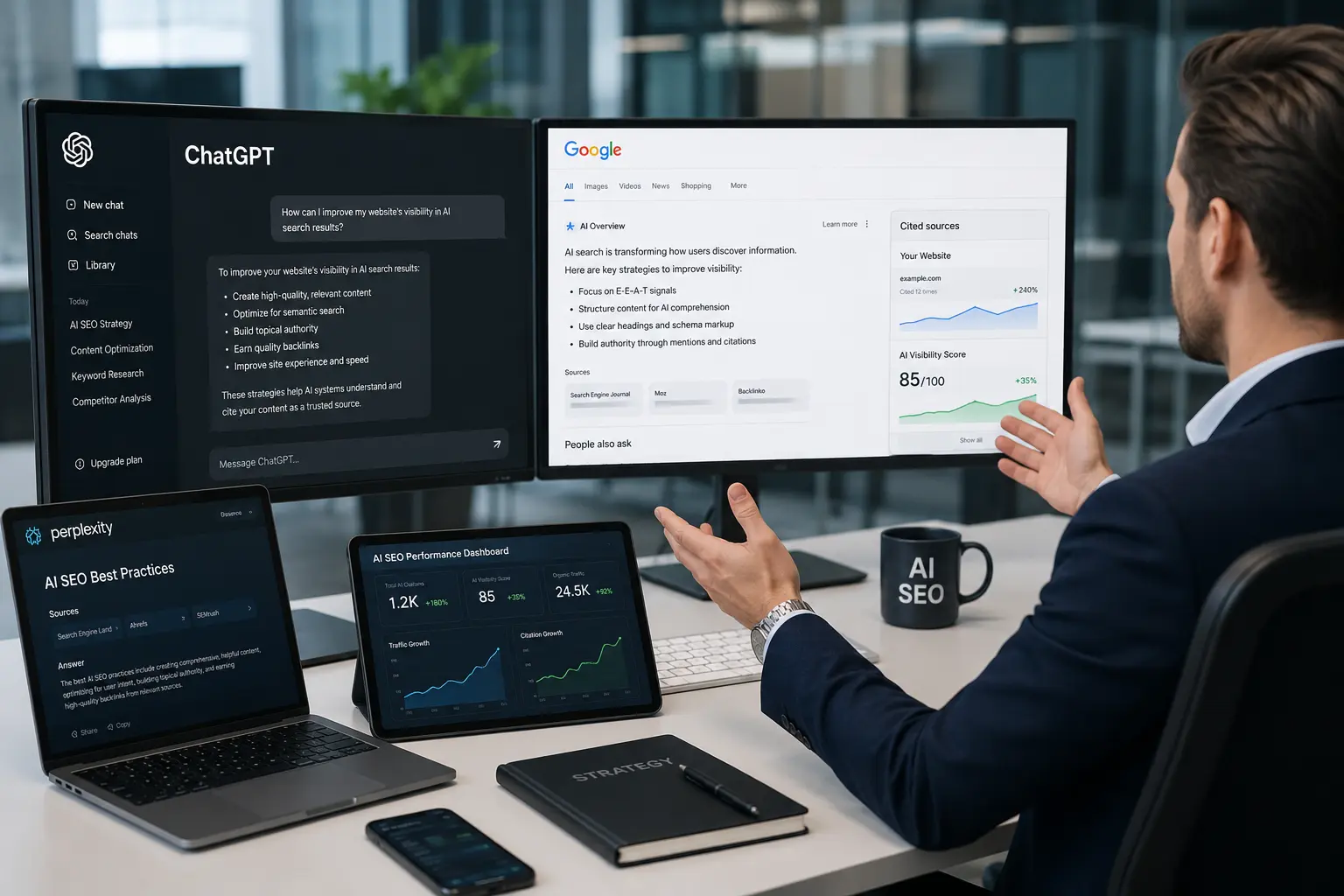
Search behavior is increasingly split between traditional search engines and AI-powered search. A significant portion of your potential customers still use Google the traditional way and click through to websites, while others are turning to AI platforms for recommendations, comparisons, and direct answers.
Another portion goes directly to ChatGPT or Perplexity for recommendations and never encounters your site at all. Recent research has found that AI-generated search experiences can reduce traditional organic click-through traffic, particularly when users receive enough information directly in the search or AI response to avoid visiting a website. The impact varies by industry, query type, and search experience, so your own traffic and visibility data should be analyzed before assuming AI search is the cause of a decline.
That’s not a projection. It’s measured data from searches happening right now while you read this.
Here’s the specific mechanism behind the traffic drop. You might still rank on page one for your most important keywords. But Google is showing a Google AI Overview at the top of those search results that answers the question without requiring a click.
Or your competitor gets cited in the ChatGPT response when someone asks for the best solution in your category, and your brand doesn’t appear anywhere in that answer. You’re ranking but you’re not getting the traffic those rankings used to deliver.
Traditional SEO has historically focused on improving visibility in conventional search results. That work remains important, but it doesn’t automatically tell you whether your brand is being surfaced or cited in AI-generated responses across platforms such as ChatGPT and Perplexity.
So your site can be technically flawless for traditional search while becoming completely invisible to the AI platforms where your buyers are increasingly going for answers.
Right now, your competitors are actively building citations in ChatGPT, accumulating mentions in Perplexity, and earning positions in Google AI Overviews.
The gap isn’t standing still while you evaluate options. AI search systems can draw on previously indexed, retrieved, and cited information when generating answers. That makes consistent, authoritative information about your business increasingly important across your website and relevant external sources.
When a competitor gets established in those patterns first, displacing them later requires substantially more content work, more technical groundwork, and more time than it would have taken to get there ahead of them. This is genuinely a first-mover situation, not a manufactured sales urgency.
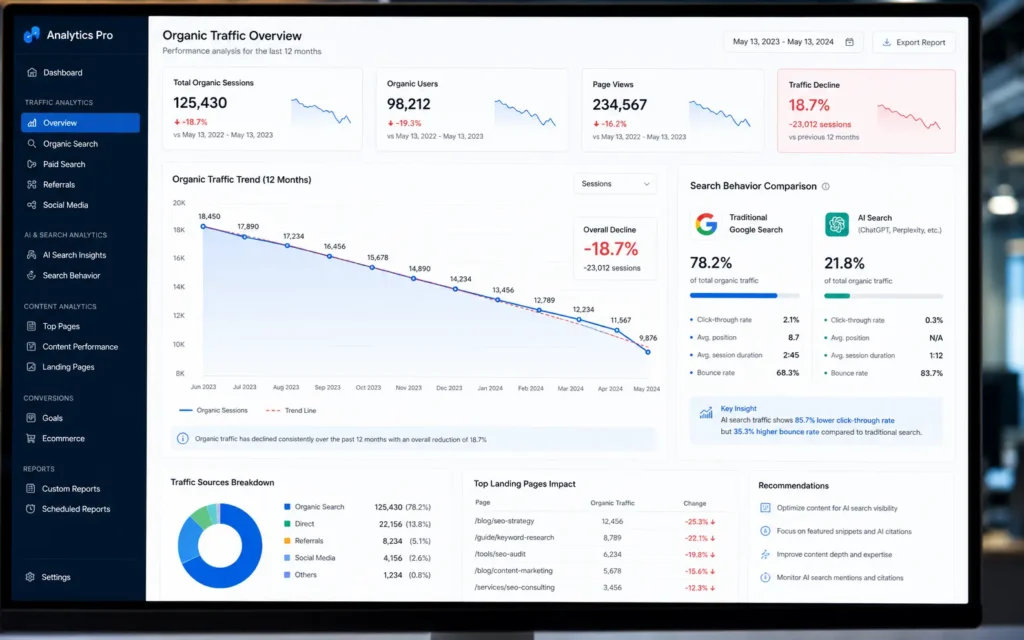
Your organic traffic growth has likely stalled because search behavior shifted without a visible announcement. Some of your visitors moved to AI search platforms and are getting answers there.
Some of your clicks got absorbed by Google AI Overviews that answer questions directly on the search results page without requiring a visit to your website.
And your brand visibility in AI search is probably low or nonexistent right now, because nothing on a standard SEO-optimized site is built for how AI models extract and cite information. We test that with your specific brand before we make assumptions.
That’s exactly the problem our AI SEO services were built to solve. We work with businesses that are serious about maintaining their organic visibility as search behavior shifts, and we give them a measurable presence in the AI platforms their buyers are already using. The section below explains specifically how we do that.
GET IN TOUCH
Get Your Free AI Search Visibility Audit – See Where You Rank in ChatGPT & Perplexity
WHAT MAKES AN AI SEO COMPANY DIFFERENT FROM A TRADITIONAL SEO AGENCY?
An AI SEO company optimizes your business to get cited by artificial intelligence platforms like ChatGPT, Perplexity, Google AI Overviews, and Gemini, the platforms your buyers increasingly use to find solutions. Traditional search engine optimization agencies focus exclusively on ranking your website in Google’s blue link results. Both matter for your overall search visibility, but they require different technical approaches and produce different measurable outcomes.
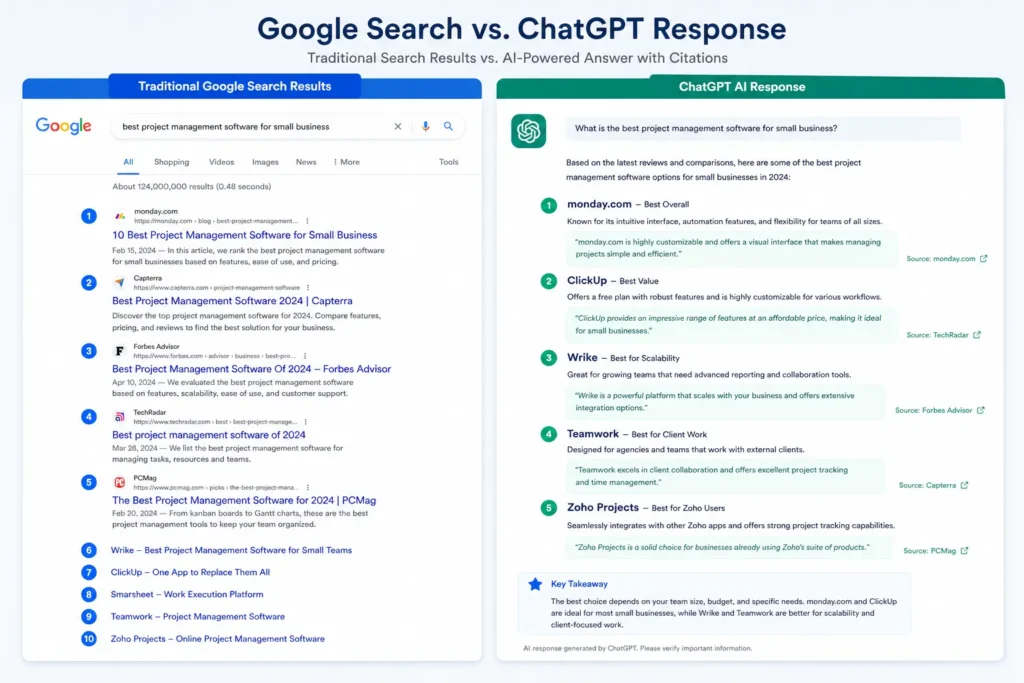
Traditional SEO focuses on earning visibility in search results. AI SEO also focuses on getting your brand and content cited in AI-generated answers when potential customers ask platforms such as ChatGPT or Perplexity for recommendations, comparisons, or solutions.
When someone searches Google, they see your site at position 3 or 7. When someone asks ChatGPT for recommendations in your category, they either see your brand in the answer or they don’t. There’s no position 3 in AI search. You’re either cited or invisible, and right now, most businesses are invisible because nobody optimized their content for how AI models extract and present information.
The technical term is LLM SEO, which stands for large language model optimization. You might also hear it called generative engine optimization (GEO) or answer engine optimization (AEO). All three describe the same practice: making your site understandable enough for AI systems to cite when answering questions about your industry.
And the requirements are different enough that you can rank perfectly on Google and still get zero AI citations.
The Three Technical Differences Between Traditional SEO and AI SEO
Content Structure
Traditional SEO rewards well-written paragraphs with natural keyword placement. AI systems can benefit from content that answers the underlying question clearly and early rather than burying the key point beneath several paragraphs of background information. We therefore restructure important sections so the main answer is easy to identify, followed by supporting context and evidence.
If your answer is buried in paragraph four, ChatGPT skips your page and cites a competitor whose content answers immediately — and that competitor gets the lead, not you. We restructure your content so every important section leads with a clear, extractable statement followed by supporting detail. That content restructuring is one of the fastest ways we improve your AI citation rates because most existing service pages aren’t written this way
Technical Signals
Google evaluates content quality, backlinks, page speed, and mobile usability. AI platforms rely on structured data optimization and entity-based SEO. Structured data is markup code that makes your content machine-readable so AI systems can identify your business type, services, and expertise without ambiguity. Entity-based SEO means making it clear to AI platforms what your business is, what category it belongs to, and how it differs from similar providers. Your schema markup must be implemented correctly, and your business entity must be defined consistently across your entire site. If Perplexity AI can’t determine what you do, who you serve, and how you differ from competitors, the platform won’t recommend you even when your content is excellent. Semantic SEO strategy is how we make those connections explicit and reliable.
Measurement
Traditional SEO tracks keyword rankings and organic traffic in tools like Google Search Console and Analytics. AI SEO requires a completely different measurement framework: citation rate per platform, source attribution quality, prompt-level visibility, and direct traffic arriving from AI-referred visitors. These metrics don’t show up in standard SEO dashboards, which is why most businesses have no idea whether they’re appearing in AI search results at all. We built our own prompt testing infrastructure that checks your brand across 150-plus category-relevant queries monthly on ChatGPT, Perplexity, Gemini, and Google AI Overviews because the only way to know your AI search engine rankings is to test them directly
Why AI SEO Builds ON TOP OF Traditional SEO (Not Instead Of)
AI SEO is an additional layer, not a replacement. You still need traditional search engine optimization fundamentals working correctly before AI optimization adds any value: fast page speed, mobile-ready design, quality content, clean site structure, proper indexing, and solid backlinks.
If your technical SEO audit reveals foundation problems, AI platforms struggle to cite you for exactly the same reason Google struggles to rank you: the platform can’t extract reliable information from a technically broken or poorly structured site.
Google has stated directly that AI Overview eligibility has no separate technical requirements beyond normal indexing standards; the same signals that improve your organic search rankings also improve your AI visibility. We add schema clarity, content restructuring, and entity mapping on top of that existing foundation. This means you don’t have to choose between traditional SEO and AI optimization. You build one on top of the other.
AI SEO WON’T HURT YOUR GOOGLE RANKINGS—HERE’S WHY
Many businesses worry that optimizing for AI search engines will hurt their Google rankings. We understand that fear. You’ve worked hard to build your organic search rankings, and you don’t want to risk losing them for something new.
But AI SEO won’t damage your Google performance. Here’s why.
Google uses the same quality signals for both traditional search and AI overviews. Google has stated directly that Google AI Overviews have no separate technical requirements beyond what’s already needed for normal indexing and ranking. The pages that appear in AI Overviews are the same pages that rank well in traditional search results. There are no conflicting optimization requirements between the two systems.
The technical changes AI SEO requires actually improve your traditional SEO at the same time. Better schema markup, for example, helps Google understand your content more precisely, which typically improves the click-through rate on your existing rankings.
Clearer entity signals make your business easier for Google to categorize and rank correctly. More structured content with direct answers at the top of each section improves user experience signals that both Google and AI platforms use to evaluate quality. Every improvement we make for AI visibility is simultaneously strengthening the same technical foundation that your Google rankings depend on.
This holds up in practice across the client work we’ve done. We track both Google rankings and AI visibility throughout every campaign, and we’ve consistently found that the underlying quality improvements we make for AI optimization carry over to traditional search performance as well.
In campaigns where we’ve had six months or more of data, Google rankings have either improved or held steady because better content structure, clearer entity signals, and properly implemented schema markup are improvements that both systems recognize. If we ever detected a ranking decline during an active campaign, we’d diagnose and adjust before the next optimization cycle
Our commitment is straightforward. We monitor both Google rankings and AI visibility throughout your campaign, not just at the end. If we detect any unexpected ranking movement in either direction, we communicate it within 48 hours and propose a specific adjustment before the next work cycle begins. You’re not left wondering what’s happening to your rankings while we work.
AI-POWERED SEO SERVICES: WHAT YOU’LL ACTUALLY RECEIVE
Most service descriptions for AI SEO are vague because the work itself is still new and many providers are still figuring out their own methodology.
We’ve been doing this long enough to describe our process precisely. Our AI-powered SEO services are organized into six specific workstreams, each producing deliverables you can see and verify. The workstreams below cover the complete scope of what we do from initial AI visibility testing through ongoing monthly reporting
We start by testing where you currently appear in AI search results, then fix the technical foundation that AI models rely on, then optimize your content for AI citation optimization, and finally track your progress with detailed monthly reporting. You’ll know exactly what we’re doing and exactly what results you’re getting from our work.
AI Visibility Baseline Audit: Where You Appear (and Don’t) Across 4 AI Platforms
We test your brand across ChatGPT, Perplexity AI, Google AI Overviews, and Gemini using 50 to 150 category-relevant prompts that your buyers actually use. You’ll receive a detailed audit report showing your citation rate per platform, which competitors appear instead of you, and priority prompt targets where you should be cited but currently aren’t.
Most businesses are shocked to discover they have zero AI search visibility even when they rank well on Google. This baseline audit shows you exactly where you stand before we start any optimization work.
Schema Markup and Structured Data Implementation
We implement or fix Organization, Product, Article, FAQ, HowTo and other relevant schema types following Google’s structured data guidelines across your critical pages. Structured data optimization makes your content machine-readable so AI models can extract accurate information about your business, your services, and your expertise.
Structured data optimization makes your content machine-readable so AI models can extract accurate information about your business, your services, and your expertise.
You’ll receive a technical report showing which schema types we implemented, which pages we optimized, and validation screenshots proving the markup is working correctly. AI platforms rely heavily on structured data to understand what your business offers and how you differ from competitors.
Entity Clarity and Mapping
We ensure AI models understand your business entity by aligning signals across your content, schema, internal links, and external citations. Entity-based SEO involves defining exactly what your business is, what you offer, and how you’re positioned in your market.
You’ll receive an entity mapping document showing how we’ve clarified your business identity across your website. This semantic SEO strategy work ensures AI platforms consistently describe your business accurately instead of getting confused about what you do or mixing you up with similar companies.
Content Restructuring for Answer Extraction
We rewrite priority pages so the direct answer to the buyer’s question appears clearly in the first two or three sentences. Content optimization for AI search requires a different structure than traditional SEO copywriting. AI models need quotable, standalone answers they can extract without paraphrasing.
You’ll receive content revisions for your most important pages with before and after examples showing exactly what changed. Our approach builds on the same content optimization principles we use in our SEO content writing services, but specifically structured for AI platforms to extract and cite your expertise directly.
This restructuring makes it easy for ChatGPT and Perplexity to cite your content directly instead of skipping your pages for competitors whose content answers questions more clearly.
Prompt Coverage Strategy
We identify the 100-plus prompts and conversational queries your buyers use in ChatGPT SEO optimization and Perplexity SEO searches. These differ significantly from Google keyword searches because people ask AI platforms questions in natural language rather than typing keyword phrases.
You’ll receive a prompt coverage map showing which buyer questions you currently answer and which gaps need new content. We then create or optimize pages to target each major prompt cluster so you appear in AI-generated answers when prospects ask about solutions in your category.
Monthly AI Search Reporting
You’ll receive a monthly dashboard showing citation rate per platform, citation quality scores, source attribution tracking, prompt-level visibility changes, and traffic from AI-referred visitors in your analytics. Our SEO reporting and analytics system tracks AI search engine rankings the same way traditional SEO tracks Google rankings.
This reporting proves the work is producing measurable results. You’ll see exactly which prompts are now citing your business, which platforms are driving the most AI-referred traffic, and how your citation rates improve over time as AI models re-index your optimized content.
HOW AI SEO ACTUALLY WORKS: OUR STEP-BY-STEP PROCESS
What happens after you hire us follows four distinct phases spread over the first six months. Each phase has defined timelines, specific deliverables, and clear milestones so you know exactly where we are and what’s coming next.
We start with discovery and diagnosis, move into technical implementation, then focus on content optimization and testing, and finally establish ongoing monitoring and refinement. Each phase has clear timelines and deliverables so you know exactly what we’re working on and when you’ll see results.
Most clients see their first AI citations within 8 to 12 weeks, with citation rates improving steadily over months 3 through 6 as AI models re-index the improved content.
Phase 1 (Weeks 1-2): AI Visibility Discovery and Audit
We test your brand across 50 to 150 prompts on ChatGPT, Perplexity, Gemini, and Google AI Overviews to establish your current AI search visibility baseline. Our technical SEO audit covers your schema markup, entity signals, content structure, and crawlability foundation. We analyze which competitors are getting cited instead of you and identify the technical or content gaps causing those citation losses.
You’ll provide access to your website analytics and any existing SEO documentation. We handle all the prompt testing, technical analysis, and competitive research. You’ll receive a detailed audit report showing exactly where you appear in AI search results, where you don’t, and a priority roadmap outlining what needs to change first.
This keyword research and strategy phase reveals which buyer questions you should be answering but currently aren’t optimized for.
| Area | Traditional SEO | AI SEO |
|---|---|---|
| Primary goal | Improve visibility in conventional search results | Improve visibility in AI-generated answers |
| Main platforms | Google and other search engines | ChatGPT, Perplexity, Gemini, Google AI Overviews and other AI search experiences |
| Content focus | Search intent, topical relevance, useful content and crawlability | Clear, extractable answers combined with strong topical and entity context |
| Technical foundation | Indexing, crawlability, site performance, internal linking, structured data | The same technical foundation plus stronger entity and machine-readable context |
| Measurement | Rankings, organic clicks, impressions, conversions | AI mentions/citations, prompt visibility, source attribution and AI-referred traffic |
| Key outcome | More visibility and organic clicks | Greater likelihood of being surfaced, mentioned or cited in AI-generated answers |
Phase 2 (Weeks 3-6): Technical Foundation and Schema Implementation
We implement or fix schema markup across your priority pages using organization, product, article, FAQ, and HowTo structured data types. Our entity-based SEO work clarifies your business identity in your content, internal links, and structured data so AI models understand exactly what you offer and how you differ from competitors.
We optimize site speed and crawlability issues that prevent AI bots like GPTBot and PerplexityBot from accessing your content properly. You’ll approve major content changes before we publish anything. We handle all the structured data optimization and technical implementation work.
You’ll see technical changes rolled out across your site with validation reports proving the markup is working correctly.
Phase 3 (Weeks 7-12): Content Optimization and Prompt Coverage
We restructure existing priority pages so they answer buyer questions directly and quotably in the first two to three sentences. Our content optimization for AI search work creates new pages to cover prompt gaps where you currently have no optimized content targeting specific buyer questions.
We test each change across all four AI platforms to verify citation improvements and adjust our approach based on what’s working. You’ll receive content drafts for approval before publishing and citation test results showing which pages are now getting quoted by ChatGPT SEO optimization and other platforms.
This search intent optimization phase focuses on making your content more quotable and citation-worthy.
Phase 4 (Month 4+): Ongoing Monitoring and Continuous Improvement
We track your AI search visibility monthly across all platforms and prompts to identify citation rate trends and new opportunities. Our SEO reporting and analytics system monitors traffic from AI-referred visitors and adjusts optimization strategy based on performance data.
We identify new prompt opportunities as your market evolves and refine content based on which citation approaches are working best. You’ll receive monthly reports showing citation rate improvements, AI search engine rankings changes, and optimization recommendations for the following month.
Most clients see steady citation rate improvement over months 3 through 6 as AI models re-index the enhanced content and begin citing your brand more frequently.
WHAT AI SEO COSTS: INVESTMENT FRAMEWORK AND PRICING FACTORS
Most AI SEO companies don’t publish pricing. We do, because we think you should be able to evaluate the investment before you spend time on a discovery call. AI SEO services typically run between $2,500 and $6,000 per month depending on scope, with initial implementation taking 3 to 6 months and ongoing monthly optimization continuing after that.
We’ve been working on AI search optimization since ChatGPT launched in 2022, and our pricing reflects the actual scope of work the results require.
What Affects Your AI SEO Investment
Five factors determine where your project falls in the pricing range:
Website size and complexity. Larger sites with 100-plus pages require more schema work and content optimization than 20-page service sites. An eCommerce site with product catalogs needs different optimization than a law firm with basic service pages. The number of pages we need to optimize directly impacts the monthly investment.
Number of AI platforms tracked. Tracking visibility across all four major platforms (ChatGPT, Perplexity, Gemini, and AI Overviews) costs more than focusing on one or two. Most clients want comprehensive coverage, but smaller budgets can start with ChatGPT and AI Overviews, then expand later.
Current technical foundation. Sites with poor existing SEO require more foundational work before AI optimization can happen. If your site has broken schema, slow loading times, or crawlability issues, we need to fix those problems first. Sites with solid technical foundations can move directly to AI-specific optimization.
Competition level. Highly competitive industries require more aggressive prompt coverage and content production. If your competitors are already investing heavily in AI SEO, displacing them requires more content and technical work than being first to market.
Content production volume. Projects requiring 20-plus new pages cost more than optimizing existing content only. Some sites need extensive new content to cover buyer questions they currently don’t address. Others just need existing pages restructured for better AI citation.
What’s Included in Monthly AI SEO Service
Your monthly fee covers ongoing monitoring across all AI platforms, content optimization based on citation performance data, technical updates as AI crawling requirements evolve, SEO reporting and analytics showing citation improvements, and strategy adjustments based on what’s working best for your market.
This isn’t a one-time setup project. AI SEO requires continuous optimization because AI models update regularly and your competitors adjust their strategies. The monthly service ensures your visibility stays strong as the landscape changes.
We’ll provide an exact quote after your free AI visibility audit, once we understand your specific situation. No surprises, no hidden fees.
WHY CLIENTS CHOOSE US AS THEIR TRUSTED AI SEO COMPANY
We’ve been tracking AI search visibility since ChatGPT launched in late 2022. Most businesses didn’t know what LLM optimization meant at that point, and most marketing agencies didn’t either. We were testing what actually moved AI citation rates before the category had a standard name.
That early start means we’ve accumulated real data on what works, what doesn’t, and how AI model behavior changes when those platforms update their underlying systems, not from reading industry articles, but from running the tests ourselves.
AI SEO Results We’ve Delivered
Our clients see measurable AI search visibility improvements within the first six months.
A B2B software company we worked with went from appearing in zero of our 150 monthly test prompts to appearing in 42% of the same prompts within five months of optimization. This kind of growth is exactly what we help achieve through our B2B SEO agency services, where we connect AI search visibility to actual lead generation and pipeline growth.
A legal services firm moved from appearing in 2 of 15 priority AI overview searches to appearing in 8 of those same 15 searches after four months. An eCommerce brand saw traffic arriving from AI-referred visitors increase by 67% in the first full quarter, measured in their Google Analytics against the prior quarter’s baseline.
We track results differently than traditional SEO because AI search requires different metrics. Citation rate improvements, AI Overview appearances, and source attribution quality matter more than keyword rankings when measuring ChatGPT SEO optimization success.
These results happen because we built our own AI visibility tracking system that tests your brand across 150-plus prompts monthly, something most agencies can’t offer because they don’t have the technical infrastructure.
What Clients Say After Working With Us
“Before working with them, we had zero visibility in ChatGPT searches for our industry. Now we appear in AI-generated answers about 35% of the time when people ask for software recommendations in our category. That’s translating to real qualified leads contacting us directly.”
— Sarah Chen, Marketing Director, TechFlow Solutions
“Their monthly reports show exactly which AI platforms are citing our law firm and for which types of legal questions. We’re getting client calls from people who found us through Perplexity searches, which never happened before. The transparency in their reporting is remarkable.”
— Michael Rodriguez, Partner, Rodriguez & Associates
“What impressed me most was their honesty about timelines. They told us upfront it would take 3-4 months to see meaningful results, and they were exactly right. No overpromising, no surprises. Just steady progress we could track every month.”
— David Park, CEO, GreenTech Innovations
You’re not hiring an agency that’s guessing about AI SEO. You’re hiring specialists who’ve successfully implemented AI search optimization for businesses across technology, professional services, and eCommerce industries.
GET IN TOUCH
Ready to Get Cited by AI Search Engines? Start Your Free AI SEO Audit Today
AI SEO QUESTIONS WE HEAR FROM EVERY NEW CLIENT
What exactly is AI SEO, and how is it different from regular SEO?
Regular SEO optimizes your website to rank in Google’s blue-link search results, while AI SEO optimizes your content to get cited by ChatGPT, Perplexity AI, Google AI Overviews, and Gemini. AI SEO requires direct answers in the first few sentences, heavy schema markup for machine readability, and tracking citation rates instead of keyword rankings.
How do you actually track visibility in ChatGPT and Perplexity?
We test your brand across 50 to 150 category-relevant prompts monthly on ChatGPT, Perplexity, Gemini, and Google AI Overviews, documenting whether you appear in each response. You’ll receive monthly reports showing your citation rate per platform with comparisons to your competitors’ citation rates.
Will AI SEO hurt my current Google rankings?
No, the technical improvements AI SEO requires actually help Google understand your site better through better schema markup, clearer entity signals, and more structured content. We monitor both Google rankings and AI visibility throughout your campaign, and Google rankings either improve or stay stable because both systems reward the same quality fundamentals.
How long does it take to see AI SEO results?
Most clients see their first ChatGPT or Perplexity citations within 8 to 12 weeks after we implement schema and content changes. Meaningful citation rate improvements typically take 3 to 6 months because AI models re-index content on their own schedules.
How much do AI SEO services typically cost?
Most AI SEO services run $2,500 to $6,000 per month depending on your website size, number of AI platforms tracked, and content production needs. We provide an exact quote after your free AI visibility audit once we understand your specific situation.