Your Systems Aren’t Talking to Each Other and That’s Costing You Every Day
Your CRM has no idea what your ecommerce store just sold. Your accounting tool is waiting for payment data that your payment gateway already processed an hour ago. And somewhere in your business, someone is copying and pasting information between two systems that should have been connected years ago.
That is not a small inefficiency. It adds up fast.
Every manual data entry is a chance for an error. Every hour your team spends moving information between disconnected platforms is an hour they are not spending on actual work. And when customer records do not match across your systems, the decisions you make based on that data are only as good as the last time someone remembered to update both places.
We have seen this exact situation across businesses of every size. The tools are good. The data is there. But without proper app connectivity and data flow automation, nothing talks to nothing and someone is always playing catch-up.
Our API integration services connect your systems so data moves automatically, accurately, and in real time. No more manual syncing. No more mismatched records. No more wasted hours.
If your systems are disconnected and your team is paying the price, keep reading — or jump straight to [Get a Free Quote].
What API Integration Services Actually Do for Your Business
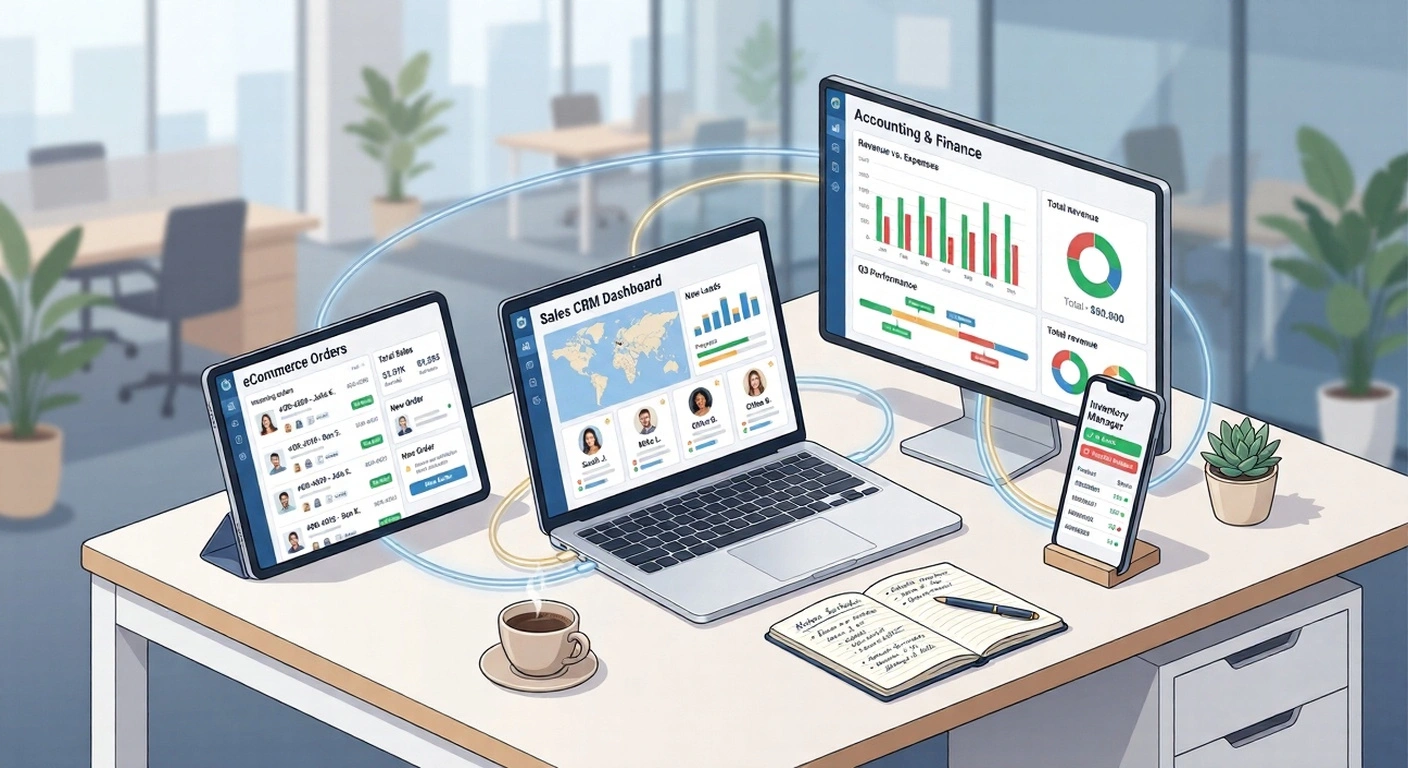
At the most practical level, API integration services connect your business systems so they can exchange data automatically, without anyone on your team doing it manually. When a customer places an order, your inventory adjusts, your CRM logs the new contact, and your accounting tool records the sale. That gives your team access to integrated data and real time data across the systems they rely on, while automating repetitive business processes behind the scenes. Nobody copied anything. Nobody switched between tabs. Nobody forgot to update one of the systems.
That is what a properly built integration actually looks like in practice.
An API, or application programming interface, is the set of rules that allows two software systems to communicate with each other. According to Mozilla’s comprehensive API guide, APIs serve as intermediaries that enable different applications to request and share data seamlessly. As your API integration service provider, our job is to build and maintain those connections so your platforms work together the way they were always supposed to
But not every integration works the same way. The right setup depends on what your business actually needs the data to do.
GET IN TOUCH
Stop Playing Data Catch-Up — Get Your Free Integration Assessment
Integration Patterns We Use and When Each One Fits
Most businesses need one of several types of custom API integrations, and choosing the wrong approach can create problems that show up months later. The right API solution depends on how your systems exchange data, how quickly information needs to move, and how much custom business logic the integration needs to handle.
One-way data sync pushes data from one system to another on a set schedule. This works well for reporting, backups, and situations where one system is the clear source of truth and the other just needs to stay updated.
Two-way sync keeps data consistent across both systems in real time. If a contact gets updated in your CRM, the change reflects in your ecommerce platform too. This is the pattern most businesses need when sales and marketing teams are working from the same records.
Event-driven webhooks fire the moment something specific happens rather than waiting for a scheduled sync. A payment is processed, a form is submitted, an order status changes the webhook triggers instantly and the connected system responds right away. No delay. No polling.
Multi-system data pipelines chain several integrations together so data flows through a sequence of platforms automatically. A new lead comes in, gets scored, lands in the CRM, triggers an onboarding email, and updates the project management tool. All from a single trigger. This is where REST API connections handle the heavy lifting across your entire stack.
The pattern we recommend for your business depends on how time-sensitive your data is, how many systems are involved, and what happens when data synchronization breaks down. We work through that with you before we build anything.
What Our API Integration Services Include From First Connection to Ongoing Support
Most providers will tell you what API integration is. We are going to tell you exactly what you get when you work with us.
Our custom API integration services cover every part of the process from the initial design of your connection through to the monitoring and maintenance that keeps everything running after launch. You do not need your own developers. You do not need to read a 200-page API documentation guide. You tell us which systems need to talk to each other and what you need the data to do. We handle everything from that point forward.
Here is what is included in every project we take on:
Custom API connection design and build We design the integration specifically for your systems and your business logic, not a generic template dropped into your stack.
Data mapping and transformation We map exactly which fields move between your systems and handle any formatting differences so the data arrives correctly on the other end. This step is where most DIY integrations fail.
Integration testing before launch We run the connection against real data scenarios before anything goes live. We test for errors, edge cases, and failure points so you do not discover problems after launch.
Post-deployment monitoring Once live, we watch the connection. If an error occurs or an upstream API changes, we catch it before your team notices something is wrong.
Ongoing maintenance — APIs change. Platforms update. Authentication methods expire. We handle all of that as part of our service so your integration keeps working without you having to manage it.
This is a managed service. Not a one-time build and goodbye.
Systems and Platforms We Connect
If you use any of the following platforms, we already know how to connect them.
CRM systems: Salesforce, HubSpot
Ecommerce platforms: Shopify, WooCommerce, Magento
Payment gateways: Stripe, PayPal, Braintree
ITSM and service platforms: ServiceNow
Accounting tools: QuickBooks, Xero
These are the platforms that come up most often in the projects we work on, but the list does not stop there. If your SaaS integration involves a platform not listed here, contact us and we will confirm whether we can support it. In most cases, if the platform has a documented API, we can build to it.
We do not limit you to a preset connector library. Custom API integration services exist precisely because not every business runs on the same stack.
Want to know if your specific systems are on our supported list? [Ask Us Now — It’s Free]
Custom API Builds for Systems Without Standard Connectors
Not every system has a clean, well-documented API waiting to be used. Some businesses run on legacy system software that was built before modern integration standards existed. Others use proprietary platforms built in-house that have no off-the-shelf connector available anywhere.
This is not a problem we walk away from.
We build custom API integrations to any specification REST, SOAP, GraphQL, or fully custom API endpoints designed around what your system can actually expose.
Whether you need to connect your existing office management system or legacy platforms, we assess what integration pathways are available at the data level and build an integration solution around what your systems can actually support.
The honest truth is that the most valuable integrations we build are often the ones other providers said could not be done. If your system is unusual, older, or simply not in anyone’s standard connector list, that is exactly the situation our custom software integration work was built for.
GET IN TOUCH
Ready to Connect Your Systems? Get Your Custom Integration Quote in 24 Hours
How Our Integration Process Works From First Call to Live Connection
A lot of businesses hesitate to start an API integration project because they do not know what they are walking into. The process feels technical and unfamiliar, and nobody wants to commit to something they cannot picture. So here is exactly what happens when you work with us, from the first conversation to the moment your systems are live and connected.
Step 1: We map your systems together
The first thing we do is sit down with you usually in a call and ask straightforward questions. Which systems do you use? What data needs to move between them? What should happen and when? You do not need to prepare anything technical. You just need to know your own business. We listen ask the right follow-up questions and by the end of that first conversation we have a clear picture of what needs to be built and whether it is feasible. If it is not the right fit we tell you that too.
Step 2: We review the APIs and design your connection
This is where our team goes to work on the technical side. We pull the API documentation for each platform, review the available endpoints, understand the data formats whether that is JSON, XML, or something else and map out exactly how the data will flow between your systems. You do not read a single line of documentation. We bring you a plain-language plan that shows what the integration will do, and you approve it before we build anything.
Step 3: We build and test before you see anything live
Once the plan is approved, we build the connection and run it through integration testing with real data scenarios. We check that data mapping works correctly at every field level, that REST API calls return the right responses, and that error handling catches problems before they reach your live environment. Most issues that would cause headaches after launch get resolved during this phase. And that is exactly the point.
Step 4: We go live together
We deploy the integration with you present and walk you through what is happening in plain language. You see the connection running, you watch data move between your systems, and you confirm that everything works the way you expected. We do not push it live and send you an email. We do it together.
Step 5: We monitor and maintain the connection
This is the step most providers skip entirely.
Once your integration is live, we keep watching it. APIs change. Platforms push updates. API endpoints get deprecated. Authentication credentials expire. When any of that happens, we catch it and handle it before your data stops moving. You get notified of what changed and what we did to fix it not the other way around, where you notice something is broken and then contact us.
The integration does not end at launch. Neither does our responsibility for it.
What You Need to Have Ready (And What You Don’t)
The most common reason businesses delay starting an integration project is the belief that they need to understand the technical side before they can have a useful conversation with a developer. You do not.
Here is what you actually need: know which platforms you use and have a general idea of what data you need to move between them. That is it. You do not need to have read the API documentation. You do not need to know what OAuth is or how authentication works. You do not need to understand data mapping or have a JSON structure prepared.
All of that is our job. You bring the business knowledge. We bring the technical expertise. Between those two things, we have everything we need to get started.
Industries and Business Situations We Solve This For
The fastest way to know whether we can help you is to see whether your industry shows up here. If it does, we have built this exact type of integration before and we already know which platforms connect poorly, which data transformations always cause issues, and what the final result should look like when everything is working properly.
Ecommerce Connecting Your Store to Everything Behind It
If you run an online store on Shopify, WooCommerce, or Magento, the number of systems you need to keep in sync grows every time you scale. Orders need to flow into your ERP. Inventory needs to update in real time across your store, warehouse system, and accounting platform. Shipping carriers need tracking numbers sent back to the store automatically.
We handle ecommerce platform integration so that when a customer places an order at 2 AM, your inventory adjusts, your accounting tool logs the sale, your warehouse gets the pick list, and your customer gets a tracking number all without anyone touching a keyboard. No manual entry. No data synchronization delays that leave your stock count wrong for hours.
SaaS Companies Building Integrations Your Customers Need
If you sell a SaaS application, your customers expect it to connect with the tools they already use. They want your platform talking to their Salesforce CRM, their HubSpot marketing automation, their ServiceNow service desk, or their QuickBooks accounting system. These system integrations need to work reliably before customers finish onboarding, because disconnected tools can quickly become a barrier to adoption.
Building those SaaS integrations in-house pulls your development team away from your core product. We build the integration layer for you — so your customers get the connections they need and your team stays focused on what they were hired to build. This is how smaller SaaS companies compete with platforms that have 200-person integration teams.
Payments and Fintech Secure Gateway Connections That Actually Work
Payment gateway integration is not something you get to be wrong about. When Stripe, Braintree, PayPal, or a banking API is moving money between systems, the connection needs to be secure, accurate, and monitored around the clock. One missed transaction or failed reconciliation creates customer service chaos and financial reporting problems that take days to untangle.
We build payment integrations with API security and compliance handled from the start. Your payment data flows to your accounting system, your fraud detection tools, and your reporting dashboards without exposure risk. And when a payment gateway pushes an API update that breaks half the integrations on the internet, yours keeps working because we caught it before it went live.
Enterprise and Legacy System Modernization
If your business runs on systems that were built before REST APIs became the standard, you are not stuck. We have connected ERP platforms from the early 2000s to modern cloud-based ERP systems, proprietary databases with custom schemas, and mainframe systems that nobody outside your company has ever heard of. No system is too old to integrate if it has any data access layer at all.
Enterprise integration work and legacy system integration is where most providers walk away and tell you to replace the whole platform. We do not. If your old system still runs the core of your business and replacing it would cost six months and seven figures, we find a way to connect it to everything modern around it. Custom software integration for systems without standard connectors is exactly the type of project we were built to handle.
How We Keep Your Data Secure Before, During, and After Integration
When you connect two business systems, data moves between them. Sometimes that data includes customer records, financial transactions, payment information, or proprietary business logic. And the question you should be asking every API integration provider is this: how do you make sure none of that data ends up somewhere it should not be?
Here is our answer.
We use OAuth 2.0 authentication for all API connections. That means no passwords are stored anywhere in the integration. Instead, each system grants limited access through secure tokens that can be revoked instantly if needed. If a token expires or a credential changes, the connection stops working until we replace it — which is exactly what should happen.
All data moving between your systems is encrypted in transit using TLS and HTTPS protocols. The data does not travel in plain text. If you are handling particularly sensitive information that needs encryption at rest as well, we design for that from the start.
Role-based access controls mean that each API connection only touches the specific data it needs to function. Your payment gateway does not get access to your entire CRM database. Your accounting tool does not see inventory data it has no reason to touch. We configure API security with the minimum permissions required for each integration to do its job and nothing more.
We also rotate API keys and manage credential lifecycles as part of the service. When platforms push authentication updates or deprecate old methods, we handle the transition before your connection breaks.
For enterprise projects where SOC 2 compliance or similar standards apply, we build integrations within those frameworks. We do not store your business data on our systems. We build the connection. Your data moves directly between your platforms. We are not a middleman holding copies of anything.
And once your integration is live, our monitoring watches for more than just data synchronization errors. We track authentication failures, unexpected access patterns, and any activity that looks like an unauthorized attempt to reach your systems. If something does not look right, we investigate before it becomes a problem.
What Happens After Your Integration Goes Live Support, Monitoring, and Maintenance
APIs change. Platforms push updates to their endpoints, deprecate features you were using last month, and change authentication requirements with two weeks notice. An integration built by someone who delivers the code and disappears will break within six months. Maybe sooner.
We do not work that way.
Once your integration is live, we monitor the connection around the clock. We watch for error handling failures, data synchronization issues, authentication problems, and anything else that could interrupt the flow of data between your systems. If something breaks at 3 AM, we know about it before you do. And we start fixing it before your first employee logs in.
When an upstream API announces breaking changes and they will we get notified and assess the impact on your integration immediately. If the change affects your connection, we make the necessary updates and test them before the old version stops working. You get an email telling you what changed and what we did. Not the other way around, where you notice your data stopped moving and then contact us to ask why.
We also offer ongoing maintenance agreements for businesses that want a long-term partner rather than a one-time build. Your business grows. Your data volume increases. You add new systems to your stack. A scalable integration is one that adjusts to those changes without requiring a full rebuild every time your needs evolve.
The difference between hiring a developer and hiring a partner is what happens after the work is delivered. We stay. The integration keeps working. And when something in the ecosystem changes, we handle it.
Why Businesses Choose Our API Integration Services Over Building It Themselves
You have three real options when you need systems connected. Build the integration yourself with internal developers. Use a self-service iPaaS platform like Zapier or Tray. Or choose managed API integration solutions like ours when you need custom development, reliable system connections, and ongoing support.
Here is when each option actually makes sense.
Building it yourself with your own developers works when you have a large internal development team with specific integration expertise and ongoing bandwidth to maintain what they build. Most businesses do not have that combination. Even businesses with strong development teams often do not have integration developers on staff — because integration is a specialized skillset that is different from building applications.
iPaaS platforms like Zapier and similar middleware tools work very well for simple, popular app-to-app connections with minimal custom logic. If you need a form submission to create a contact in your CRM, Zapier can do that in ten minutes. But iPaaS platforms hit walls fast when the business logic gets complex, when your systems are not in their connector library, or when the data transformation requires more than basic field mapping. And when you outgrow the platform, you are back to square one.
Our custom enterprise API integration services are the right fit when the integration involves complex data transformation or custom business logic that an off-the-shelf tool cannot handle. We can build custom integrations when your systems include enterprise platforms, legacy software, or proprietary applications that do not have standard connectors. This is also a strong option when your team does not have integration developers in-house or when the integration is business-critical and downtime is not an option. A scalable integration built and monitored by specialists is more reliable than one maintained by a generalist developer who also has ten other projects.
The integration cost comparison is straightforward. Hiring an integration developer full-time for a project that takes 2 to 12 weeks of specialized work costs more and takes longer than hiring us to build, test, deploy, and monitor the connection as a service. You get the integration without the overhead of managing the person who built it.
Ready to Connect Your Systems? Here’s Your Next Step
You tell us what you need connected. We build it, test it, secure it, and keep it running.
Get a free consultation where we review your systems, confirm feasibility, and give you a realistic integration timeline and cost range. No obligation. No sales pressure. Just an honest assessment of what it would take to connect your platforms properly.
Most businesses who contact us get a response within one business day with an initial assessment.
We serve clients across the United States and beyond. If your systems have APIs or any accessible data layer, we can most likely connect the
We work with businesses of all sizes from small teams connecting two systems for the first time to enterprises managing complex multi-platform data pipelines. Our API integration services are built to scale with your needs.
GET IN TOUCH
Your Systems Should Work Together Let’s Make It Happen
Frequently Asked Questions
How much does API integration cost?
Simple integrations range from pkr 25,000-300,000, medium complexity runs 25,000-50,000, and enterprise multi-system integrations start at 25,000+. We provide fixed-price quotes before any work begins no surprises.
How long does an API integration take to build?
Simple integrations take 1-2 weeks, moderate complexity requires 3-6 weeks, and complex enterprise integrations need 6-12 weeks or more. We give realistic timelines in your free consultation not optimistic estimates that slip.
What happens if my integration breaks after it’s built?
Our 24/7 monitoring catches errors before you notice them, and we fix API changes or platform updates before they affect your business. Integrations need ongoing care—we offer maintenance plans to keep yours running smoothly.
Do I need technical knowledge to work with you?
No just tell us which systems you use and what data needs to move between them. We handle all technical work and explain everything in plain language throughout the project.
Can you integrate systems that don’t have standard APIs?
Yes, in most cases we can work with legacy systems using database connections, file exports, or custom endpoints. Very old systems occasionally have no integration pathway, but we’ll assess alternatives and modernization options.