
Custom API Integration Services for Businesses That Can’t Afford Disconnected Systems
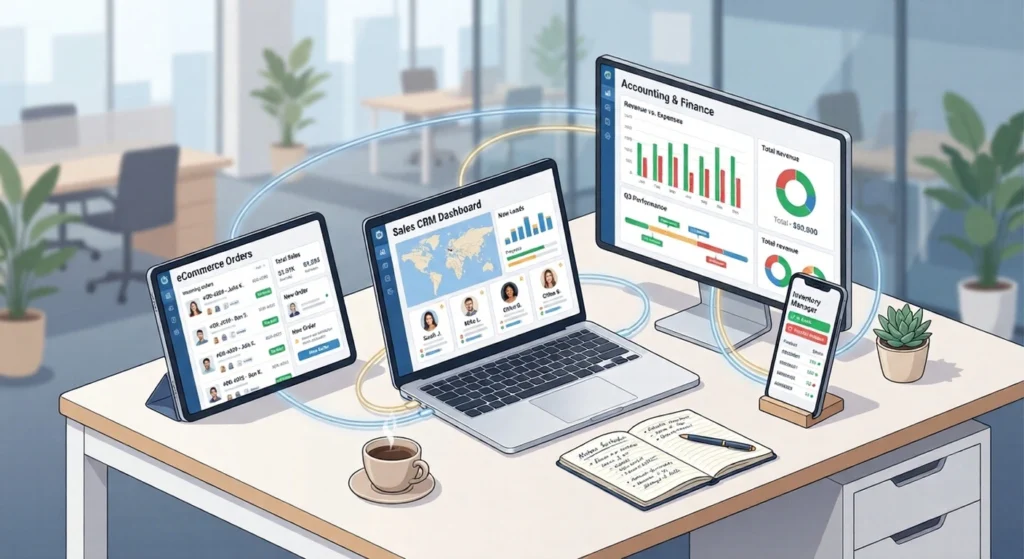
Your Systems Aren’t Talking to Each Other and That’s Costing You Every Day Your CRM has no idea what your ecommerce store just sold. Your accounting tool is waiting for payment data that your payment gateway already processed an hour ago. And somewhere in your business, someone is copying and pasting information between two systems that should have been connected years ago. That is not a small inefficiency. It adds up fast. Every manual data entry is a chance for an error. Every hour your team spends moving information between disconnected platforms is an hour they are not spending on actual work. And when customer records do not match across your systems, the decisions you make based on that data are only as good as the last time someone remembered to update both places. We have seen this exact situation across businesses of every size. The tools are good. The data is there. But without proper app connectivity and data flow automation, nothing talks to nothing and someone is always playing catch-up. Our API integration services connect your systems so data moves automatically, accurately, and in real time. No more manual syncing. No more mismatched records. No more wasted hours. If your systems are disconnected and your team is paying the price, keep reading — or jump straight to [Get a Free Quote]. What API Integration Services Actually Do for Your Business At the most practical level, API integration services connect your business systems so they can exchange data automatically, without anyone on your team doing it manually. When a customer places an order, your inventory adjusts, your CRM logs the new contact, and your accounting tool records the sale. That gives your team access to integrated data and real time data across the systems they rely on, while automating repetitive business processes behind the scenes. Nobody copied anything. Nobody switched between tabs. Nobody forgot to update one of the systems. That is what a properly built integration actually looks like in practice. An API, or application programming interface, is the set of rules that allows two software systems to communicate with each other. According to Mozilla’s comprehensive API guide, APIs serve as intermediaries that enable different applications to request and share data seamlessly. As your API integration service provider, our job is to build and maintain those connections so your platforms work together the way they were always supposed to But not every integration works the same way. The right setup depends on what your business actually needs the data to do. ⚡ GET IN TOUCH Stop Playing Data Catch-Up — Get Your Free Integration Assessment 💬 Chat on WhatsApp 📞 Call 0307 3319555 Integration Patterns We Use and When Each One Fits Most businesses need one of several types of custom API integrations, and choosing the wrong approach can create problems that show up months later. The right API solution depends on how your systems exchange data, how quickly information needs to move, and how much custom business logic the integration needs to handle. One-way data sync pushes data from one system to another on a set schedule. This works well for reporting, backups, and situations where one system is the clear source of truth and the other just needs to stay updated. Two-way sync keeps data consistent across both systems in real time. If a contact gets updated in your CRM, the change reflects in your ecommerce platform too. This is the pattern most businesses need when sales and marketing teams are working from the same records. Event-driven webhooks fire the moment something specific happens rather than waiting for a scheduled sync. A payment is processed, a form is submitted, an order status changes the webhook triggers instantly and the connected system responds right away. No delay. No polling. Multi-system data pipelines chain several integrations together so data flows through a sequence of platforms automatically. A new lead comes in, gets scored, lands in the CRM, triggers an onboarding email, and updates the project management tool. All from a single trigger. This is where REST API connections handle the heavy lifting across your entire stack. The pattern we recommend for your business depends on how time-sensitive your data is, how many systems are involved, and what happens when data synchronization breaks down. We work through that with you before we build anything. What Our API Integration Services Include From First Connection to Ongoing Support Most providers will tell you what API integration is. We are going to tell you exactly what you get when you work with us. Our custom API integration services cover every part of the process from the initial design of your connection through to the monitoring and maintenance that keeps everything running after launch. You do not need your own developers. You do not need to read a 200-page API documentation guide. You tell us which systems need to talk to each other and what you need the data to do. We handle everything from that point forward. Here is what is included in every project we take on: Custom API connection design and build We design the integration specifically for your systems and your business logic, not a generic template dropped into your stack. Data mapping and transformation We map exactly which fields move between your systems and handle any formatting differences so the data arrives correctly on the other end. This step is where most DIY integrations fail. Integration testing before launch We run the connection against real data scenarios before anything goes live. We test for errors, edge cases, and failure points so you do not discover problems after launch. Post-deployment monitoring Once live, we watch the connection. If an error occurs or an upstream API changes, we catch it before your team notices something is wrong. Ongoing maintenance — APIs change. Platforms update. Authentication methods expire. We handle all of that as part of our service so your integration keeps working without you having to manage it. This is a managed service. Not a one-time