What We Build: E-commerce App Development Services That Drive Revenue
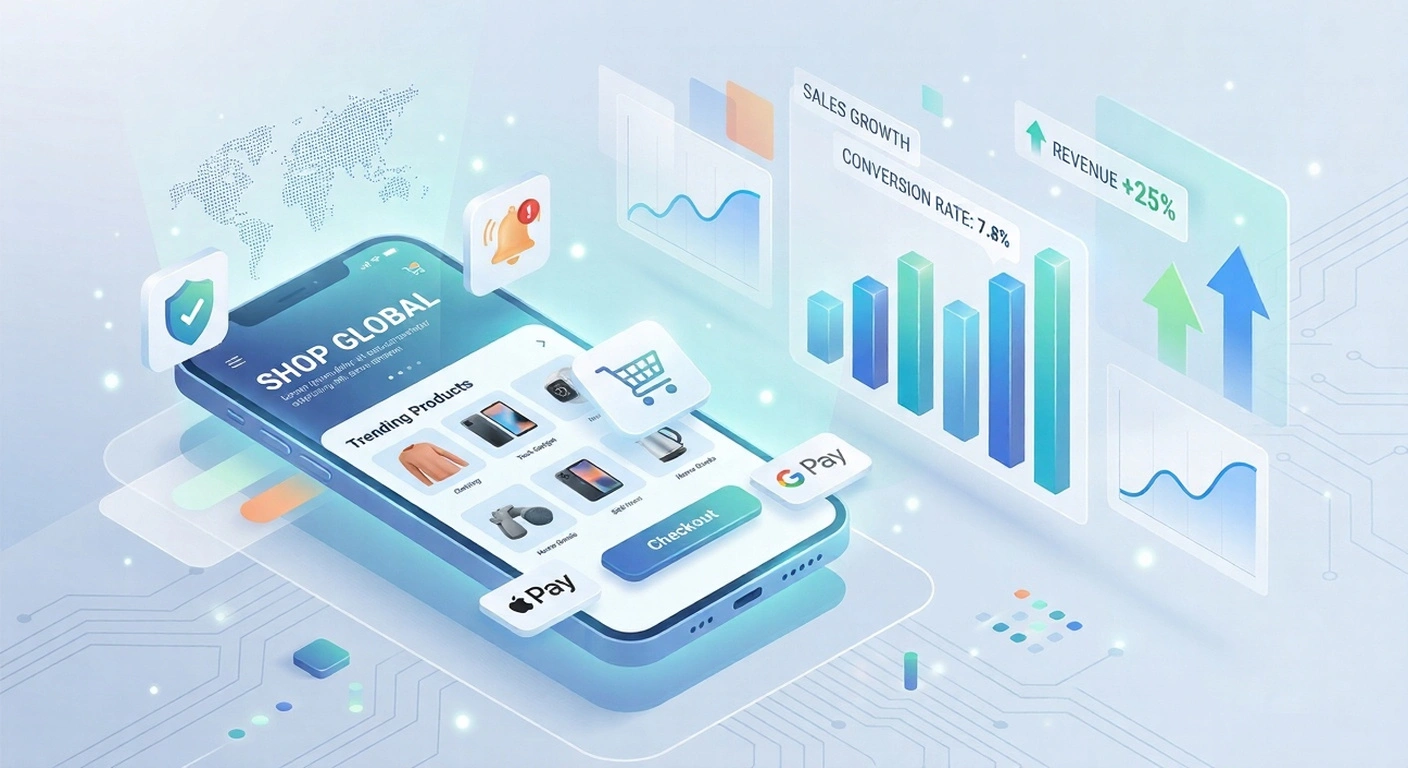
We’ve built 150+ e-commerce mobile apps for retailers, DTC brands, and B2B marketplaces across 12 industries. Our apps don’t just look good. They convert. On average, our clients see a 28% lift in mobile checkout conversions within the first 90 days of launch, cart abandonment drops by 20-40%, and customers who download the app spend 3x more than web-only shoppers.
Whether you’re running a $2M Shopify store or a $50M multi-vendor marketplace, we build e-commerce applications that turn browsers into buyers, with the features and workflows needed to support your specific business model.
Here’s what we specialize in as an ecommerce app development company:
Custom Native iOS & Android Ecommerce Apps
For brands that need maximum performance and full control. We build separate apps in Swift for iOS and Kotlin for Android, which means you get the fastest load times, native features like AR virtual try-on and Apple Pay, and seamless integration with device hardware. Best for companies with the budget to invest in premium mobile experiences and brands where performance is make-or-break.
Shopify & Magento Mobile App Development
Already running an online store on Shopify or Magento? We build native mobile apps that connect directly to your existing backend. Same inventory, same admin panel, better mobile experience. Your customers get push notifications, offline browsing, and checkout flows that convert 30% higher than mobile web. Faster to launch than a fully custom build because we’re building on proven infrastructure you already use.
Multi-Vendor Marketplace App Development
For platforms where multiple sellers list and sell products, like Etsy, eBay, or our client Vici Sneakers. We build vendor dashboards, commission management systems, automated order routing, payment splitting between sellers, and review systems. As a marketplace app development company, we’ve launched 25+ multi-vendor platforms, and we know exactly how to handle the complexity of managing hundreds of sellers in one app.
B2B Ecommerce & Procurement Platforms
Wholesale ordering works differently than retail. We build B2B ecommerce apps with bulk pricing tiers, multi-level approval workflows (so managers can approve purchases before they process), recurring order automation for repeat clients, and direct integration with your ERP or inventory management system. Built for distributors, manufacturers, and wholesalers who need more than a standard shopping cart.
Apps We’ve Built That Made Our Clients Money
Here’s the proof. Real clients, real challenges, real results.
We track conversion rates, customer engagement, user engagement, and revenue impact for every ecommerce app development project we launch. Not just “the client was happy” testimonials. Actual numbers that show our apps drive measurable business growth and keep customers actively interacting with the brand.
Case Study: Vici Sneaker Marketplace — 5,000+ Users in First Quarter
The Challenge: A sneaker startup wanted to build a marketplace where users could buy, sell, and trade new and used sneakers. But they also needed live raffles for limited-edition drops and community features that kept sneakerheads engaged beyond just transactions.
Our Solution: We built a native iOS and Android marketplace app with size-based product listings, a ticket-based raffle engine for limited releases, integrated Apple Pay and Stripe for instant checkout, and personalized feeds using collaborative filtering algorithms. The app learned what brands and sizes each user preferred and surfaced relevant sneakers automatically.
The Results: 5,000+ active users signed up within the first 90 days after launch. The raffle feature generated over 2,000 entries per month for limited drops. Thousands of sneakers got listed across all categories. Seller conversion rates jumped 40% higher than their previous web-only platform because the detailed size filtering helped buyers find exactly what they needed.
Technology: React Native for cross-platform development, Node.js backend with MongoDB, Stripe payments, AWS hosting with CloudFront CDN.
Case Study: B2B Construction Commerce Platform — 35% Faster Delivery
The Challenge: A construction supply company needed to handle bulk orders with custom material specifications, coordinate site-specific deliveries across multiple job sites, and sync inventory in real-time across 12 warehouse locations. Their existing system couldn’t handle the complexity.
Our Solution: We built a B2B e-commerce app with web and mobile components. Real-time inventory sync so out-of-stock items disappeared instantly. Admin panel for multi-location management. Driver communication system via push notifications. Secure payment gateway with NET-30 terms for established contractors.
The Results: Project delivery times improved by 35% because contractors could see exactly what materials were available at which locations. User engagement increased 32% as contractors started placing orders through the app instead of phone calls. All stakeholders gained real-time visibility into order status from placement to job site delivery.
Technology: Custom PHP backend, native iOS and Android apps, MySQL database with real-time sync, and custom API integrations with the existing ERP system.
Case Study: Price Comparison App — Live Data Across Major Retailers
The Challenge: A client wanted to launch a price comparison app for consumer electronics, but major retailers had closed their APIs to prevent price comparison. Standard data feeds weren’t available, but customers still needed accurate, up-to-date pricing.
Our Solution: We built a custom web scraping system to pull live pricing data directly from retailer websites, paired with automated monitoring that flagged price changes within hours. The mobile commerce app included cashback rewards, referral bonuses, and price drop alerts to drive user retention.
The Results: Real-time price comparison across 15 major US electronics retailers. Users could compare prices on thousands of products without manually checking each store. The rewards program generated 25% higher user return rates compared to basic comparison apps.
Technology: Python-based web scraping with rotating proxies, React Native mobile app, PostgreSQL database, and automated price monitoring system.
Want a similar e-commerce app ROI for your business? Let’s discuss what we can build for your specific market and customer base.
Shopify vs Magento vs Custom Build: Which Platform is Right for Your Business?
Most businesses ask us this question before they build anything. Should I go with Shopify for quick setup? Build on Magento for more control? Or create something completely custom?
The answer depends on your business model, revenue size, and growth timeline. We’ve built apps on all three approaches, and each works best for specific situations. Here’s the honest breakdown based on what we’ve seen work for different types of businesses.
Shopify Mobile Apps — Best for DTC Brands Under $5M Revenue
Shopify app development connects a native mobile app directly to your existing Shopify store backend. Same inventory, same admin panel, and a better mobile experience for your customers.
This works best for DTC brands, small to mid-sized retailers, and anyone who needs to launch fast with proven infrastructure. Setup typically takes 6-8 weeks because we’re building on top of Shopify’s existing ecosystem. Cost usually runs $30K to $50K since we’re not building everything from scratch.
The biggest advantages? Quick launch timeline, lower upfront investment, easy store management through Shopify’s proven admin panel, and access to thousands of existing Shopify apps and integrations.
But there are limits. You’ll pay 2.9% transaction fees on every sale. Customization options are more restricted than other platforms. And scaling beyond $10M in annual revenue gets challenging because of Shopify’s architectural constraints.
Choose Shopify if you’re already running your store on their platform, need to launch within two months, or want the simplest possible management experience.
Magento Mobile Apps — Best for High-SKU Catalogs and B2B
Magento app development means building a custom mobile frontend that connects to Magento Commerce as your backend system. Full control over the customer experience with enterprise-grade catalog management behind it.
Perfect for B2B wholesalers, retailers with 10,000+ SKUs, and businesses that need complex pricing rules, multi-warehouse inventory, or custom checkout workflows that Shopify can’t handle.
Development typically costs $60K to $100K and takes 12-16 weeks because Magento requires more custom integration work. But you get powerful catalog management, no transaction fees, unlimited customization options, and the ability to handle massive product volumes without performance issues.
The downside? You need a technical team or ongoing developer support. Magento requires more maintenance than Shopify. And the initial setup is more complex.
Choose Magento if you have complex catalog requirements, B2B workflows, or you’ve outgrown Shopify’s limitations.
Fully Custom Ecommerce Apps — Best for Unique Business Models
Custom e-commerce app development means we build custom e-commerce applications from scratch with zero platform constraints. You get total flexibility to create exactly what your business needs, including features and workflows that standard platforms cannot support.
This works for marketplaces, subscription box services, unique business models that platforms can’t support, and venture-funded startups that need to own their entire technology stack.
Custom builds typically cost $80K to $200K and take 14-20 weeks because we’re coding every feature specifically for your requirements. You get complete flexibility, own all your data, pay no platform fees, and can build features that don’t exist anywhere else.
But custom builds require ongoing development support, take longer to launch, and cost more upfront than platform-based solutions.
Choose custom development if your business model doesn’t fit Shopify or Magento, you’re raising funding, or you need features that no existing platform offers.
Not sure which approach fits your business model and budget? That’s exactly what we help you figure out in our free 30-minute strategy call. We’ll recommend the platform comparison that actually makes sense for your situation, even if it means a smaller project for us.
Native iOS/Android vs. Cross-Platform: What’s Actually Best for Your Ecommerce App
Most businesses get confused by this choice. Do I need separate iOS and Android apps built in different programming languages? Or can I use React Native or Flutter to build one app that works on both platforms?
The native app vs. cross-platform decision comes down to your performance needs, budget, and timeline. We’ve built apps both ways, and each approach works better for specific situations. Here’s what we tell our clients based on their business requirements.
Native iOS & Android (Swift + Kotlin) — Maximum Performance
Native app development means building two separate apps. One in Swift for iPhone and iPad. Another in Kotlin for Android phones and tablets.
This approach gives your mobile applications maximum performance, access to the latest iOS and Android features first, and the smoothest possible user experience. Native apps can handle complex animations, AR virtual try-on features, and heavy data processing without performance issues.
But building native requires two separate development teams and takes longer. Cost typically runs $80K to $150K because we’re essentially building your app twice. The timeline stretches 2-4 weeks longer than cross-platform builds.
Choose iOS ecommerce app development and Android ecommerce app development separately if you need AR features, complex animations, heavy performance requirements, or plan to use cutting-edge platform features that aren’t available in cross-platform frameworks yet.
Cross-Platform (React Native or Flutter)—One Codebase, Both Stores
Cross-platform mobile app development means using one codebase that compiles to both iOS and Android apps. We write the app once, and it runs on both platforms, allowing your business to launch across both major mobile operating systems without maintaining two completely separate codebases.
React Native ecommerce app development costs 40% less than native builds because we’re building one app instead of two. Flutter app development delivers the same cost savings. The timeline is faster because one development team handles both platforms. Maintenance is simpler because updates go to both apps simultaneously.
The tradeoff? Slight performance difference compared to native apps. Some platform-specific features take longer to implement. But for standard e-commerce features like product catalogs, checkout, payments, and push notifications, the performance difference is barely noticeable.
Cost typically ranges from $40K to $80K. The timeline runs 8-12 weeks instead of 12-16 weeks for native builds.
Choose cross-platform if you’re budget-conscious, need fast market entry, or your app uses standard e-commerce features without heavy customization.
Our Recommendation: Match Platform to Business Stage
Startups and MVPs should start with React Native to validate the market quickly and cost-effectively. Growing brands with $1M to $10M revenue can launch with cross-platform and switch to native later if they hit performance limits.
Enterprise companies and VC-backed startups should consider native from the start if the budget supports it and they need cutting-edge features.
We’ll recommend the approach that actually fits your timeline and budget. Even if it means a smaller project for us.
How We Work—Your Ecommerce App from First Call to App Store Launch
Most clients tell us the same thing. “I don’t know what to expect if I hire you.”
Fair question. Building an app feels like a black box when you’ve never done it before. Our ecommerce app development process removes that uncertainty by showing you exactly what happens at every stage, what you’ll receive each week, and what decisions you’ll make along the way.
Total timeline: 10-14 weeks for standard Shopify or cross-platform apps, 16-20 weeks for custom builds with advanced features. Here’s what you’ll experience from your first call to seeing your app live in the App Store.
Stage 1—Discovery & Strategy (Weeks 1-2)
We start every project with discovery and strategy before writing any code. We audit your current sales funnel, analyze your top competitors, map your customer journey from discovery to purchase, and define which features belong in your MVP versus Phase 2.
You’ll receive a written proposal with fixed pricing, a complete feature list, a recommended platform choice (Shopify, Magento, or custom), and a week-by-week timeline. No obligation to move forward.
Your role: Share your business model, revenue goals, and any existing data like conversion rates, traffic sources, and customer feedback. Bring your brand assets and tell us what’s working (and what isn’t) in your current setup.
Stage 2—UX/UI Design & Prototyping (Weeks 2-4)
We design your app’s user flow, checkout process, product pages, and overall interface based on conversion best practices for your specific industry. No generic templates. Every screen gets customized for your brand and optimized for your customer behavior, creating a user-friendly experience that makes browsing, product discovery, and checkout easier.
You’ll receive interactive prototypes you can click through on your phone to test navigation, user flow, and overall experience before we write any code. Changes are much easier at this stage than after development starts.
Your role: Provide brand guidelines, logo files, colors, and style preferences. Review and approve designs. Give feedback on user flow and suggest improvements based on how your customers actually shop.
Stage 3—Development & Weekly Builds (Weeks 4-10)
Our development team builds your app using agile development in 2-week sprints. We focus on frontend (what customers see), backend (databases and APIs), admin panel (your control center), and payment gateway integration during this phase.
You’ll receive weekly progress updates and working test builds you can install directly on your phone. No waiting months to see progress. You’ll watch your app come to life feature by feature.
Your role: Test each weekly build on your device. Provide feedback on features as they’re completed. Approve major milestones before we move to the next sprint.
Stage 4—QA Testing & Bug Fixes (Weeks 10-12)
Our quality assurance team tests your app on 20+ device types (different iPhone and Android models), loads thousands of products to test performance under real conditions, runs complete payment gateway testing, and identifies every bug before launch.
You’ll receive detailed bug reports and confirmation when each issue gets resolved. Plus a final test build that’s polished and ready for App Store submission.
Your role: Complete final acceptance testing on your own devices. Verify that all features work as expected and approve the final version for store submission.
Stage 5—App Store Submission & Launch (Weeks 12-14)
We handle the complete App Store submission process for both Apple and Google. This includes preparing store listings, writing optimized descriptions, creating screenshots, submitting for review, and handling any feedback from Apple or Google.
You’ll receive your app live in both the Apple App Store and Google Play Store, plus launch support during your first week to monitor for any issues.
Your role: Approve final store listings, app descriptions, and screenshots. Choose your launch timing and decide whether you want a soft launch (limited release) or full public launch.
Stage 6 — Post-Launch Support & Optimization (Week 14+)
Every project includes 30-day post-launch support with a bug-free guarantee. We monitor crash reports, track performance metrics, and provide immediate fixes for any issues that surface with real user traffic.
You’ll receive weekly performance reports showing user engagement, conversion rates, and recommendations for optimization and Phase 2 features based on actual user behavior.
Your role: Share user feedback and customer questions. Decide which optimization recommendations to prioritize and whether you want to start planning Phase 2 features. Industry-Specific Ecommerce Apps We Build
Most e-commerce apps fail because they’re built with a one-size-fits-all approach. Fashion brands need virtual try-on features. B2B wholesalers need approval workflows. Grocery apps need real-time inventory sync. Each of these requirements affects how customers experience online shopping.
We build industry-specific e-commerce apps that solve the unique challenges your business faces every day, creating shopping experiences that match how customers actually browse, compare, and purchase products.
We build industry-specific ecommerce solutions that solve the unique challenges your business faces every day, from specialized product discovery and ordering workflows to inventory synchronization and customer engagement features.
Fashion & Apparel Ecommerce Apps
Fashion customers return 30% of online purchases because they can’t try items on first. We solve this with AR virtual try-on technology and AI size recommendation engines that learn from return data. Our fashion apps include style quiz funnels that guide shoppers to products they’ll love, lookbook galleries for inspiration, and size charts with real fit feedback from previous buyers. We also integrate influencer features for social commerce so your brand ambassadors can sell directly through the app.
B2B Wholesale & Procurement Apps
B2B sales require approval chains, custom pricing, and bulk ordering that consumer apps can’t handle. We build multi-level approval workflows so purchase orders route to the right managers automatically. Our wholesale apps include customer-specific pricing tiers, bulk order management, and recurring order automation for repeat purchases. We integrate with your ERP and inventory systems, set up credit terms with NET-30 payment options, and create sales rep access controls so your team can manage their accounts on the go. CMORE Construction uses our B2B platform to manage their entire wholesale operation seamlessly.
Food, Grocery & Meal Delivery Apps
Nothing frustrates grocery shoppers more than ordering items that are out of stock when the driver arrives.
Our food and grocery apps sync with your inventory in real time, so unavailable items disappear from the app instantly. For restaurants specifically, check out our restaurant app development guide for Pakistani businesses.
We build delivery time slot scheduling, substitution preference settings, and recurring order subscriptions for weekly essentials. The apps include driver tracking with live maps and cold chain compliance monitoring for perishables so food safety stays documented throughout delivery.
Electronics & Tech Product Apps
Tech shoppers need to compare specifications before buying expensive electronics. We create side-by-side product comparison tools with filters for processor speed, RAM, screen size, and other technical specs. Our electronics apps include warranty registration and tracking systems, compatibility checkers that answer “Will this work with my device?”, and trade-in calculators for upgrades. Customers can build their perfect setup by filtering exactly what they need instead of scrolling through hundreds of products.
Multi-Vendor Marketplaces
Building a marketplace like Etsy or Amazon requires vendor management, commission tracking, and dispute resolution that single-store apps don’t need. We create vendor onboarding and approval systems, seller dashboards with detailed sales analytics, and automated commission and payout processing. Our marketplace apps include robust product review and rating systems, dispute resolution workflows, and tiered seller accounts from basic to pro level. Vici Sneakers built their entire multi-vendor sneaker marketplace on our platform and now manages hundreds of sellers effortlessly.
Each industry has different requirements. We understand yours.
Essential Features We Build Into Every Ecommerce App
Every successful e-commerce app needs the same conversion-focused features that make buying simple and keep customers coming back. We build these mobile commerce features into every project because they directly impact your bottom line.
Here’s what your customers get with our e-commerce app development:
One-Tap Checkout (Apple Pay, Google Pay, Shop Pay)—Customers complete their purchase in under 10 seconds without typing credit card numbers. Payment gateway integration with digital wallets reduces cart abandonment by 25% compared to manual form entry. Most abandoned carts happen because checkout takes too long.
AI-Powered Product Recommendations—”Customers who bought this also bought” suggestions and personalized recommendations based on browsing history, purchase behavior, and product interests. These features create more personalized shopping experiences by showing customers products that are relevant to them instead of making them search through the entire catalog.
Smart recommendation engines increase average order value by 18% because they show products customers actually want, and according to recent ecommerce personalization research, personalized experiences can drive 10-15% revenue increases.
Advanced Search & Filtering — Customers can find products by price range, size, color, brand, customer rating, and availability status. We build filters that actually work because 40% of shoppers abandon sites when they can’t find what they need quickly. Smart search prevents lost sales from frustrated customers.
Wishlist & Save for Later — Users bookmark products they want to buy when they have money or time to decide. Wishlist features drive 12% higher conversion rates on return visits because customers come back with purchase intent already formed.
Push Notifications — Alert customers to restocked items, price drops, abandoned cart reminders, and order shipping updates. Push notifications get 3x higher engagement than email because they appear instantly on the phone screen. But we never spam. Only useful alerts that customers want to see.
Real-Time Order Tracking — Live maps showing order status from warehouse to doorstep with accurate delivery estimates. Order tracking reduces “where’s my order” support tickets by 60% and keeps customers confident about their purchase. Anxiety kills repeat business.
Guest Checkout Option — Let customers buy without creating an account first. Forced registration causes 25% of cart abandonment because people want to buy now, not fill out forms. We make account creation optional after purchase when customers are already happy with your service.
Multiple Payment Methods—credit cards, debit cards, PayPal, Affirm, Klarna, Afterpay, and other buy-now-pay-later options. Every additional payment method adds 3% to 5% to conversion rates because customers can pay how they prefer. Payment flexibility removes the last barrier to purchase.
Customer Reviews & Ratings — Real customer photos and verified purchase reviews with helpful sorting options. Products with 5 or more reviews convert 270% better than products without reviews because social proof builds trust faster than marketing copy.
Loyalty & Rewards Program — Points for every purchase, referral bonuses, and tier-based perks like free shipping or early access. Loyalty programs increase customer lifetime value by 35% and turn one-time buyers into repeat customers who spend more over time.
Offline Mode (Progressive Web App)—Browse products and access saved wishlists even without an internet connection. Critical for customers with spotty mobile data who don’t want to lose their shopping progress when the connection drops.
Multi-Language & Multi-Currency — Serve international customers in their preferred language with prices in their local currency. Global e-commerce features expand your addressable market by 40% because customers buy more when they shop in a familiar language and currency.
These e-commerce app features work together to create smooth shopping experiences that convert browsers into buyers.
5 Ecommerce App Mistakes That Kill Conversions (And How We Prevent Them)
We’ve seen too many e-commerce apps fail because developers made preventable mistakes that destroy sales. These aren’t small issues. They’re conversion killers that can cost you thousands in lost revenue every month.
Here are the five most common e-commerce app mistakes and exactly how we prevent them in every build.
Mistake #1 — Slow Load Times (Over 3 Seconds)
Most e-commerce apps load too slowly because developers use unoptimized images, bloated code, and cheap hosting infrastructure. They build the app and never test it on real mobile networks.
40% of users abandon apps that take over 3 seconds to load. Every additional second costs 7% of conversions because mobile shoppers have zero patience for slow apps.
We prevent slow app performance through image compression, lazy loading, CDN hosting, and code minification. Our ecommerce apps average 2.1 seconds load time on 4G networks because we optimized for real-world mobile conditions from day one.
Mistake #2 — Complicated Checkout (More Than 3 Screens)
Developers often force account creation, ask for unnecessary information, and split checkout into multiple steps because they think more data collection is better. Wrong.
69% of mobile users abandon their cart during complicated checkout processes. Every extra form field costs 5% of completing purchases because people want to buy now, not fill out surveys.
We build one-screen checkout with guest options, Apple Pay and Google Pay one-tap purchasing, and autofill for addresses. Our checkout flows average 8 seconds from cart to confirmation because we remove every unnecessary barrier between wanting to buy and actually buying.
Mistake #3 — Desktop UX Forced onto Mobile
Most developers build for desktop first and then shrink everything down for mobile instead of designing for fingers and thumbs from the start. This creates tiny tap targets, horizontal scrolling, and illegible text.
60% of mobile users leave apps immediately when buttons are too small to tap accurately or text is too small to read. Mobile UX isn’t desktop UX made smaller.
We design mobile-first with thumb-zone navigation, large tap targets (44×44 pixels minimum), and finger-friendly controls. Every button, link, and form field works perfectly with actual human fingers on actual phone screens.
Mistake #4 — Weak Payment Security (Non-PCI Compliant)
Some developers store credit card data incorrectly, skip security audits, or use outdated encryption to save time and money. This creates massive legal liability and puts customer data at risk.
Apple and Google will reject your app from their stores if payment security isn’t PCI compliant. Customer data breaches can cost millions in legal fees and destroy your brand reputation permanently.
We build PCI-DSS-compliant payment integration where we never store card data locally. All payment processing uses tokenization through Stripe or PayPal, SSL encryption, and biometric authentication. Your customers’ payment information stays completely secure.
Mistake #5 — No Analytics or Conversion Tracking
Developers often build the app and forget to add event tracking because they focus on features instead of measurement. You launch with no way to see what’s working or what’s broken.
Without analytics, you have no idea where users drop off, which products drive revenue, or what to optimize next. You’re flying blind with your most important business metrics.
We build full analytics instrumentation into every e-commerce app using Mixpanel, Amplitude, or Google Analytics 4. Conversion funnel tracking and A/B testing infrastructure are included from day one so you can measure and improve performance immediately after launch.
These mistakes are expensive. But they’re completely preventable when you work with developers who understand conversion optimization.
What Your Ecommerce App Will Actually Cost—Transparent Pricing
Most e-commerce app development companies hide their pricing behind “contact us for a quote” because they want to sell you more than you need. We believe in transparent pricing so you know exactly what your investment looks like before we even talk.
Our ecommerce app development cost depends on your specific requirements, but here are our three standard pricing tiers that cover 90% of the projects we build.
Starter Tier — $40K to $60K
Perfect for startups and DTC brands testing the mobile channel for the first time. You get a cross-platform app built in React Native or Flutter that launches on one platform initially (either iOS or Android, your choice).
The starter pricing includes your product catalog, shopping cart, secure checkout, and payment gateway integration with Stripe or PayPal. We connect your app to Shopify if you’re already using it or build a simple custom backend if you’re not. Development takes 8 to 10 weeks from signed contract to App Store submission.
You get 30 days of post-launch support to fix any bugs and handle initial user feedback. This tier works best for businesses with budgets under $60K who want to prove mobile commerce works before investing in advanced features.
Growth Tier—$70K to $110K
Our most popular option for established retailers doing $1M to $10M in annual revenue. You get native iOS and Android apps (or a cross-platform app with advanced features), completely custom design, and an admin panel to manage everything yourself.
This standard pricing includes AI product recommendations, loyalty programs, push notifications, advanced search and filtering, customer reviews, and wishlist functionality. We handle App Store submission for both iOS and Android, plus all the payment gateway integration you need. The project timeline runs 12 to 14 weeks with 60 days of post-launch support.
Growth-tier clients often come to us because they’re replacing an outdated app that doesn’t convert well, or they’re building their first professional mobile commerce platform. This tier also works perfectly for multi-vendor marketplaces that need seller management features.
Enterprise Tier — $120K+
Built for enterprise retailers doing $10M+ in revenue, VC-backed startups with serious funding, and global brands that need everything custom. You get fully native iOS and Android apps, a web platform, headless commerce architecture, and white-glove treatment throughout the entire process.
Enterprise e-commerce app development includes AI personalization, AR virtual try-on features, multi-language and multi-currency support, and complex integrations with your ERP, CRM, and POS systems. We assign a dedicated QA team and handle your App Store launch with premium developer support. The timeline runs 16 to 24 weeks depending on complexity.
You get 90 to 180 days of post-launch support with a dedicated engineer who knows your system inside and out. Enterprise clients choose us because they need apps that handle millions of users and integrate perfectly with existing business systems.
What Affects Your App’s Cost
Six main factors determine where your project falls within these pricing ranges, and understanding them helps you plan your budget accurately.
Platform choice makes the biggest difference. Connecting to Shopify costs less than building custom backend systems. Native iOS and Android apps cost about 40% more than cross-platform development, but they also perform better and feel more polished to users.
Feature complexity drives significant cost variation. Basic product catalogs and checkout are standard, but adding AI recommendations, AR try-on, or video streaming can add weeks to development time. Custom design work costs more than template-based designs, but the results look professional instead of generic.
Third-party integrations add time and complexity. Each integration with payment processors, shipping providers, or business software typically adds 1 to 2 weeks to the timeline.
Admin panel complexity varies widely. Some clients need basic content management; others want full analytics dashboards with sales reporting and customer insights.
Our transparent pricing is fixed-fee based on your specific requirements. No hidden fees, no scope creep charges, no hourly rate surprises. What we quote in your proposal is exactly what you pay.
Want an exact quote for your project? Book a discovery call and we’ll send you a detailed fixed-price proposal within 72 hours. No pressure, no sales pitch, just honest pricing for exactly what you need.
What to Look for When Hiring an Ecommerce App Development Partner
Choosing the wrong e-commerce development company can cost you months of delays, budget overruns, and an app that doesn’t convert visitors into customers. We’ve seen too many businesses burned by developers who overpromise and underdeliver, so it’s important to evaluate technical expertise, communication, pricing, and post-launch support before choosing a partner.
Here are the five selection criteria you should use to evaluate any e-commerce app development partner, including us. Use these questions to make sure you’re hiring one of the best e-commerce app development companies for your project.
Criterion #1 — Portfolio with Real Metrics, Not Just Pretty Screenshots
Anyone can show you beautiful app designs and polished demo videos. What you need is proof they’ve delivered actual business results for clients like you.
Ask this question: “Can you show me case studies with measurable outcomes like conversion lifts, revenue impact, or user growth numbers?”
How we measure up: Every case study includes the client’s name, their specific challenge, our solution, and the exact results we delivered. Vici Sneakers increased sales by 32% in six months. HelloFresh reduced delivery time by 35%. We don’t hide behind NDAs because our clients are proud of what we built together and happy to share their results.
Most agencies show you pretty pictures. We show you business impact with numbers you can verify.
Criterion #2 — Platform-Specific Expertise (Not Generalists)
Building on Shopify requires completely different skills than Magento or custom development. Generalists fumble platform nuances that specialists handle smoothly.
Ask this question: “How many Shopify and Magento apps have you built? Can I see platform-specific examples from my industry?”
How we measure up: We’ve built 40+ Shopify apps, 25+ Magento apps, and 85+ fully custom e-commerce platforms. We know each platform’s strengths, limitations, and technical gotchas that can derail projects. Our platform expertise guide transparently explains when to use each option because we want you to pick the right foundation, not just hire us for the wrong solution.
Generalists learn your platform on your budget. Specialists already know it inside and out.
Criterion #3 — Fixed Pricing & Timeline Transparency (No Scope Creep)
Hourly rate projects balloon by 40% to 60% on average because developers have no incentive to work efficiently. You need fixed pricing and guaranteed timelines to protect your investment.
Ask this question: “Is your quote a fixed fee with no hourly charges? What happens if the project goes over the timeline?”
How we measure up: Every engagement uses fixed-fee pricing with deliverables and timelines locked in writing before we start any work. Our on-time delivery rate over the past two years is 95% (19 out of 20 projects completed on schedule). The one delay? The client’s product content wasn’t ready when promised.
Fixed pricing means we eat any overruns, so we’re motivated to estimate accurately and work efficiently.
Criterion #4 — Post-Launch Support (What Happens After Launch?)
Bugs happen. App Store policies change. You need a development partner who sticks around to fix problems, not a team that disappears after collecting final payment.
Ask this question: “What’s included in your post-launch support? How long does it last, and what does it cover?”
How we measure up: Every project tier includes 30 to 90 days of post-launch support depending on complexity. We monitor crash reports, fix bugs immediately, and provide performance optimization recommendations. When Apple or Google changes their policies, we handle the app updates so your app stays compliant.
78% of our clients hire us for Phase 2 features because we’re still there when they need us.
Criterion #5 — Client Retention Rate (Do Clients Come Back?)
If clients don’t return for additional projects or refer other businesses, that’s a red flag about quality or service. Happy clients become repeat clients.
Ask this question: “What’s your client retention rate? How many clients have hired you for multiple projects or referred others to you?”
How we measure up: 78% of our clients return for Phase 2 development or additional apps. 65% of our new projects come from client referrals rather than marketing. Our Clutch rating is 4.8 out of 5 stars from over 150 verified client reviews.
Client retention speaks louder than sales pitches. When businesses hire us again and recommend us to others, that’s proof we deliver what we promise.
Use these criteria to evaluate every e-commerce app development company you consider. The right partner will welcome these questions because they’re confident in their answers.
Security & Compliance for Ecommerce Apps How We Protect Your Customers’ Data
Your customers trust you with their credit card numbers, personal information, and shopping habits. One data breach can destroy years of business building and cost hundreds of thousands in legal fees.
We build e-commerce app security into every project from day one using industry-standard data protection protocols, similar to how we approach security in our custom ERP software development projects.
PCI-DSS Compliance — We Never Store Your Customers’ Credit Card Data
The Payment Card Industry Data Security Standard requires specific rules for handling credit card information. If you store card data incorrectly, you’re personally liable for any breaches, with fines starting at $50,000. Apple and Google will also reject non-compliant apps from their stores.
We solve this with tokenization through certified payment processors like Stripe, PayPal, or Braintree. Your ecommerce app never touches actual credit card numbers. When customers enter payment information, the data goes directly to certified processors who send back a secure token instead. You get proof of payment without the liability of storing sensitive card data.
This PCI-DSS compliance approach protects your business from payment security risks while meeting App Store requirements.
GDPR & CCPA — Privacy Protection for EU and California Customers
Data privacy laws in Europe (GDPR) and California (CCPA) require user consent for data collection, plus the ability for customers to access or delete their personal information. Violations can cost up to 4% of your annual revenue in fines.
If you sell to EU or California customers, compliance isn’t optional.
We build privacy protection directly into your app architecture with cookie consent flows, data deletion APIs, privacy policy integration, and opt-in tracking systems. Users can export their personal data or request complete deletion at any time. The privacy controls work automatically so you stay compliant without manual work.
SSL Encryption & Two-Factor Authentication
SSL encryption protects customer data while it travels between the app and your servers so hackers can’t intercept personal information. Two-factor authentication adds an extra security layer to prevent unauthorized account access.
43% of data breaches target small businesses, and SSL encryption is mandatory for App Store approval on both iOS and Android.
Every ecommerce app we build gets SSL certificates, encrypted API calls, and biometric login options like Face ID or fingerprint scanning. We can also add SMS or email two-factor authentication for high-value customer accounts. Your customers’ personal information stays secure from login to checkout.
These security standards aren’t optional extras. They’re built into every project because protecting your customers protects your business.
What Our Clients Say After Their App Launches
Real results speak louder than promises. Here’s what happens when businesses launch e-commerce apps that actually drive revenue and solve customer problems.
“Our mobile app now drives 42% of our total revenue, up from 18% before the rebuild. The checkout flow they designed converts at 32%—nearly double our old app. Best investment we’ve made in our tech stack.”
— Sarah Martinez, Head of Ecommerce, Luxe Fashion Co.
“What impressed me most was the transparency. We got working test builds every week, not radio silence for months. When Apple requested changes during review, they handled it same-day. They made a complex process feel simple.”
— James Chen, CTO, BuildTrade Marketplace
“We’d tried two other agencies before finding them. Both went over budget and missed deadlines. This team delivered in 11 weeks at exactly the quoted price, and the app has been live for 8 months without a single crash. Wish we’d started here.”
— Amanda Rodriguez, Founder, Verde Beauty
“The AR try-on feature they built gets used by 68% of our customers before purchase, and it cuts returns by 19%. That feature alone paid for the entire app development in 4 months.”
— Michael Thompson, VP Product, StyleForward
Want similar results for your business? Let’s discuss your project and show you exactly how we can drive revenue growth through mobile commerce.
Here’s Exactly What Happens After You Contact Us
No mystery. No pressure. Just a straightforward process that gets you exactly what you need to make a confident decision.
Step 1: Fill out the form below (takes 2 minutes) or call us directly if you prefer talking.
Step 2: We review your project within 24 hours and send confirmation via email.
Step 3: We schedule a 30-minute discovery call at your convenience. No sales pitch—just questions about your business model, target customers, must-have features, timeline, and budget.
Step 4: Within 72 hours, you receive a written proposal with the recommended platform, prioritized feature list, week-by-week timeline, and fixed-fee pricing.
Step 5: You decide. No pressure, no follow-up spam.
We sign NDAs if needed and respond within 24 hours, not weeks.
Frequently Asked Questions About Ecommerce App Development
How much does it cost to build an e-commerce app in 2026?
Most e-commerce apps cost $40K-$150K depending on platform choice (Shopify vs. custom), feature complexity (basic vs. AI/AR), and number of platforms (iOS only vs. both). We provide fixed-price quotes, not hourly estimates that balloon—you’ll know the exact cost before we write a single line of code.
How long does it take to develop an e-commerce app from start to launch?
Timeline ranges from 8-10 weeks for Shopify apps to 12-14 weeks for standard custom builds to 16-24 weeks for enterprise marketplaces. Our on-time delivery rate is 95% over the past 2 years—we lock the timeline in writing and build in App Store review buffers.
Do I need a native app, or will a cross-platform app work for my e-commerce business?
Cross-platform (React Native/Flutter) works perfectly for 80% of e-commerce apps and saves 40% on costs, handling all standard features like catalog, cart, and payments. Choose native only if you need AR try-on, complex animations, or cutting-edge features—we’ll recommend what fits your budget and needs.
Should I build my app on Shopify or Magento or go fully custom?
Choose Shopify for DTC brands under $5M revenue ($40K-$60K), Magento for B2B or 10K+ SKUs ($70K-$110K), or fully custom for marketplaces and unique business models ($120K+). Not sure? We’ll audit your business model in our free strategy call and recommend the platform that actually fits.