Why UK Healthcare Clinics Need WhatsApp Automation Right Now
UK healthcare clinics are under more pressure than ever and traditional systems like phone bookings are no longer keeping up.This is exactly why a WhatsApp chatbot for healthcare clinics UK is quickly becoming essential.
GP surgeries and private clinics are dealing with more patients every single day. At the same time staff are stretched thin and the phone lines never stop ringing. Something has to change. That is where WhatsApp automation for clinics comes in.
The NHS No Show Crisis
15 Million Missed Appointments a Year
Here is a number that should stop you in your tracks.
In 2025 alone patients missed around 16 million GP appointments in England. That is roughly one in every 23 booked consultations. To put that in simple terms health officials say it is like every GP practice in England losing an entire day of appointments every single month.
Approximately 7.2 million of these are missed GP appointments costing NHS England £216 million every year.
This is lost time, lost revenue, and patients who didn’t get the care they needed.
That is real money. Real appointment slots. Real patients who needed care but did not get it because someone forgot to show up or could not find a way to cancel in time.
A WhatsApp chatbot for healthcare clinics in the UK sends automatic reminders before every appointment. Patients can confirm or reschedule with one tap. No phone call needed. No waiting on hold. Just a simple message that saves your clinic time and money.
A WhatsApp chatbot for healthcare clinics UK directly solves this problem by sending automated reminders and allowing instant rescheduling.
Why Phone Calls Are Failing UK Patients (And What They Prefer Instead)
Be honest how many times have you tried calling your GP and given up? Long hold times. Busy signals. Calling back at 8am just to get through. It is frustrating for patients and exhausting for your front desk staff.
Most patients today would rather send a quick message than wait on a phone call. WhatsApp has over 2 billion users worldwide and is one of the most used apps in the UK. People already know how to use it. They feel comfortable with it. That makes it the perfect tool for patient communication.
With AI chatbot automation for healthcare UK clinics can handle booking queries and reminders around the clock without a single staff member picking up the phone.
This is why WhatsApp automation for clinics is replacing traditional phone systems across the UK.
The Rise of Digital First Primary Care in the UK
The NHS is pushing hard toward a digital first approach.
The NHS App now stops 1.5 million hospital appointments from being missed and has saved 5.7 million staff hours since July 2024. It now has over 40 million registered users.
Healthcare digital transformation is no longer a future plan. It is happening right now. Private clinics and GP surgeries that embrace WhatsApp automation today will be ahead of the curve tomorrow.
Table of Contents
What Is an AI-Powered WhatsApp Chatbot for Healthcare Clinics?
An AI-powered WhatsApp chatbot is a smart automated messaging tool that talks to your patients through WhatsApp. It answers questions. It books appointments. It sends reminders. And it does all of this without anyone on your team having to type a single reply.
Think of it as a smart digital receptionist that works 24/7 without breaks, delays, or missed calls.
How WhatsApp Business API Powers Clinical Communication
To run a WhatsApp chatbot for a UK healthcare clinic you need something called the WhatsApp Business API. This is not the same as the free WhatsApp Business app you can download on your phone. The API is a more powerful version built for businesses and healthcare providers that need to send messages at scale.
The WhatsApp Business platform lets your clinic connect with a chatbot system that uses conversational AI and natural language processing. That means patients can type questions in plain everyday language and the intelligent virtual assistant understands exactly what they mean and replies in seconds.
It also uses end-to-end encryption which means every message between your clinic and your patient is fully protected. That matters a great deal when you are handling sensitive healthcare information under UK GDPR rules.
Rule Based vs AI Chatbots: Which Does Your Clinic Need?
Not all chatbots work the same way. Before your clinic picks one it helps to understand the difference between the two main types.
A rule-based chatbot follows a fixed script. It can only respond to specific questions in a specific order. If a patient asks something outside of that script the bot gets stuck. It is like a phone menu system. Press 1 for appointments. Press 2 for test results. It works for very simple tasks but it cannot handle real conversations.
An AI chatbot is different. It uses conversational AI and natural language processing to actually understand what a patient is saying. A patient could type “I need to move my Friday appointment to next week” and the intelligent virtual assistant understands that perfectly. It does not need the patient to use exact words or follow a set menu.
For most UK healthcare clinics a hybrid AI chatbot works best. It uses AI for flexible conversations and falls back on simple rules for tasks like booking confirmations. This gives you the best of both worlds.
8 Powerful Use Cases of a WhatsApp Chatbot for Healthcare Clinics UK
Now let us get into the practical side. Here are eight real ways a WhatsApp chatbot for healthcare clinics in the UK can make your clinic run better every single day.
1. Automated Appointment Booking and Confirmation
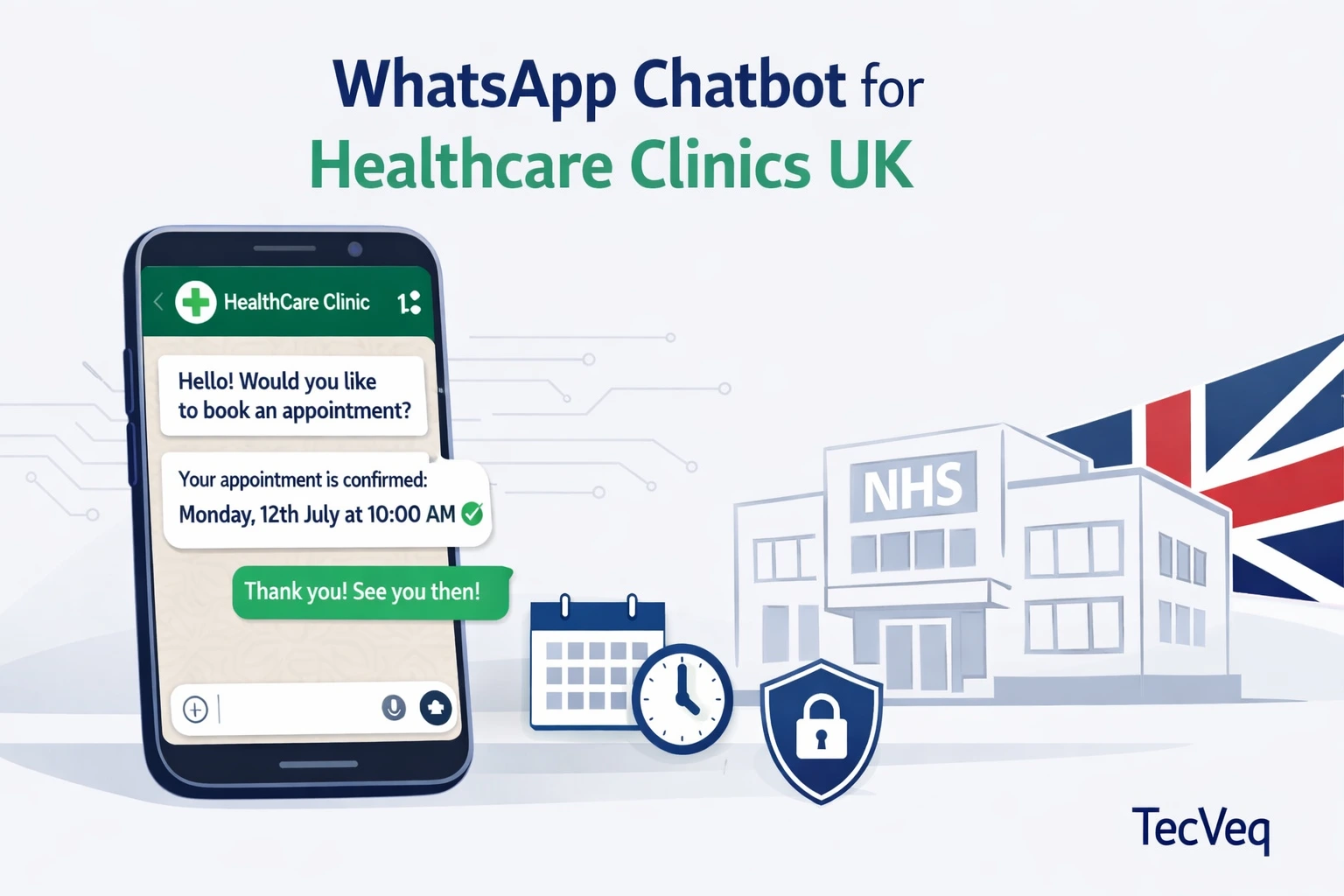
Patients can instantly book appointments through WhatsApp without calling your clinic.. The automated booking system checks real-time availability and sends an instant confirmation message. No phone calls. No back and forth emails. Just a smooth online appointment scheduling experience that patients actually enjoy.
2. Appointment Reminders to Reduce No-Shows
This is one of the biggest wins for any clinic. The chatbot sends automatic reminders one day or a few hours before every appointment. Patients can confirm or reschedule with one simple reply. This one feature alone can seriously reduce no-shows and save your clinic thousands of pounds every year.
3. Patient Triage and Symptom Screening
Before a patient even walks through your door the chatbot can ask a few simple questions about their symptoms. This helps your clinical team prepare in advance. It also means urgent cases get flagged faster. Patient triage through WhatsApp saves time for both staff and patients.
4. Post Consultation Follow Up and Medication Reminders
After a visit your chatbot can send follow-up messages to check how a patient is feeling. It can remind them to take their medication at the right time. This kind of automated follow-up improves patient experience and helps with long-term health outcomes.
5. 24/7 Patient FAQs and Self-Service Support
Patients have questions outside of office hours. What are your opening times? How do I get a sick note? Where is the clinic located? Your chatbot handles all of these instantly. Round-the-clock availability means patients always get answers and your staff are not flooded with basic enquiries first thing in the morning.
6. Patient Feedback and Satisfaction Surveys
After every appointment your chatbot can send a short feedback message. Patients can rate their experience and leave a comment in seconds. This gives your clinic real data to improve patient satisfaction and shows the Care Quality Commission that you take patient feedback seriously.
7. Multilingual Support for Diverse UK Patient Populations
The UK is one of the most diverse countries in the world. Many patients speak languages other than English at home. A good AI chatbot for healthcare in the UK can communicate in multiple languages. This removes a huge barrier for patients and improves patient engagement across your entire community.
8. Digital Patient Onboarding and Intake Forms
New patients can complete their registration and intake forms through WhatsApp before their first visit. No paper forms. No waiting room delays. The chatbot collects the information securely and feeds it straight into your clinic management system. This makes digital patient onboarding fast and stress free for everyone involved.
Real UK Case Study: The NHS North Central London WhatsApp AI Pilot
Sometimes the best proof is a real example. And in the UK we now have one that every clinic owner should know about.
What the SPRYT Pilot Achieved (And What UK Clinics Can Learn)
NHS North Central London Integrated Care Board the Islington GP Federation and technology provider SPRYT are piloting the use of WhatsApp and AI to streamline cancer screening appointment booking and rescheduling. This is the first time WhatsApp and AI have been approved by the NHS for appointment scheduling.
The AI receptionist at the heart of this pilot is called Asa. Asa is designed to interact with patients by offering answers to non-diagnostic questions and providing information on appointments. It also sends voice messages in a patient’s chosen language. Patients can book change or cancel appointments through WhatsApp at any time without downloading a new app or visiting a website.
Uptake of cervical screening was less than 10% in some underserved communities in North London.The pilot targeted exactly those hard-to-reach groups. And the early results were encouraging. The scheme received positive reviews from patients according to North London health bosses who said that by making it easier to book reschedule and ask questions the scheme can increase cancer screening uptake.
Matthew Nye Director of Digital Transformation Primary Care at NHS England said the use of an AI-powered WhatsApp chatbot to assist patients with cervical screening appointments is a great example of how technology can enhance patient care in primary care.
What can your clinic take from this? Three things. First WhatsApp AI automation works in a real NHS setting. Second it helps reach patients who were previously hard to engage. Third the NHS itself is now backing this kind of UK health tech innovation. If you run a GP surgery or a private clinic this pilot is your roadmap.
UK Legal and Compliance Guide: What Every Clinic Must Know Before Deploying
This section is one the most important parts of this entire guide. Deploying a WhatsApp chatbot for healthcare clinics in the UK is not just a technology decision. It is a legal one. Get it right and you are protected. Get it wrong and the ICO will come knocking.
UK GDPR and the Data Protection Act 2018: The Basics for Clinics
Under UK GDPR patient data is classed as special category data. This means it gets the highest level of legal protection. Your clinic must have a clear and lawful reason for processing it. You must store it securely. You must only keep it for as long as you need it.
The Data Protection Act 2018 works alongside UK GDPR to set out the specific rules for how health data should be handled in the UK. Before you launch any WhatsApp automation tool your clinic needs a Data Processing Agreement in place with your chatbot provider. This is not optional. It is a legal requirement.
Patient data security is your responsibility. End-to-end encryption on WhatsApp helps but it is not enough on its own. You need proper policies, staff training and regular data protection reviews.
NHS Data Security and Protection Toolkit (DSPT) Requirements
If you are an NHS practice you need to meet the NHS Data Security and Protection Toolkit standards. The DSPT is an annual self-assessment that shows NHS England and NHS Digital that your organisation handles patient data safely.
Any digital tool you use including a WhatsApp chatbot must fit within your DSPT obligations. This means checking that your chatbot provider meets NHS data security standards and that all patient data flows through approved and secure channels.
CQC Compliance: How WhatsApp Chatbots Affect Your Rating
The Care Quality Commission inspects clinics against five key areas. One of those is whether your clinic is safe and well led. Using an unvetted or poorly configured chatbot that handles patient information without proper safeguards could be flagged during a CQC inspection.
On the other hand a well-implemented chatbot that improves patient experience and collects feedback systematically can actually support your CQC rating. Clinical governance around your digital tools matters. Document your processes. Show the CQC that you have thought through how your chatbot protects patient confidentiality.
The Data (Use and Access) Act 2026: What Changed for Healthcare AI
The Data (Use and Access) Act became law in the UK in 2026. This is a significant piece of legislation that directly affects how AI tools handle health data. It introduces new frameworks around automated decision-making in health settings and strengthens patients’ rights around how their data is used.
If you are deploying an AI chatbot in your clinic right now you need to be aware of this law. Make sure your provider has updated their data practices to comply with it. This is a health data regulation that no competitor blog is currently talking about. Being aware of it puts your clinic ahead of the curve.
ICO Warning: Lessons from the NHS Lanarkshire WhatsApp Reprimand
This is a story every UK clinic must know.
Between April 2020 and April 2022 26 staff at NHS Lanarkshire had access to a WhatsApp group where patient data was entered on more than 500 occasions including names phone numbers and addresses. Images videos and screenshots which included clinical information were also shared.
WhatsApp was not approved by NHS Lanarkshire for processing patient data and was adopted by these staff without the organisation’s knowledge. A non staff member was also added to the WhatsApp group in error resulting in the inappropriate disclosure of personal information to an unauthorised individual.
The ICO launched an investigation. The ICO’s investigation concluded that NHS Lanarkshire did not have the appropriate policies clear guidance and processes in place when WhatsApp was made available to download.
The lesson here is clear. Using WhatsApp in a healthcare setting without the right setup is a serious risk. The difference between that situation and a properly deployed WhatsApp Business API chatbot is enormous. A chatbot built on the official WhatsApp Business platform with a signed Data Processing Agreement proper opt-in consent and clear governance policies is a completely different tool to an informal staff group chat.
Do not let this story put you off. Let it guide you to do it properly.
Patient Consent and WhatsApp Opt-In: A Practical Checklist
Before your chatbot sends a single message to a patient you must have their informed consent. Here is a simple checklist to follow:
Before launch your clinic must have:
Explicit written consent from each patient to receive WhatsApp messages from your clinic. A clear explanation of what data you will collect and how you will use it. A signed Data Processing Agreement with your WhatsApp chatbot provider. An easy opt-out option in every message you send. A documented data protection impact assessment for the chatbot. ICO guidelines compliance reviewed by a qualified data protection officer.
Patient confidentiality is not something you can cut corners on. Done correctly a GDPR compliant healthcare chatbot in the UK is safe effective and fully legal. Done carelessly it becomes a regulatory problem.
NHS GP Surgery vs Private Clinic: Which Approach Is Right for You?
Not every clinic is the same. A busy NHS GP surgery in Manchester has very different needs to a private dermatology clinic in London. Before you pick a WhatsApp chatbot solution it helps to understand which path fits your type of practice.
NHS Practices: Integration with NHS App EMIS and SystmOne
If you run an NHS GP surgery your biggest priority is integration. Most NHS practices in the UK use either EMIS Web or SystmOne as their clinic management system. Any WhatsApp automation tool you bring in needs to work alongside these platforms without creating extra work for your staff.
The NHS App already has over 40 million registered users. Your WhatsApp chatbot does not need to replace it. Instead it can sit alongside it and handle the quick everyday tasks like appointment reminders and basic patient FAQs that do not need a full NHS App login.
EHR integration is the key thing to look for here. When patient booking data flows directly into your electronic health records your team saves hours every week. No manual data entry. No double checking spreadsheets. Just clean automatic updates.
NHS practices also need to make sure any tool they use meets DSPT standards and sits within their wider clinical governance framework. Always check this before signing up to any platform.
Private Clinics: Faster Deployment Direct ROI and CRM Integration
Private healthcare in the UK works differently. You have more flexibility to move quickly. You are not tied to NHS procurement processes or system restrictions. That means you can often have a WhatsApp chatbot up and running in days rather than months.
For private clinics the return on investment is very direct. Fewer no-shows means more revenue. Faster patient onboarding means a better first impression. Automated follow-up messages mean stronger patient retention.
Private clinics also benefit hugely from healthcare CRM integration. When your WhatsApp chatbot connects with your CRM system you can track every patient interaction. You can see who booked. Who cancelled. Who has not visited in six months. This kind of data helps you grow your clinic with confidence.
How to Choose the Right WhatsApp Chatbot Platform for Your UK Clinic
There are a lot of platforms out there. Some are built for global markets and have little understanding of UK healthcare rules. Others are specifically designed with UK compliance in mind. Here is what to look for.
Key Features to Look For
UK compliance support is non-negotiable. Your platform must support GDPR compliant data handling and be willing to sign a Data Processing Agreement with your clinic.
EHR and booking system integration matters enormously. A cloud-based solution that connects with EMIS SystmOne or your private booking software will save your team real time every day.
A no-code chatbot builder is ideal for most clinics. You should not need a developer to set up basic conversation flows. Look for a platform where your practice manager can make changes without technical help.
WhatsApp Cloud API support is essential. Make sure the platform uses the official Meta-approved WhatsApp Business platform and not a third party workaround that could put your clinic at risk.
Top Platforms Compared: Wati Esendex and Click4Assistance
Wati is a popular healthcare SaaS platform built on the WhatsApp Cloud API. It offers a no-code chatbot builder and works well for private clinics that need a quick and affordable setup. It is not specifically built for the UK market so you will need to configure GDPR settings manually.
Esendex is a UK-based messaging platform that understands the British market well. It offers WhatsApp Business API integration and has experience working with healthcare organisations in the UK. A strong choice for clinics that want local support.
Click4Assistance is another UK platform with a specific focus on NHS and healthcare clients. It holds ISO 27001 certification and understands CQC and DSPT requirements. For NHS practices it is worth a serious look.
Step-by-Step: How to Set Up a WhatsApp Chatbot for Your UK Clinic
Setting up your chatbot does not have to be complicated. Follow these five steps and you will be up and running the right way.
Step 1: Apply for WhatsApp Business API Access via Meta
Start by applying for access to the official WhatsApp Business API through Meta. You will need a verified business phone number and a Meta Business Suite account. Most clinics get approved within a few days when they apply through an official WhatsApp Business Solution Provider.
Step 2: Map Your Patient Journey and Conversation Flows
Before you build anything write down the most common questions and tasks your front desk handles every day. Appointment booking. Opening hours. Directions to the clinic. These become your chatbot conversation flows. Keep them simple and focused on what patients actually need.
Step 3: Integrate with Your Booking System or EHR
Connect your chatbot to your existing booking system or electronic health records platform. This is where the real time-saving happens. When a patient books through WhatsApp the slot should appear in your calendar automatically without anyone on your team having to do anything.
Step 4: Set Up GDPR-Compliant Opt-In and Data Processing Agreement
Before going live get your consent process right. Every patient must actively opt in to receive WhatsApp messages from your clinic. Your Data Processing Agreement with your platform provider must be signed and stored. Your privacy notice must mention WhatsApp as a communication channel.
Step 5: Test Launch and Monitor Performance
Run the chatbot with a small group of patients first. Test every conversation flow. Check that bookings land in your calendar correctly. Make sure opt-out requests are handled immediately. Once everything works smoothly roll it out to your full patient list and track your no-show rate and response times every month.
Common Mistakes UK Clinics Make With Healthcare Chatbots (And How to Avoid Them)
Getting a WhatsApp chatbot for your healthcare clinic is an exciting step. But a lot of UK clinics rush into it and end up making avoidable mistakes. Some of these mistakes cost money. Others create serious legal problems. Here are the most common ones and exactly how to avoid them.
Skipping the Data Processing Agreement
This is the most common mistake and the most dangerous one. Many clinics get excited about the technology and forget the legal paperwork. Before your chatbot handles a single piece of patient data you must have a signed Data Processing Agreement with your platform provider. Without it you are in breach of UK GDPR. Full stop.
Using WhatsApp Without Official API Access
Some clinics try to use the free WhatsApp Business app instead of the proper WhatsApp Business API. This might seem like a cheaper option but it breaks Meta’s terms of service for healthcare messaging. It also means your messages are not properly governed or logged. Always use the official WhatsApp Business platform through an approved solution provider.
No Patient Opt-In Process
Sending WhatsApp messages to patients without their explicit consent is a direct violation of UK GDPR and ICO guidelines. Every patient must actively agree to receive messages from your clinic through WhatsApp before you send anything. This consent must be recorded and easy to withdraw at any time.
Building Conversation Flows That Are Too Complicated
Some clinics try to make their chatbot do everything at once. The result is a confusing patient experience that frustrates people and drives them back to calling the phone line. Start simple. Cover the top five or six tasks your front desk handles most. Once those work well you can add more over time.
Not Training Staff on the New System
A chatbot does not replace your team. It supports them. But if your staff do not understand how the chatbot works they will not trust it. They may even accidentally duplicate work or confuse patients with mixed messages. Take time to train your frontline healthcare staff properly before launch.
Ignoring the Follow-Up Data
Your chatbot collects valuable information every single day. Which questions come up most? Where do patients drop off in the conversation flow? Which appointment slots get cancelled most often? Clinics that ignore this data miss a huge opportunity to improve their clinical workflow and patient journey over time.
Choosing a Platform With No UK Healthcare Experience
Not every chatbot platform understands the UK market. Some are built for global e-commerce and have no knowledge of CQC compliance NHS DSPT requirements or ICO guidelines. Always ask a potential provider directly whether they have experience working with UK healthcare clients. Ask for references. Check their data centre locations. Make sure patient data stays within the UK or European Economic Area as required under UK GDPR.
Treating the Chatbot as a Set-and-Forget Tool
A WhatsApp chatbot needs regular attention. Patient needs change. Clinic services change. NHS guidelines change. If you set up your chatbot once and never review it the conversation flows will become outdated and patients will start getting wrong information. Schedule a monthly check-in to review performance and update your content.
The clinics that get the most value from WhatsApp automation are the ones that treat it as a living tool rather than a one-time installation. Avoid these mistakes and your clinic will be set up for long-term success.
FAQs WhatsApp Chatbot for Healthcare Clinics UK
Is WhatsApp GDPR Compliant for UK Healthcare Clinics?
Yes but only when set up correctly. WhatsApp uses end-to-end encryption which protects patient data in transit. However to be fully GDPR compliant your clinic must have explicit patient consent a signed Data Processing Agreement with your provider and clear data retention policies in place. WhatsApp alone is not enough. Your entire setup must meet UK GDPR standards.
Can a WhatsApp Chatbot Book NHS Appointments Automatically?
Yes it can. A WhatsApp chatbot connected to your booking system or EHR platform can check real-time availability and confirm appointments instantly. The NHS North Central London SPRYT pilot proved this works in a real NHS setting. For GP surgeries using EMIS or SystmOne you will need a provider that supports direct integration with those systems.
How Much Does a WhatsApp Chatbot Cost for a UK Clinic?
Costs vary depending on the platform and the size of your clinic. Basic setups through platforms like Wati can start from around £50 to £100 per month. More advanced solutions with full EHR integration and UK compliance support can range from £200 to £500 per month or more. The cost is almost always recovered quickly through reduced no-shows and lower administrative burden.
What Is the WhatsApp Business API and Do I Need It?
The WhatsApp Business API is the official version of WhatsApp built for businesses and healthcare providers that need to send messages at scale. Unlike the free WhatsApp Business app it allows full chatbot automation proper data governance and secure clinical communication. If you want to run an automated patient messaging system for your clinic then yes you need the API.
Can WhatsApp Chatbots Handle Prescription Requests?
No and this is important to understand. WhatsApp Business policy does not permit the promotion or exchange of prescription medications through its platform. Your chatbot can remind patients to request a repeat prescription through the correct channel such as the NHS App or your online system. But it cannot process or issue prescriptions directly. Always keep prescription requests within your regulated clinical systems.
How Does a WhatsApp Chatbot Reduce No-Shows in UK Clinics?
It sends automatic appointment reminders to patients one day or a few hours before their visit. Patients can confirm or reschedule with a single reply. This simple step removes the most common reason for no-shows which is patients simply forgetting. Clinics using WhatsApp automation regularly report a significant drop in missed appointments within the first few months of going live.
Which CQC and ICO Rules Apply to WhatsApp in Healthcare?
The CQC expects all digital tools used in clinical settings to support safe and well-led care. Your chatbot must protect patient confidentiality and have clear governance documentation behind it. The ICO requires that any processing of patient data through WhatsApp follows UK GDPR rules including lawful basis consent and data minimisation. The NHS Lanarkshire reprimand is a clear warning that using WhatsApp without proper policies in place will attract ICO scrutiny. Always document your processes and review them regularly.
Is a WhatsApp Chatbot Right for Your UK Clinic? Final Checklist
Before you get started run through this quick checklist.
✅ You want to reduce no-shows and save staff time
✅ Your clinic handles a high volume of appointment bookings daily
✅ You want to offer patients 24/7 support without extra staff costs
✅ You are ready to set up proper GDPR consent and opt-in processes
✅ You want to improve patient engagement and satisfaction scores
✅ You are prepared to sign a Data Processing Agreement with your provider
If you ticked most of these boxes then a WhatsApp chatbot for healthcare clinics in the UK is the right next step for your practice.
TecVeq builds GDPR compliant AI powered WhatsApp chatbots for UK healthcare clinics. Get in touch today and let us help your clinic work smarter.