Why Pakistani Restaurants Are Losing Customers Without Digital Marketing
Walk into any busy restaurant in Lahore or Karachi on a Friday night and you’ll see packed tables. But walk into that same restaurant on a Tuesday afternoon and you might find it nearly empty. The difference isn’t the food quality. It’s visibility.
I’ve worked with restaurant owners across Pakistan for years, and the pattern is always the same. They have amazing food, great locations, and loyal customers who’ve been coming for decades. But their customer base isn’t growing. New customers aren’t finding them. And younger customers especially are going elsewhere.
The problem isn’t what these restaurant owners think it is.
The Shift From Word-of-Mouth to Google & Instagram Discovery
Pakistani families used to discover restaurants through relatives and friends. Your uncle would recommend a great karahi place in Defence. Your colleague would suggest a family restaurant near Liberty Market. Word-of-mouth was everything.
That’s changed completely in the last five years.
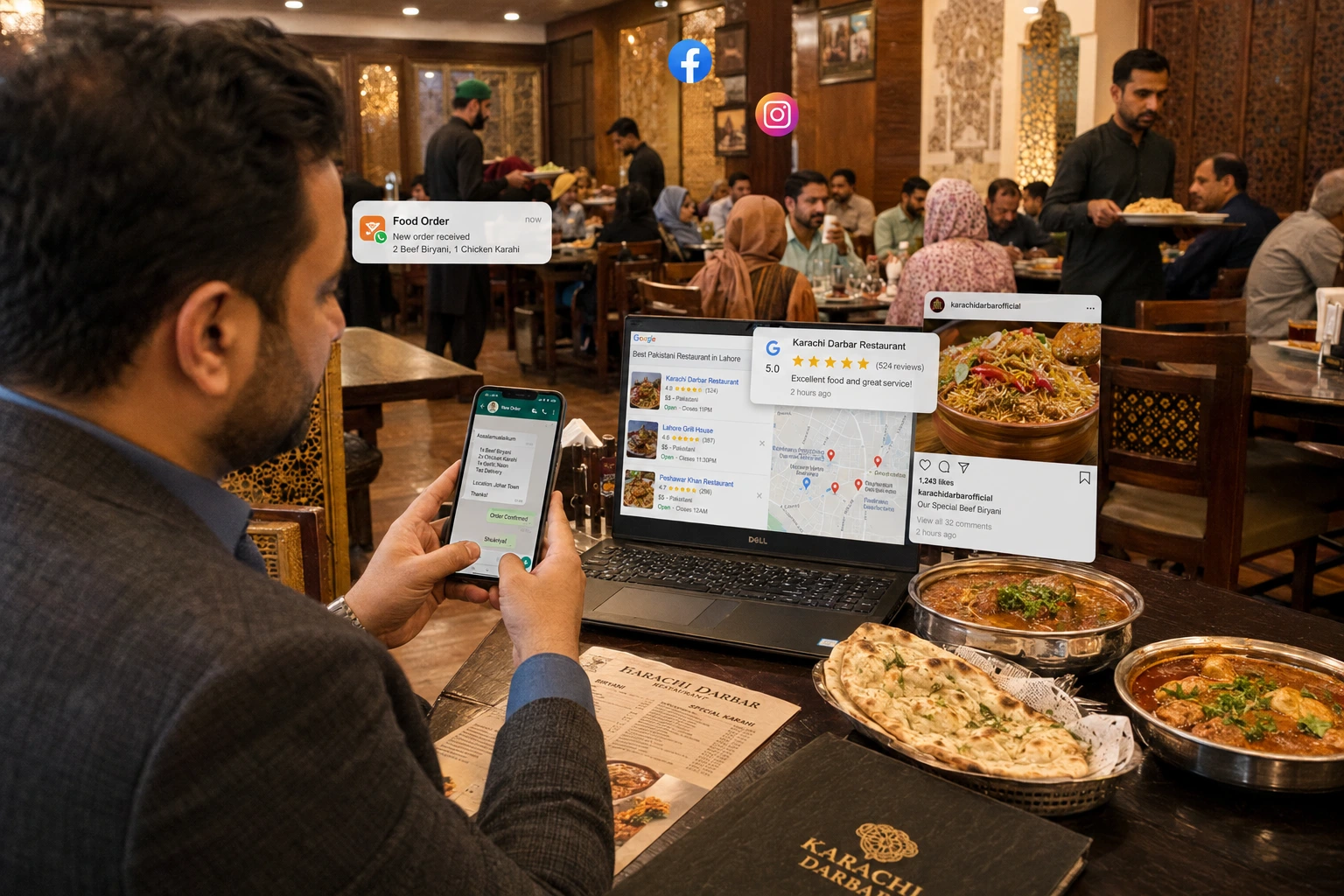
Now when someone wants to try a new restaurant, they open Google Maps. They scroll through Instagram food accounts. They check reviews and photos before they even consider visiting. This shift has happened so fast that many restaurant owners missed it entirely.
I see this every week when I analyze restaurant marketing in Pakistan. The restaurants getting new customers are the ones showing up in Google searches for “best biryani near me” or getting featured on food Instagram accounts. The restaurants losing customers are the ones still waiting for word-of-mouth to bring people through the door.
Your potential customers are searching for restaurants online right now. If your restaurant doesn’t appear in those searches, those customers are going to your competitors instead.
And it’s not just young people anymore. Families planning dinner outings check Google reviews before choosing where to eat. Office groups ordering lunch search for nearby restaurants on delivery apps. Even traditional customers now expect to see photos of your food and read reviews from other diners.
The restaurants that understand this are growing. The ones that don’t are slowly losing ground to competitors who show up where customers are looking.
GET IN TOUCH
Get Free Restaurant Digital Marketing Pakistan Audit
Cost of Staying Invisible Online
Most restaurant owners don’t realize how much money they lose by staying invisible online. They see full tables during peak hours and think business is fine. But they’re missing the bigger picture.
Every day, potential customers in your area search for restaurants like yours. When you don’t appear in those searches, those customers choose your competitors. That’s not just one lost meal. That’s lost families who could have become regular customers for years.
I worked with a family restaurant in Gulberg that was struggling with declining weekday business. The owner thought it was because of new competition in the area. But when we analyzed local search data, we found hundreds of people searching for “family restaurants near Gulberg” every month. His restaurant wasn’t appearing in any of those searches.
After implementing proper restaurant digital marketing Pakistan strategies, his weekday covers increased by 40% in just three months. The customers were always there. They just couldn’t find him.
The cost goes beyond immediate lost sales. Restaurants without an online presence miss out on customer data, repeat order opportunities, and the ability to communicate directly with their customer base. When your only marketing channel is hoping customers walk past your door, you’re building a business on luck instead of strategy.
Delivery platforms charge 20-30% commission on every order. But restaurants with strong direct online presence can drive orders through their own channels at much lower costs. The savings add up to thousands of rupees every month for busy restaurants.
Even worse, invisible restaurants can’t respond to negative reviews or showcase their best dishes to new customers. One bad experience shared online can cost them dozens of potential customers who never give them a chance to prove themselves.
The restaurants thriving in Pakistan right now aren’t necessarily the ones with the best food. They’re the ones that make it easy for hungry customers to find them, see their menu, read reviews, and place orders. Restaurant digital marketing Pakistan has become as essential as good ingredients and skilled chefs.
Tecveq’s Restaurant Digital Marketing Pakistan Framework
Most marketing agencies tell you what to do. We build it for you.
We’ve developed a complete restaurant digital marketing Pakistan system that combines marketing strategy with the actual technology your restaurant needs to compete online. While other agencies create social media posts and run ads, we also build custom ordering websites, AI chatbots, and automated systems that turn online visibility into real orders.
Our framework works because it addresses the three biggest problems Pakistani restaurants face online. First, they can’t be found when customers search locally. Second, their social media doesn’t convert followers into diners. Third, they waste money on ads that reach the wrong people.
We fix all three systematically.
The difference is integration. Your Google Business Profile optimization connects to your social media strategy. Your Instagram content feeds into your paid advertising. Your WhatsApp automation system works seamlessly with your custom ordering website. Everything works together instead of fighting each other for customer attention.
This isn’t theory. We’ve implemented this exact framework for restaurants across Lahore, Karachi, and Islamabad. The results are measurable: increased phone calls, more online orders, higher customer retention, and lower marketing costs per customer acquired.
Local SEO Foundation for Restaurants
When someone searches “biryani near me” or “family restaurants in DHA,” your restaurant needs to appear in the top three results. Not on page two. Not buried under your competitors. Right at the top where hungry customers make decisions.
We start every restaurant project with local SEO because it’s the foundation everything else builds on. Your social media posts and paid ads can drive traffic, but if your Google Business Profile isn’t optimized properly, you’re sending potential customers to incomplete information that doesn’t convert.
Most restaurants set up their Google Business Profile once and never update it. That’s a massive missed opportunity.
We optimize your profile completely. Correct business hours that actually match when you’re open. High-quality photos of your best dishes taken during busy service periods. Menu information that’s current and easy to read. Location details that help delivery drivers find you without calling.
But the real advantage comes from our review velocity system.
Pakistani customers read reviews before choosing where to eat. Restaurants with 4.5+ star ratings get significantly more clicks than restaurants with lower ratings. But getting consistent positive reviews requires a systematic approach that most restaurant owners don’t have time to manage.
We implement automated review request systems that ask happy customers to leave reviews at the exact right moment. Right after they’ve finished a great meal, when they’re most likely to say positive things about their experience. The requests go out through WhatsApp or SMS, making it easy for customers to leave reviews without extra effort.
For restaurants with existing negative reviews, we develop response strategies that show future customers how you handle problems professionally. A well-handled negative review response actually builds more trust than having no negative reviews at all.
The technical side matters too. We ensure your Google Business Profile connects properly to your website, your phone system, and your ordering platforms. When customers click “Call” or “Order Online,” they need to reach the right place immediately. Broken links or wrong phone numbers cost you customers every single day.
Local citation building is where most DIY restaurant marketing fails. Your business information needs to appear consistently across dozens of local directories, food delivery platforms, and review sites. One inconsistent address or phone number confuses Google’s algorithm and hurts your local rankings.
We handle all of this systematically. The result is a Google Business Profile that works as a customer acquisition machine, bringing you qualified local traffic that converts into actual restaurant visits and orders.
About Tecveq – Restaurant Digital Marketing Pakistan Specialists
| Company Information | Details |
|---|---|
| Company Name | Tecveq |
| Founded | 2025 |
| Headquarters | Sahiwal, Punjab, Pakistan |
| Regional Offices | 2 Idmiston Road, London, England, E15 1RG |
| International Presence | United Kingdom, Bahrain |
| Contact Phone | +44 7721 716507 |
| WhatsApp Business | +44 7721 716507 |
| hello@tecveq.com | |
| Core Services | Restaurant Digital Marketing, AI Development, Mobile App Development, Custom Software Development, SEO Services, Social Media Marketing |
| Restaurant Specializations | WhatsApp Automation, Custom Ordering Systems, Local SEO, Social Media Management, Review Management, Multi-Branch Solutions |
| Industries Served | Restaurants & Food Service, Healthcare, Real Estate, E-commerce, Education, Construction, Logistics, Manufacturing |
| Technology Stack | React, Node.js, Flutter, React Native, Python, AI/ML, WordPress, Shopify |
| Team Size | 50+ Digital Marketing & Development Experts |
| Languages | English, Urdu, Arabic |
| Certifications | Google Partner, Facebook Marketing Partner |
| Service Areas | Pakistan (All Major Cities), UK, Bahrain, GCC Region |
Social Media Marketing for Restaurants Pakistan Content That Converts
Posting food photos isn’t social media marketing. It’s just posting.
Real social media marketing for restaurants Pakistan creates a systematic content strategy that turns social media followers into paying customers. We develop content that makes people want to visit your restaurant, order from you, and bring their friends next time.
The strategy starts with understanding your customer journey. Someone discovers your restaurant on Instagram. They check your stories to see today’s specials. They read comments from other customers. They click through to your WhatsApp to place an order or make a reservation. Every piece of content needs to move them closer to that final action.
Pakistani food content performs differently than international food content. What works on Instagram in the US doesn’t necessarily work here. We create content specifically designed for Pakistani social media behavior and cultural preferences.
Behind-the-scenes content performs exceptionally well. Videos of fresh naan coming out of the tandoor. Time-lapse of karahi being prepared. Staff members explaining why they use specific ingredients. Pakistani customers want to see the human side of their food preparation, especially for traditional dishes where authenticity matters.
But the real conversion power comes from strategic storytelling.
Instead of just showing the final dish, we create short video stories around your food. The family recipe that’s been passed down for three generations. The special spice blend that makes your biryani unique. The customer who drives from Islamabad to Lahore just for your haleem. These stories create emotional connections that turn casual followers into loyal customers.
We also implement Instagram and Facebook automation that most restaurants don’t know exists. Automated responses to story mentions. Chatbot sequences that guide customers from Instagram to your ordering system. Automated follow-up messages for customers who interact with your content but don’t place orders immediately.
The content calendar is built around Pakistani food culture and seasonal behavior. Ramadan content strategy that drives iftar and sehri orders. Eid celebration posts that position your restaurant as the perfect family gathering place. Winter comfort food campaigns. Summer BBQ and cold drink promotions. Content that matches what your customers are thinking about and craving.
Most importantly, we create content that drives immediate action. Posts with clear calls to action that tell followers exactly how to order, what to order, and why they should order today. Social media content that generates actual revenue, not just likes and comments.
Every post includes strategic hashtags for local discovery, tagged locations that improve local search visibility, and captions written to encourage engagement and sharing. The goal isn’t just to build a following. It’s to build a following of people who become regular customers.
Paid Ads With Hyper-Local Targeting
Facebook and Instagram ads for restaurants in Pakistan require completely different strategies than ads for other businesses. You’re not trying to reach everyone in Lahore. You’re trying to reach people within 3-5 kilometers who are likely to order food in the next few days.
We create hyper-local targeting that reaches the right people at the right time with the right message.
Geographic targeting goes beyond basic city selection. We target specific neighborhoods, landmark areas, and even individual housing societies. Someone living in DHA Phase 5 might order from your restaurant in DHA Phase 4, but they probably won’t order from your location in Johar Town. The targeting reflects real customer behavior and delivery zones.
Time-based targeting is crucial for restaurant ads. Lunch promotion ads run from 11 AM to 1 PM. Dinner ads run from 6 PM to 9 PM. Late-night snack ads run from 9 PM to midnight. Weekend family dining ads run Friday through Sunday. Each time slot gets different ad creative designed for that specific eating occasion.
But the real advantage comes from behavioral and interest targeting combined with local geography.
We target people who follow food delivery apps, food bloggers, and competitor restaurants within your delivery area. People who’ve recently engaged with restaurant content on social media. People whose behavior patterns indicate they order food online regularly. This creates audiences of people who are already likely to order from restaurants and happen to live near yours.
The ad creative follows Pakistani visual preferences and cultural cues. Food photography that looks authentic, not overly styled. Prices displayed clearly in PKR. Urdu text where appropriate. Visual elements that resonate with local customers, not international food photography that looks foreign.
Video ads consistently outperform static image ads for restaurants in Pakistan. Short videos showing food preparation, steam rising from hot dishes, satisfied customers enjoying their meals. But the videos need to be shot specifically for mobile viewing, since most Pakistani social media users browse primarily on phones.
We also run retargeting campaigns that most restaurant owners never implement. Ads that reach people who visited your website but didn’t place an order. People who engaged with your social media but haven’t ordered recently. Previous customers who haven’t ordered in the last month. Each audience gets different messaging designed to bring them back.
The offer strategy is tailored to Pakistani price sensitivity and family ordering patterns. Buy-one-get-one offers for family portions. Percentage discounts on minimum orders. Free delivery promotions. Limited-time combo deals. Each offer is tested to find what drives the most profitable orders, not just the most orders.
Campaign performance tracking goes beyond clicks and impressions. We track actual orders generated, cost per order acquired, customer lifetime value, and return on ad spend. The goal is profitable growth, not just social media vanity metrics. Every rupee spent on ads needs to generate more than one rupee in restaurant revenue.
Beyond Marketing Custom Tech That Drives Restaurant Growth
Most marketing agencies tell restaurants to get on food delivery apps and accept the 25% commission fees. We build custom technology that lets restaurants keep those profits instead.
This is where Tecveq differs from every other restaurant marketing agency Pakistan. We don’t just create social media campaigns and run ads. We develop the actual technology infrastructure that modern restaurants need to compete independently of delivery platforms and reduce their dependence on expensive third-party systems.
While other agencies help you optimize your Foodpanda presence, we build you a branded ordering website that captures orders directly. While others suggest WhatsApp marketing, we develop automated chatbot systems that handle orders and reservations without human intervention. While others design menu graphics for Instagram, we create digital ordering interfaces that convert browsers into buyers.
The result is a restaurant that markets effectively AND owns its customer relationships, order data, and profit margins.
We’ve built custom ordering systems for restaurants that now generate 40% of their revenue through direct channels instead of paying delivery commissions. That’s thousands of rupees saved every month, plus complete control over customer communication and order fulfillment.
But the technology has to work seamlessly with the marketing. Your custom website needs to rank in local search results. Your WhatsApp automation needs to integrate with your social media campaigns. Your ordering system needs to connect with your review management and customer retention programs. Everything works together as one system.
Branded Ordering Websites & Apps to Escape Delivery Commissions
Delivery apps charge Pakistani restaurants 20-30% commission on every order. For a restaurant doing 50,000 PKR in daily delivery sales, that’s 10,000-15,000 PKR going to the platform instead of staying in your pocket.
We build custom branded ordering websites that let customers place orders directly through your own system. For restaurants ready for mobile solutions, our restaurant app development services in Pakistan create dedicated mobile applications that provide even more direct customer engagement.
The ordering website looks and feels like your restaurant brand, not a generic food delivery interface. Your logo, your colors, your photography, your menu descriptions. Customers feel like they’re ordering directly from your restaurant, because they are.
But the real advantage goes beyond saving commission fees.
Direct ordering gives you complete customer data. Names, phone numbers, addresses, order history, preferred dishes, spending patterns. This information belongs to you, not the delivery platform. You can use this data for targeted promotions, loyalty programs, and direct marketing that brings customers back.
The ordering process is optimized specifically for your restaurant and your Pakistani customers. Payment options that work locally, including cash on delivery, JazzCash, EasyPaisa, and bank transfers. Order confirmation through SMS and WhatsApp. Delivery time estimates based on your actual kitchen capacity and delivery zones.
We also build mobile apps for restaurants that want even more direct customer engagement. Push notifications for new menu items and special offers. Location-based promotions when customers are near your restaurant. Integration with loyalty point systems that encourage repeat orders.
Most restaurants worry that customers won’t find their direct ordering system. That’s why we integrate the ordering website with all your digital marketing channels. QR codes on tables that link to the ordering page. Social media posts that drive traffic to your website instead of delivery platforms. Google Ads that promote direct ordering with special discounts for customers who order through your system.
The transition strategy is gradual and risk-free. We don’t suggest cutting ties with delivery platforms immediately. Instead, we create incentives for customers to try direct ordering. Free delivery for orders above a certain amount. Exclusive menu items only available through your website. Loyalty points that can only be earned through direct orders.
After six months, most restaurants see 30-40% of their delivery orders coming through their own platform. The commission savings typically pay for the entire website development cost within the first few months of operation.
And unlike delivery platforms that can change their policies or raise their fees at any time, you own your ordering system completely. No one can shut it down, change the commission structure, or promote your competitors on your menu page.
AI Chatbot & WhatsApp Automation for Orders and Reservations
Pakistani customers prefer WhatsApp communication over phone calls for restaurant orders and reservations. But managing WhatsApp conversations manually takes staff time away from food preparation and in-person customer service.
We develop WhatsApp chatbots specifically designed for restaurants in Pakistan that handle routine customer interactions automatically while feeling completely natural and helpful to your customers.
The chatbot can take complete food orders through WhatsApp conversation. Customers send a message saying they want to place an order. The system responds with your current menu, takes their selections, calculates the total including delivery charges, confirms their address, and processes payment information. The entire order gets sent directly to your kitchen system without any staff intervention.
But this isn’t a generic chatbot that gives robotic responses.
We customize the conversation flow to match your restaurant’s tone and Pakistani customer communication preferences. The chatbot understands Urdu and English mixed conversations. It recognizes common local food terms and slang. It handles price inquiries, availability questions, and modification requests just like your best staff member would.
For reservations, the automation system checks your actual table availability in real-time and confirms bookings instantly. Customers can request specific seating preferences, party sizes, and special occasion setups. The system sends automatic confirmation messages with reservation details and directions to your restaurant.
The automation extends beyond just taking orders. Follow-up messages to confirm delivery addresses. Order tracking updates that let customers know when food is being prepared and when it’s out for delivery. Thank you messages after successful deliveries that include links to leave reviews and special offers for next orders.
But the most valuable feature is intelligent routing to human staff when needed.
The AI recognizes when customer requests require human intervention. Complex modification requests, complaint handling, special dietary needs, or catering inquiries get transferred seamlessly to your staff with complete conversation context. Your team never has to ask customers to repeat information.
We also build analytics dashboards that show you exactly how the automation system is performing. How many orders came through WhatsApp automation versus phone calls. Which menu items are ordered most frequently through chat. What times of day generate the most automated conversations. This data helps you optimize both your automation system and your overall operations.
The setup includes training your staff on how the system works and when to take over conversations manually. Most restaurant teams learn the system completely within one week of implementation.
Integration with your other restaurant technology is automatic. Orders from WhatsApp automation appear in the same kitchen display system as orders from your website and delivery platforms. Customer data syncs with your CRM system for marketing campaigns and loyalty programs.
Pakistani restaurants using our WhatsApp automation typically see 60-70% of their phone order volume shift to automated chat within the first month. Staff can focus on food quality and in-person service while the technology handles routine order taking and customer communication.
Menu Design and Digital Ordering UX That Increases Conversions
A confusing digital menu costs you orders every day. Customers who can’t find what they want or understand your pricing will order from a competitor instead.
We design digital menu interfaces specifically optimized for Pakistani customer behavior and mobile browsing patterns. The goal isn’t just to display your food items. It’s to guide customers toward placing larger, more profitable orders.
Menu psychology principles that work internationally don’t always apply in Pakistan. Pakistani customers compare prices heavily and prefer family-style portions and sharing dishes. They want to see exact ingredients because of dietary preferences and religious considerations. They need clear spice level indicators and customization options.
Our menu design process starts with analyzing your actual order data to understand customer preferences and ordering patterns. Which dishes are ordered together most frequently. What price points generate the largest orders. Which menu sections customers browse but don’t order from. This data drives the menu structure and presentation.
High-converting digital menus use strategic visual hierarchy to highlight your most profitable items. Popular dishes and chef recommendations get prominent placement with appealing photography. Bundle deals and family packages are positioned to catch attention before customers start browsing individual items.
But the conversion optimization goes deeper than visual design.
Loading speed is critical for mobile users in Pakistan where internet connections can be inconsistent. We optimize menu images and page structure so your digital menu loads fast even on slower mobile data connections. Customers who wait more than 3 seconds for a menu to load often abandon their order attempt entirely.
The ordering flow removes friction at every step. Clear portion sizes with serving suggestions. One-click add-ons for drinks, desserts, and sides. Automatic suggestions for completing family meals or reaching free delivery minimums. Progress indicators that show customers how close they are to order completion.
Payment integration is customized for Pakistani preferences. Multiple payment options displayed clearly with security indicators. Cash on delivery prominently featured since many customers prefer this option. Mobile wallet integration for JazzCash and EasyPaisa users. Bank transfer information for corporate orders and large catering requests.
We also implement smart upselling features that feel helpful rather than pushy. Recommendations based on what other customers ordered with similar items. Automatic suggestions for drinks that pair with spicy dishes. Family package suggestions when someone orders multiple individual portions.
The menu adapts automatically based on time of day, day of week, and seasonal availability. Breakfast items appear prominently during morning hours. Weekend family specials get featured positioning on Fridays and Saturdays. Ramadan iftar menus replace regular offerings during appropriate times.
Mobile optimization is essential since most Pakistani customers browse restaurant menus on their phones. Touch-friendly buttons sized for easy tapping. Scroll-friendly layouts that don’t require zooming. Category filtering that works smoothly on small screens.
Testing and optimization continue after launch. We track which menu items get the most views versus which ones actually get ordered. Sections where customers spend time browsing but don’t convert. Points in the ordering process where customers abandon their carts. This data guides ongoing improvements to increase order conversion rates.
Restaurants typically see 15-25% increases in average order values within the first month of implementing optimized digital menu design. Better menu presentation not only converts more browsers into buyers, but also guides customers toward higher-value orders that improve your profit margins.
Local SEO for Restaurants Pakistan Google Business Profile Mastery
Most Pakistani restaurants lose hundreds of potential customers every month because their Google Business Profile isn’t properly optimized for local search. When someone searches “best biryani near me” or “family restaurants in DHA,” your restaurant needs to appear in the top three local results to capture those customers.
We optimize Google Business Profiles specifically for restaurant search behavior in Pakistan. This isn’t just filling out basic business information and hoping for the best. It’s a systematic approach that makes your restaurant show up when hungry customers are ready to order or visit.
The difference shows up immediately in your phone calls and walk-in traffic. Restaurants with properly optimized Google Business Profiles get 3x more calls and directions requests than restaurants with basic, unoptimized listings.
Local SEO for restaurants Pakistan requires understanding exactly how Pakistani customers search for food. They search by cuisine type, location landmarks, and specific occasions. “Karahi near Fortress Stadium.” “Best family restaurant for birthday dinner in Gulberg.” “Late night food delivery Johar Town.” Your Google Business Profile needs to capture all these search patterns.
But optimization goes far beyond just keywords.
Google’s algorithm considers dozens of factors when deciding which restaurants to show in local search results. Review velocity and star ratings matter enormously. Photo quality and quantity affect click-through rates. Response time to customer messages influences local rankings. Menu information accuracy impacts conversion from searches to actual orders.
We handle every element systematically. Complete business information that matches exactly across all platforms. High-quality photos taken during peak service hours that show your food looking amazing and your restaurant atmosphere feeling welcoming. Service area definitions that match your actual delivery zones. Business hours that stay updated during holidays and special events.
The most overlooked factor is Google Posts optimization. These are the short updates that appear directly in your Google Business Profile when people search for your restaurant. Most restaurants either ignore Google Posts completely or use them poorly. We create strategic Google Posts that highlight daily specials, new menu items, seasonal promotions, and customer testimonials.
Google Posts that include high-quality food photography and clear calls to action can increase profile clicks by 40-60%. But the posts need to be published consistently and optimized for local search terms that Pakistani customers actually use.
Integration with your other digital marketing efforts multiplies the results. Your social media campaigns drive more Google reviews. Your website content provides material for Google Posts. Your WhatsApp automation system captures leads from Google Business Profile inquiries. Everything works together instead of competing for customer attention.
Review Velocity and Reputation Management System
Getting steady positive reviews is what separates thriving restaurants from struggling ones in local search results. Pakistani customers read reviews before choosing where to eat, and Google’s algorithm heavily favors restaurants with consistent positive review flow.
We implement systematic review generation that feels natural to your customers and builds genuine trust with potential diners. This isn’t about buying fake reviews or pressuring customers. It’s about asking satisfied customers for reviews at exactly the right moment using the right approach.
The timing matters more than most restaurant owners realize. Ask too early and customers haven’t had enough time to appreciate the full experience. Ask too late and they’ve forgotten the details that make reviews specific and helpful. We identify the optimal review request timing for each restaurant based on their service style and customer behavior patterns.
For dine-in restaurants, the best review request moment is usually 24-48 hours after the visit. Customers have had time to digest the experience but still remember the specific details. For delivery orders, the ideal timing is within 2-3 hours after successful delivery when satisfaction is highest.
The request method makes all the difference between getting reviews and being ignored.
We develop customized review request messages that feel personal and appreciative rather than automated and pushy. Messages that reference specific details about the customer’s experience. “Thanks for trying our new lamb karahi yesterday. If you enjoyed it, we’d really appreciate a quick review to help other food lovers discover us.”
But the real advantage comes from our multi-channel approach. Review requests go out through WhatsApp, SMS, and email depending on customer preference and order method. Each channel gets messaging optimized for that communication style. WhatsApp messages feel conversational. SMS messages are concise and direct. Email messages include helpful review writing tips and direct links.
Response to negative reviews is just as important as generating positive ones. Pakistani customers pay attention to how restaurants handle complaints and problems. A professional, helpful response to a negative review actually builds more trust than having no negative reviews at all.
We develop response templates that acknowledge legitimate concerns, offer specific solutions, and invite the customer to contact the restaurant directly to resolve issues. Never defensive, never argumentative, always focused on making things right and showing future customers how you handle problems professionally.
The system also includes reputation monitoring that alerts you immediately when new reviews appear. Quick response times to both positive and negative reviews show customers and Google that you actively manage your online presence and care about customer experience.
Advanced reputation management includes review response optimization for local SEO. Review responses that naturally include location keywords and service terms help improve local search rankings. A response thanking someone for their review of your “DHA Phase 5 location” or your “weekend family buffet” reinforces those local search signals.
Most restaurants see review velocity increase by 200-300% within the first month of implementing our systematic approach. But more importantly, the average star rating typically improves because we’re capturing feedback from satisfied customers who wouldn’t have left reviews otherwise.
GET IN TOUCH
Boost Restaurant Orders 40% in 30 Days
Local Citations & Map Pack Ranking Tactics
Your restaurant’s online presence needs to be consistent across dozens of local directories, food platforms, and review sites for Google to trust your business information and rank you highly in local search results.
We build and maintain local citations that strengthen your restaurant’s authority in Google’s local search algorithm. A local citation is any mention of your restaurant’s name, address, phone number, and website on other websites. Google uses these citations to verify your business legitimacy and determine local search rankings.
But citation building for restaurants requires specialized knowledge of Pakistani food platforms and local directories that actually matter for restaurant SEO. Building citations on random international directories wastes time and provides no local SEO value. We focus on citations that Pakistani customers actually use and Google recognizes as authoritative for restaurant searches.
The foundation is ensuring perfect consistency across all major platforms. Your restaurant name, address, and phone number must match exactly on Google Business Profile, Facebook Business Page, food delivery apps, local directory sites, and review platforms. Even small inconsistencies like “Rd” versus “Road” or different phone number formats can confuse Google’s algorithm and hurt local rankings.
We audit existing citations first to identify and fix any inconsistencies that might be holding back your local search performance. Many restaurants have citations with old addresses, disconnected phone numbers, or outdated business names that prevent them from ranking well locally.
Strategic citation building focuses on platforms that provide the most local SEO value for restaurants in Pakistan. Local chamber of commerce directories, food blogger websites, event planning sites, and catering directories that Pakistani customers actually browse when looking for restaurants.
But the real advantage comes from earned citations through digital PR and content marketing.
When local food bloggers write about your restaurant, when event planning websites list you as a recommended vendor, when local news sites mention your catering services, these earned citations carry much more SEO weight than basic directory listings. We develop strategies to earn these high-value citations through relationships with local food influencers and targeted outreach to relevant Pakistani websites.
Google Business Profile optimization connects directly to citation building success. A complete, engaging Google Business Profile with regular posts, customer photos, and active review responses signals to other websites that your restaurant is worth mentioning and linking to.
The Map Pack is where most local restaurant customers make their selection. This is the box of three restaurants that appears at the top of Google search results with map locations, star ratings, and basic information. Ranking in the Map Pack for relevant local searches can double or triple your phone calls and directions requests.
Map Pack ranking factors include review velocity, star rating average, Google Business Profile completeness, citation consistency, website optimization, and user engagement signals. We optimize all these factors systematically rather than focusing on just one or two elements.
Location relevance is crucial for Map Pack rankings. Google wants to show restaurants that are actually convenient for the searcher. We optimize your service area settings, location descriptions, and local content to ensure you appear for searches in neighborhoods where you can actually serve customers effectively.
Proximity isn’t the only factor though. A restaurant with better reviews, more complete information, and higher customer engagement can rank above closer competitors in Map Pack results. This creates opportunities for restaurants to capture customers from areas where they face geographic disadvantages through superior local SEO optimization.
Seasonal & Cultural Marketing Calendar for Pakistani Restaurants
Pakistani restaurants that ignore cultural seasons miss their biggest revenue opportunities of the year. Ramadan alone can generate 40-50% higher monthly revenue for restaurants that plan properly, while poorly prepared restaurants often see decreased sales during the same period.
We develop cultural marketing calendars that align your restaurant promotions with Pakistani traditions, religious observances, and seasonal eating patterns. This isn’t just changing your social media posts for Eid. It’s restructuring your entire marketing approach around when Pakistani families actually gather, celebrate, and spend money on food.
Most restaurant owners think seasonally about Western holidays that don’t drive significant business in Pakistan. Valentine’s Day promotions that generate lukewarm response. Christmas specials that appeal to a tiny customer segment. Meanwhile, they completely miss Eid ul-Adha, Shab-e-Barat, wedding season peaks, and monsoon comfort food opportunities that could fill their restaurants.
Pakistani food culture follows patterns that international restaurant marketing completely misses. Extended family gatherings during Eid that require large group bookings. Sehri and iftar timing that changes daily during Ramadan. Wedding season from November through February when catering demand explodes. Summer cooling foods versus winter comfort dishes. Office party season that peaks before Eid bonuses get distributed.
We map these cultural patterns against your restaurant’s capacity, menu strengths, and target customer behavior to create marketing campaigns that feel authentic and drive real business results.
The key is preparation that starts months in advance. Ramadan marketing doesn’t begin when the moon is sighted. It starts 60 days earlier with menu planning, staff training, supply chain adjustments, and campaign development. Wedding season catering bookings happen 3-6 months before the actual events. Eid party reservations get made weeks ahead of time.
Restaurants that understand Pakistani cultural timing capture the business. Restaurants that react at the last minute get whatever customers are left over.
Ramadan Sehri & Iftar Campaign Strategy
Ramadan transforms Pakistani restaurant behavior completely for 30 days. Restaurants that adapt their operations and marketing to Ramadan schedules can generate their highest revenue month of the year. Restaurants that don’t often struggle with empty dining rooms during normal meal times.
We develop comprehensive Ramadan marketing strategies that capture both sehri and iftar business while respecting the spiritual significance of the month. This means understanding that Ramadan marketing needs to feel appropriate and helpful, not pushy or commercial.
Sehri marketing requires completely different timing and messaging than regular breakfast promotions. Sehri happens at 3-4 AM and families need quick, satisfying food that will sustain them until iftar. Most restaurants miss this opportunity entirely because they don’t want to adjust their operating hours.
But sehri delivery and takeaway can be incredibly profitable with the right approach.
We help restaurants develop sehri packages that families can pre-order and pick up or have delivered during sehri hours. Traditional sehri foods like parathas, eggs, yogurt, dates, and fresh fruits packaged for easy family sharing. Pre-payment systems that let customers order a week’s worth of sehri meals in advance.
The marketing message for sehri focuses on convenience and family care. “Let us handle sehri preparation so you can focus on prayer and family time.” Content that shows food being prepared fresh at 2 AM. Testimonials from families about how sehri delivery service helped them maintain their Ramadan routine without early morning cooking stress.
Iftar marketing is where most restaurants focus their Ramadan efforts, but many still get the approach wrong.
Iftar isn’t just dinner moved to a different time. It’s a spiritual and social occasion that brings families and communities together. The food needs to reflect traditional iftar elements while the timing needs to accommodate the precise sunset prayer time that changes daily throughout Ramadan.
We create iftar campaigns that highlight traditional breaking-fast foods. Dates, rooh afza, pakoras, samosas, fresh fruit, and main dishes that families associate with proper iftar. Menu photography that shows food arranged for family sharing, not individual portions. Content that emphasizes the communal and spiritual aspects of iftar, not just the food.
Timing precision is critical for iftar success. Delivery and pickup times coordinated to the exact minute with daily iftar schedules. Automated SMS and WhatsApp reminders sent to customers 30 minutes before iftar time with their order status. Staff trained to handle the intense rush that happens in the 15 minutes before and after iftar.
But the most successful Ramadan campaigns extend beyond just food service.
Community iftar events that bring customers together for breaking fast at your restaurant. Charity components where portions of iftar sales support local food distribution for families in need. Educational content about traditional iftar foods and their nutritional benefits for people who are fasting. Content that adds value to customers’ Ramadan experience beyond just promoting your food.
Ramadan social media content requires cultural sensitivity and authenticity. Posts that reference Quranic verses or hadith about food and fasting, shared respectfully and appropriately. Behind-the-scenes content showing your kitchen staff preparing traditional foods with care. Customer stories about family iftar traditions and how your restaurant helps them maintain those traditions.
The business results from proper Ramadan marketing are dramatic. Restaurants typically see 200-300% increases in order volume during iftar hours and 150-200% increases in total daily revenue. But the key is starting preparation 8-10 weeks before Ramadan begins, not scrambling when the month starts.
Eid, Wedding Season & Weekend Family Dining Promotions
Eid celebrations and Pakistani wedding season represent the highest-spending periods for family dining and catering in Pakistan. Families that normally cook at home splurge on restaurant meals during these occasions. Extended families gather for large group bookings. Gift-giving includes restaurant gift cards and catering for special events.
We develop promotion strategies that capture these high-value occasion dining opportunities without appearing opportunistic or culturally insensitive.
Eid promotions start with understanding that there are two major Eids with completely different celebration patterns. Eid ul-Fitr focuses on family gatherings and gift-giving after the month of fasting. Eid ul-Adha centers around meat dishes and large family meals that often include extended relatives visiting from other cities.
For Eid ul-Fitr, successful promotions emphasize family reunion dining and convenience for busy hosts. Special Eid breakfast and brunch menus that families can enjoy together after Eid prayers. Take-home family packs that include traditional Eid sweets and main dishes for families hosting relatives. Gift card promotions marketed as appropriate Eid gifts for family members.
The messaging focuses on family togetherness and celebration rather than just food discounts. “Bring the whole family together for Eid breakfast at our place while you take a break from hosting.” Content showing multigenerational families enjoying meals together. Testimonials from customers about how restaurant Eid dining helped them focus on family time instead of cooking stress.
Eid ul-Adha promotions naturally center around meat dishes and traditional cooking that many families can’t easily do at home. Special lamb and beef dishes that showcase traditional preparation methods. Large family packages designed for 8-12 people that include multiple meat dishes, rice, bread, and side dishes. Catering options for families hosting large Eid gatherings.
Wedding season marketing requires understanding the Pakistani wedding timeline that can extend from engagement parties through multiple wedding events over several months. Engagement dinners, mehndi parties, barat receptions, walima celebrations, and post-wedding family gatherings all represent catering and group dining opportunities.
But wedding season marketing isn’t just about catering services.
Families often host multiple smaller gatherings during wedding preparations that require restaurant bookings for 15-30 people. Shopping trip meals when families spend days buying wedding items. Relative accommodation dinners when out-of-town family members arrive for wedding festivities. Thank-you dinners for people who helped with wedding planning and execution.
We develop wedding season packages that capture this extended celebration timeline. Group booking discounts for parties of 12 or more during wedding season months. Catering menu showcases designed specifically for different wedding events. Consultation services for families planning multiple wedding-related gatherings.
Weekend family dining promotions address the Pakistani cultural pattern of large family meals on Fridays and Sundays when extended families gather. These aren’t casual dining occasions. They’re structured family time where food quality and restaurant atmosphere matter enormously.
Friday family dinner promotions need to account for timing around Maghrib and Isha prayers. Flexible reservation times that accommodate prayer schedules. Family packages that include options for different age groups in the same family. Private or semi-private seating arrangements that allow families to gather comfortably without disrupting other diners.
Sunday family lunch marketing emphasizes leisure dining and multigenerational gathering. Buffet options that let families share multiple dishes without complicated ordering. Kid-friendly options that make the meal enjoyable for families with children of different ages. Extended dining times that accommodate leisurely family conversation and bonding.
The promotional calendar coordinates all these cultural occasions to maximize revenue while respecting the authentic significance of each celebration. December through February wedding season promotions. March through April spring family gathering campaigns. Ramadan and Eid campaigns timed precisely with religious calendar. Summer family vacation dining. Monsoon comfort food promotions.
Each promotion includes specific menu items, pricing strategies, staff training, and marketing messages designed for that particular cultural occasion. The result is year-round marketing that feels authentic to Pakistani families and generates significantly higher revenue than generic seasonal restaurant promotions
Restaurant Marketing Agency Pakistan Multi-Branch & Franchise Solutions
Managing marketing for multiple restaurant locations is completely different from marketing a single restaurant. Most restaurant marketing agency Pakistan providers treat multi-branch campaigns like scaled-up single-location marketing, which fails every time.
We develop integrated marketing systems that work across multiple locations while adapting to local market conditions in each city. Your Lahore location needs different messaging than your Karachi branch, but the brand experience must feel consistent. Your Islamabad franchise might serve different customer demographics than your original location, but the quality standards and core appeal must remain identical.
The challenge isn’t just multiplying your marketing budget by the number of locations. Different cities have different food preferences, pricing sensitivities, competitor landscapes, and cultural nuances. A family dining promotion that works perfectly in Lahore might flop completely in Karachi if the messaging doesn’t account for local family dining patterns.
We’ve managed marketing campaigns for restaurant chains operating across Pakistan’s major cities. The successful ones understand that multi-location marketing requires centralized strategy with localized execution. The ones that struggle try to run identical campaigns everywhere or give each location complete marketing independence without coordination.
Centralized strategy means consistent brand positioning, uniform service standards, coordinated promotional timing, and shared customer data systems across all locations. Localized execution means city-specific menu adjustments, location-appropriate pricing, local competitor analysis, and neighborhood-targeted advertising.
But the real complexity comes from operational coordination across multiple locations.
Your social media content needs to showcase all locations without favoring one over others. Your delivery zones can’t overlap in confusing ways that frustrate customers. Your pricing needs to account for different city economics while maintaining brand perception consistency. Your staff training must ensure identical customer experience whether someone visits your DHA branch or your Gulshan location.
Most importantly, your customer data needs to connect across locations so a customer who orders from your Lahore branch can easily order from your Karachi location when traveling, and you can track lifetime customer value across your entire restaurant network.
Scaling Campaigns Across Lahore, Karachi & Islamabad
Each major Pakistani city requires different marketing approaches because customer behavior, competition, and local culture vary significantly between Lahore, Karachi, and Islamabad.
Lahore customers tend to be more traditional in food preferences and family-oriented in dining decisions. Karachi customers are more diverse, price-sensitive, and convenience-focused. Islamabad customers often have higher disposable income and are more influenced by presentation and atmosphere than pure value.
We develop city-specific campaign strategies that account for these behavioral differences while maintaining your brand consistency across all markets.
Lahore marketing emphasizes traditional food authenticity and family gathering occasions. Content that shows traditional cooking methods, family recipes, and multigenerational dining experiences. Promotions timed around cultural events that matter specifically to Lahore families. Local influencer partnerships with food bloggers who understand Lahore’s traditional food scene.
The competitive landscape in Lahore includes many established family restaurants with decades of local loyalty. Your marketing needs to respect that tradition while positioning your restaurants as worthy additions to customers’ dining rotation, not replacements for their existing favorites.
Karachi marketing focuses on convenience, variety, and value because of the city’s fast-paced lifestyle and diverse population. Quick delivery times become a major selling point. Menu variety that appeals to different ethnic communities within Karachi. Pricing promotions that clearly demonstrate value compared to local competitors.
Karachi customers are more likely to try new restaurants but also more likely to switch to competitors if they find better value or convenience elsewhere. The marketing message needs to continuously reinforce why your restaurants deserve their repeat business in a highly competitive market.
Islamabad marketing emphasizes quality, presentation, and dining experience because customers often have higher expectations and more disposable income. High-quality food photography becomes especially important. Restaurant atmosphere and service quality get featured prominently. Premium menu items and special occasion dining get more marketing attention.
But Islamabad also has a significant government and corporate dining market that requires different marketing approaches. Business lunch promotions, corporate catering services, and professional meeting spaces need dedicated marketing campaigns separate from family dining promotions.
The technical coordination required for multi-city campaigns is where most agencies fail completely.
Each city needs its own Google Business Profile optimization with city-specific keywords, local citations, and location-appropriate content. But the profiles must maintain visual and messaging consistency that reinforces your overall brand. Social media accounts need to feature content from all locations without appearing to favor one city over others.
Paid advertising requires separate campaigns for each city with different budgets, targeting parameters, and creative content optimized for local preferences. But the campaigns must coordinate timing and messaging to reinforce overall brand promotions rather than competing against each other for customer attention.
Customer data integration across cities creates a unified view of your restaurant network performance while allowing location-specific analysis and optimization. You can track which menu items perform best in each city, how customer acquisition costs differ between markets, and how promotional effectiveness varies by location.
The logistics of content creation for multi-city campaigns require systematic planning and production. Food photography sessions that capture menu items in ways that work across all locations. Video content that features different locations without creating hierarchy or favoritism. Social media content calendars that give appropriate attention to each city while maintaining overall brand narrative.
Staff coordination across locations ensures consistent customer experience regardless of which branch customers visit. Training materials that cover brand standards, customer service protocols, and promotional execution. Communication systems that keep all locations informed about campaign changes, promotional updates, and customer feedback trends.
Multi-location review management requires monitoring and responding to reviews across all Google Business Profiles, social media platforms, and food delivery apps in each city. Response strategies that maintain brand voice while addressing location-specific customer concerns. Reputation monitoring that identifies trends affecting multiple locations versus issues isolated to individual branches.
The result is marketing that feels locally relevant to customers in each city while building overall brand strength and customer loyalty across your entire restaurant network. Customers who discover your brand in Lahore feel confident ordering from your Karachi location when traveling. Corporate clients in Islamabad can arrange catering from your Lahore branch for events. Your brand becomes recognized and trusted throughout Pakistan rather than being seen as separate restaurants that happen to share the same name.
Common Mistakes Killing Restaurant Marketing Results in Pakistan
Most Pakistani restaurants waste thousands of rupees every month on marketing that generates zero orders. They post beautiful food photos, run expensive Facebook ads, and wonder why their phones aren’t ringing and their tables stay empty.
We’ve audited marketing for dozens of restaurants across Pakistan that were spending heavily on digital marketing with terrible results. In almost every case, the problem wasn’t their food quality or their location. It was basic marketing mistakes that killed every campaign before it had a chance to work.
These aren’t small technical issues that slightly reduce effectiveness. These are fundamental problems that make marketing completely useless no matter how much money you spend or how beautiful your content looks.
The most frustrating part is how easily these mistakes can be fixed once you know what to look for. Restaurant owners often discover they were losing 50-70% of their potential customers through completely preventable problems that took less than a week to correct.
But you have to fix all of them systematically. Fixing just one or two while leaving others in place still results in failed marketing campaigns and wasted advertising budgets.
We see the same patterns repeatedly across different types of restaurants in different Pakistani cities. Family restaurants, fast food chains, fine dining establishments, and local eateries all make variations of these exact mistakes. The good news is that fixing them creates immediate improvements in customer inquiries, order volume, and revenue.
The restaurants that grow consistently in Pakistan are the ones that avoid these mistakes completely or fix them quickly when they occur. The restaurants that struggle year after year usually have several of these problems running simultaneously, canceling out any positive marketing efforts.
Ignoring Response Time on WhatsApp/Instagram
Pakistani customers expect immediate responses on WhatsApp and Instagram, but most restaurants take hours or days to reply to customer messages. This single mistake costs restaurants more potential orders than any other marketing problem we encounter.
When a hungry customer sends a WhatsApp message asking about menu prices or delivery times, they want an answer within 15-20 minutes maximum. If you don’t respond quickly, they order from a competitor who does. Pakistani food culture is immediate. People decide what to eat and want to order right away, not tomorrow.
We’ve tracked customer behavior for restaurants that improved their WhatsApp response times from 2-3 hours down to under 30 minutes. Order volume increased by 200-400% without any other marketing changes. The same customers who were already finding the restaurant just converted at dramatically higher rates because they got responses when they were ready to buy.
The problem gets worse during peak ordering times. Friday and Saturday evenings when families are deciding where to order dinner. Iftar time during Ramadan when customers need immediate responses to place orders before breaking their fast. Holiday periods when people are planning group meals and comparing restaurant options.
During these high-demand periods, slow response times don’t just lose individual orders. They lose customers permanently because people remember restaurants that don’t respond when they need them most.
But most restaurant owners don’t realize how slow their response times actually are.
They check WhatsApp a few times per day and think they’re being responsive. They don’t track how long customers wait for replies or how many inquiries never get answered at all. They assume customers will wait patiently for responses like they would wait for food to be prepared.
Instagram response expectations are even higher than WhatsApp. Customers who comment on your posts or send direct messages expect responses within hours, not days. Instagram’s algorithm also favors accounts with high engagement rates, so slow responses hurt both customer conversion and organic reach.
We implement response time monitoring systems that track how long customers wait for replies and alert restaurant staff when messages need immediate attention. Automated response systems for common questions about hours, location, and basic menu information. Escalation protocols that ensure urgent inquiries get human responses even during busy service periods.
The automation handles routine questions instantly while routing complex inquiries to staff who can provide detailed responses. Customers get immediate acknowledgment that their message was received, even if the complete answer takes a few more minutes to prepare.
Response time improvements show results immediately. Within the first week, restaurants typically see 30-50% increases in successful order conversions from social media and WhatsApp inquiries. Within a month, overall digital marketing ROI improves significantly because the same advertising budget generates more actual sales instead of just inquiries that never convert.
But the response quality matters just as much as speed. Quick responses that don’t answer customer questions properly still lose orders. The goal is fast, helpful responses that move customers toward placing orders or making reservations.
Posting Without a Conversion Path
Most restaurant social media posts show beautiful food photos but give customers no clear way to actually order that food. Pretty pictures generate likes and comments, but they don’t generate revenue unless customers can easily move from seeing your post to placing an order.
We analyze social media content for restaurants that post consistently but see poor sales results from their online presence. In almost every case, their posts lack clear conversion paths that guide customers toward taking action. The posts build brand awareness but fail to drive actual business.
Pakistani customers who see appetizing food photos want to know immediately how they can order that dish. What’s the price? How long does delivery take? Can they order through WhatsApp? Is it available today? Can they make a reservation? Posts that don’t answer these questions waste the customer interest they generate.
The most common missing element is clear contact information and ordering instructions on every post. Restaurants assume customers will figure out how to place orders if they want the food badly enough. But customers have short attention spans and many options. If ordering seems complicated or unclear, they move on to restaurants that make it simple.
Instagram Stories offer perfect opportunities for conversion-focused content, but most restaurants use them poorly. They post behind-the-scenes content and daily specials without including direct links to ordering systems, WhatsApp numbers, or specific calls to action that tell customers exactly what to do next.
Facebook and Instagram post captions often describe the food beautifully but end without any instruction for customers who want to order. “Fresh biryani prepared with traditional spices” sounds appealing, but it doesn’t tell interested customers how to actually buy that biryani today.
We develop content templates that include conversion elements in every post without making the content feel overly commercial. Natural mentions of ordering methods, pricing information that helps customers make decisions, and specific calls to action that feel helpful rather than pushy.
The conversion path must work smoothly from social media to completed order. Customers who click from Instagram to your website should find easy navigation to menu and ordering information. WhatsApp links should open to numbers that actually get answered quickly. Delivery area information should be clearly visible so customers don’t waste time inquiring about orders you can’t fulfill.
Location-specific information becomes crucial for restaurants with limited delivery zones. Posts visible to customers outside your delivery area waste impressions and create frustration when people try to order and discover you can’t serve their location.
Menu integration with social media content drives higher conversion rates than generic food photography. Posts that show specific dishes with prices, ingredients, and availability information convert better than artistic photos with minimal details. Pakistani customers want practical information that helps them decide what to order and how much it will cost.
Seasonal and time-sensitive content needs especially clear conversion paths. Ramadan iftar specials, weekend family packages, and limited-time promotions should include ordering deadlines, availability windows, and advance booking requirements. Customers who see appealing special offers but can’t figure out how to access them represent completely wasted marketing opportunities.
The measurement focuses on conversion metrics rather than vanity metrics. Engagement rates and follower counts don’t matter if they don’t translate to orders and revenue. We track how many social media interactions lead to actual customer inquiries, how many inquiries convert to orders, and which types of content generate the most profitable customer actions.
Budget Planning What Restaurant Digital Marketing Costs in Pakistan
Restaurant owners always ask about digital marketing costs before they understand what digital marketing actually includes. Most expect a simple monthly fee like they pay for electricity or rent. But restaurant digital marketing Pakistan involves multiple services, platforms, and ongoing optimization that requires different budget allocations.
The biggest mistake is comparing digital marketing agencies based only on monthly retainer fees without understanding what’s included in each package. One agency might charge 50,000 PKR per month for basic social media posting. Another might charge 80,000 PKR for social media, Google Ads, website maintenance, review management, and WhatsApp automation. The second option delivers much better value even though the price appears higher.
We break down restaurant marketing budgets into clear categories so you understand exactly what you’re paying for and what results each investment should generate.
Platform advertising costs are separate from agency service fees. Facebook and Instagram ads require media buying budgets that go directly to the platforms, not to your marketing agency. Google Ads budgets also get spent on clicks and impressions. A complete restaurant marketing campaign typically allocates 60-70% of total budget to direct advertising spend and 30-40% to agency services and management.
Pakistani restaurant advertising costs vary dramatically based on location, competition, and target audience. Running ads in Lahore targeting family dining customers costs differently than running delivery ads in Karachi targeting office workers. Your actual location and customer base determines realistic budget requirements much more than generic industry averages.
Seasonal budget planning is essential for restaurants in Pakistan. Ramadan marketing requires 150-200% of normal monthly budgets to capture increased customer spending during the holy month. Wedding season campaigns need higher budgets for catering lead generation. Summer months might require lower budgets when family dining decreases due to heat and travel.
But most restaurant owners focus too much on monthly costs and not enough on return on investment.
A marketing campaign that costs 100,000 PKR per month and generates 300,000 PKR in additional revenue is much better than a campaign that costs 40,000 PKR per month and generates 60,000 PKR in additional revenue. The more expensive campaign delivers 200,000 PKR net profit while the cheaper campaign delivers only 20,000 PKR net profit.
Startup costs for comprehensive restaurant digital marketing include website development, professional food photography, initial ad account setup, review system implementation, and WhatsApp automation configuration. These one-time investments typically range from 150,000 to 400,000 PKR depending on restaurant size and feature requirements.
Monthly ongoing costs include social media management, paid advertising spend, content creation, review monitoring, and campaign optimization. Most successful restaurant marketing campaigns require total monthly budgets between 80,000 to 250,000 PKR including both service fees and advertising spend.
The budget allocation depends on your restaurant’s current situation and growth goals. Established restaurants with strong reputations might spend more on customer retention and upselling campaigns. New restaurants typically need larger budgets for customer acquisition and brand awareness. Restaurants with multiple locations require higher budgets for coordinated multi-city campaigns.
Geographic targeting affects budget efficiency significantly. Restaurants in densely populated areas like DHA or Gulberg can reach more potential customers per rupee spent on advertising. Restaurants in less populated areas need higher budgets to reach the same number of potential customers, but they often face less competition.
Menu price points influence realistic marketing budgets. Fast food restaurants with average orders of 500-800 PKR need different budget structures than fine dining restaurants with average orders of 2,500-4,000 PKR. Higher-priced restaurants can justify larger marketing investments per customer acquired because their customer lifetime value supports higher acquisition costs.
Measurable Results Tecveq Delivers for Restaurant Clients
Restaurant marketing that can’t be measured is just expensive guessing. We track specific metrics that directly connect to your restaurant’s revenue, profit margins, and long-term customer value rather than vanity metrics like social media followers or website traffic.
The metrics we focus on are the ones that actually predict restaurant success. How many new customers try your restaurant each month. How often existing customers return. How much each customer spends on average. How efficiently your marketing budget converts into actual orders and reservations.
These measurements show whether your marketing investment is working within weeks, not months. Restaurant owners can see exactly which campaigns generate profitable results and which ones waste money, allowing for quick adjustments that improve performance before significant budget is lost.
But measurement only works when it’s connected to actionable improvements. Raw data without interpretation doesn’t help restaurant owners make better marketing decisions. We provide monthly analysis that explains what the numbers mean and recommends specific changes to improve results.
Integration across all marketing channels gives complete visibility into customer behavior patterns. How customers discover your restaurant, what convinces them to place their first order, what keeps them coming back, and what causes them to stop ordering. This comprehensive view enables marketing optimization that increases both customer acquisition and retention simultaneously.
GET IN TOUCH
WhatsApp Now for Restaurant Marketing Quote
Repeat Orders, Response Rate & Ad Spend Efficiency Metrics
Repeat order rates determine restaurant profitability more than any other single metric. New customer acquisition costs money, but repeat customers generate profit. Pakistani restaurants need 40-60% of their monthly orders coming from returning customers to maintain healthy profit margins.
We track repeat order frequency, time between orders, and order value progression for each customer segment. Family dining customers typically reorder every 2-3 weeks if they’re satisfied with their experience. Delivery customers might reorder weekly during busy periods but monthly during slower seasons. Corporate catering clients often place large orders quarterly but provide high-value relationships worth nurturing.
Customer retention analysis identifies exactly when and why customers stop ordering. The critical period for restaurant customer retention is between the second and fourth order. Customers who place four orders almost always become long-term regulars. Customers who try your restaurant once or twice but don’t return represent expensive acquisition costs with no payoff.
We implement automated retention campaigns that target customers at risk of churning before they stop ordering. WhatsApp follow-ups after positive experiences, special offers for customers who haven’t ordered recently, and personalized recommendations based on previous order history. These retention efforts typically cost 70-80% less than acquiring new customers while generating similar revenue.
Response rate tracking covers all customer communication channels. WhatsApp message response times, Instagram comment engagement, Google Business Profile inquiry handling, and phone call answer rates. Pakistani customers expect fast responses, and slow communication kills more potential orders than poor food quality.
Response quality measurement goes beyond speed to track conversation conversion rates. How many WhatsApp conversations result in actual orders. How many Instagram inquiries convert to reservations. How many phone calls generate successful bookings. High response rates with poor conversion indicate communication problems that training can fix.
Peak time response performance receives special attention because most restaurant orders happen during specific high-demand windows. Lunch rush, dinner time, weekend family dining, and holiday periods when quick responses are most critical for capturing orders. Response rate improvements during peak times generate disproportionately large revenue increases.
Ad spend efficiency measurement focuses on cost per customer acquired rather than cost per click or impression. Facebook advertising might generate thousands of clicks, but only the clicks that convert to actual customers matter for restaurant profitability. We track the complete customer journey from ad impression through completed order to determine true advertising ROI.
Geographic ad performance analysis identifies which neighborhoods and cities generate the most profitable customers. Advertising budgets get reallocated toward areas that produce higher customer lifetime value and lower acquisition costs. This geographic optimization often improves overall campaign performance by 30-50% without increasing total advertising spend.
Seasonal performance tracking captures how customer acquisition costs and order values change throughout the year. Ramadan campaigns typically show higher conversion rates but also higher competition costs. Wedding season ads generate larger average orders but require longer lead nurturing periods. Summer promotions might show lower acquisition costs but also lower order frequency.
Campaign attribution connects specific marketing activities to revenue results. Which social media posts generate the most orders. Which Google Ads keywords produce the highest-value customers. Which promotional offers create long-term customer relationships versus one-time bargain hunters. This attribution data guides budget allocation toward the most profitable marketing activities.
Customer lifetime value calculation determines how much your restaurant can afford to spend acquiring new customers while maintaining profitability. Pakistani restaurants with strong customer retention can justify higher acquisition costs because loyal customers generate significant long-term revenue. Restaurants with poor retention must focus on improving customer experience before increasing acquisition spending.
The measurement system provides weekly dashboards that restaurant owners can understand without marketing expertise. Clear charts showing order volume trends, customer acquisition costs, repeat customer percentages, and total revenue generated from digital marketing campaigns. Restaurant owners see exactly how their marketing investment translates into business results.
Getting Started With Tecveq’s Restaurant Digital Marketing Services
Most restaurant owners finish reading about digital marketing and feel overwhelmed by everything that needs to be done. Social media strategies, Google optimization, review management, WhatsApp automation, website development, and paid advertising campaigns all seem like separate projects requiring months of work.
We handle the complexity for you. While you focus on running your restaurant, we implement the complete digital marketing system that drives more customers to your tables and ordering channels.
The first step is understanding your current situation and your growth goals. Are you a new restaurant trying to build initial customer awareness? An established restaurant losing customers to competitors with better online presence? A growing restaurant ready to expand to multiple locations? Each situation requires different prioritization and budget allocation.
We start every restaurant project with a comprehensive digital presence audit. Your current Google Business Profile performance, social media engagement rates, website conversion metrics, review management status, and competitor analysis in your specific market area. This audit reveals exactly which problems are costing you the most customers right now.
But we don’t just identify problems and hand you a list of recommendations to implement yourself.
We fix everything systematically while you continue operating your restaurant. Google Business Profile optimization happens within the first week. Social media automation gets implemented within two weeks. Review management systems start working immediately. Paid advertising campaigns launch with proven targeting and creative that works for Pakistani restaurants.
The timeline depends on your restaurant’s current digital marketing foundation. Restaurants with basic websites and established social media accounts typically see first results within 2-3 weeks. Restaurants starting from zero digital presence need 4-6 weeks to build complete systems, but they often see the most dramatic improvement in customer acquisition.
Restaurant owners worry about the time commitment required from their staff. Our systems are designed to work with minimal disruption to your daily operations. We handle the technical setup, campaign management, and ongoing optimization. Your team just needs to maintain food quality and customer service while we drive more customers through your doors.
The investment starts paying for itself quickly when implemented correctly. Restaurants typically see 20-40% increases in customer inquiries within the first month. Order volume improvements follow within 6-8 weeks as the complete marketing system reaches full effectiveness. Customer retention improvements take 2-3 months to measure accurately, but they provide the highest long-term value.
Ready to stop losing customers to competitors with better digital marketing? Schedule a free consultation where we analyze your restaurant’s current online presence and explain exactly how our system will increase your customer base and revenue.
The consultation takes 30-45 minutes and gives you a clear roadmap for restaurant digital marketing Pakistan success whether you work with us or handle everything internally. But most restaurant owners discover that professional implementation generates much better results than trying to manage multiple marketing channels while running a busy restaurant.
Don’t let another month pass watching customers choose competitors because they can’t find your restaurant online or don’t understand how to place orders easily. The longer you wait, the more customers you lose to restaurants that already have effective digital marketing systems working for them.
FAQs
What is the best restaurant digital marketing strategy in Pakistan?
The strongest approach combines local SEO, social media content, WhatsApp automation, and hyper-local paid ads. Tecveq builds these into one connected system so visibility, orders, and reservations grow together instead of working in isolation.
How much does restaurant digital marketing cost in Pakistan?
Costs vary based on city, competition, and whether you need SEO, ads, or a full custom ordering platform. Tecveq offers scalable packages for single-location restaurants as well as multi-branch chains.
Can Tecveq build a custom ordering website or app for my restaurant?
Yes, Tecveq develops branded ordering websites and apps so restaurants can take direct orders and avoid high delivery platform commissions. This is paired with WhatsApp and AI chatbot automation for a seamless customer experience.
How long does it take to see results from restaurant digital marketing?
Local SEO improvements typically show visible ranking gains within 3-6 months, while paid ads and social media can drive traffic almost immediately. Tecveq tracks performance monthly so you always see measurable growth in orders and reservations.