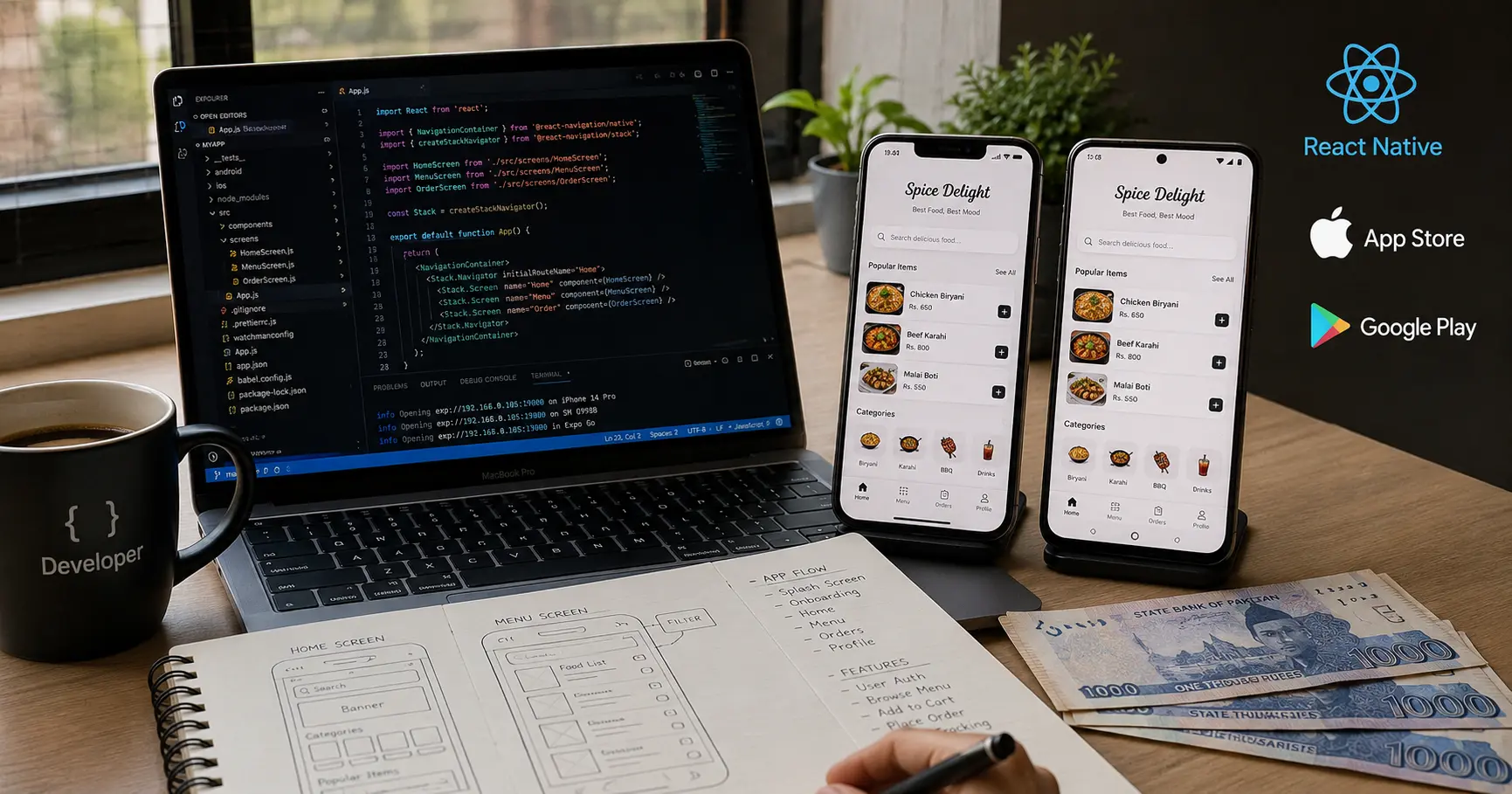
Why Companies Hire a React Native Mobile App Development Company (Instead of Building Native)
You need an app that works on both iPhone and Android. Building two separate native apps means hiring two development teams, writing every feature twice, and waiting six to nine months before launch. Most businesses cannot afford that timeline or budget.
That is exactly why we build with React Native.
React Native lets us write one codebase that runs on both platforms. Same features. Same functionality. Native performance on iOS and Android. Our clients typically save 40 to 50 percent compared to building separate native apps. And we cut development time by three to four months.
We have built 47 React Native apps over the last three years for startups, mid-market companies, and enterprises. The React Native framework was created by Meta and powers major apps like Instagram, Facebook Messenger, and Shopify with over billions of users worldwide. According to the official React Native documentation, this proven technology delivers native performance while maintaining code efficiency across platforms. You are not taking a risk on unproven technology.
But here is what most agencies will not tell you upfront. React Native is not the right choice for every project. And we will be honest about that before you spend a dollar with us.
See if React Native fits your project jump to our FAQ section or keep reading to understand exactly when this approach makes sense.
GET IN TOUCH
Get Your React Native App Built Starting at 20,000 PKR – Free Quote in 24 Hours
Cross-Platform App Development: One Codebase, Two Native Apps
Cross-platform app development means we write your app once and deploy it to both iOS and Android app stores. Typically 70 to 90 percent of the code is shared between platforms.
The way it works is straightforward. We write your app logic in JavaScript. React Native translates that code into native components that match each platform’s design guidelines. Your iPhone users see iOS interface patterns. Your Android users see Material Design. Both get native performance.
This is not a webview wrapper pretending to be an app. React Native uses real native components. The animations run at 60 frames per second. Push notifications work exactly like native apps. Camera access, GPS, biometric authentication — all of it functions the same way a fully native app would.
And when you need a new feature next year, we add it once. It appears on both platforms in the same update cycle. That ongoing cost savings is where React Native really proves its value over time
When React Native Makes Sense (And When It Doesn’t)
React Native is ideal for business apps, e-commerce platforms, social networking apps, fintech products, and content-driven mobile experiences. For specialized requirements like patient management systems and HIPAA compliance, our healthcare app development services combine React Native’s cross-platform benefits with medical industry expertise. If you are building something users interact with daily to complete tasks, make purchases, communicate, or consume content, React Native will serve you well
It is not the right choice for everything.
Heavy 3D games perform better with native tools or game engines like Unity. Apps that need bleeding-edge platform features on launch day (the moment Apple or Google releases them) may need native development. And if your app requires extremely low-latency real-time performance think high-frequency trading or professional audio production you should build native.
We will tell you this during our first conversation if we think native development makes more sense for your project. Our goal is not to sell you React Native. Our goal is to recommend the approach that actually solves your business problem at a cost and timeline you can work with.
Most of our clients choose React Native because they need to launch fast, serve users on both platforms, and keep ongoing development costs manageable. If that sounds like your situation, we can help.
Company Information Table
| Detail | Information |
|---|---|
| Company Name | Tecveq |
| Website | https://tecveq.com/react-native-mobile-app-development-company/ |
| Location | M3CH+JG7, Farid Town, Sahiwal, 57000 |
| info@tecveq.com | |
| Phone | 0307 3319555 |
| Primary Services | React Native App Development, Flutter Apps, Custom Software, Web Development, WhatsApp Automation |
| Starting Price | 20,000 PKR (Basic React Native App) |
| Tech Stack | React Native, JavaScript, TypeScript, Firebase, Node.js, MongoDB, PostgreSQL |
| Frameworks | Expo, Redux, React Navigation |
| Backend Services | Firebase, AWS, Custom APIs |
| Payment Integration | JazzCash, Easypaisa, Stripe |
| Platforms | iOS App Store, Google Play Store |
| Development Time | 5-14 days (Basic Apps) |
| Support | 30-day warranty + ongoing maintenance |
| Industries Served | Healthcare, Food & Restaurant, E-commerce, Education, Startups |
| Languages | English, Urdu |
React Native App Development Services We Provide
We build affordable React Native apps for small businesses, startups, and entrepreneurs who need mobile apps but cannot spend $50,000 or more with expensive agencies.
Our starting price is just 20,000 PKR for a complete basic app. No hidden fees. No surprise charges.
Most development agencies price themselves out of reach for small businesses. They quote $60,000 to $120,000 USD for projects that can be built efficiently for a fraction of that cost. We focus on getting you a working app fast without the premium agency markup.
Here are the React Native app development services we offer and what you get for your budget.
Basic React Native App (Starting at 20,000 PKR)
Perfect for small businesses that need a simple mobile presence. You get a clean, functional app with essential features like contact information, service listings, image gallery, and basic user interaction.
Delivery time is 5 to 7 days from approval of design mockups.
What’s included: basic UI design, up to 5 screens, contact forms, social media links, basic navigation, and publishing to both App Store and Google Play Store.
Choose this if you need a mobile app for your business but you’re working with a tight budget. Most of our basic app clients are restaurants, salons, small retail stores, and service providers who want customers to have an easy way to reach them.
Custom MVP Development (25,000 to 30,000 PKR)
For startups that need core functionality to test their business idea. We build the essential features you need to launch and get user feedback.
Timeline is 10 to 14 days depending on feature complexity.
You get user registration, login system, basic database functionality, your core feature set (streamlined), and a clean interface that works on both iPhone and Android. Perfect for testing your concept before investing in advanced features.
This works well for booking apps, simple marketplaces, community platforms, or any app where you want to validate demand before building the full version.
Business App with Admin Panel (30,000 to 35,000 PKR)
Ideal for businesses that need customer-facing app plus admin control. You get everything in our basic package plus an admin dashboard where you can update content, manage users, and track app activity.
Development time is 2 to 3 weeks.
Common examples include food delivery apps for single restaurants, appointment booking for clinics, inventory apps for small stores, and event management for local organizers.
API Integration & Third-Party Services (Additional 15,000 to 20,000 PKR)
We can connect your app to payment systems like JazzCash or Easypaisa, SMS services, social media APIs, or existing websites and databases.
Most integrations take 3 to 5 additional days to complete.
Popular add-ons include payment processing for e-commerce, WhatsApp integration for direct messaging, Google Maps for location services, and Firebase for real-time chat features.
App Updates & Maintenance (5,000 PKR per month)
After your app launches, you might need small changes, bug fixes, or new features. Our monthly maintenance covers minor updates, compatibility fixes when iOS or Android updates, and adding simple features.
Response time for fixes is within 24 hours. Most updates deploy within 2 to 3 days.
This is optional but recommended if you plan to grow your app over time or if your business requirements change.
Our React Native Development Process: From Idea to App Store
Most clients want to know exactly what happens after they hire us. We keep our React Native app development process simple and fast because you need results quickly without paying for unnecessary overhead.
Here is exactly what happens from the day you approve our quote to the day your app goes live on both app stores. No surprises. No hidden phases. No project managers charging you hourly rates for status meetings.
We focus on getting your app built and launched fast while keeping quality high and costs low.
GET IN TOUCH
Launch Your Mobile App in 5-14 Days – Contact Our React Native Developers Today
Phase 1 – Planning & Requirements (Day 1-2)
We start with a quick planning session where you tell us exactly what your app needs to do. This takes about one hour over WhatsApp call or in-person meeting.
You provide us with your app idea, any reference apps you like, your logo and brand colors, and the main features you want included. We ask specific questions about user flow, payment methods if needed, and any special requirements.
We deliver a simple project plan with features list, timeline, and final cost breakdown. No lengthy documents. Just clear agreement on what we are building and when you will get it.
Most planning sessions happen the same day you contact us. We move fast because small businesses need apps quickly.
Phase 2 – Basic Design & Layout (Day 2-4)
We create simple, clean designs that work well on both iPhone and Android. No complex wireframes or multiple design rounds that slow things down and add costs.
You get to see mockups of your main screens within 2 days. We use standard design patterns that users already know how to navigate. This keeps development time short and makes your app easy to use.
One round of design changes is included if needed. After that, major design changes add time and cost to the project.
For basic apps under 20,000 PKR, we use proven layouts that work well for most small businesses. Custom designs are available for higher-tier projects.
Phase 3 – App Development (Day 3-10)
This is where we build your actual app using React Native. We write clean, efficient code that works smoothly on both platforms.
You get a test version of your app every 2-3 days so you can see progress and try the features yourself. We send you a link to install the test version directly on your phone.
We handle all the technical setup including user accounts, data storage, push notifications, and connecting to any payment systems you need. Most apps take 5 to 10 days to complete depending on feature count.
If you want changes during development, small tweaks are included. Major feature additions require timeline and cost adjustments.
Phase 4 – Testing & Bug Fixes (Day 8-12)
We test your app on both iPhone and Android devices to make sure everything works correctly before launch. This includes checking all buttons, forms, payment flows, and user accounts.
Basic quality assurance testing catches the obvious problems. We fix any bugs we find at no extra cost. You also test the app yourself and report any issues you notice.
For budget projects, we focus on making sure core features work properly rather than extensive testing on dozens of devices. The app launches stable and functional.
Phase 5 – App Store Launch (Day 10-14)
We handle the entire App Store and Google Play submission process. You provide your app store developer accounts (Apple costs $99/year, Google costs $25 one-time).
We create the app descriptions, upload screenshots, set up the store listings, and submit for review. Apple typically approves apps in 1-2 days. Google approval usually takes 1-3 days.
Once approved, your app is live and available for download. We send you the direct links to share with customers and include on your website.
Phase 6 – Basic Support (First 30 Days)
Every app includes 30 days of free bug fixes after launch. If users find problems we missed during testing, we fix them quickly at no charge.
This covers actual bugs and functionality issues. It does not cover new features, design changes, or problems caused by you changing your app store accounts or business requirements.
After 30 days, small fixes cost 2,000-5,000 PKR depending on complexity. Major updates or new features require separate quotes.
Our React Native Technology Stack
We use proven, reliable technology that gets your app built fast without unnecessary complexity. Our React Native technology stack focuses on tools that work well for small business apps while keeping development time and costs low.
Many agencies list expensive enterprise tools to sound impressive. We choose our technology based on what actually delivers results for apps at your budget level.
Here are the main technologies we use and why they make sense for affordable React Native development.
React Native Framework & Frontend Tools
We build all our apps using React Native with Expo framework for faster development and easier deployment. React Native lets us write your app once and have it work on both iPhone and Android automatically.
Expo framework speeds up development significantly. Instead of configuring complex build systems, we use Expo’s tools to get your app running quickly. Most small business apps work perfectly with Expo and it cuts development time in half.
For JavaScript development, we write clean code that is easy to maintain and update later. We use TypeScript when projects require extra code reliability, but standard JavaScript works fine for most budget apps.
Backend & Data Storage
Most of our budget apps use Firebase for data storage and user accounts. Firebase handles user registration, data syncing, and push notifications automatically. This saves weeks of backend development time.
For simple apps that just need basic data storage, we use local SQLite databases that work without internet connection. Perfect for apps that store contact lists, inventory, or basic business information.
When apps need API integration with existing business systems like payment processors or SMS services, we connect directly using REST APIs. We keep integrations simple and focused on what your business actually needs.
App Store Deployment
We handle the entire app store submission process using Expo’s publishing tools. This makes getting your app live on both stores much faster than traditional deployment methods.
Your app gets published to both Apple App Store and Google Play Store with the same code. We handle all the technical setup, screenshots, and store descriptions needed for approval.
Testing happens on real devices during development so we catch problems before your app goes live. Basic testing covers the core features to make sure everything works properly for your users.
Security & User Protection
We include standard security features that small business apps need. User passwords get encrypted automatically. App data stays secure on the device using React Native’s built-in security features.
For apps that handle payments, we integrate with trusted services like Stripe or local payment systems like JazzCash and Easypaisa. We never store sensitive payment information in your app.
Basic GDPR compliance is included for apps that collect user information. We add privacy notices and user consent features when required.
Why We Choose Simple Technology
Complex enterprise technology stacks add months to development time and thousands to project costs. For most small business apps, simpler tools work just as well and get you to market faster.
We focus on technology that is reliable, well-supported, and easy to maintain. Your app will work smoothly without requiring expensive ongoing technical support.
When your business grows and you need more advanced features, these tools scale up easily. You are not locked into budget-only solutions forever.
Types of Businesses We Build React Native Apps For
We build affordable React Native apps for small businesses, startups, and local service providers across Pakistan who need a mobile presence but cannot spend huge amounts on app development.
Most of our clients are restaurants, retail shops, service businesses, clinics, and small companies that want to connect with customers through mobile apps. We focus on practical apps that help businesses grow without breaking their budget.
Here are the main types of businesses we work with and what kind of apps we typically build for each industry.
Restaurants & Food Businesses
Local restaurants, cafes, and food delivery services need simple apps to take orders and stay connected with customers. We build apps with menu displays, online ordering, delivery tracking, and customer contact information.
Most food business apps include WhatsApp integration for easy customer communication, basic loyalty programs, and push notifications for daily specials. Simple payment integration works with JazzCash, Easypaisa, or cash on delivery options.
These apps help small restaurants compete with larger delivery services while keeping costs much lower than complex e-commerce platforms.
Retail Shops & Small Stores
Clothing stores, electronics shops, and local retailers use apps to showcase products and connect with customers. We build apps with product catalogs, basic inventory displays, and customer contact features.
For e-commerce functionality, we add shopping carts, order management, and simple payment processing. Most retail apps work well with existing WhatsApp Business accounts for order confirmation and customer service.
Perfect for businesses that want to show products digitally but do not need full online marketplace complexity.
Service Providers & Professionals
Salons, repair services, consultants, and other service businesses need appointment booking and customer management apps. We build apps with service listings, basic booking systems, and client communication features.
These apps typically include photo galleries of past work, pricing information, contact forms, and simple calendar integration. Many service providers use these apps to replace paper appointment books and improve customer communication.
Great for healthcare clinics, beauty salons, home services, and professional consultants who want to organize their client interactions.
Startups & New Business Ideas
Entrepreneurs and new business owners often need MVP apps to test their ideas quickly and affordably. We build basic versions of business concepts that can be improved over time as the business grows.
Typical startup projects include simple marketplace apps, community platforms, basic social features, and small business management tools. These apps focus on core functionality rather than advanced features.
Perfect for testing business concepts with real users before investing in more complex development.
Educational & Community Organizations
Schools, training centers, and community groups use apps to communicate with students and members. We build apps with event listings, announcements, basic course information, and communication features.
These apps often include photo galleries, contact directories, news updates, and simple registration forms. Many educational apps work well for sharing announcements and keeping communities connected.
Good for language schools, training institutes, community centers, and local educational organizations.
How to Choose the Right React Native Development Company (Without Getting Scammed)
Most small businesses hiring React Native developers for the first time make expensive mistakes. They choose based on the lowest price and end up with half-finished apps, hidden costs, or developers who disappear mid-project.
Here is how to evaluate any app development agency or freelancer to make sure you get what you pay for. Use these questions to separate legitimate providers from scammers, whether you hire us or someone else.
These evaluation criteria will save you from costly mistakes that many small business owners make when choosing the right react native development company.
Ask to See Real Apps They Built (Not Just Screenshots)
Reliable developers can show you actual apps they built that are live on App Store and Google Play right now. Ask for direct download links so you can test the apps yourself on your phone.
Red flags to watch for: only showing screenshots, claiming all work is “confidential,” or apps that crash when you try to use them. Good developers are proud to show working examples of their past projects.
We can send you links to apps we built that you can download and test immediately. Real apps with real users prove we deliver what we promise.
Get Clear Pricing Upfront (Watch for Hidden Costs)
Honest app development agencies give you detailed pricing that explains exactly what is included and what costs extra. Ask for a written breakdown before starting any work.
Common pricing tricks: extremely low initial quotes that double with “unexpected” charges, charging extra for basic features like contact forms, or requiring expensive monthly fees just to keep your app working.
Our pricing includes everything needed to get your app live on both stores. No surprise charges. No hidden monthly fees. You own the app completely when we finish.
Verify They Actually Communicate Well
Test their communication before hiring by asking specific questions about your project. Good developers explain things clearly and respond within 24 hours, not just during sales calls.
Warning signs include: vague answers to direct questions, only communicating through generic contact forms, heavy accents that make phone calls difficult to understand, or pressure to pay upfront before explaining the full project scope.
You will work directly with our developers throughout your project. We explain everything in simple terms and respond to messages the same day.
Check How They Handle Project Changes
Ask what happens if you want to change something during development. Professional providers have clear change policies that protect both you and them from scope creep problems.
Bad approaches: charging hourly for every small change, refusing any modifications once work starts, or not explaining how changes affect timeline and cost. Good providers include reasonable changes and explain cost implications upfront.
We include minor changes during development and explain any additional costs before making major modifications to your original plan.
GET IN TOUCH
Ready to Build? Get Transparent Pricing & Timeline for Your React Native App Project
Understand What Happens After Launch
Many developers build your app and disappear when problems show up later. Ask about bug fixes, app updates when iOS and Android release new versions, and ongoing support options.
Red flags include: no mention of post-launch support, charging immediately for any bug fixes, or claiming the app will never need updates. All apps need occasional maintenance as mobile operating systems change.
Every app we build includes 30 days of free bug fixes after launch. We also offer affordable maintenance plans and help you understand what ongoing support actually costs.
Trust But Verify References
Ask for contact information of recent clients you can speak with directly. Legitimate developers provide references gladly because satisfied clients are their best marketing.
Be suspicious of: only providing written testimonials, claiming client privacy prevents giving references, or references that sound too perfect or generic. Real client feedback includes both positives and honest project challenges.
We provide phone numbers of recent clients who agreed to speak with potential new customers. They will tell you honestly what working with us was like and whether they would hire us again.
What React Native App Development Actually Costs (And What Affects the Price)
Most agencies avoid pricing discussions entirely. We believe you deserve transparency upfront. Real app development costs depend on three main factors: your app’s complexity, the features you need, and how much custom work is involved. We have built over 200 React Native apps in the past 6 years, so we know exactly what drives costs up or down.
Here’s what you can expect to invest, broken down by project complexity and engagement type.
Pricing Tiers by App Complexity
Simple MVP Development: 30,000 to 40,000 (8 to 12 weeks)
This covers core features only with basic UI design. Single user role, straightforward backend, essential functionality to test your concept. Most startups begin here. We include user registration, basic data storage, and one primary feature set. No complex integrations or custom animations.
Standard Business App: $60,000 to $100,000 (12 to 20 weeks)
Multiple user roles, custom design work, user authentication systems, API integrations with third-party services, and admin dashboard functionality. This is where most established businesses land when they need custom app development that goes beyond basic MVP features. We add payment processing, push notifications, and moderate backend complexity.
Complex Enterprise App Development: $10,000 to $15,000+ (20 to 32 weeks)
Advanced feature sets, multiple user roles with different permissions, complex backend logic, extensive third-party integrations, compliance requirements like HIPAA or GDPR, custom animations, and sophisticated data handling. Large organizations typically need this level when replacing legacy systems or building comprehensive platforms.
These ranges reflect real project costs we have quoted in 2024 and 2025.
What Drives Development Costs
Screen count affects timeline more than any other factor. More screens mean more design work, more development time, and more testing. Custom UI design versus template modifications can add $10,000 to $25,000 depending on complexity.
Backend requirements vary dramatically. Simple data storage costs much less than complex business logic with multiple database relationships. Adding payment processing through Stripe or similar services typically adds $5,000 to $8,000. Admin dashboards for content management add $10,000 to $15,000.
Third-party API integration complexity matters too. Connecting to existing systems, especially legacy enterprise software, often requires custom middleware development. HIPAA compliance adds specific security requirements that increase both development time and ongoing maintenance costs.
React Native vs Native Development: Cost Comparison
Building separate iOS and Android apps means hiring two development teams, maintaining two codebases, and essentially doubling your timeline. Native development typically costs twice what cross-platform app development costs for equivalent functionality.
React Native reduces this by 40 to 50 percent through code reusability. A $100,000 native development project usually costs around $60,000 with React Native. The savings come from shared codebase architecture, where 70 to 90 percent of code works on both platforms, single development team coordination, and faster iteration cycles when making changes.
You get native performance on both iOS and Android without the traditional cost penalty of separate development tracks.
Engagement Models: Fixed-Price vs Time & Materials vs Dedicated Team
Fixed-Price Works Best for well-defined scope projects like MVP development or adding specific features to existing apps. You pay the agreed total regardless of timeline variations. Risk: scope changes require separate quotes and can delay delivery.
Time & Materials Fits evolving requirements perfectly. Startups iterating on features benefit most. You pay hourly or weekly rates with complete transparency. Maximum flexibility for changes and additions as you learn what users actually want.
Dedicated Development Team makes sense for long-term projects lasting six months or longer. Monthly retainer covers your full team including developers, designers, and project management. Highest flexibility and fastest response times for ongoing development needs.
Choose fixed-price for tight budgets and clear requirements. Choose time and materials for uncertain scope and iterative development. Choose dedicated team when you want to hire React Native developers for ongoing partnership rather than one-time projects.
Get your exact estimate in 24 hours. Send us your app requirements and we will provide detailed pricing breakdown with timeline, feature scope, and engagement model recommendations. No sales pressure, just honest numbers based on real project experience.
What Happens After Your App Launches (Maintenance & Long-Term Support)
Launching your app is the starting line, not the finish line. Real users find bugs that slip through testing. Apple and Google release new operating system versions annually that require compatibility updates. Performance optimization becomes necessary based on actual usage data, and you will want to add features based on user feedback.
We have supported over 150 apps post-launch, so we know exactly what to expect. Most development agencies mention app maintenance and support as a service but never explain what that actually means or costs. Here’s the complete picture of what happens after your app goes live and how we handle ongoing support without locking you into anything you do not want.
90-Day Warranty Period (What’s Included)
Every project includes 90 days of bug-fix warranty starting from app store deployment. We cover functional bugs, crashes, and performance issues that slip through quality assurance testing. Critical bugs that prevent core functionality get fixed within 24 hours.
The warranty does not cover new feature requests, design changes, or issues caused by third-party API changes outside our control. But every legitimate bug gets resolved at no additional cost during this period.
Ongoing App Maintenance and Support Options
Basic Plan ($2,000 to $3,000 monthly): Operating system compatibility updates, bug fixes, performance monitoring, and security patches. Best for apps with stable feature sets that need reliable maintenance.
Standard Plan ($4,000 to $5,000 monthly): Everything in Basic plus minor feature updates with 10 development hours included monthly, analytics reviews, and priority support response.
Premium Plan ($6,000+ monthly): Dedicated development team access, major feature additions, fastest support response, and strategic planning sessions for app growth.
Alternative option: per-request pricing at $100 to $150 hourly for clients who prefer no monthly retainer. You call when you need something, we quote the work, and you approve before we start.
Code Ownership & Transition Support
You own 100% of your app’s source code. We provide complete source code transfer, documentation, and deployment access at project completion. No vendor lock-in whatsoever.
Want to transition to an in-house team later? We provide knowledge transfer sessions, developer onboarding support, and detailed architecture documentation. Your code goes wherever you want it to go.
OS Updates & Long-Term Compatibility
iOS and Android release major updates annually requiring app compatibility testing. We proactively test your app against beta OS releases and update the code before public launch. Most compatibility updates take 2 to 4 weeks depending on changes required.
This ongoing reality means post-launch support is not optional if you want your app to keep working. But you choose how to handle it.
Ask about maintenance plans during your quote request.
How We Protect Your App Idea and Data (Security, NDA, IP Ownership)
Healthcare, fintech, and enterprise app development requires bulletproof security and legal protections. We sign NDAs before any detailed discussions begin. You own 100% of your intellectual property and source code. Our development environment meets enterprise security standards with encrypted repositories, access controls, and compliance capabilities for GDPR, HIPAA, and other regulatory requirements.
Most agencies avoid discussing data security and NDA policies entirely. That silence disqualifies them from enterprise projects before conversations even start. Here’s exactly how we protect your ideas, data, and intellectual property throughout the development process.
Standard NDA for Every Project
We sign a Non-Disclosure Agreement before any detailed app discussions. This protects your business model, proprietary information, competitive advantages, and technical specifications. Mutual NDAs are available to protect both parties.
We can have your data security and NDA signed within 24 hours of request.
Code & IP Ownership Guarantee
You own 100% of the intellectual property we create for your project. Source code, design files, documentation, and any trademarks belong to you completely. Full transfer happens upon project completion and final payment.
No hidden licensing fees. No ongoing ownership claims. Your code is yours forever.
Security Practices During Development
Our enterprise app development environment uses GitHub private repositories with two-factor authentication required for all team members. Developers only access code sections relevant to their work through strict access controls. All communication happens through encrypted channels.
Every code commit gets reviewed before merging. We never share client data with third parties. Post-project, your data gets deleted from our systems upon request.
Compliance Capabilities (GDPR, HIPAA, SOC2)
We build compliant apps for regulated industries including healthcare and fintech. GDPR compliance includes data encryption, user consent management, right to deletion, and data portability features. For healthcare projects, HIPAA compliance covers encrypted databases, audit logs, BAA agreements, and secure authentication.
Our hosting infrastructure uses AWS and Azure compliant services that meet enterprise security standards. Which is exactly why regulated companies choose us over agencies that cannot demonstrate compliance expertise.
Why Companies Choose Us Over Other React Native Mobile App Development Companies
Most top React Native app development companies hide pricing until you’re on a sales call, give vague timelines, and disappear for weeks during development. We publish real pricing ranges upfront, show you working builds every Friday, and prove our technical capabilities through verifiable work you can actually check.
The difference comes down to transparency versus typical agency secrecy. Our approach eliminates the guesswork that makes hiring an app development agency feel risky. You know what you’re getting, what it costs, and exactly when you’ll see progress.
We Show You Real Numbers (Pricing, Timelines, Process)
Other React Native mobile app development companies force you through sales calls before revealing basic pricing information. We publish detailed cost ranges by project complexity because you deserve to make informed budget decisions upfront.
Most agencies give vague timelines like “12 to 16 weeks.” We break down exact phases with specific deliverables and review checkpoints. Why the transparency? Because hidden information creates distrust and wastes everyone’s time.
We’ve Built Apps You Can Download and Test Right Now
Talk is cheap in app development. We have launched React Native apps since 2019 across healthcare, fintech, and e-commerce industries. You can download working apps from the app stores and test the actual functionality instead of just looking at screenshots.
Our portfolio includes apps with over 50,000 downloads, complex backend integrations, and regulatory compliance requirements. These are not demo projects. Real businesses use them daily.
You Get Weekly Builds (Not Monthly Check-Ins)
Many app development agencies go dark for weeks, then emerge with progress updates and screenshots. You get a working build on your phone every Friday. Test real functionality, not mock-ups.
This agile development process means course corrections happen quickly when something needs adjustment. Result: fewer surprises at launch and apps that actually match what you envisioned. Most problems get caught and fixed within days, not weeks.
Our Clients Return for Phase 2 Development
Strong client retention proves the code is maintainable and we’re easy to work with long-term. Most of our app development projects lead to ongoing feature additions and platform expansion because the initial launch exceeds expectations.
And that repeat business comes from results, not contracts or vendor lock-in.
Portfolio: React Native Apps We’ve Built (With Real Results)
Client testimonials and screenshots only tell part of the story. Real proof comes from measurable business outcomes and technical solutions that solve specific problems. Here are three React Native projects that demonstrate our capability across healthcare, e-commerce, and complex technical migrations.
Each case study includes the business challenge, technical approach, and quantifiable results you can verify. These apps are live in production, handling real users and generating real business value for our clients.
Healthcare: Patient Management Platform for Regional Medical Practice
Client: Mid-sized medical practice with 12 locations across three states
Challenge: Paper-based patient intake and scheduling caused 45-minute average wait times and frequent appointment errors. Needed HIPAA-compliant mobile solution integrated with existing practice management software.
Solution: React Native app with patient registration, appointment scheduling, prescription refill requests, and secure messaging with providers. Integration with Epic EHR system through HL7 FHIR APIs.
Technologies: React Native, Firebase Authentication, AWS HIPAA-compliant hosting, Twilio for SMS notifications, Epic MyChart integration
Results: Reduced average wait times to 12 minutes, eliminated 89% of scheduling errors, processed over 15,000 patient interactions in first year. Practice expanded from 12 to 18 locations using efficiency gains from the platform.
E-commerce: Inventory Management System for Wholesale Distributor
Client: Regional food distributor serving 200+ restaurants and cafes
Challenge: Sales reps used paper catalogs and phone orders, leading to inventory discrepancies and lost sales. Needed offline-capable mobile ordering system for field sales teams.
Solution: React Native app with real-time inventory sync, offline ordering capability, customer order history, and integrated payment processing. Warehouse staff app for inventory updates and order fulfillment tracking.
Technologies: React Native, Redux for state management, SQLite for offline storage, Stripe payment processing, PostgreSQL backend with real-time sync
Results: Increased sales rep productivity by 40%, reduced order processing time from 2 days to 4 hours, achieved 99.2% order accuracy rate. Client expanded sales territory by 35% with same staff size.
Technical Migration: Legacy iOS/Android Apps to React Native
Client: Financial services company with separate iOS and Android apps requiring constant feature parity maintenance
Challenge: Maintaining two native codebases cost $120,000 annually in developer resources. New features took 6 months to reach both platforms. Needed unified codebase without sacrificing performance.
Solution: Complete migration to React Native while maintaining all existing functionality. Custom native modules for biometric authentication and secure document storage. Gradual rollout with A/B testing between native and React Native versions.
Technologies: React Native, Custom Swift/Kotlin native modules, Keychain/Keystore integration, CodePush for over-the-air updates, Jest for automated testing
Results: Reduced development costs by 60%, cut feature delivery time to 6 weeks for both platforms, achieved 98% code reuse between iOS and Android. No performance degradation measured in production analytics.
See detailed case studies and client references upon request.
GET IN TOUCH
Join 47+ Successful App Launches – Start Your React Native Development Now
Frequently Asked Questions About React Native App Development
How long does it take to build a React Native app?
Simple MVPs take 8 to 12 weeks, standard business apps need 12 to 20 weeks, and complex applications require 20 to 32 weeks. Timeline depends on feature complexity, revision rounds, integration requirements, and how quickly you provide feedback during development phases.
React Native vs Flutter: Which should I choose?
React Native wins for most business apps due to larger developer community, JavaScript familiarity, and easier hiring. Flutter works better for animation-heavy apps and offers slightly better performance in specific cases, but has a smaller talent pool and fewer resources.
Do you sign NDAs? Who owns the code?
Yes, we sign NDAs before any detailed discussions as standard practice for all projects. You own 100% of the source code, design files, and intellectual property with full transfer upon project completion and final payment.
What if the project goes over budget or timeline?
Our detailed discovery phase and weekly progress checks minimize overruns, but if delays occur due to our error, we absorb the additional cost. Scope changes requested by clients get transparent estimates and approval before proceeding.
How much does React Native app development actually cost?
React Native development costs $30,000-$200,000+ (8-32 weeks) depending on complexity – we sign NDAs, you own 100% of code/IP, 90-day warranty included, ongoing support from $2,000/month.
Choose React Native over Flutter for larger developer community and JavaScript familiarity – we offer fixed-price, time & materials, or dedicated team engagement models.