When Off-the-Shelf Plugins Can’t Keep Up With Your Business
Your WordPress site is running slow. You’ve installed five different plugins trying to get one simple feature to work the way you need it. And now your admin dashboard takes 10 seconds to load.
We see this all the time.
Most businesses start with free plugins from the WordPress repository because they seem like the easiest solution. And sometimes they work fine. But when your business needs something specific—a custom calculator, a unique booking flow, a specialized form that connects to your CRM—you run into a wall. The free plugin gets you 80% of the way there, and then you’re stuck trying to force it to do something it was never built to do.
So you install another plugin to fill the gap. Then another one to make those two work together. Before long, you’re running 40 plugins on a site that should need 12. Your site is slow. Your customers are waiting. And you’re paying monthly fees for three different SaaS tools that sort of work but don’t talk to each other.
That’s when businesses come to us.
We build custom WordPress plugins that do exactly what your business needs as part of our complete WordPress development company services across Pakistan and internationally.
. Nothing more, nothing less. No bloat, no unnecessary features you’ll never use, and no monthly subscription fees for functionality you should own outright. You get clean, secure, well-documented code that integrates directly into your site and does the job right.
If you’ve been patching problems with stacks of generic plugins, you already know it’s not sustainable. When your website is core to your business operations, you need tools built specifically for the way you work. Not tools built for everyone and optimized for no one.
Article Overview
- The Problem With Off-the-Shelf Plugins
- Our Plugin Development Services
- Industries We Serve With Custom Plugin Development
- Our Plugin Development Process in Pakistan
- Plugin Development Pricing in Pakistan
- Why Choose Our Plugin Development Company
- Proof of Our Plugin Development Work
- FAQs About Our Plugin Development Service
Our Plugin Development Service in Pakistan
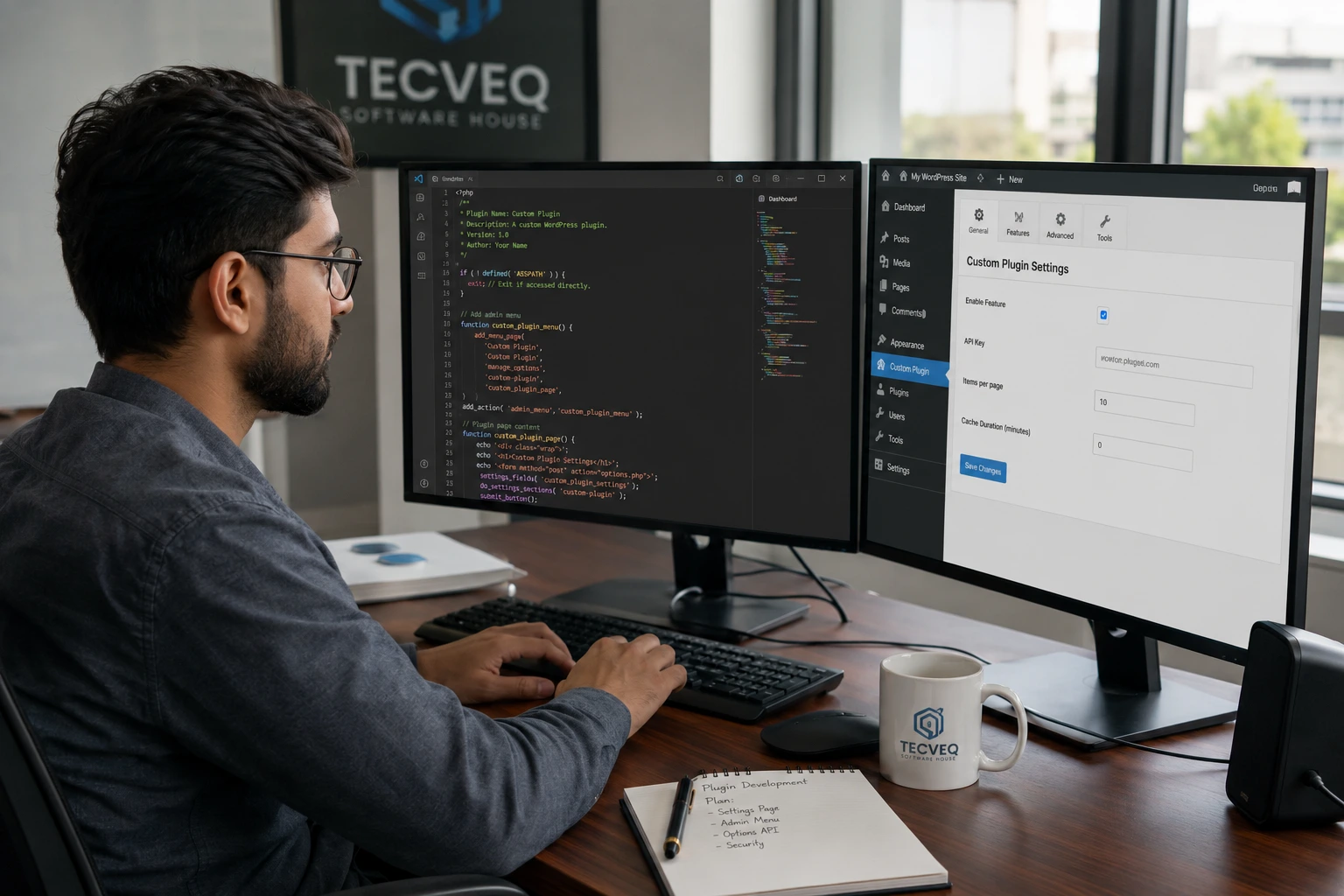
We write custom WordPress plugins from scratch to solve specific business problems that off-the-shelf solutions can’t handle. Every plugin we build is coded cleanly, documented thoroughly, and designed to do one job exceptionally well without slowing down your site or creating conflicts with your existing setup.
Here’s what we build and how each service solves a real business challenge.
GET IN TOUCH
Need a custom plugin? Get a free quote in 24 hours.
Custom Plugin Development
We build WordPress plugins tailored to your exact business requirements. No template code. No borrowed frameworks that bloat your site with features you’ll never touch. Just clean, purpose-built functionality that does what you need.
Most businesses come to us when they’ve searched the WordPress plugin directory for hours and can’t find anything that works the way their operations actually run. You need a membership system with a specific approval workflow. Or a custom product configurator that calculates pricing based on six different variables. Or a booking system that integrates with your internal scheduling software.
We start by mapping out exactly what the plugin needs to do. Then we write the code from the ground up, test every function, and hand you full documentation so your team understands how it works. You own the code completely. No licensing restrictions, no recurring fees, and no vendor lock-in.
The plugin integrates directly into your WordPress admin panel exactly where you need it. Your team can use it without training because we design the interface around how people actually work, not around how developers think people should work.
WooCommerce Extensions & Custom Modules
We build custom WooCommerce extensions when the default store functionality doesn’t match how you sell. Standard WooCommerce works fine for straightforward products, but the moment you need custom pricing rules, unique checkout flows, or specialized product options, you hit limitations fast.
We’ve built WooCommerce plugins for businesses that sell by the square foot, by weight with tiered pricing, with deposit and balance workflows, and with approval-required custom B2B eCommerce solutions that need specialized wholesale ordering logic. Each one required custom cart logic, custom pricing calculations, and custom admin controls that no existing extension could handle.
Our WooCommerce development services in Pakistan include custom payment gateway integrations, inventory sync with external systems, automated order routing based on product type or location, and custom reporting dashboards that show the metrics you actually need to run your business.
Every WooCommerce plugin we build follows WordPress and WooCommerce coding standards so it updates cleanly when WooCommerce releases new versions. We don’t hack the core. We extend it properly so your store stays stable and secure.
| Factor | Freelance Developers | Generic Dev Agencies | Tecveq (Specialized) |
|---|---|---|---|
| Code Ownership | Usually yours | Varies by contract | 100% yours, no restrictions |
| WordPress Standards | Hit or miss | Basic compliance | Full WordPress coding standards |
| Documentation | Minimal or none | Basic setup guide | Complete technical + user docs |
| Post-Launch Support | Often unavailable | Ticket system delays | Direct developer access |
| Scalability Planning | Build for current needs | Standard architecture | Growth-ready, modular design |
| Security Practices | Basic | Standard | Security audit + hardening |
| Update Compatibility | Your responsibility | Limited testing | Proactive update management |
| Fixed Pricing | Scope creep common | Estimates change | Fixed quote, transparent |
REST API & Third-Party Integrations
We connect your WordPress site to external platforms through custom API integrations. When your business uses a CRM, an accounting system, a shipping platform, or any other software that needs to talk to your website, our custom API integration services build the plugin that makes that connection work reliably.
Most API integration projects come to us after a business has tried Zapier or another middleware tool and realized the limitations. You can’t control the exact data flow. You’re paying monthly fees that add up fast. And when something breaks, you’re stuck waiting for support from three different companies trying to figure out whose fault it is.
We build direct API connections between WordPress and your other systems. Orders sync automatically to your fulfillment software. Form submissions push directly into your CRM with all the custom fields mapped correctly. Customer data updates in both systems when changes happen in either place.
The plugin handles authentication, error logging, retry logic when connections fail, and admin notifications if something needs attention. You get a stable connection you control, and we document every endpoint and data mapping so your team knows exactly how information flows between systems.
Custom Admin Panels & Dashboards
We create custom WordPress admin interfaces when your team needs to manage data or workflows that the default WordPress dashboard wasn’t designed to handle. Standard WordPress admin works well for posts and pages, but when you’re managing inventory, tracking service requests, processing applications, or coordinating multi-step workflows, you need purpose-built admin tools.
We build custom admin panels that give your team exactly the controls and views they need without forcing them to navigate through generic WordPress screens that don’t match their actual work. Custom list tables with the filters that matter for your data. Bulk action tools that handle your specific processes. Edit screens organized around how your team actually thinks about the information they’re managing.
One client needed an admin dashboard to manage 300+ franchise locations with custom fields for compliance tracking, training status, and territory assignments. Another needed a system to process membership applications with multi-stage approval workflows and automated email triggers at each step. Neither fit into standard WordPress pages or custom post types in any usable way.
The admin panels we build sit inside the WordPress dashboard where your team already works. They use familiar WordPress UI patterns so there’s a minimal learning curve, but they’re structured around your business logic, not around WordPress’s blogging heritage.
Plugin Licensing & Monetization Setup
We build licensing systems for businesses that want to sell their WordPress plugin commercially. If you’ve developed internal functionality that other businesses in your industry would pay to use, we help you package that into a licensable product with proper activation controls, update mechanisms, and revenue protection.
The licensing plugin we build generates unique license keys, validates them against your server, and restricts plugin functionality to sites with active licenses. It handles annual renewals, upgrade paths between license tiers, and domain switching when clients move to new hosting. You get an admin panel to manage customer licenses, track active installations, and handle support requests.
We also integrate your plugin with payment platforms so customers can purchase licenses directly and receive automatic activation keys. The system tracks trial periods, sends renewal reminders, and deactivates licenses when subscriptions lapse.
This isn’t DRM that frustrates legitimate customers. It’s clean licensing that lets you run a sustainable plugin business while giving your customers a fair and transparent activation process.
Existing Plugin Fixes & Debugging
We fix broken WordPress plugins that have stopped working, conflict with other software, or were abandoned by the original developer. Most of these projects come to us when a business is stuck with a plugin that’s critical to their operations but no longer has support.
The previous developer disappeared. The plugin throws PHP errors after a WordPress update. Or it mostly works but has one persistent bug that’s disrupting daily operations.
We review the existing code, identify what’s broken, and fix it properly without breaking other functionality. Sometimes that’s a compatibility update for a new PHP version. Sometimes it’s rewriting a function that was poorly coded from the start. Sometimes it’s removing a deprecated library and replacing it with current WordPress core functions.
After the fix, we document what was wrong and what we changed so you understand the problem and the solution. If the plugin is worth maintaining long-term, we can take over ongoing support and keep it updated as WordPress evolves.
We won’t always recommend keeping an old plugin alive. If the codebase is too far gone, we’ll tell you honestly that rebuilding it from scratch will cost less in the long run than trying to patch bad code indefinitely.
Security Hardening & Vulnerability Audits
We audit WordPress plugins for security vulnerabilities and fix the issues we find. If you’re running custom plugins, especially ones built years ago or by developers who didn’t follow WordPress security best practices, you’re likely exposed to SQL injection risks, XSS vulnerabilities, or insecure data handling.
Our security audit checks for all the common plugin vulnerabilities. Unescaped database queries. Unsanitized user input. Weak nonce verification. Insecure file uploads. Exposed admin functions that don’t check user permissions properly.
We provide a full report of every vulnerability, ranked by severity, with specific code examples and recommendations for how to fix each one. Then we fix them. Every database query gets parameterized. Every input gets sanitized and validated. Every admin function gets proper capability checks. Every output gets escaped based on context.
For businesses that are preparing for security audits, selling to enterprise clients, or operating in regulated industries, we also provide compliance documentation showing what security standards the plugin meets and what testing we performed.
A secure plugin protects your business and your customers. And it protects your reputation when you’re not dealing with data breaches caused by preventable code vulnerabilities.
Performance & Speed Optimization
We optimize slow WordPress plugins that are dragging down your site’s load time. When a plugin adds 2 seconds to your page load or runs heavy database queries on every request, it’s costing you traffic, conversions, and search rankings.
We profile the plugin to identify exactly what’s slowing it down. Unnecessary database queries running on every page load. Large scripts loading when they’re only needed on specific admin screens. Inefficient loops processing hundreds of records when a single optimized query could do the job.
Then we fix the performance bottlenecks. We add proper caching so repeated operations use stored results instead of recalculating every time. We load scripts conditionally so they only run where they’re actually needed. We rewrite database queries to use indexes and joins efficiently. We defer non-critical processes to background tasks that don’t block page rendering.
The result is a plugin that does the same job but loads faster, uses fewer server resources, and doesn’t slow down your site for visitors. Performance optimization is especially important for high-traffic WooCommerce stores where every 100ms of load time affects revenue directly.
We measure before and after so you can see exactly how much faster the plugin runs after optimization. And we explain what we changed so your team understands what was causing the slowdown and how the fix works.
Industries We Serve With Custom Plugin Development
We build WordPress plugins for businesses across different industries, each with unique workflows that standard plugins can’t handle. The technical approach stays the same—clean code, proper security, solid performance—but the business logic changes completely depending on what problem you’re solving.
Here’s how our custom plugin development work applies to specific industries and the kinds of challenges we solve in each one.
E-Commerce & Retail
Online stores need plugins that handle pricing complexity, inventory rules, and checkout workflows that WooCommerce wasn’t built to manage out of the box. We build custom e-commerce plugins for businesses selling products with variable pricing, bulk order discounts, subscription add-ons, or multi-location inventory.
One retail client needed dynamic pricing that changed based on customer account type, order volume, and product category—all calculated in real time at checkout. Another needed a custom product builder where customers configured items through a multi-step interface, and each selection affected available options in the next step.
We’ve built plugins that sync inventory across WordPress and external warehouse systems, calculate shipping costs using custom business rules instead of carrier APIs, and handle split payments where customers pay a deposit upfront and the balance later. These aren’t features you can piece together from free plugins without creating a slow, conflict-prone mess.
For B2B retailers, we build quote request systems, approval workflows for large orders, and tiered account access where different user roles see different products and prices. The plugin integrates into your WooCommerce store so your team manages everything from one admin panel instead of juggling separate systems.
Real Estate
Real estate websites need custom property management plugins with search filters, lead capture, agent assignment, and listing syndication that goes far beyond what a standard WordPress theme can deliver. We build plugins that let you manage properties as structured data with all the custom fields, taxonomies, and relationships your business actually uses.
Most real estate plugins force you to adapt your workflow to their structure. We do it the other way. We build the plugin around how your agency operates. Custom fields for the property details you track. Search filters for the criteria your buyers actually care about. Lead routing rules that assign inquiries to the right agent based on property type, location, or buyer qualifications.
We’ve built plugins that sync listings between your WordPress site and MLS databases, display property comparisons with mortgage calculators, and track showing requests with calendar integration for your agents. The plugin can restrict which agents see which listings, log all client interactions, and generate reports on lead sources and conversion rates.
For property developers, we’ve built pre-sale reservation systems where buyers select units from an interactive floor plan, submit deposits, and move through a multi-stage purchase process with document uploads and milestone tracking. This kind of custom functionality can’t be patched together from real estate themes and contact form plugins.
Healthcare
Healthcare providers need plugins that handle appointment scheduling, patient intake forms, HIPAA-compliant data handling, and insurance verification workflows. We build medical practice management plugins that collect sensitive information securely and integrate with practice management software without exposing patient data to unnecessary risk.
We’ve built custom intake form plugins that adapt questions based on previous answers, calculate risk scores, and route urgent cases to immediate staff review while standard appointments go into the normal queue. The forms encrypt data before storage and restrict access based on user roles so only authorized staff can view patient information.
For telehealth platforms, we build plugins that manage video consultation scheduling, payment processing for session fees, and document sharing between providers and patients. The plugin handles consent forms, session notes, and prescription requests within a secure patient portal.
One clinic needed a referral tracking system where primary care physicians could submit patient referrals to specialists, attach medical records, and track referral status through completion. The plugin created a secure workflow between multiple provider types with proper audit logging for compliance reviews.
Healthcare plugins require extra attention to data security, access controls, and compliance documentation. We don’t cut corners on encryption, user permission checks, or audit trails. When patient privacy is on the line, the code has to be bulletproof.
Education & E-Learning
Schools and training platforms need custom learning management plugins that deliver courses, track student progress, issue certificates, and integrate with grading systems. We build education plugins for businesses that have outgrown basic LMS platforms and need something tailored to their specific curriculum structure and assessment methods.
We’ve built plugins that manage cohort-based learning programs where students move through content together on a schedule, discussion forums tied to specific lessons, and assignment submission systems with rubric-based grading and instructor feedback loops. The plugin tracks completion rates, quiz scores, and time spent on each module so administrators can identify students who need additional support.
For professional certification programs, we build plugins that enforce prerequisite requirements, track continuing education credits, manage exam scheduling with proctoring integrations, and automatically issue digital certificates when students meet all completion criteria. The system maintains transcripts and allows students to download verifiable credential documents.
One client needed a complex competency tracking system where students demonstrated skills across multiple assessment types—written exams, practical demonstrations, peer reviews, and portfolio submissions—and the plugin calculated overall competency scores based on weighted performance across all areas.
Education plugins also handle payment plans for course fees, group enrollment with corporate billing, and content drip scheduling that releases lessons based on student progress rather than fixed dates. When your learning model doesn’t fit into cookie-cutter LMS templates, custom development gives you exactly the teaching and tracking tools your instructors need.
Booking & Scheduling Platforms
Booking businesses need plugins that manage appointment calendars, resource allocation, staff scheduling, and payment processing with rules far more complex than what standard booking plugins support. We build custom scheduling systems for businesses with multiple locations, different service types, variable pricing, and capacity constraints.
We’ve built booking plugins for medical practices where appointments require specific room types and equipment, salons where services have different durations and staff skill requirements, and event venues where customers book spaces with add-on services like catering and AV equipment. Each one required custom availability logic that accounted for overlapping resources and business-specific booking rules.
For service businesses, we build plugins that handle recurring appointments, waitlist management when time slots fill up, automated reminder systems, and rescheduling workflows that update staff calendars automatically. The plugin can enforce cancellation policies, process deposits and no-show fees, and block last-minute bookings during busy periods.
One fitness studio needed a class booking system with membership tier limits, pack purchases where clients bought blocks of sessions, and automatic expiration tracking. Another client needed equipment rental scheduling where customers reserved items by the hour with damage deposit handling and late return penalties.
The booking plugin integrates with your payment processor, sends confirmation emails with calendar invites, and gives your staff a dashboard showing daily schedules, client histories, and revenue reports. When your scheduling needs are complicated, a generic booking plugin creates more problems than it solves. Custom development gives you a system that works exactly how your business operates.
GET IN TOUCH
Stop paying monthly fees. Own your plugin code outright.
Our Plugin Development Process in Pakistan
We follow a structured development process that keeps you informed at every stage and makes sure the plugin we build actually solves your business problem. No surprises, no scope creep, and no handoff of half-finished code that breaks the first time WordPress updates.
Here’s exactly what happens from the first conversation to post-launch support.
Requirement Scoping
We start by understanding the business problem you’re trying to solve, not just the features you think you need. Most plugin projects go wrong because developers build exactly what the client asked for without questioning whether that’s actually what the business needs.
We ask a lot of questions upfront. What’s broken in your current workflow? What manual process are you trying to automate? What happens when this specific edge case comes up? Who on your team will use this daily, and what do they need to accomplish in the least number of clicks?
Sometimes you’ll come to us asking for a complex multi-feature plugin, and after scoping we’ll recommend a simpler solution that solves 90% of the problem at half the cost and development time. Other times you’ll think you need something basic, and we’ll identify dependencies and requirements you hadn’t considered.
We document every requirement in plain language. Not technical jargon. Clear statements about what the plugin needs to do, what data it needs to handle, and what outcomes define success. You review this document and approve it before we write a single line of code.
This scoping phase also surfaces any integration requirements, security considerations, or performance constraints we need to account for in the architecture. Better to identify those now than halfway through development.
Architecture & Planning
Once we know what the plugin needs to do, we plan how to build it. This is where we map out the database structure, define the admin interface layout, identify third-party APIs we’ll connect to, and decide which WordPress hooks and filters we’ll use to integrate the plugin cleanly into your site.
We plan the code architecture to be modular and maintainable. Functions separated by purpose. Database queries optimized for performance. Proper error handling so the plugin fails gracefully instead of breaking your site when something goes wrong.
If the plugin needs to interact with WooCommerce, BuddyPress, or another major WordPress plugin, we verify compatibility and plan the integration points carefully. If it needs to handle sensitive data, we plan the encryption and access control structure. If it will process high transaction volumes, we plan caching and background processing to keep your site fast.
We also plan the admin user experience at this stage. Where will the plugin’s settings live in the WordPress dashboard? What permissions will different user roles have? How will your team perform common tasks with minimum clicks and maximum clarity?
This planning document becomes the blueprint for development. It keeps the project on track and makes sure we’re building something that fits into your existing WordPress environment without creating conflicts or technical debt.
Design & Client Approval
Before we start coding, we design the user interface—both the admin screens your team will use and any front-end elements your customers will see. This isn’t about making things pretty. It’s about making the plugin intuitive and efficient for the people who’ll use it every day.
We create wireframes or mockups showing the layout of admin panels, the flow of multi-step processes, and the placement of key controls and information. You see exactly what the settings pages will look like, how data tables will display, and how forms will be structured.
This is your chance to request changes before we build anything. Moving a field or reorganizing a section takes 5 minutes at the design stage. Making the same change after the code is written takes hours and pushes back your timeline.
We’ve learned that clients often don’t realize how they want something to work until they see a visual mockup. The abstract concept makes sense, but the actual interface reveals workflow issues or missing functionality that didn’t come up during scoping.
Once you approve the design, we lock it down. Changes after this point get treated as scope additions, not refinements, because they require reworking completed code. Clear approval at this stage protects both of us from miscommunication and timeline drift.
| Service Component | Simple Plugins (PKR 30K-80K) | Medium Plugins (PKR 80K-200K) | Advanced Plugins (PKR 200K-400K+) |
|---|---|---|---|
| Custom Database Tables | Basic data storage | Multiple tables + relationships | Complex data architecture |
| Admin Interface | Settings page | Custom admin panels | Full dashboard with reports |
| Third-Party Integrations | Not included | 1-2 API connections | Multiple system integrations |
| User Role Management | Basic permissions | Multi-role access | Enterprise user controls |
| Security Features | Standard WordPress | Enhanced validation | Security audit + compliance |
| Performance Optimization | Clean code | Database optimization | Caching + background processing |
| Documentation | Basic setup guide | User + technical docs | Complete system documentation |
| Testing Scope | Core functionality | Multi-environment testing | Enterprise QA process |
| Post-Launch Support | 30 days included | 60 days included | 90 days + priority support |
| Timeline | 5-10 business days | 2-5 weeks | 6-16 weeks |
Hand-Coded Build
We write every plugin from scratch using clean, documented, WordPress-standard code. No page builders. No code generators. No copying chunks from old projects and hoping they work in a new context.
Every function is named clearly so other developers can read the code and understand what it does. Every database query uses prepared statements to prevent SQL injection. Every user input gets sanitized. Every output gets escaped based on context. We follow WordPress coding standards because they exist for good reasons—security, compatibility, and maintainability.
We build in stages, starting with core functionality and adding features incrementally. This lets us test as we go instead of writing 5,000 lines of code and hoping it all works when we flip the switch.
You get access to a staging site where you can see development progress and test functionality as we complete each section. This keeps you in the loop and lets you catch issues early when they’re easier to fix.
The code is yours. We don’t obfuscate it, lock it behind licensing, or retain any ownership rights. You get full source code with inline comments explaining complex logic, and we include a README file documenting how the plugin is structured and where key functions live.
Testing & Quality Assurance
We test every function of the plugin before handing it over. This isn’t a quick “does it load” check. We run through every workflow, every user role, every edge case, and every error condition to make sure the plugin handles them correctly.
We test with the latest version of WordPress and PHP. We test with your theme and the other plugins running on your site to catch conflicts before you do. We test what happens when someone enters invalid data, leaves required fields blank, or tries to access admin functions without proper permissions.
For plugins that handle payments, booking, or other critical business operations, we test failure scenarios. What happens if the API connection times out? What happens if someone submits a form twice? What happens if the payment processor returns an error code?
We use browser testing tools to verify the plugin works in Chrome, Firefox, Safari, and Edge. We test responsive behavior on mobile devices if the plugin has front-end components. We run code through security scanning tools to catch common vulnerabilities.
When we find bugs, we fix them and retest to make sure the fix didn’t create new problems. Testing continues until the plugin passes every scenario on our QA checklist and operates exactly as specified in the approved requirements document.
Launch & Handover
When testing is complete, we deploy the plugin to your live site during a maintenance window you choose. For complex plugins that affect critical business operations, we stay online during deployment to monitor for issues and respond immediately if anything unexpected happens.
We provide complete documentation that covers how to use the plugin, how to configure settings, and how to perform common admin tasks. This isn’t technical developer documentation. It’s written for your team in plain language with screenshots showing exactly where to click and what to enter.
If the plugin requires any ongoing maintenance tasks—database cleanup, cache clearing, or backup verification—we document those processes and can train your team or set up automated scheduling.
We also provide technical documentation for your developers if you have an in-house team. This covers the plugin’s architecture, key functions, database schema, and how to extend functionality safely if you need to add features later.
The handover includes all source code, development notes, and any credentials for third-party services the plugin integrates with. You have everything you need to maintain, modify, or migrate the plugin without depending on us.
That said, most clients keep us on retainer for updates and ongoing support. Which brings us to the final phase.
Post-Launch Support
We offer post-launch support to handle WordPress updates, bug fixes, and feature additions after your plugin goes live. WordPress releases major updates 2 to 3 times per year, and PHP versions advance regularly. Plugins need maintenance to stay compatible, secure, and performant.
Our support packages include compatibility testing when WordPress or PHP updates release, security patches if vulnerabilities are discovered, and priority bug fixes if issues appear in production. We also handle feature additions when your business needs evolve and the plugin needs new functionality.
Support response times depend on severity. If your plugin breaks and your business operations stop, we respond within 2 hours. If you need a feature addition or non-critical enhancement, we schedule it into the development queue and provide a timeline.
We keep staging environments active for supported plugins so we can test updates and new features before deploying to production. You never get untested code pushed to your live site.
Some clients need ongoing development as their business grows. We handle that through monthly retainer agreements that give you a set number of development hours per month for enhancements, integrations, and optimization work.
Other clients just want insurance that someone will fix the plugin if something breaks. We offer maintenance-only plans that cover compatibility updates and emergency fixes without ongoing development hours.
Either way, you’re not left maintaining custom code alone. We built it, we understand it, and we’re available when you need changes or support.
Proof of Our Plugin Development Work
Tecveq PWA Toolkit Built & Published by Our Team
We don’t just talk about plugin development we build and publish real plugins. Tecveq PWA Toolkit turns any WordPress website into a fast, installable Progressive Web App with offline support, native install prompts and a mobile-first experience.
Check out Tecveq PWA Toolkit on WordPress.orgPlugin Development Pricing in Pakistan
Custom plugin development in Pakistan typically costs between PKR 30,000 and PKR 400,000+, depending on the complexity, features, and integrations involved. Most projects fall clearly into one of three complexity tiers, and knowing which tier your project fits into gives you a realistic budget range before you speak to anyone.
We price every project based on what it actually requires to build correctly. Not a flat rate that cuts corners on complex work, and not an inflated quote that charges enterprise rates for something straightforward. Here’s how we think about pricing across the three tiers.
Simple Plugins
Price Range: PKR 30,000 to PKR 80,000
Simple plugins handle one focused function with minimal database interaction and a basic admin settings panel. These are projects where the requirements are clear, the scope is contained, and the development path is straightforward.
Examples of simple plugin projects include a custom contact form with specific fields and conditional logic, a content restriction plugin that hides pages or posts based on user role, a basic shortcode plugin that displays dynamic content in posts and pages, or a lightweight admin notification system that alerts staff when specific site events occur.
The PKR 30,000 to PKR 80,000 range covers development, basic admin interface design, testing across current WordPress and PHP versions, and documentation. Simple doesn’t mean low quality. The same coding standards, security practices, and testing process apply at every price point. Simple means the scope is narrow and the build time reflects that.
Turnaround for simple plugins is typically 5 to 10 business days from approved requirements to tested delivery.
Medium-Complexity Plugins
Price Range: PKR 80,000 to PKR 200,000
Medium-complexity plugins involve multiple interconnected features, custom database tables, more sophisticated admin interfaces, and often some level of third-party integration. These projects require more planning, more development time, and more thorough testing because more components need to work together reliably.
Examples include a booking and appointment system with availability management and email notifications, a WooCommerce extension with custom pricing rules and checkout logic, a membership plugin with tiered access levels and payment integration, a custom admin dashboard that pulls and displays data from multiple sources, or a plugin that syncs your WordPress data with an external CRM or accounting platform through a REST API connection.
The PKR 80,000 to PKR 200,000 range reflects the additional architecture planning, database design, integration work, and testing cycles these projects require. At this level, we spend meaningful time upfront mapping out exactly how the plugin’s components interact before writing code, because changes to the structure midway through development are expensive for both sides.
Turnaround for medium-complexity plugins is typically 2 to 5 weeks depending on scope and the number of revision cycles during client approval stages.
Advanced & Enterprise Plugins
Price Range: PKR 200,000 to PKR 400,000+
Advanced plugins are large-scale builds with complex business logic, multiple user roles, extensive third-party integrations, high-volume data processing, and custom reporting systems. These are projects where the plugin is essentially a business application running inside WordPress.
Examples include a full property management system with agent portals, MLS integration, and lead tracking, an e-learning platform with custom LMS functionality, competency tracking, and certification management, a franchise management system with location-level reporting and compliance workflows, a healthcare patient management plugin with secure intake, referral tracking, and provider portals, or an enterprise WooCommerce solution with ERP integration, warehouse sync, and multi-currency pricing across different customer segments.
At this level, the project scope justifies a full discovery phase before we provide a fixed quote. The PKR 200,000 to PKR 400,000+ range covers requirements documentation, architecture planning, UI design and approval cycles, full development, security auditing, performance optimization, QA testing across multiple environments, complete documentation, and deployment support.
Some enterprise projects exceed PKR 400,000 when the scope involves multiple integrated systems, large team access controls, or compliance requirements that demand extensive security documentation and audit logging.
Turnaround for advanced plugins ranges from 6 to 16 weeks depending on complexity and how quickly client approvals move through internal review.
Why Businesses Choose Our Plugin Development
Every plugin development agency will tell you they write good code and care about your project. That’s not a differentiator. What actually separates one provider from another is what happens when something goes wrong, what you own at the end, and whether the price you agreed to is the price you pay.
Here’s what working with us actually looks like across the four things that matter most to businesses choosing a custom plugin development partner in Pakistan.
Clean, Documented Code — You Own It
The code we write belongs to you. Completely. No licensing restrictions, no obfuscation, no clauses that require you to keep us involved for the plugin to keep working. When we hand over your plugin, you receive full source code with inline comments explaining what each function does and why it’s written that way.
Most developers write code that works. Fewer write code that another developer can pick up, read, and modify without spending days reverse engineering what the original author intended. We write for the second scenario because we know that your business will grow, your requirements will change, and you may need another developer to add functionality years from now.
Every plugin we deliver includes a README file that covers the plugin’s architecture, where key functions live, what each database table stores, and how to extend the plugin safely without breaking existing functionality. Your in-house developer or any future agency can work with the codebase without needing us to explain it from scratch.
Clean code also means stable code. Poorly written plugins accumulate technical debt that makes every future change harder and more expensive. We write functions that do one thing well, separate business logic from display logic, and avoid shortcuts that create problems six months down the line when you need to add a new feature.
You built your business. You own your tools.
No Bloat, No Recurring Licensing Fees
One of the clearest reasons businesses commission custom plugin development is to stop paying monthly fees for software that almost does what they need. We build plugins that do exactly what your business needs, nothing more, and you pay for that once.
No subscription. No per-site licensing. No feature tiers where the functionality you actually need sits behind a premium plan. No annual renewal required to keep your plugin working.
Generic plugins are built for thousands of different users, so they include settings, features, and database tables for scenarios that have nothing to do with your business. That bloat slows your site down, creates security exposure in features you don’t use, and makes the plugin harder to configure because you’re wading through options that don’t apply to you.
The plugin we build has exactly the features your business uses. The settings panel shows exactly the controls your team needs to manage. The database stores exactly the data your workflow requires. Nothing extra loading on every page request, nothing extra sitting in your database, nothing extra to maintain and update.
Over a 3-year period, many businesses find that a one-time custom plugin investment costs less than the recurring licensing fees they were paying for commercial plugins that were only partially solving the problem. And at the end of those 3 years, you still own the custom plugin outright.
Dedicated Support After Launch
We stay available after your plugin goes live. Not through a ticket system where you wait 5 days for a response and then get a generic reply asking you to read the documentation. Direct communication with the developers who built the plugin and understand exactly how it works.
When a WordPress major update releases and something in the plugin needs adjustment, we handle it. When a PHP version change affects a function, we fix it. When you discover an edge case that wasn’t in the original test plan, we address it.
Support response times are based on severity. If your plugin is broken and your business operations are affected, we respond within 2 hours. If you have a question about a setting or need a minor adjustment, we get back to you the same business day.
We also offer ongoing development support for businesses that regularly need new features added as their operations grow. Monthly retainer agreements give you a set number of development hours per month so you can plan and budget for plugin enhancements without going through a full project scoping process every time you need a change.
Most of our clients have been working with us across multiple projects because they know what to expect from our support. That continuity matters when you’re running business-critical plugins and need someone who understands your system deeply, not someone reading your documentation for the first time every time you reach out.
Transparent, Upfront Pricing
We quote a fixed price after scoping your requirements, and that’s the price you pay. Not an estimate that grows through the project. Not a quote built on optimistic assumptions that unravel when complexity appears during development.
Before we provide a project quote, we spend time understanding exactly what you need. We ask about edge cases, integration requirements, user roles, data volumes, and security considerations. We do this because a thorough scoping conversation lets us give you a price that reflects the actual work involved, not a low number designed to win the project with adjustments coming later.
If something comes up during development that wasn’t part of the agreed scope, we stop and discuss it before proceeding. You decide whether to include the additional work and what it costs before we build it. No surprises at the final invoice.
We also tell you honestly when your project is simpler than you think and can be built for less than your initial budget. And when a project is more complex than the initial brief suggests, we explain specifically what’s driving the complexity and why the additional cost is justified.
Pricing transparency is straightforward when you have nothing to hide about how you work. We give you a clear scope, a fixed quote, and a delivery timeline. You decide whether to proceed with full information. That’s the only way a business relationship like this should start.
What Makes a Reliable Plugin Development Partner in Pakistan
Most plugin development agencies in Pakistan can build something that works. The difference between a reliable partner and everyone else shows up six months later when your business has grown, WordPress has updated, or you need to add new functionality. Reliable plugin development isn’t about getting code that works today—it’s about getting code that keeps working and growing with your business.
Here’s what separates reliable plugin development partners from the ones who disappear after delivery.
Proven Development Standards
We follow WordPress coding standards, not shortcuts. Every function we write uses proper WordPress hooks, sanitized inputs, escaped outputs, and prepared database statements. This isn’t just technical perfectionism—it’s what keeps your plugin working when WordPress updates release and what makes your code readable for any developer who needs to work with it later.
Most developers in Pakistan can make a plugin functional. Fewer follow the standards that make plugins maintainable. We write code comments that explain complex logic. We separate business logic from display logic so changes to one don’t break the other. We use consistent naming conventions so functions are self-documenting.
When you hire developers who skip these standards, you get plugins that work until they don’t. A WordPress core update changes something. PHP gets updated on your server. Another plugin conflicts with poorly written code. Then you’re stuck with broken functionality and no clean way to fix it.
Our development standards mean your plugin ages well. Code that follows WordPress conventions doesn’t break when WordPress evolves. Functions that handle errors properly don’t crash your site when unexpected data comes through. Plugins built with proper security practices don’t become vulnerability points that expose your business to attacks.
We can show you the code. Every plugin we deliver includes full source code with inline documentation explaining what each section does and why it’s structured that way. You’re not buying a black box that only we can maintain.
Post-Launch Reliability
A reliable plugin development partner stays available after your plugin goes live. Not through automated support tickets that sit for days, but direct communication with the developers who built your plugin and understand exactly how it works.
WordPress releases major updates 2 to 3 times per year. PHP versions advance. Your hosting environment changes. Reliable partners handle these transitions proactively instead of waiting for something to break and then scrambling to fix it.
We test every WordPress update against the plugins we’ve built before recommending that our clients update. If an update affects plugin functionality, we fix the compatibility issue and push the update to your staging site for testing before it touches your live environment.
Most agencies build plugins and move on to the next project. We maintain active staging environments for supported plugins so we can test changes before deploying to production. You never get untested code pushed to your live site.
Support response times depend on severity, and we’re transparent about what that means. If your plugin is broken and affecting live business operations, we respond within 2 hours. If you need a feature addition or have a question about configuration, we get back to you the same business day.
The agencies that disappear after delivery usually underprice projects to win them and then can’t afford to provide proper support. We price projects to include realistic support expectations, which means we can afford to be available when you need us.
Scalable Architecture for Growing Businesses
We build plugins that handle growth without breaking. Not just more users or more data, but the kind of business growth where your workflows change, your team expands, and your requirements evolve beyond what you originally planned.
Most plugins are built for current requirements. When your business grows and you need new functionality, you discover the original architecture can’t support the changes without major rewrites. We design plugin architecture with extension points so new features integrate cleanly instead of bolting on as separate systems.
Database design matters for scalability. We structure data tables with proper indexing, efficient relationships, and query optimization so your plugin performs well when you’re processing thousands of records instead of dozens. Poor database design is the most common reason plugins slow down as businesses grow.
We also plan for integration requirements you don’t have yet. The plugin we build today might need to connect to a CRM system next year, export data to accounting software, or sync with a mobile app. Scalable architecture includes API endpoints and data structures that support future integrations without rebuilding core functionality.
When your business outgrows the original plugin scope, we can extend it instead of replacing it. Functions are modular. Database tables are designed for additional fields. Admin interfaces are built to accommodate new settings and controls. Your investment in custom development compounds instead of getting abandoned when requirements change is a smart move.
This architectural approach costs slightly more upfront because we’re building for scenarios you don’t need today. But businesses that choose reliable partners aren’t optimizing for the cheapest initial price—they’re optimizing for the lowest total cost of ownership over time.
GET IN TOUCH
Ready to build? Contact us for fixed-price plugin development in Pakistan.
Frequently Asked Question
How much does custom WordPress plugin development cost in Pakistan?
Pricing depends on complexity. Simple plugins are quick and affordable, while advanced tools with API integrations or dashboards cost more. We provide a clear quote after understanding your exact requirements.
How long does it take to build a custom plugin?
Most simple to medium plugins are delivered within days to a couple of weeks. Complex, enterprise-level plugins with multiple integrations may take longer depending on scope.
Can you fix or improve a plugin someone else built?
Yes, we regularly take over, debug, and improve existing plugins left by previous developers. We start with a full code review before making any changes.
Will I own the plugin code after development?
Absolutely, you get full ownership of the code with proper documentation. There are no ongoing licensing fees or vendor lock-in.
Do you provide support after the plugin is launched?
Yes, we offer post-launch support to fix bugs, handle WordPress core updates, and make adjustments as your business needs evolve.
Start Your Plugin Development Project
If you have a workflow that generic plugins can’t handle, a WooCommerce store that needs custom functionality, or an existing plugin that’s broken and holding your business back, we can help. Our custom WordPress plugin development service in Pakistan covers everything from simple single-function builds to advanced enterprise systems with complex integrations and multi-role admin panels.
Tell us what you need. We’ll review your requirements, ask the right questions, and come back with a clear scope, a fixed price, and an honest delivery timeline. No vague estimates, no pressure, and no obligation to proceed until you’re confident the plan makes sense for your business.
Fill out the contact form below or send us a message directly. We respond to every project inquiry within 1 business day.