
SaaS Ideas for Small Business in Pakistan With Low Investment (2026 Guide)
What is SaaS and How to Start a SaaS Business in Pakistan (2026 Beginner Guide) If you have ever used Netflix, Google Docs, or Shopify, then you have already used SaaS even if you did not realize it. SaaS (Software as a Service) is one of the fastest growing business models in the world. And in 2026 it is becoming a huge opportunity in Pakistan. What is SaaS? Simple Explanation for Beginners in Pakistan Think of SaaS like renting software instead of buying it. You know how you pay for Netflix every month? You do not buy Netflix. You do not download it permanently. You just pay a small fee and use it whenever you want. SaaS works exactly the same way Instead of buying expensive software, SaaS lets you pay monthly. For example: That is the basic idea behind SaaS. You use it, you pay for it monthly, and you can cancel anytime. What is Micro SaaS? Small Software Businesses Explained Now here is where it gets really exciting especially if you want to start your own SaaS business in Pakistan with low investment. Micro SaaS is a small software product built to solve one specific problem for a specific group of people. Instead of solving 100 problems, it focuses on solving one problem extremely well. Global companies like Salesforce or HubSpot solve 100 problems for 100 types of businesses. Micro-SaaS solves ONE problem really well. Here is a real Pakistan example. Imagine a small software that only helps Daraz sellers track their inventory. Nothing else. Just that one thing. That is Micro SaaS. The beauty? You can build it with PKR 50,000 to PKR 150,000 using no-code tools. No big team needed. No fancy office needed. Just you, a laptop, and a real problem to solve. Why Pakistan’s Small Business Market Needs SaaS Right Now (Huge Opportunity) Here is something most people completely ignore when discussing SaaS in Pakistan. Pakistan has over 3.8 million small and medium businesses (SMEs). And guess what? Most of them are still running on paper registers, WhatsApp screenshots, and Excel sheets. I personally visited a clothing shop in Lahore last year. The owner was managing his entire inventory in a physical notebook. He was losing sales every single week because he did not know which items were out of stock. A simple PKR 2,000/month inventory SaaS would have saved him thousands of rupees every month. This is the reality of Pakistan’s market right now: This gap is your opportunity. The demand is real. The competition is low. And Pakistani business owners are ready to pay for tools that solve their daily problems. How Much Investment Do You Need to Start a SaaS Business in Pakistan? This is the question everyone asks me. And my honest answer always surprises people. You do not need millions. Here is a realistic breakdown based on my own research and conversations with Pakistani SaaS founders: Build Type Estimated Cost (PKR) Best For No-Code SaaS (Bubble, Glide) PKR 50,000 – 150,000 Beginners, solopreneurs WordPress-Based SaaS PKR 30,000 – 100,000 Bloggers, freelancers Custom Coded SaaS PKR 300,000 – 1,200,000 Developers, funded startups The best part? If you start with a no code tool like Bubble or Glide, you can launch your first Micro SaaS product in Pakistan for less than PKR 100,000. That is less than the cost of one month’s rent for a small shop in Lahore. And once you get your first 10 paying customers the software pays for itself. 5 Reasons Why Pakistan is Ready for Low Cost SaaS Businesses I want to tell you something that most tech bloggers in Pakistan completely ignore. We always look at Silicon Valley and think“SaaS is for them, not for us.” But after spending months talking to small business owners, freelancers, and startup founders across Lahore, Karachi, and Islamabad I can tell you with full confidence: Pakistan is not just ready for SaaS. Pakistan is hungry for it. Here are 5 real reasons why 2026 is the perfect time to start a low-cost SaaS business in Pakistan. 1. 190M+ Smartphone Users & Growing Internet Penetration Let me share a number that shocked me when I first saw it. Pakistan now has over 190 million smartphone users. That is more smartphones than the entire population of most European countries. And internet usage? It is growing faster than ever. 4G coverage now reaches over 50% of Pakistan’s population and with 5G auctions already happening in 2025 that number is only going up. What does this mean for SaaS? It means your potential customers are already carrying your product in their pocket. They wake up with a smartphone. They run their business on a smartphone. They buy things on a smartphone. When I tested a simple WhatsApp based ordering tool with a small grocery shop owner in Gulberg, Lahore he was using it confidently within 20 minutes. No training needed. No laptop needed. Just his phone. Mobile first SaaS in Pakistan is not the future. It is the present. 2. Massive Untapped SME Market (3.8 Million SMEs) Here is the opportunity that keeps me up at night in the best way possible. Pakistan has 3.8 million registered small and medium enterprises (SMEs). These businesses contribute over 40% of Pakistan’s GDP. And yet most of them are running on paper, WhatsApp, and manual Excel sheets. I personally spoke to a garment shop owner in Faisalabad last year. He was tracking 500+ products in a physical register. He had no idea which items were selling fast and which were collecting dust. A simple PKR 1,500/month inventory SaaS would have completely transformed his business. Now multiply that one shop owner by 3.8 million businesses across Pakistan. That is your market. That is your opportunity. And right now almost nobody is serving them with affordable local SaaS. 3. No Code Tools Make Building Cheaper Than Ever This one personally changed my life. Two years ago, if you wanted to build a SaaS product you needed a
Restaurant App Development in Pakistan Complete Guide 2026
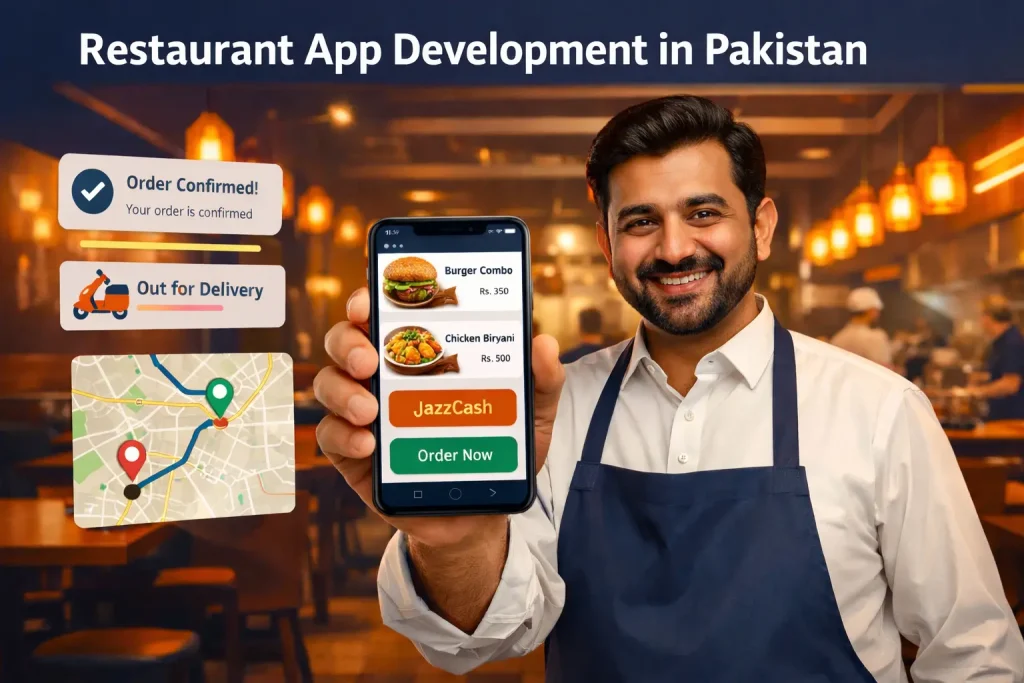
Why Restaurants in Pakistan Need Their Own Mobile App in 2026 Let me be honest with you. If your restaurant is only on Foodpanda right now you are giving away a big chunk of your hard earned money every single month. And most restaurant owners in Pakistan do not even realise how much they are actually losing. Let me show you the real numbers. The Foodpanda Commission Problem Food delivery platforms like Foodpanda typically charge restaurants between 15% and 30% commission on every order. For many restaurants in Pakistan using an online food ordering system, this commission can significantly reduce profit margins. Now think about how many orders you get in a month. Multiply that number by 25%. That is the money leaving your pocket and going straight into Foodpanda’s account. And it gets worse. There was even a time when Foodpanda tried to increase its commission from 18% all the way to 35% which caused nearly 200 restaurants in Karachi to boycott the platform completely. Sdh Restaurant owners were furious. And they had every right to be. Here is the hard truth. When you rely only on Foodpanda, you do not own your customers. You do not have their phone numbers. You cannot send them offers directly. You cannot build loyalty. Foodpanda owns that relationship not you. What You Are Actually Losing Every time a customer orders through Foodpanda, three things happen that hurt your business: First, you pay a commission on that order. Second, Foodpanda shows your competitor’s restaurant right next to yours sometimes even above yours. Third, if Foodpanda ever shuts down or removes your listing, all those customers are gone. You have nothing. This is not a business. This is renting your customers from someone else. Pakistan’s Food Delivery Market is Explodin But Who is Winning? Here is the good news. The food delivery market in Pakistan is growing fast. Pakistan’s online food delivery market is projected to reach over $2.66 billion by 2029, growing at a strong annual rate of 10.29%. Digital Waffle More people than ever are ordering food from their phones in Lahore, Karachi, Islamabad and beyond. By 2028, the number of meal delivery users in Pakistan is expected to reach 88.8 million people. Codeshaper That is an enormous number of potential customers for your restaurant. But right now, most of that money is going to platforms like Foodpanda not directly to restaurant owners. Your Own App Changes Everything That is exactly why restaurant app development in Pakistan is becoming one of the smartest investments for restaurants that want to increase profit and build long-term customer relationships. I have seen this work firsthand. Restaurants that move even 30% of their orders to their own app see a massive jump in monthly profits simply because the commission is gone. That is exactly why restaurant app development in Pakistan is one of the smartest investments a restaurant owner can make in 2026. In the next section, we will break down exactly what features your restaurant app needs and how much it will cost you in PKR no hidden surprises. What is Restaurant App Development and How Does It Work? Let me explain this in the simplest way possible. Restaurant app development means building a mobile app that belongs to your restaurant with your name, your logo, your menu and your brand colours. Customers download it on their phone, browse your menu, place an order, pay directly and track their delivery. All of this happens without any third party platform sitting in the middle. That is it. Nothing complicated. Nothing technical. Just your restaurant in your customer’s pocket. But here is where most restaurant owners in Pakistan get confused. They think a restaurant app and Foodpanda are the same thing. They are not. They are completely different and understanding this difference can change how much money your restaurant makes every single month. Your Own App vs Foodpanda What is the Real Difference? Unlike Foodpanda, a custom restaurant mobile app allows restaurants to control their entire ordering process. Think of it this way. Foodpanda is like renting a stall in someone else’s market. Yes customers walk in and find you. But the market owner takes a big cut of every sale. They also decide where your stall sits. They can move you to the back. They can put your competitor right next to you. And worst of all when a customer buys from you inside that market, they become the market’s customer not yours. Your own restaurant app is like owning your own shop on your own street. Every customer that walks in is YOUR customer. You have their number. You know what they ordered last time. You can send them a deal on Eid. You can give them a loyalty reward after 5 orders. And most importantly every single rupee they pay comes directly to you. No commission. No cut. No middleman. Research shows that 71% of customers actually prefer ordering through a restaurant’s own branded app over third-party platforms because it feels more personal, more affordable and easier to use. That is a huge number. And it proves one thing clearly customers WANT to order directly from you. They just need you to give them the option. What Does a Restaurant App Actually Do? A good restaurant app does six things really well: 1. Shows your full menu with photos, prices, descriptions and categories. Customers can browse easily and find exactly what they want. 2. Takes orders directly customers tap, select and order in under two minutes. No phone calls. No confusion. No missed orders during rush hours. 3. Accepts payments through JazzCash, Easypaisa, credit card or cash on delivery. All the payment methods Pakistanis actually use are right there in the app. 4. Tracks the delivery customers see exactly where their order is in real time. This reduces “where is my order” calls to almost zero. 5. Sends push notifications you can send a special offer or discount directly to every customer’s phone
Bespoke AI Automation for Small Businesses UK (2026)

Why Off the Shelf AI Tools Are Failing UK Small Businesses in 2026 Let me be real with you.Over the past year I tested many AI tools that everyone talks about Zapier, HubSpot, Make.com, ChatGPT plugins and more.What I discovered surprised me. Most of these tools are not built for your business. They are built for everyone. And when a tool is built for everyone, it truly works well for no one. Right now in 2026, only 35% of UK small businesses are actively using AI and out of those, only 11% are seeing real results. GOV.UK Stop and think about that for a second. That means nearly 9 out of every 10 small businesses that bought into the AI hype are not getting anything meaningful back. So what is going wrong? The answer is simple. UK small business owners are being sold the idea that off-the-shelf AI tools will fix their problems. But the truth is the complete opposite. If you are running broken or fragmented processes inside these tools, AI does not fix them it simply amplifies the dysfunction. You are not solving a problem. You are automating a mess. I have seen this happen to real businesses. A small e-commerce shop in London spent £3,600 a year on a bundle of AI tools a chatbot here, a marketing automation tool there, a scheduling assistant on top. After six months, their team was spending more time fixing errors from these tools than actually doing the work they were meant to replace. The tools could not talk to each other. The data was wrong. The automations kept breaking. That is not a technology failure. That is what happens when you buy tools designed for a generic business and force them to fit your specific one. According to Gartner, organisations will abandon 60% of AI projects by the end of 2026 because of poor data readiness and the wrong tools for the job. For UK small businesses, this challenge is even bigger because you do not have a large IT department to clean up the mess when things go wrong. The honest truth? Off the shelf AI tools are great for testing ideas. They are not great for building a real, reliable, automated business. That is exactly where bespoke AI automation steps in and why more UK small businesses in 2026 are making the switch. The Hidden Costs of Generic AI Tools for UK Businesses Here is something the sales pages never tell you. When you sign up for a generic AI tool at £30 or £50 a month, you think you are getting a bargain. But that price is just the beginning. The real cost of using off-the-shelf AI tools for your UK business is much higher than that monthly subscription fee and most business owners only find this out after they have already spent thousands. Let me walk you through exactly what I found when I dug into the numbers. The Subscription Stack Problem One tool is never enough. You need a chatbot tool. Then you need a separate automation tool to connect it to your CRM. Then you need another tool to handle your emails. Then another for your social media. Before you know it, you are paying for five, six, seven different tools every single month. According to Zylo’s 2026 SaaS Management Index, annual SaaS spend rose 8% while the number of applications remained flat meaning businesses are paying more for the same number of tools, mostly because AI premiums are being layered onto existing subscriptions. For a UK small business, this adds up fast. By the time you stack Zapier, HubSpot’s AI features, a chatbot tool and a content AI on top of each other, you are easily spending £400 to £800 per month. That is £5,000 to £10,000 per year on tools that still do not fully understand your business. The Integration Cost Nobody Talks About Generic AI tools are built to work with hundreds of different platforms. That sounds like a strength. In reality, it means they do not work deeply with any of them. When you try to connect your specific systems your booking software, your stock management, your customer database you hit walls. Integration costs go far beyond the subscription fee. These tools require workflow changes, training time, and often additional software just to reach their basic potential. BUSINESS TO MARK That time has a cost. Every hour your team spends trying to get Tool A to talk to Tool B is an hour they are not spending on your actual business. The Wasted Licence Problem Here is a stat that genuinely shocked me. In 2025, over 52% of software licences went completely unused in any given 30-day period. DesignRush That means more than half of what most businesses are paying for AI tools is going straight in the bin. Think about that in real terms. If you are spending £600 a month on your AI tool stack, statistically speaking, around £300 of that is money you are never getting any value from. The Retraining and Maintenance Trap Off-the-shelf tools get updated constantly. Their interfaces change. Features move around. Pricing tiers shift. AI systems require continuous monitoring, retraining, and infrastructure management and for many companies these hidden long term costs outweigh the initial development budget entirelz. With a bespoke AI system built specifically for your UK business by a development agency like Tecveq, none of this applies. You own the system. It does not change unless you want it to. It is built around your exact processes, your data, and your customers. There are no surprise price increases, no broken integrations when a third party tool updates its API, and no wasted licences for features you never use. The hidden cost of generic AI tools is not just financial. It is the cost of your team’s time, your customers’ experience, and the opportunity cost of running a business on tools that were never built for you in the first place.
Build vs Buy vs Outsource Software for UK Startups: The 2026 Decision Guide
Why This Choice Could Make or Break Your UK Startup in 2026 You have a business idea. You know the problem you want to solve. You might even have your first potential customers ready. Then someone asks the one question that makes every UK startup founder pause: “So… how are you going to build the software?” Suddenly, you have too many options. Should you hire developers and build it yourself? Should you buy an off-the-shelf SaaS tool and get started? Or should you outsource everything to a software agency so you can focus on growing your business? Here is something most people do not tell you: this one decision affects everything. It impacts your budget, your timeline, your chances of raising investment, how quickly you reach product-market fit, and even your stress levels late at night. Many UK startup founders make the wrong software decision early on. Some invest £40,000 building custom software before validating their idea. Others rely on SaaS tools that break once their startup begins to scale. In 2026, with less funding, higher development costs, and more SaaS tools than ever, making the right choice is even more important for UK startups. The Real Cost of Making the Wrong Software Decision Most founders focus only on the upfront cost. That is their first mistake. The real problems show up later. This is known as the total cost of ownership. Total cost of ownership is the full price you pay over time. It is not just what you spend at the start, but every pound you spend on maintenance, fixes, upgrades, and scaling your software over the next few years. Here is what making the wrong choice can actually cost UK startups: If you build too early: If you buy the wrong SaaS tool: Why Most build vs buy vs outsource software Guides Miss the Point for UK Founders I have read nearly every build vs buy vs outsource software guide online while researching this topic. I want to be honest with you about something. Most of them are written for the wrong person. They are written for CTOs at Series B companies. For enterprise IT managers with a team of 20 developers. For American tech companies with $2 million seed rounds. They are not written for you, a UK startup founder who might not be technical, working with a tight budget, and trying to reach product market fit before your runway ends. Here is what those guides consistently miss: They also ignore the UK market. Development costs and funding in the UK are different. The startup scene in London, Manchester, and Birmingham is not the same as Silicon Valley. Guides written for a US audience give you the wrong numbers, assumptions, and advice. Many guides are written for enterprise teams rather than early stage founders. Real experience matters. The best software decisions I have seen UK founders make come from knowing their own stage, budget, and technical skills not from following a generic checklist made by a content team. They treat it like a one time decision. But the build vs buy vs outsource choice is not something you make once and forget. Bootstrapped startups often start with SaaS tools, then outsource their first custom build, and later hire in-house developers once they have revenue and proof. The smartest early-stage software strategies change as your business grows. This guide is different. It is written specifically for UK startup founders in 2026. It covers all three options honestly. And it gives you a clear decision framework you can actually use whether you are technical or not. Understanding Your 3 Options: Build vs Buy vs Outsource software Every UK startup founder faces the same software development decision at some point. This decision can feel overwhelming at first. Online research often leads to technical jargon, complex frameworks, and advice tailored to large enterprises rather than early stage UK startups. Let me simplify your options. When it comes to software for your startup, you have exactly three options. For most startups, the software decision ultimately comes down to three choices. Build it yourself. Buy an existing tool. Or outsource it to experts. These are the core options; all other considerations are secondary. I will outline each option, including the experience, costs, and suitability, based on real examples from UK startups. Option 1 Build: When You Develop Software In House Building software in house means your startup hires developers either full time employees or freelancers and they create your software from scratch inside your own company. You own everything. The code, the design, the decisions, the direction. This option offers complete control and customization, allowing you to build software to your exact specifications without external limitations. However, a review of actual costs for UK startups reveals significant challenges. What building in house actually looks like: Hiring a mid-level developer in the UK costs between £45,000 and £75,000 per year in salary alone. Add national insurance, pension contributions, equipment, and management time and you are looking at £60,000 to £90,000 per developer annually before they write a single line of code. Most startup software projects need at least two to three developers to build properly. That is £180,000 to £270,000 per year in team costs alone. Building in house makes sense when: Building in house does NOT make sense when: In house development offers the greatest long-term potential but is also the most expensive, slowest, and riskiest option for early-stage UK startups. Many founders exhaust their resources before achieving product-market fit. Option 2 Buy: When You Use SaaS Tools and Off the Shelf Solutions Buying software means using tools that already exist. SaaS tools, off-the-shelf solutions, ready-made platforms that other businesses already use every day. Think Shopify for ecommerce. Salesforce for CRM. Bubble for no-code apps. Xero for accounting. These are all “buy” options. Early stage startups adopting this approach benefit from rapid deployment, moving from concept to live product in days rather than months, without the need for hiring or lengthy
Custom Software Development for Startups: Complete Guide
Did you know that 90% of startups fail within their first five years? One major reason is relying on software that cannot keep up with its growth. When your business needs change faster than your software can adapt, you lose customers, waste money, and fall behind competitors. Off-the-shelf software might seem like the easy choice at first. It is quick to set up and appears cost-effective. However, these ready-made solutions come with serious limitations. They force you to change your business processes to fit their features. They charge recurring fees that add up quickly. They lock you into their ecosystem with limited control over your data and functionality. Custom software development for startups offers a different path. It gives you complete control, perfect alignment with your business model, and the ability to scale without limits. This guide will show you exactly how to make custom software work for your startup. In this complete guide, you will learn: Whether you are building your first minimum viable product or scaling an existing platform, this guide will help you make smart decisions about your startup’s software development. What is Custom Software Development for Startups? Custom software development for startups means creating digital solutions that are made just for your business. Instead of using generic, ready-made software, custom software is built from the ground up to fit your specific needs, workflows, and goals. It’s like the difference between buying a suit off the rack and having one made just for you. A custom suit fits better and meets your needs. The same idea applies to custom software for startups. With custom software development, you team up with developers, designers, and project managers to build an app that solves your specific challenges. This might be a mobile app, a web platform, a SaaS product, or an enterprise system. Every feature and design choice is made to support your business strategy. Key Characteristics of Startup-Specific Development: For example, if you’re starting a food delivery business, you might need real-time order tracking, dynamic pricing, and connections to several payment providers. Off-the-shelf software might cover some of these needs, but not in the way you want. With custom software, you can build exactly what your business needs. The main difference between custom and ready-made software is control, flexibility, and long-term value. Off-the-shelf software can help you start quickly, but custom solutions set your startup up for lasting growth and a stronger competitive edge. Why Startups Need Custom Software Development in 2026 The startup world looks very different now. Strategies that worked five years ago are no longer enough. Customers want smooth experiences, investors look for scalable tech, and competitors are moving faster. For startups to succeed, custom software development is now a must. Scalability and Growth Potential You might have 100 users now, but what if you grow to 10,000 or even 100,000? Off-the-shelf software often struggles as you scale. Pages can load slowly, features may break, and you might need costly upgrades or even a full rebuild. Custom software is designed to scale from the start. Developers build it to handle more traffic, data, and users without slowing down. This helps you avoid technical debt, which means you won’t have to fix problems caused by rushed or poor decisions later. Here’s a real example: A health tech startup used a ready-made platform that worked well for 100 users. But when they grew to 1,000 users, the system slowed down a lot. They ended up rebuilding everything, which cost them six months and $200,000. If they had chosen custom software from the beginning, they could have scaled up without these problems. A scalable setup grows as your business does. With cloud-based systems, load balancing, and optimized databases, you can handle millions of transactions. This means your users get fast, reliable service whether you have 100 or 100,000 customers. Competitive Advantage Standing out is important in busy markets. If you use the same software as everyone else, your business looks and works just like your competitors. Custom software lets you offer unique features that make you different. These special features act as your competitive edge. Competitors can’t easily copy what you’ve built because they would have to start from zero. This gives you more time to grow your brand and win customers. Custom software also helps you launch faster. By building only what you need, you avoid delays that come with setting up and tweaking off-the-shelf tools. Every week you launch ahead of others gives you an advantage. For example, a fintech startup built a custom loan approval system that processed applications in minutes instead of days. This one feature brought in thousands of users who were tired of slow traditional lenders. Competitors using standard platforms couldn’t match this speed without spending a lot. Cost-Effectiveness in the Long Run Custom software can seem expensive at first. That’s why many startups pick off-the-shelf options, thinking they’ll save money. But this short-term choice often leads to higher costs in the long run. Off-the-shelf software often has hidden costs. Subscription fees go up as you add more users. Premium features cost extra. Connecting with other tools may need paid plugins or custom work. Training costs rise as staff changes. Support issues grow when the software doesn’t fit your needs. Custom software costs more upfront but removes ongoing fees. You fully own the software. You choose when to add features and which integrations to build. Over three to five years, custom solutions usually cost 40-60% less than off-the-shelf options. A break-even analysis shows most startups get back their custom software investment in 18-24 months by saving on fees, avoiding upgrade costs, and working more efficiently. After that, the savings keep growing each year. The return on investment is even higher when you add in more revenue from a better user experience, faster feature releases, and special features that bring in more customers. Complete Control and Ownership One big risk with off-the-shelf software is vendor lock-in. Your business depends on someone else’s platform.