
Best LMS in Pakistan: Tecveq’s Complete Guide to AI-Powered Learning Management
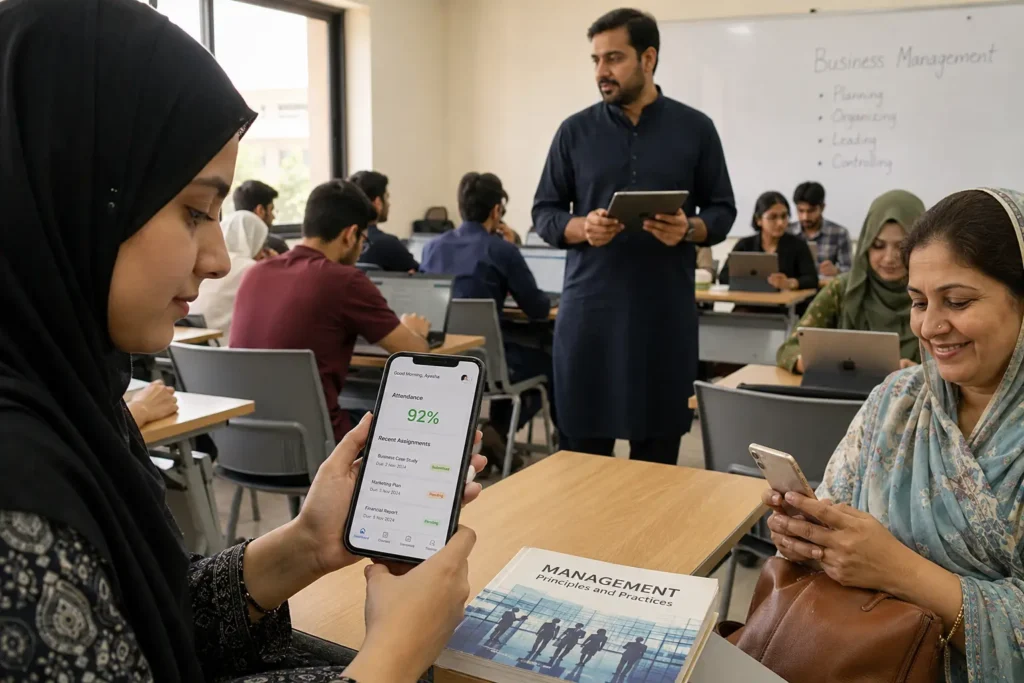
What Is a Learning Management System (LMS)? We build learning management systems specifically for Pakistani colleges and universities. Not corporate training platforms that get forced into education. An LMS handles everything your institution does academically. Student enrollment and assignment submissions. Teacher gradebooks and attendance tracking. Parent communication and administrative oversight. All in one secure platform that works exactly how educational institutions actually operate. Most colleges right now juggle separate systems. Email for assignments. Spreadsheets for attendance. Phone calls to parents. Manual grade calculations. We replace that chaos with a single system where everything connects. And here’s what makes our approach different from generic platforms. We designed every feature around real classroom needs. When a student submits an assignment, our AI immediately scans it for plagiarism and AI-generated content. When a student skips class, both the teacher and principal get instant notifications. When parents want to check their child’s progress, they text “Hi” to our WhatsApp bot and get immediate reports. These aren’t add-on features. They’re built into the core system because we know what Pakistani educational institutions actually need to run smoothly. ⚡ GET IN TOUCH Start Your Free 30-Day Trial — No Credit Card Required 💬 Chat on WhatsApp 📞 Call 0307 3319555 How a Cloud-Based LMS Differs from Traditional Systems Traditional LMS platforms require your IT team to install servers, manage updates, and handle security patches. We handle all of that for you. Our cloud-based system runs entirely online. You access everything through a web browser or mobile app. No software to install. No servers to maintain. No security updates to worry about. But the real difference is reliability and speed. We guarantee 99.9% uptime and sub-2 second response times. Your teachers can take attendance, students can submit assignments, and parents can check reports anytime from anywhere. Even during peak usage with thousands of students online simultaneously. Traditional systems crash during exam periods when everyone logs in at once. They go down during critical enrollment windows. They require expensive IT staff to keep running. We’ve built our infrastructure to handle over 10,000 concurrent users without slowdowns. When your entire student body submits assignments on the same deadline, the system just works. When parents across Pakistan check their children’s reports at the same time, everyone gets instant access. Plus we back up all your data daily and maintain disaster recovery systems. If something happens to our primary servers, your institution keeps running on backup systems within minutes. Not hours or days like traditional installations. The cost difference is dramatic too. Traditional systems require upfront server purchases, ongoing IT salaries, and expensive upgrade cycles every few years. Our cloud platform includes all maintenance, security, and updates in one predictable monthly fee. Your administrators focus on education instead of managing technology. Why Pakistani Colleges & Universities Need the Best LMS in Pakistan in 2026 We see the same problems every time a new college contacts us. Teachers spending hours on manual attendance. Assignment submissions scattered across email threads. Parents calling administrators for basic updates about their children. Pakistani educational institutions are running on systems that worked twenty years ago. But not anymore. Student enrollment has grown. Parent expectations have increased. Government reporting requirements have multiplied. And the manual processes that barely worked for smaller institutions completely break down when you’re managing thousands of students across multiple campuses. The best LMS in Pakistan solves these specific challenges that Pakistani colleges and universities face right now. Not generic problems that apply everywhere. The real operational headaches that consume your administrative time and frustrate your faculty daily. We’ve implemented our system in institutions across Pakistan, from K-12 schools seeking smarter educational technology to large universities with over 15,000 enrollments. The same core problems show up everywhere before we fix them. The Problem with Manual Attendance Your teachers waste two hours every day on attendance. Mark papers. Transfer numbers to spreadsheets. Calculate percentages. Submit reports to administration. Then parents call asking why their child was marked absent when they attended class. Teachers have to go back through handwritten records to verify. Administration spends time resolving these disputes instead of focusing on academic quality. Manual attendance creates three serious problems for Pakistani institutions. First, it’s inaccurate because human error is inevitable when tracking thousands of students daily. Second, it’s slow because generating attendance reports takes days or weeks instead of minutes. Third, it provides no early warning system when students start skipping classes regularly. Our automated attendance system eliminates all manual record keeping. Teachers mark attendance directly on their mobile devices in under thirty seconds per class. The system instantly calculates percentages and flags students approaching the minimum attendance requirement. But here’s the part most institutions don’t expect. When a student misses class, both the teacher and principal receive immediate notifications. Parents get WhatsApp updates the same day instead of finding out weeks later during parent meetings. Students who start developing attendance problems get early intervention instead of academic failure. We track attendance across all subjects automatically. No spreadsheets. No calculations. No disputes about whether someone was present or absent on a specific date. Email Chaos in Assignment Submissions Assignment submissions through email create complete chaos in Pakistani institutions. Students send work to wrong email addresses. Teachers lose submissions in crowded inboxes. Files get corrupted or won’t open on different devices. We’ve seen teachers with over 200 assignment emails in a single day. Mixed in with administrative emails, parent communications, and personal messages. Finding specific submissions becomes nearly impossible when grading time comes. Then students claim they submitted work that teachers never received. Or teachers can’t find submissions that students definitely sent. These disputes waste enormous amounts of time and create friction between faculty and students. Our assignment management system replaces email completely. Students submit work directly through the platform with automatic confirmation receipts. Teachers receive all submissions organized by subject and due date. No files get lost in email systems. Every submission includes an automatic timestamp and AI-powered plagiarism scan. Teachers see exactly when work was
Smart Office Management System: How Tecveq’s OMS Brings HR, Attendance, and CRM Into One Dashboard
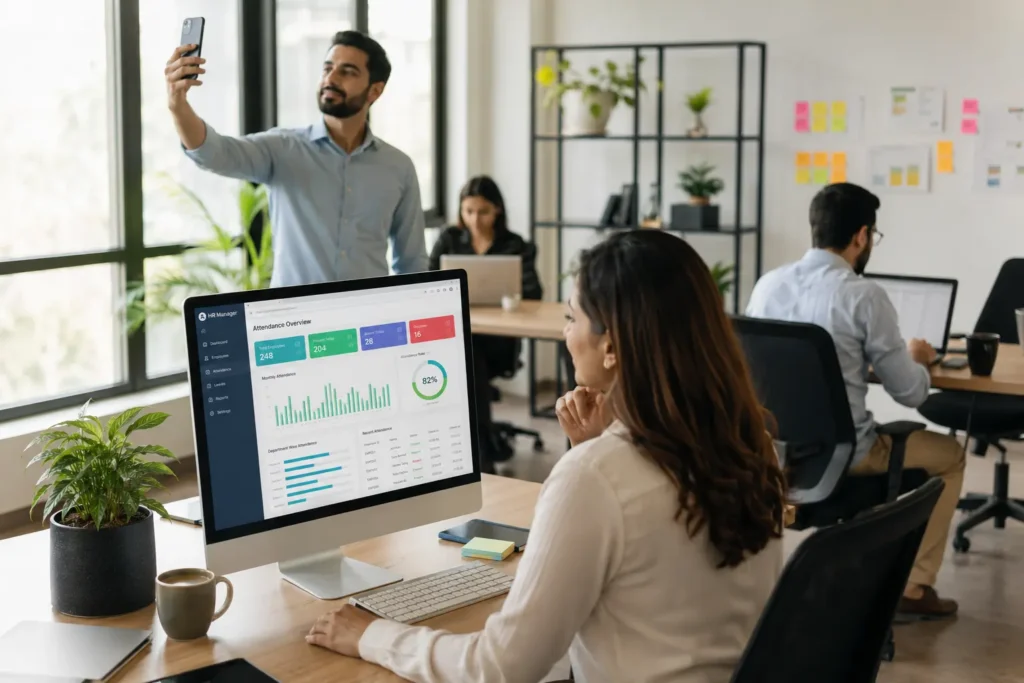
What Is a Smart Office Management System? A smart office system is software that brings your HR, attendance tracking, CRM, and reporting into one dashboard instead of juggling separate tools for each function. We built Tecveq OMS as a practical smart office solution for businesses that waste hours every week switching between different platforms just to manage basic office tasks Traditional office management means one tool for attendance, another for leave requests, a separate CRM for leads, and spreadsheets for everything else. Unlike disconnected management systems, modern smart office solutions bring these functions together, reducing data silos, duplicate entry, and constant confusion about where information actually lives. Why Businesses Are Moving to All-in-One Office Platforms We see the same pattern with almost every client before they switch to OMS. They start with basic tools that work fine for five employees. Then they grow to 20 or 50 team members, and suddenly those disconnected systems become a daily headache Here’s what actually happens. Your HR manager approves leave in one system. Your finance team tracks it in another. Your department head has no idea who’s actually in the office today. And nobody can pull a clean report without exporting three different spreadsheets and matching them manually. An all-in-one platform fixes this by centralizing everything. One login. One source of truth. Real-time data that everyone sees at the same time. Similar to how ERP software streamlines business operations, OMS brings office management, HR, and CRM under one unified system built specifically for growing teams The ROI is immediate. Most of our clients recover 8 to 12 hours per week just from eliminating duplicate data entry and system-switching time. ⚡ GET IN TOUCH Stop Juggling 5 Tools. Manage Everything in One. Try Tecveq OMS Free – No Credit Card Required 💬 Chat on WhatsApp 📞 Call 0307 3319555 Who Tecveq’s OMS Is Built For We designed OMS for growing businesses with 10 to 200 employees who need professional office management without enterprise-level complexity or cost. According to Gartner’s research on digital workplace solutions, companies that centralize their office operations see up to 30% improvement in employee productivity within the first six months. You’re a perfect fit if you currently manage attendance manually, track leads in spreadsheets, approve leave requests through email, or spend your Friday afternoons building reports nobody reads because the data is already outdated. OMS works especially well for businesses with remote teams, field employees, or multiple office locations and different work environments. The selfie and GPS attendance system solves the biggest challenge of hybrid work: knowing who’s actually working and where they’re working from, while giving managers the visibility they need for improved employee productivity. Inside Tecveq OMS — 20+ Modules in One System We packed over 20 modules into Tecveq OMS so you can run your entire office from one login instead of switching between five different tools every hour. No integrations to configure. No data syncing issues. Everything lives in the same dashboard and updates in real time. Most office management platforms force you to pick between HR features or CRM features. We built OMS to handle both because that’s what actually happens in a growing business. Your HR manager needs to see who’s available before assigning a lead. Your sales team needs to log time on tasks. Your admin needs to pull reports that combine attendance data with productivity metrics. And that only works when everything runs on the same system. Office & HR Modules The Office & HR section gives you full employee management, attendance tracking, leave requests, leave type configuration, and company settings. You can add employees with department assignments, set up shift schedules, define leave policies per employee type, and approve or reject leave requests without opening your email. CRM & Marketing Modules We built a full CRM directly into OMS because most small business CRMs are either too basic or way too complicated. You get lead tracking with status and priority flags, lead assignment to specific employees, follow-up date reminders so nothing gets forgotten, email campaign tools, and an AI content generation history log that shows exactly what was created and when. Self-Service Modules Employees handle their own attendance through selfie and GPS check-in, view their attendance history with timestamps and location data, apply for leave with auto-calculated durations, check leave balances across all four leave types, update their profile and upload documents, and see assigned leads with follow-up schedules. This self-service approach improves the employee experience while cutting your HR workload by at least 60%, because employees can get answers and complete routine tasks without constantly relying on HR Administration Modules Admins get a live dashboard with company-wide metrics, user role and permission controls, shift management, IP whitelisting for security, notification settings, and custom report builders that pull exactly the data you actually need. Tecveq OMS Product Overview Category Details Product Name Tecveq OMS (Office Management System) Company Tecveq Solutions Headquarters M3CH+JG7, Farid Town, Sahiwal, 57000, Service Type SaaS (Software as a Service) Deployment Cloud-Based, Web Application Technology Stack React.js, Node.js, MongoDB, Express.js AI Integration Google Gemini API Mobile Support Progressive Web App (PWA), Android & iOS Compatible Primary Users HR Managers, Admin, Department Heads, Employees, Accountants Target Business Size 10-200 Employees Core Modules 20+ (HR, Attendance, Leave, CRM, Tasks, Reports) Security Features IP Whitelisting, 2FA, Role-Based Access, Audit Logs Pricing Model Contact for Pricing(+92 307 3319555) Free Trial Yes Support 24/7 Email & Chat Support Industry Focus IT, Consulting, Agencies, Remote Teams, Field Operations Compliance GDPR Ready, Data Privacy Compliant Integration APIs REST API, Webhook Support Launch Year 2026 Selfie + GPS Attendance Tracking System We require employees to take a live selfie and share their GPS location every time they check in or check out. No pre-recorded photos. No screenshots. The camera activates in real time and captures their face at that exact moment along with their current location coordinates. This stops the most common attendance fraud we see in offices with remote or field teams. Someone cannot clock in from
Best LMS for Schools in 2026 Why Tecveq Is the Smarter Choice for K-12 Education
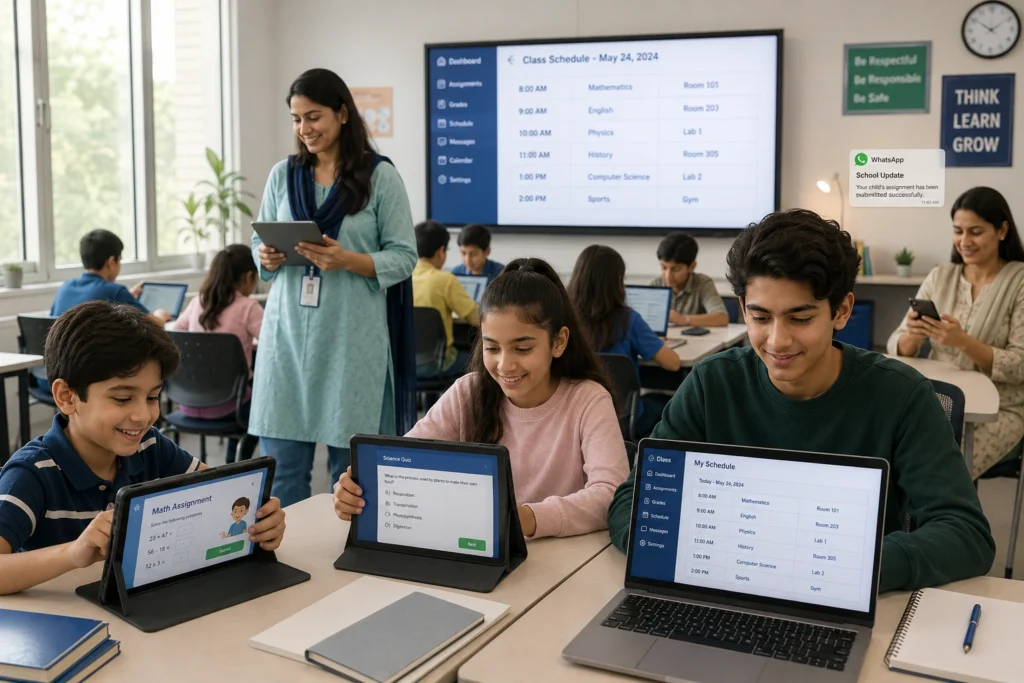
What Is a Learning Management System and Why Do Schools Need One in 2026? A Learning Management System (LMS) is software that helps schools organize teaching, learning, assessment, communication, and student progress in one digital environment. Depending on the platform, an LMS can manage courses, assignments, quizzes, attendance, grades, learning materials, schedules, and communication between teachers, students, administrators, and parents. Tecveq LMS brings these functions together for K-12 schools, including class scheduling, assignment management, quizzes, attendance tracking, parent communication, and student progress reporting. Most schools still run on spreadsheets, paper attendance sheets, and email chains between teachers and parents. That worked 15 years ago. It does not work now. We designed Tecveq specifically for K-12 schools that need to coordinate hundreds of students, dozens of teachers, and parents who want real-time updates on their child’s progress. Everything happens in one system. Teachers post assignments. Students submit work online. Parents check grades and attendance from their phone. Admins see the whole school at a glance. And it all syncs automatically. ⚡ GET IN TOUCH See the Best LMS for Schools 2026 in Action Free Tecveq demo with AI detection + WhatsApp access. 💬 Chat on WhatsApp 📞 Call 0307 3319555 How an LMS Transforms Traditional Classroom Management Traditional classroom management means teachers spend hours every week on administrative work that has nothing to do with teaching. Tracking attendance by hand. Collecting paper assignments. Emailing parents individually when a student misses class. Manually calculating grades at the end of each term. Tecveq eliminates most of that work. When a teacher schedules a class in our system, students see it on their personal calendar. Attendance gets marked digitally during class. If a student skips, the system sends an automatic notification to the teacher and the principal within minutes. No phone calls. No manual tracking. The system handles it. Teachers create assignments once and upload them to the platform. Students download the assignment, complete it, and submit it back through Tecveq. Teachers grade it online and students see their score immediately. Parents can log in and see exactly which assignments their child completed and which ones they missed. We have also built in AI detection for assignments and quizzes.Tecveq can screen submitted assignments and quizzes for signals associated with AI-generated text and flag submissions for teacher review. The result should be treated as an indicator rather than definitive proof that a student used an AI tool. Teachers can review the submission alongside the student’s previous work and apply the school’s academic integrity policy before making a decision.Teachers get an alert and can review the submission before grading. This protects academic integrity without teachers having to manually check every assignment for AI-generated content.the time savings are significant. Tecveq is designed to reduce repetitive administrative work by digitizing attendance, assignment collection, grading workflows, scheduling, and routine parent communication. The exact time savings will vary depending on the school’s size, existing processes, and how much work was previously handled manually. What Is a Cloud-Based LMS? A cloud-based LMS is a learning management system hosted online rather than installed and maintained on individual school computers. Teachers, students, administrators, and parents can access the platform through supported devices while school data and learning activities remain connected in one central system. For schools, a cloud-based LMS can make it easier to manage assignments, attendance, schedules, grades, and communication without maintaining separate software installations. LMS Approach How It Works Potential Benefits Considerations for Schools Cloud-based LMS Hosted online and accessed through supported devices Easier centralized access, provider-managed infrastructure, remote accessibility Schools should evaluate security, integrations, support, and data policies Open source LMS Source code is available under its applicable license and can be customized High customization potential and greater control May require technical resources for hosting, maintenance, updates, and customization Locally hosted LMS Installed and maintained on school-controlled infrastructure Greater control over infrastructure and configuration Requires internal infrastructure, maintenance, backups, and technical support Key Problems Schools Face Without a Proper LMS Schools without a centralized learning management system run into the same problems repeatedly. We have seen it at every school that contacts us before switching to Tecveq. Communication breakdowns between teachers and parents. Parents have no easy way to check their child’s attendance or assignment grades without emailing the teacher directly. Teachers get overwhelmed with individual parent requests for updates. Everyone wastes time repeating the same information to different people. No real-time visibility into student performance. Admins and principals cannot see how students are performing across different classes without asking every teacher for a manual report. By the time they identify a struggling student, weeks have passed and the student has fallen further behind. Attendance tracking chaos. Teachers mark attendance on paper. Someone has to manually enter that data into a spreadsheet. If a student is absent frequently, no one notices until it becomes a serious problem. There is no automated system to alert anyone when attendance patterns indicate trouble. Lost assignments and grade disputes. Students claim they submitted an assignment. Teachers have no record of it. Parents get involved. Everyone spends time trying to figure out what actually happened. With no digital submission system, there is no clear proof either way. Inconsistent scheduling and missed classes. Class schedules get updated but students do not get notified. Students show up at the wrong time or miss classes entirely because no one told them about a schedule change. Teachers waste time tracking down absent students who never knew class was happening. Parent frustration and disengagement. Parents want to stay involved in their child’s education but they have no easy way to monitor progress without constantly emailing teachers. Most parents eventually stop asking because they feel like they are bothering the teacher. Student performance suffers when parents are not engaged. No way to manage bulk administrative tasks. Admins need to assign 30 students to a new subject. Without an LMS, they have to do it one student at a time. It takes hours. Simple administrative changes become all-day projects. Tecveq is designed to address these common problems by
ERP Accounting Software in Pakistan for Growing Businesses Tecveq
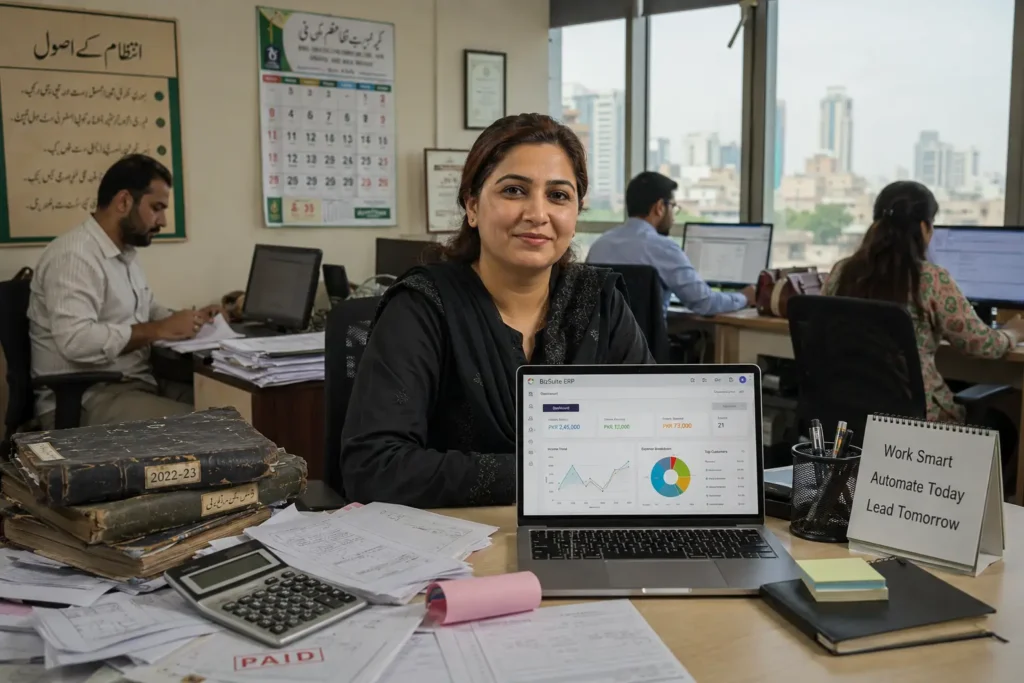
Why Pakistani Businesses Are Moving from Manual Accounting to ERP Software If you are searching for ERP accounting software in Pakistan, you have probably already identified the problem. Your accounts live in Tally. Your inventory sits in Excel. Your sales team maintains a separate sheet. And when month end arrives, someone spends three days trying to reconcile numbers from three different sources that never quite agree That is not a small business problem. That is what happens to every growing Pakistani business that outpaces its tools. We have configured Tecveq for businesses operating in textiles, pharma distribution, FMCG, and trading, and this pattern shows up consistently regardless of industry. A company starts small. Tally handles the books, Excel tracks the stock, and everything holds together. Then the second branch opens. A third salesperson joins. Purchase orders start arriving from Karachi and Lahore simultaneously, and suddenly the same data exists in four different places, nobody agrees on which version is current, and your accountant is manually copying figures from one file into another before any real analysis can happen. The cost of operating on disconnected systems is not just inconvenience. Inventory errors mean you are promising customers stock you do not have, or placing reorders for items already sitting in a warehouse no one checked. Someone has to find that mistake, trace it back through two systems, and correct it manually. In a typical Pakistani SME running on Excel and Tally, that error-finding process costs accounting staff four to eight hours per week on average, hours that should be going toward analysis and planning. When your manager is making strategic decisions based on numbers from five days ago, decisions that should cost one thing end up costing another. And then there is the FBR pressure. When an audit notice arrives, the scramble starts immediately. Purchase registers pulled from one system, sales records from another, withholding tax figures manually calculated from paper files that may or may not reflect every transaction. What should take two hours takes two weeks. Pakistani SMEs are losing staff time, management focus, and in some cases facing compliance penalties not because of intentional errors, but because their accounting tools were never built to handle FBR reporting at the scale a growing business demands. That specific problem is something Tecveq was designed to eliminate from day one. The move to ERP accounting software in Pakistan is not driven by fashion. It is driven by a simple business calculation: when the cost of staying with disconnected systems exceeds the cost of replacing them, businesses make the change. Standalone accounting tools were built for straightforward bookkeeping and they do that job genuinely well. But when your business runs multiple departments, manages stock across more than one location, and carries real FBR compliance obligations, those same tools become operational bottlenecks regardless of how comfortable your team is with them. This is why businesses across textile manufacturing, pharmaceutical distribution, retail, trading, and FMCG in Pakistan are making the switch, and most of them tell us they waited longer than they should have. Dealing with exactly these problems right now? Tecveq ERP was built specifically to eliminate them for Pakistani SMEs. Book a free 30-minute demo and we will show you how businesses in your industry handle this in the system live ⚡ GET IN TOUCH See Tecveq ERP configured for YOUR industry – Free 30-minute demo for Pakistani businesses 💬 Chat on WhatsApp 📞 Call 0307 3319555 ERP vs Basic Accounting Software: What’s the Difference for Pakistan Businesses? The difference between accounting software and ERP comes down to one practical question: how many parts of your business need to share the same data at the same time? Accounting software manages your books. ERP manages your entire operation and ensures that every department, from sales to warehouse to finance, works from identical numbers in real time. For a growing Pakistani business managing multiple departments or locations, that difference determines whether your manager makes decisions on accurate current data or on yesterday’s figures manually compiled by your accounts team. A standalone accounting management system like Tally records your transactions, maintains your ledger, and produces financial reports. It does that job reliably. But Tally has no visibility into your warehouse stock levels. Your sales team’s order register exists somewhere separate. Production floor data, payroll calculations, and branch figures from Karachi never reach Tally automatically someone has to pull them, compile them, and enter them manually. By the time your Lahore head office sees consolidated numbers from all those sources, the data is already a day or two old and it took staff hours to produce. An integrated accounting system like Tecveq ERP connects all of those departments in one shared database. Record a sale in Lahore and inventory adjusts automatically in your Karachi warehouse. Approve a purchase order and the accounts payable entry appears without your accountant retyping it. Your manager in Islamabad no longer needs to send WhatsApp messages to three offices asking for today’s cash position — the dashboard shows every branch’s figures in real time the moment they log in. That is not a feature. That is a fundamentally different way of running daily operations When Basic Accounting Software is Enough Not every business needs ERP, and we will say that clearly before recommending anything. If your business runs from a single location with straightforward operations, Tally probably still serves you well. However, if you’re unsure whether your business has outgrown basic accounting software, our comprehensive guide on selecting the best ERP software for small business covers the key indicators that signal ERP readiness and helps you evaluate your options systematically. Basic accounting software for businesses at this stage is often exactly the right fit. It is affordable, familiar and handles the core job without requiring more infrastructure than the business actually needs. If that describes where your business is today, there is no reason to change yet. But keep reading, because growth shifts that calculation faster than most Pakistani business owners anticipate.
Best ERP Software for Small Business: Complete 2026 Selection & Implementation Guide

Is Your Small Business Ready for ERP Software? We speak with small business owners every week who have hit the same wall. They are buried in spreadsheets, chasing numbers across three different systems, and spending Sunday evenings doing work that should take ten minutes on a Tuesday morning. You did not build your business to babysit data. But that is exactly what disconnected software forces you to do—manually updating inventory, reconciling cash flow reports that never quite match your bank statement, and answering the same operational questions over and over again. There is a point where basic tools stop being good enough. We help small businesses figure out whether they have reached that point and what to do when they have. Over the past ten years, we have worked through ERP evaluations and implementations with businesses ranging from eight-employee distributors to 45-person professional services firms. What we have learned is that the businesses who get the most out of ERP software are not necessarily the biggest or the most technical. They are the ones who have hit a specific ceiling with tools like QuickBooks, separate CRMs, and stacks of spreadsheets that used to work fine but no longer keep up with what their operation actually needs. One concern we hear constantly is that ERP means laying people off or buying into software they will never actually use. That is not what we do and not what the right ERP implementation looks like. Business process automation at the small business level is straightforward: it stops your team from spending half their week on manual data entry and gives every department access to accurate information without waiting on someone else to compile it. The goal is not to replace your staff. It is to stop wasting their time on work that a properly configured system should handle automatically. Small business management software hits its stride at a specific point in a company’s growth. Too early and you are paying for modules you will not use for two years. But wait too long and you are genuinely losing money—not in a theoretical sense, but in actual hours spent fixing errors, delays caused by decisions made on outdated data, and customers frustrated by problems your team did not see coming. We see this timing question come up in almost every consultation we take. Most businesses are not wondering whether ERP is worth it in principle. They are wondering whether the investment makes sense right now, for their specific size and situation. That is exactly the question a proper needs assessment answers. ⚡ GET IN TOUCH Ready for better business software? Free ERP consultation.Get Help Now 💬 Chat on WhatsApp 📞 Call 0307 3319555 5 Clear Signs Your Business Has Outgrown Basic Software Sign 1: You’re entering the same customer information in multiple places.When your sales team updates a client’s address in your CRM, accounting is still sending invoices to the old one. Your team ends up spending real hours every week correcting errors that a connected system would prevent entirely. Real-time business data means one update in one place reaches every department instantly. Sign 2: Monthly reporting takes a week to complete.If you cannot get an accurate picture of your performance until the 15th of the following month, every decision you made in the first two weeks was based on old numbers. Data centralization pulls figures from every department automatically so you are never waiting on a spreadsheet someone is still updating. Sign 3: You regularly discover inventory problems after customers have already placed orders.We hear this one constantly. A customer calls to check on an order, and your team discovers there are five units in stock, not fifty. That conversation is expensive to have—and it keeps happening until the inventory system talks to the sales system in real time. Connected inventory tracking stops these surprises before they reach the customer. Sign 4: Your team asks you the same process questions every single day.Every price quote requires three spreadsheets and two approvals from people who are not always available. Your growth is being throttled not by demand but by the number of decisions that can only route through you. A properly configured ERP pushes the right information to the right people without you in the middle. Sign 5: You have hired someone whose primary job is moving information between systems.This person is sharp and reliable—you needed them because your software could not talk to itself. But you are paying a full salary for work that an integrated system handles automatically in the background. That budget should be going somewhere more valuable. What Small Business ERP Software Actually Costs (Hidden Fees Included) We are going to cover something that most ERP consultants leave out of the first conversation: the total cost of implementation is substantially higher than the monthly software fee you see on any vendor’s pricing page. We have worked with business owners who got partway through implementation before discovering that data migration, custom reporting setup, and integration with their existing tools were all quoted separately—and the combined total doubled their original budget. These are not rare edge cases. They are the standard pattern for how ERP vendors present costs, and they catch unprepared buyers off guard every single time. After a decade of helping small businesses evaluate ERP software pricing, we lead with full cost transparency because business owners who understand the real investment make better decisions—and they are far less likely to abandon an implementation halfway through when a surprise invoice arrives. After a decade of helping small businesses work through ERP software pricing, one pattern shows up consistently: the owners who come in with realistic budget expectations get better implementations than the ones who locked in a number before understanding the full scope of the project. Here is what we cover in every first consultation before any vendor is discussed: total cost of ownership (TCO) across the first three years, not just the monthly licensing fee on the website. This