
Digital Marketing Agency Built for Small Business Growth

Digital Marketing Agency for Small Businesses That Want Measurable Growth Most small business owners we talk to share the same frustration. They invested 50,000–100,000 PKR into marketing and watched their budget disappear with nothing to show for it. No leads. No calls. No sales. Just confusion and regret. The problem usually isn’t the channel itself. Facebook ads work. Google Ads works. Email marketing works. The problem is that most small businesses are doing all of them at once with a budget that can’t support any of them properly. You hire an agency and get back a 50-page report full of charts and metrics that mean nothing to your business. Or you try DIY and spend three months learning what works instead of actually implementing it. Either way, you’re frustrated, the budget is gone, and you’re not sure whether to try again or give up on digital marketing entirely. We get it. We’ve seen it happen hundreds of times. Here’s what we’ve learned: You don’t need a perfect marketing strategy. You need one that actually works for your specific business, in your actual market, with your real budget constraints. We provide digital marketing services for small businesses that need measurable growth without wasting their budget. Our approach focuses on the channels most likely to generate leads, sales, and revenue for your specific market. We’ve worked with small business owners across Pakistan and the United States to build focused marketing strategies around their goals, budgets, and customers. Here’s how we’re different: We prioritize ruthlessly. We pick the one or two channels most likely to work for your business instead of spreading your budget thin across every platform. We measure business outcomes: leads, calls, and revenue, not vanity metrics. And we’re transparent about pricing, process, and timeline from the first conversation. If you’ve been burned by a bad agency before, this page will show you something different. If you’ve never tried working with an agency, this is exactly the right time to start. ⚡ GET IN TOUCH Stop Guessing. Start Growing. Get Your Free Marketing Plan Today. 💬 Chat on WhatsApp 📞 Call 0307 3319555 Why Most Small Businesses Never See Results from Their Marketing We’ve worked with hundreds of small business owners. Almost all of them say the same thing when we first meet: “I’ve tried marketing before, and it just didn’t work.” What they really mean is they invested time and money and saw nothing come back. The problem isn’t that marketing doesn’t work. It does. The problem is almost always one of these five things. Your Budget Gets Spread Too Thin Across Too Many Channels You have $100 a month to spend on marketing. That sounds like enough, right? But then you think about all the places you could reach customers. Facebook, Instagram, Google Ads, email, LinkedIn, TikTok. The list never ends. So you split the budget. Maybe $45 on Facebook, $75 on Google, $50 on email. And $100 sits in an ad account you haven’t touched because you ran out of money to test anything else. Here’s what happens: None of those channels get enough attention to actually learn what works. You spend $75 on Facebook and get 3 clicks. You can’t tell if Facebook is the problem or if your ad copy is the problem or if your audience targeting is wrong. With only $75, you’ll never test enough variations to know. Every channel needs enough budget to generate meaningful testing data, but there is no universal minimum. In a high-CPC market, a small budget may produce too few clicks or conversions to make reliable decisions. That’s why we recommend concentrating a limited budget rather than dividing it across several channels. If you’re splitting a $300 budget across four channels, you’re guaranteeing failure on all of them. The math is simple: divided attention means divided results. Research from Demand Metric’s Content Marketing Study shows that 72% of marketing failures stem from lack of strategy clarity and channel prioritization not from the channels themselves. This is exactly why we start by asking ‘What’s your biggest pain right now?’ instead of defaulting to an agency template that spreads your budget thin Digital Marketing Services Built Around Your Business Goals Our digital marketing services are built around the outcome you need, not a fixed list of channels. Depending on your business, strategy may include search engine optimization, Google Ads, social media marketing, email marketing, local SEO, conversion optimization, or lead generation. We don’t recommend every service to every client. We first identify where your customers are searching, what is preventing conversions, and which channel can realistically produce results within your budget. You Don’t Know Which Channel Actually Works for Your Business Here’s the thing about digital marketing. Facebook Ads work incredibly well for some businesses and waste money for others. Google Ads are perfect for some industries and completely useless for others. A local plumbing business searching for “plumber near me” should probably prioritize Google Local Search. A fashion brand reaches more customers on Instagram than anywhere else. A B2B consulting firm finds clients on LinkedIn, while B2C e-commerce finds them on TikTok. Your industry, your customer, your offer. These three things determine the best channels. But most marketing advice pretends this doesn’t matter. Agencies push whatever channels they specialize in, not necessarily what works for your business. We’ve seen businesses waste six months on Instagram because someone told them “that’s where your audience is” when their actual customers were finding them through Google Search the whole time. A wrong channel choice means a wasted budget. Even if you execute perfectly, you’re building results in the wrong place. For some businesses, search engines are the strongest source of high-intent customers because people are actively looking for a product or service. For others, social platforms may create more demand. The right choice depends on how your customers discover and evaluate businesses like yours. Marketing Channel Best For Main Strength When to Prioritize Google Ads High-intent services Captures existing demand Customers actively searching SEO
Pakistan’s Leading Custom Website Development Company for Growing Businesses

Why Choose Custom Website Development Over Templates Most Pakistani businesses start their online journey with WordPress themes or website builders. We get it. Templates seem faster and cheaper upfront. But here’s what we’ve learned at Tecveq after building custom web applications for over 150 Pakistani companies: businesses that choose templates often return to us within 18 months asking for a complete rebuild. They hit walls that templates simply cannot break through. Custom website development means we build your web application from scratch, designed specifically for how your business operates and grows. Not forcing your business to adapt to a pre made template. This approach requires more investment initially, but it saves you from expensive rebuilds and gives you capabilities that templates will never provide. We’ve rescued too many growing businesses trapped by their template limitations. A textile exporter in Faisalabad couldn’t add the fabric specification portal their international buyers needed. A logistics company in Karachi couldn’t integrate their tracking system because their template didn’t support the custom APIs they required. These aren’t minor inconveniences. They’re business growth barriers that cost real money. ⚡ GET IN TOUCH Ready for custom development? Get your free consultation with Pakistan’s trusted web development experts. 💬 Chat on WhatsApp 📞 Call 0307 3319555 Template Limitations That Hold Businesses Back Templates come with built-in restrictions that become serious problems as your business expands. Website performance suffers because template code includes dozens of features you don’t need but can’t remove. Your site loads slowly, especially on the mobile devices that 85% of Pakistani customers use to browse. Search engine optimization becomes nearly impossible when you’re competing against hundreds of other businesses using identical template structures. Google recognizes duplicate code patterns and themes, which hurts your rankings regardless of how good your content becomes. Customization hits hard limits quickly. Need a specific checkout process for your B2B customers? Most templates can’t handle it. Want to integrate with local Pakistani payment gateways or your existing business software? Template plugins rarely support the connections you actually need. Maintenance becomes expensive and unpredictable. Template updates break your customizations without warning. Plugin conflicts crash your site at the worst possible moments. You’re dependent on third-party developers who may abandon the theme your business relies on. How Tecveq’s Custom Development Solves These Problems Our custom web development process eliminates every template limitation by building exactly what your business needs. We write clean, optimized code that includes only the functionality you actually use. Your website loads 3-4 times faster than template-based competitors because there’s no bloated code slowing it down. Scalable website solutions start with architecture we design for growth from day one. When you need new features, we integrate them seamlessly into your existing system. No plugin conflicts. No theme limitations. No starting from scratch. Custom functionality means your website works exactly how your business works. We build customer portals that match your specific service process, ecommerce systems that handle JazzCash, EasyPaisa, and international payments properly, and admin panels that give you precisely the control you need over your business operations. SEO performance improves dramatically because we control every aspect of your site’s technical foundation. Clean code, optimized database queries, and custom schema markup that helps Google understand exactly what your business offers Pakistani customers. The investment in Tecveq’s custom development pays for itself through better performance, higher conversions, and eliminating costly rebuilds. Our custom development clients typically see 40-60% improvement in website speed and 25-35% increase in conversion rates compared to their previous template-based sites. Your business has unique requirements. Your website should be built specifically for them. Ready to move beyond template limitations? Let’s discuss how custom development can support your business growth. Our Custom Website Development Process: From Strategy to Launch Most clients ask us the same question during their first consultation: “How long will this actually take?” We get it. You’ve probably heard promises of “quick turnaround” from other developers, only to watch projects drag on for months without clear updates. Our custom website development timeline runs 8-12 weeks for most projects. Not because we work slowly. Because we build it right the first time. We’ve refined our development process through 150+ custom web projects for Pakistani businesses. Every phase has specific deliverables, clear deadlines, and client checkpoints. No surprises. No scope creep. No wondering what’s happening with your project. Here’s exactly what happens from the day you hire Tecveq until your custom web application goes live. Week 1-2: Discovery and Requirement Analysis We start every custom development project with deep discovery and requirement analysis. Not a quick phone call. A thorough business analysis that maps how your company actually operates. Our technical team interviews your key staff to understand your current workflow, pain points, and growth goals. We document your existing systems, identify integration requirements, and analyze your competition’s digital presence. Most importantly, we create detailed user personas for your customers and map their complete journey through your future website. This becomes the blueprint for everything we build. Week 1 deliverable: Complete business requirements document with technical specifications.Week 2 deliverable: Custom website architecture plan and development timeline. You approve both documents before we write a single line of code. Week 3-8: Custom Development and Testing The custom development phase is where your web application actually gets built. We code in 2-week sprints, so you see real progress every 14 days. Our development team builds your custom functionality using clean, optimized code written specifically for your business requirements. No template modifications. No plugin dependencies. Pure custom development that gives you exactly what you need and nothing you don’t. Quality assurance happens throughout development, not just at the end. We test every feature on desktop, mobile, and tablet devices as we build it. Performance optimization starts from day one, ensuring your site loads quickly even as we add complex functionality. Client review checkpoints happen every 2 weeks. We demo new features, gather your feedback, and make adjustments before moving to the next sprint. This prevents expensive changes later and
AI Agent Development Services in Pakistan Built for Real Business Workflows
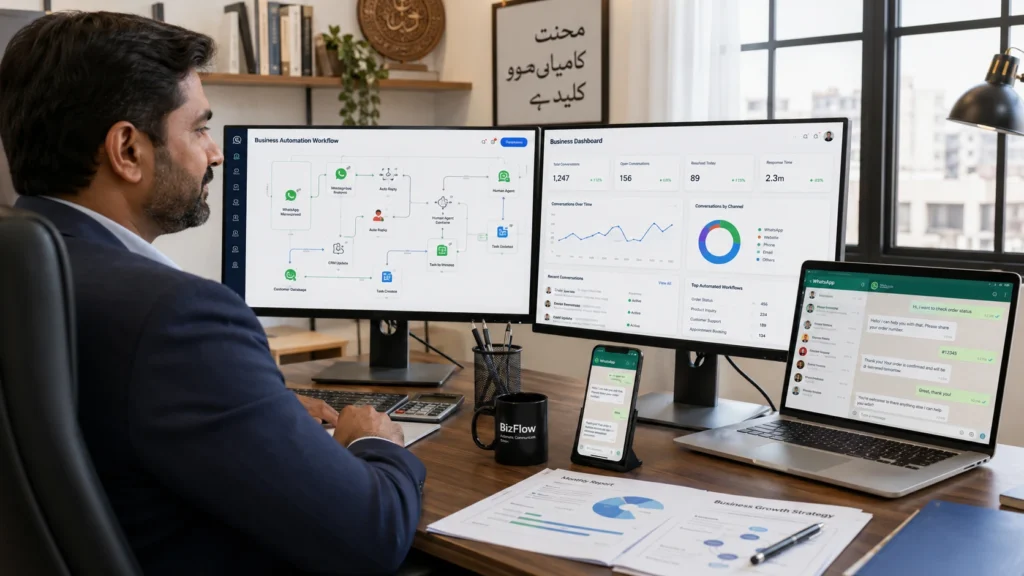
That difference is why we focus on ai agent development services in Pakistan that automate the repetitive tasks currently eating your team’s time. AI Agent Development Services in Pakistan Agents That Do the Work, Not Just Answer Questions A chatbot answers your customer’s question about order status. An AI agent checks your database, finds the order, updates the delivery time, sends a WhatsApp confirmation, and logs it in your CRM without anyone touching it. That’s the difference. We build ai agent development services in Pakistan around workflows like this one: the manual, repetitive tasks currently eating your team’s time. Most Pakistani businesses we talk to are drowning in manual follow-ups. Leads sit in spreadsheets. Queries pile up on WhatsApp. We take the exact workflow your team does by hand right now and turn it into something that runs itself. We use the same frameworks (LangChain, OpenAI, Claude) that international agencies charge Silicon Valley rates for. You get the same engineering, priced for the Pakistani market. Want to see this on your own workflow? Message us on WhatsApp or book a free 30-minute consultation. We’ll tell you what an agent would actually do for your business and what it costs in PKR before you pay us anything. Our ai agents for business are built using the same global frameworks international agencies use (LangChain, OpenAI, Claude), but priced and delivered for the Pakistani market. You get enterprise-grade automation without enterprise-grade invoices. Want to see how this works for your specific workflow? Message us on WhatsApp or book a free 30-minute consultation—we’ll show you exactly what an agent would do for your business and what it would cost in PKR. Still Running Your Business on Manual Follow-Ups, Spreadsheets, and WhatsApp Chaos? Your staff is replying to customer WhatsApp messages at 11 PM because that’s when inquiries come in. By morning, half of yesterday’s leads are already cold because no one had time to follow up while handling walk-ins and phone calls. Customer data lives in three places. One Excel sheet on the office computer. Another spreadsheet someone started on their laptop last month. And dozens of unread WhatsApp conversations sitting on your sales team’s personal phones. When a customer calls asking about their order status, your team has to check all three before they can answer. The work gets done. But it takes twice as long as it should. We see this exact pattern in small and medium businesses across Karachi, Lahore, and Islamabad. Someone manually copies order details from WhatsApp into a spreadsheet. Someone else chases JazzCash and EasyPaisa payment confirmations and updates them by hand. Your best employee spends two hours every afternoon sending follow-up messages that could run automatically while they sleep. None of this is because your team is slow. It’s because ai workflow automation hasn’t replaced the manual processes eating their time yet. And every hour your staff spends copying data or sending routine follow-ups is an hour they’re not closing deals or serving customers who actually need a human. Which Type of AI Agent Does Your Business Actually Need? The answer depends on what you’re trying to automate. A customer support problem needs a different agent than an internal workflow problem. We build five distinct types, each using specific frameworks chosen for what that agent has to do. Multi-Agent Systems We build collaborative frameworks using CrewAI or AutoGen where multiple specialized agents work together on complex workflows. One agent might qualify a lead, another pulls pricing from your database, and a third drafts the quote—all through agent orchestration where they hand tasks between themselves. This makes sense when your workflow crosses multiple departments or data sources and no single autonomous ai agent can handle the full process alone. Conversational & Customer Support Agents These conversational ai agents integrate directly with your CRM platforms like Salesforce, HubSpot, or Zoho to handle inbound customer queries, qualify sales leads, and manage support tickets through WhatsApp or your website. They pull customer history, answer questions using your actual product data, and route complex issues to your team when needed. Most Pakistani businesses start here because customer support automation delivers immediate time savings. Workflow & Task Automation Agents We build these using LangChain or ReAct frameworks to trigger actual business actions. They read incoming data, make decisions based on rules you set, retrieve information from multiple systems, and execute tasks like updating records, sending confirmations, or flagging exceptions for human review. These autonomous ai agents handle the repetitive work your team does manually every day between systems that don’t talk to each other. RAG & Knowledge Base Integration These agents connect to vector databases like Pinecone or Weaviate loaded with your company’s documents, policies, manuals, and historical data. When asked a question, the agent searches your actual knowledge base and answers using your information, not generic training data. This works well for businesses with deep technical documentation, legal knowledge, or product catalogs where accuracy matters more than speed. Enterprise LLM Fine-Tuning We customize foundation models from OpenAI, Gemini, or Claude and train them on your industry-specific data. Large language model agents fine-tuned for healthcare understand medical terminology and compliance requirements. Agents built for finance understand your reporting formats and regulatory language. This level of customization makes sense when your business vocabulary or workflows are specialized enough that generic models miss the nuances. What We Build: Our Core AI Agent Development Services Most clients come to us thinking they’re buying ‘an AI that answers questions.’ They leave with something bigger: a full system built around their actual workflow, wired into the tools they already use, and looked after as their business changes. We don’t build the agent and disappear. We map your process first. We design the architecture around how your team actually works not how a demo is supposed to look. Then we connect it to every system you use, and we stay on it after launch. The difference is in what happens after the agent goes live. We don’t just build
Best SaaS LMS in 2026: A Complete Feature Breakdown of tecveq lms

Education is shifting fast. Schools and institutions need a SaaS LMS that works the way students, teachers, and parents actually learn—easy to access, built around real classroom workflows, and designed for accountability. A learning management system is the digital backbone of an institution. It brings course content, assignments, quizzes, schedules, attendance, progress tracking, and communication into one learning platform so administrators, teachers, students, and parents can work from the same system. But most LMS platforms treat these as separate problems. TECVEQ solves them as one integrated system. This breakdown covers all 26 features across admin, teacher, student, and parent roles, including two capabilities most competitors don’t have: built-in AI detection for academic integrity and WhatsApp-based parent engagement that requires zero app downloads. If you’re evaluating the best SaaS LMS options for your school, academy, or training institute, you need to see what’s actually possible when a platform is built from the ground up for institutional accountability and real-world usability. This is a hands-on analysis of the platform itself, not generic comparison listicle content. For institution-specific guidance, explore our best lms for schools 2026: Why Tecveq is smarter choice for K-12 education. Let’s walk through exactly what TECVEQ does and why it matters. ⚡ GET IN TOUCH Stop Missing Student Absences — Get Real-Time Alerts to Teachers & Principals 💬 Chat on WhatsApp 📞 Call 0307 3319555 What Is TECVEQ LMS and Who Is It Built For? Most LMS platforms try to be everything to everyone. They end up being clunky for everyone. TECVEQ takes a different approach by building one system that actually works for four completely different user groups: administrators who need institutional control, teachers who need classroom simplicity, students who need to focus on learning, and parents who need to stay connected without downloading another app. TECVEQ LMS is a role-based learning management system designed specifically for schools, academies, and training institutes that need their entire community on one platform. Unlike generic software, this platform recognizes that an admin’s workflow looks nothing like a student’s workflow, so the interface changes completely based on who logs in. Why Schools Choose a SaaS LMS A SaaS LMS removes much of the infrastructure work associated with traditional software. Instead of installing and maintaining the platform on local servers, institutions access the system through the web. This can simplify deployment, updates, and access for administrators, teachers, and students. For growing schools and training institutes, the cloud-based model also makes it easier to provide a consistent platform across departments and locations. Core Purpose of the Platform Here’s what TECVEQ actually does at the foundation level. It replaces the chaos of managing classes, assignments, schedules, attendance, and parent communication across multiple tools. You get everything in one place where every user sees only what they need to see and can do only what they need to do. The system handles the operational side of running a school: admins create classrooms and assign subjects in bulk, teachers schedule classes and track student work, students submit assignments and take quizzes, and parents see their child’s progress without logging into anything at all. No sync problems between different platforms. No missing information because something didn’t integrate properly. And this is where TECVEQ stands apart from other learning management system software. It includes AI-generated assignment detection built directly into the grading workflow and automatic notifications to teachers and principals when a student bunks class. These are features that competitive LMS platforms either don’t have or charge extra for through third-party integrations. The platform focuses on the actual problems schools face: keeping track of who’s attending, catching academic integrity issues early, and getting parents involved without requiring them to be tech-savvy. Four User Roles at a Glance: Admin, Teacher, Student, Parent Each role has its own complete workspace. Not everyone sees the same buttons and dashboards. This is what makes TECVEQ different from systems where you have to hide features and permissions in nested menus. Role Main Responsibilities Key TECVEQ Features Admin Manage the institution and monitor operations User management, class scheduling, subject assignment, reports, attendance alerts Teacher Manage classes and student work Assignments, quizzes, attendance, student reports, AI-detection alerts Student Complete learning activities and track progress Assignments, quizzes, timetable, attendance, academic reports Parent Monitor the child’s progress WhatsApp attendance, assignment reports, quiz results, web portal The admin dashboard manages the entire institution. You see all students, all teachers, and all classes at once. You create proficiency levels, assign subjects in bulk to entire classrooms or one student at a time, schedule classes with specific teachers and topics, and monitor attendance across the whole school. You also get real-time alerts when students are absent or bunking, and that notification goes directly to both the teacher and the principal. The admin panel is built for someone running a school, not using general-purpose software. Teacher Workspace is completely different. Teachers see only their classes, their students, and their schedule. They create assignments and quizzes, track which students submitted work and which didn’t, mark attendance, and view individual student performance. They also get the AI-detection notification when a student submits an assignment that looks AI-generated, so they can flag it for review before grading. Teachers focus on teaching, not navigating a complex admin interface. Course Creation & Learning Materials Teachers need more than a place to upload individual assignments. A complete learning platform should give them a structured way to organize subjects, learning materials, assignments, quizzes, and supporting resources. TECVEQ brings these classroom activities into the same environment, giving teachers a central place to manage the work connected to their classes. The student dashboard shows what students actually need. Class schedule, current assignments, quizzes to complete, attendance percentage, and announcements from teachers and admin. They upload completed assignments, attempt quizzes, and track their progress by subject. The student experience is designed to be straightforward so learning stays the focus. Parent Portal is the standout feature most LMS software doesn’t include. Parents don’t download an app or create a password. They text “Hi” to a WhatsApp
Professional Cloud-Based ERP Implementation Services

Why Your Business Needs Professional Cloud-Based ERP Implementation Cloud based ERP implementation is not something you set up over a weekend. It involves moving years of business data, connecting departments that have never shared a system, and configuring workflows around how your company actually operates. We’ve worked through enough of these projects to know where implementations usually become difficult: incomplete requirements, messy data, rushed integrations, and teams that aren’t properly prepared for go-live. Most failed implementations don’t fail because the software was wrong. They fail because the setup process skipped steps that only show up once real users start relying on the system every day. Small businesses often assume ERP implementation is only for enterprise organizations with large IT teams, but that’s simply not true. Our cloud-based ERP implementation services work across all business sizes. If you’re exploring ERP solutions for your small business, we recommend starting with our complete guide to the best ERP software for small businesses, which walks through platform selection, cost considerations, and implementation readiness before you commit to any system. We handle the full process. Data migration, system configuration, user training, and the go-live support that catches problems before they slow your team down. Here’s what most businesses don’t realize until they’re mid-project. A cloud ERP solution gives you flexibility in how an ERP system is configured, connected, and accessed, but that flexibility also creates more decisions during implementation. Many cloud platforms use a multi-tenant architecture, where the software is hosted centrally and maintained by the provider rather than installed separately on your company’s own servers. Pick the wrong configuration or integration path early and you can end up rebuilding sections of the setup months later. Most cloud ERP platforms are hosted by the provider rather than installed on a company’s own servers. Many use a multi-tenant architecture, meaning multiple customers use the same underlying software environment while their business data remains logically separated. For businesses, this can reduce the need to manage ERP infrastructure internally, but it also makes configuration, access controls, integrations, and data management important parts of the implementation process. We assess your current systems first. Then we map out exactly how the implementation will run, what data moves when, and who on your team needs training and on what. This is not a side service we offer. Implementation services are what we do, project after project, for businesses moving off outdated systems. Talk to an implementation specialist before you start. We’ll walk through your current setup and tell you honestly what the project will involve. ⚡ GET IN TOUCH Ready to Migrate to Cloud ERP? Get Your Free Project Roadmap 💬 Chat on WhatsApp 📞 Call 0307 3319555 The shift to cloud-based ERP has accelerated dramatically in recent years. Forbes reports on cloud ERP adoption trends, showing that businesses using cloud ERP experience 22% faster implementation times compared to on-premises solutions, but moving to the cloud does not automatically make implementation faster. The quality of the planning, data migration, integrations, testing, and training still determines how smoothly the transition goes. The Hidden Risks of DIY Cloud ERP Implementation ERP implementation projects fail more often than most business owners realize, and it’s rarely because the software itself was bad. It’s because the rollout skipped steps that only matter once real employees start using the system every day. We’ve seen the same patterns repeat across different industries and different platforms. A common one is rushing system integration. Connecting your new ERP to existing accounting software, inventory tools, or CRM platforms sounds simple on paper. In practice, mismatched data formats and incomplete field mapping cause errors that don’t surface until weeks after go-live, when transactions start getting recorded incorrectly and nobody notices until month end. Another is skipping a real implementation roadmap. Teams jump straight into configuration without mapping out which departments go live first, how data gets cleaned before migration, or who is responsible for testing each module. Without that sequence laid out in advance, problems compound instead of getting caught early. And then there’s training. Or the lack of it. Software that nobody fully understands gets used incorrectly, which creates bad data, which then makes the whole system look unreliable even when the setup itself was solid. None of these problems show up during a demo. They show up three weeks into live use, when fixing them costs far more time than building them right the first time would have. This is exactly why ERP implementation works better as a structured project, not a side task handed to whoever has spare time on the IT team. A clear roadmap, careful data migration, proper system integration testing, and real user training are not extra steps. They are the steps that determine whether the project actually works. We walk through each of these with you before anything goes live, not after something breaks. How Our Cloud-Based ERP Implementation Process Works We break every cloud-based ERP implementation into four phases, and we walk you through what to expect before any of them start. No guessing what happens next. No surprise timelines. Just a clear implementation roadmap from the first conversation through go-live. Phase 1: Discovery and Requirements Analysis We start by mapping your actual business requirements, not just the features on a sales sheet. This means sitting down with the departments who will use the system daily and documenting how work really gets done. Sales teams, finance, and operations rarely use software the same way. We catch those differences here before configuration begins. This phase typically shapes the rest of the project, which is why we treat it as ERP consulting work rather than a quick intake form. Information Details Company Name Tecveq Website https://tecveq.com Primary Service Cloud-Based ERP Implementation Industries Served Manufacturing, Construction, Distribution, Finance, Small Business Service Model Project-Based with Ongoing Support Location M3CH+JG7, Farid Town, Sahiwal, 57000, Service Areas Pakistan, United States, and Global Key Expertise ERP Consulting, Data Migration, System Integration, User Training, Go-Live Support Implementation Phases 4 Phases (Discovery, Configuration, Testing,