
Cross Platform App Development Services Built for Results
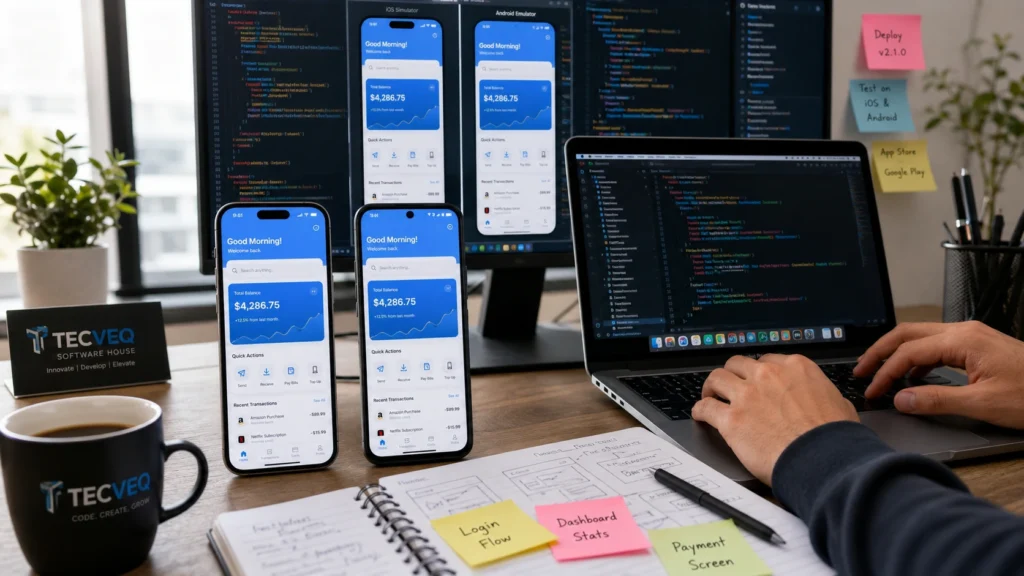
You Have One App Idea We Build It for iOS and Android at Once Most businesses come to us after getting two separate quotes one for an iOS app, one for Android and realizing the combined cost is twice what they budgeted. There is a better way. Our cross platform app development services build your application once and deploy it to both platforms from a single codebase. Same features. Same performance. One development team, one project timeline, and one budget instead of two. That is not a shortcut. It is a smarter architecture. When we build for iOS and Android app development using a shared codebase, you typically save 30 to 50 percent on initial development costs compared to building two separate native apps. Updates roll out to both platforms at the same time. Bug fixes happen once, not twice. And your users on both platforms get the same experience from day one. Hybrid app development used to mean compromising on quality. That is no longer true. Modern frameworks like Flutter and React Native produce apps that look and feel native on every device because they are built to render natively, not to simulate it through a browser layer. We handle the full build from first wireframe to app store launch. You get one point of contact, one delivery timeline, and an app that works exactly where your users are. ⚡ GET IN TOUCH Ready to Build Your Cross-Platform App? Get Your Free Strategy Call Today 💬 Chat on WhatsApp 📞 Call 0307 3319555 What Our Cross Platform App Development Services Include We are a mobile app development company that handles the full build not just the coding part. From the first strategy conversation to post-launch support, every service below is something we do in-house, on every project. Here is exactly what working with us covers. Consulting and Technology Strategy Before we write a single line of code, we sit down with you and map out the right approach for your specific project. That means reviewing your requirements, your target users, your existing systems, and your budget — then recommending the framework and scalable app architecture that actually fits your situation. Not every app needs Flutter. Not every team should use React Native. We tell you which direction makes sense and why, in plain terms, before you commit to anything. UI/UX Design for Every Platform Cross-platform apps have a reputation for looking generic. Ours do not. Our design team builds interfaces that meet Apple Human Interface Guidelines for iOS and Google Material Design standards for Android at the same time. That means your app feels native to each platform — not like a one-size-fits-all template dropped onto two different devices. UI/UX design is not an afterthought in our process. It runs alongside development from day one. Custom App Development and API Integration This is where the build happens. We develop your application against the agreed scope, connect it to your backend systems, payment gateways, third-party APIs, and cloud infrastructure and we handle app store deployment for both iOS and Android when the build is ready. For startups, we build focused MVP app development releases that get you to market fast and give you something real to test with users. For enterprises, we build against more complex integration requirements across existing platforms and internal tools. Fintech, healthcare, e-commerce the integration requirements are different in each industry and we plan for those differences from the architecture stage, not after the problems show up. TecVeq – Cross-Platform App Development Company Company Information Details Company Name TecVeq Technologies Headquarters Pakistan Phone Number 0307 3319555 Email Address info@tecveq.com Website tecveq.com Primary Services Cross-Platform App Development, Native Mobile Apps, UI/UX Design, API Integration, QA Testing, Post-Launch Support Industry Specializations Fintech, Healthcare, E-commerce, Enterprise Applications Technology Stack Flutter, React Native, .NET MAUI, Ionic, Kotlin Multiplatform Development Languages Dart, JavaScript, TypeScript, C#, Swift, Kotlin Project Timeline MVP (4-8 weeks), Standard Apps (10-16 weeks), Enterprise (16+ weeks) Pricing Range MVP: $10K-$25K | Standard: $25K-$60K | Enterprise: Custom Quote Free Consultation 30-minute strategy call with framework recommendation and budget estimate Response Time Within 1 business day for all inquiries QA, Testing and Multi-Device Validation Most cross-platform quality issues are not framework problems. They are testing gaps. We run every app through manual and automated QA and testing across real device configurations — different screen sizes, operating system versions, and hardware specs — before anything reaches your users. An app that works perfectly on a current iPhone and breaks on a mid-range Android from two years ago is not ready to ship. We check both. Post Launch Support and App Maintenance Launch is not the finish line. When iOS or Android releases a major OS update, apps that are not actively maintained start breaking in ways that frustrate users and damage reviews. Our app maintenance and support plans cover ongoing bug fixes, OS compatibility updates, performance monitoring, and planned feature additions after launch with clear response times so you know exactly how fast we move when something needs attention. Most agencies hand you the code and disappear. We stay on. That distinction matters more than most clients realize until something goes wrong six months after launch. Not sure which of these services you need or where your project fits? Tell us about your app and we will put together a custom scope no generic proposals, just a clear breakdown of what your specific build actually requires. Cross-Platform vs Native An Honest Answer, Not a Sales Pitch The question you are actually asking is whether a cross-platform build will compromise quality to save money. Fair question. Here is the real breakdown. Cross-platform development and native app development solve different problems. For most business applications, cross-platform delivers better ROI because the trade-offs do not matter to your users. But there are specific situations where native is the only responsible choice. We recommend whichever one actually fits your project. Not whichever one is easier for us to sell. What Cross Platform Does Better (With Real
YouTube Earning Course in Sahiwal 2026: Learn, Automate & Start Earning Online

What YouTube Earning Means and Why Sahiwal Students Are Getting Into It YouTube pays you once your channel meets its monetization requirements and starts attracting advertisers, not the moment you hit upload. That distinction trips up almost every beginner I talk to in Sahiwal. I have sat with students who assumed views alone meant money in the bank. They don’t. A channel needs watch time, subscriber thresholds, and content advertisers actually want to sit next to before YouTube turns on any payout option. Sahiwal has changed a lot on this front over the last two years. More local creators are posting screenshots of their earnings. More institutes are opening short courses around it. Some of what circulates online is real. Some of it is stretched to sell a seat in a class.tecveq is offer a youtube earning course in sahiwal Here’s what I tell every student in the first conversation. A channel built with a real plan, a defined niche and consistent uploads has a genuine shot at income. A channel built on guesswork usually stalls out around a few hundred views a video and stays there. ⚡ GET IN TOUCH Ready to Start Your YouTube Earning Journey in Sahiwal? Book Your Free Consultation Today 💬 Chat on WhatsApp 📞 Call 0307 3319555 YouTube Monetization Explained: AdSense, Sponsorships, Affiliate & Faceless Channels Most channels that actually earn money combine more than one of these four income sources. Relying on just one usually caps how much a channel can grow. AdSense is the starting point for almost everyone. Once your channel qualifies for the YouTube Partner Program, Google places ads on your videos and pays you a share of that revenue. Your niche, your audience’s location, and your watch time all affect the rate, which is why two channels with similar view counts can earn very different amounts. Sponsorships come later, once you have an audience a brand actually wants to reach. I’ve watched students get excited about a subscriber count and then get turned down by brands anyway. Subscriber numbers don’t close sponsorship deals. Engagement does. Tecveq – Company & Course Information Category Details Company Name Tecveq Location M3CH+JG7, Farid Town, Sahiwal, 57000 Website tecveq.com Phone 0307 3319555 Course Name YouTube Earning Course in Sahiwal Starting Price Confirmed during free consultation Course Duration Confirmed during free consultation Mode In-person / Online Consultation Free via WhatsApp or Call Batch Timing Flexible, confirmed on enrollment Affiliate marketing lets you earn a commission from products you link in your description. It works especially well for review videos, tutorials, and anything where a viewer is already looking to buy something. Faceless channels skip the camera entirely. Instead of filming yourself, you build videos with voiceover, stock footage, animation, or AI-generated visuals paired with a script. I’ve seen this model take off specifically because it removes the one thing that stops most people before they even start: discomfort being on camera. Not every niche uses these four the same way. A finance channel and a gaming channel will lean on a completely different mix, and figuring that out early saves months of wasted effort. Which Path Fits You Fastest: Content Creation vs YouTube Automation The faster path depends entirely on what you already have going for you, not on which one sounds more impressive. If you’re comfortable talking on camera, content creation usually gets you monetized sooner. Viewers connect with a real person faster than they connect with a faceless upload. The tradeoff is time. You’re filming, you’re the one showing up on screen, and your personal presence becomes part of the channel’s identity whether you plan for that or not. If camera confidence is the thing holding you back, automation is the more realistic starting point. You research a niche, write or outsource a script, add voiceover or AI narration, and pair it with footage or animation. Once that system is running, it can scale without you personally appearing anywhere in the video. But automation isn’t the easy shortcut people assume it is. Audiences take longer to trust a channel with no face attached to it, and your script has to do all the work a personality would normally do. I ask every student the same three questions before recommending a path: how comfortable are you on camera, how much time do you actually have each week, and what does success look like to you in six months. The answers usually point to one path clearly. Rarely both. What Our YouTube Earning Course in Sahiwal Covers (Modules, Duration & Fees) This course is built around what actually gets a channel to its first payout, not general theory you could find in a free YouTube video. Here’s what it includes: I confirm duration and fees during a free consultation, because the right learning path depends on whether you’re building a content creation channel, an automated one, or something in between. If your expectations don’t match what this course realistically delivers, I’ll tell you that upfront. Not after you’ve paid. Course Modules We Teach Six modules make up this course, and each one exists because I’ve watched students get stuck at that exact stage without it. Channel Setup & Niche Selection. I walk you through picking a niche based on real demand and monetization potential, not just what sounds fun to film. Get this wrong and everything downstream suffers. Content Strategy & Scripting. Random uploads don’t build watch time. Planned ones do. I show you how to map out content that keeps viewers watching past the first ten seconds, since that’s where most channels lose people. Video & Thumbnail Editing. Hands-on training with real editing software, not screenshots and theory. Thumbnail design gets its own focus here too, because a great video with a weak thumbnail still gets skipped. YouTube SEO & Growth. Keyword research, titles, tags, descriptions. The mechanics that decide whether YouTube’s algorithm ever shows your video to anyone outside your existing subscribers. Monetization & Analytics. I teach the actual Partner Program application process
React Native Mobile App Development Company That Delivers Real Results
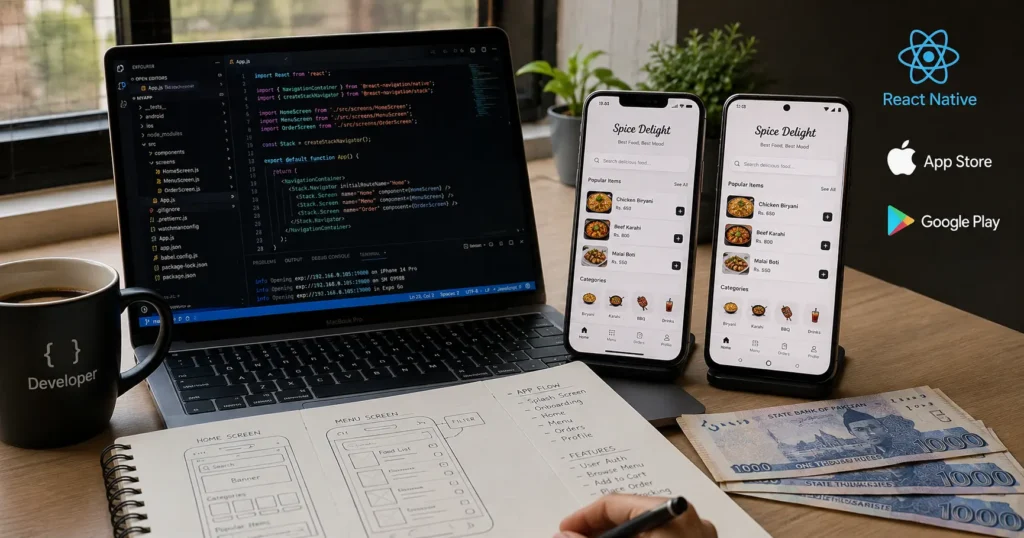
Why Companies Hire a React Native Mobile App Development Company (Instead of Building Native) You need an app that works on both iPhone and Android. Building two separate native apps means hiring two development teams, writing every feature twice, and waiting six to nine months before launch. Most businesses cannot afford that timeline or budget. That is exactly why we build with React Native. React Native lets us write one codebase that runs on both platforms. Same features. Same functionality. Native performance on iOS and Android. Our clients typically save 40 to 50 percent compared to building separate native apps. And we cut development time by three to four months. We have built 47 React Native apps over the last three years for startups, mid-market companies, and enterprises. The React Native framework was created by Meta and powers major apps like Instagram, Facebook Messenger, and Shopify with over billions of users worldwide. According to the official React Native documentation, this proven technology delivers native performance while maintaining code efficiency across platforms. You are not taking a risk on unproven technology. But here is what most agencies will not tell you upfront. React Native is not the right choice for every project. And we will be honest about that before you spend a dollar with us. See if React Native fits your project jump to our FAQ section or keep reading to understand exactly when this approach makes sense. ⚡ GET IN TOUCH Get Your React Native App Built Starting at 20,000 PKR – Free Quote in 24 Hours 💬 Chat on WhatsApp 📞 Call 0307 3319555 Cross-Platform App Development: One Codebase, Two Native Apps Cross-platform app development means we write your app once and deploy it to both iOS and Android app stores. Typically 70 to 90 percent of the code is shared between platforms. The way it works is straightforward. We write your app logic in JavaScript. React Native translates that code into native components that match each platform’s design guidelines. Your iPhone users see iOS interface patterns. Your Android users see Material Design. Both get native performance. This is not a webview wrapper pretending to be an app. React Native uses real native components. The animations run at 60 frames per second. Push notifications work exactly like native apps. Camera access, GPS, biometric authentication — all of it functions the same way a fully native app would. And when you need a new feature next year, we add it once. It appears on both platforms in the same update cycle. That ongoing cost savings is where React Native really proves its value over time When React Native Makes Sense (And When It Doesn’t) React Native is ideal for business apps, e-commerce platforms, social networking apps, fintech products, and content-driven mobile experiences. For specialized requirements like patient management systems and HIPAA compliance, our healthcare app development services combine React Native’s cross-platform benefits with medical industry expertise. If you are building something users interact with daily to complete tasks, make purchases, communicate, or consume content, React Native will serve you well It is not the right choice for everything. Heavy 3D games perform better with native tools or game engines like Unity. Apps that need bleeding-edge platform features on launch day (the moment Apple or Google releases them) may need native development. And if your app requires extremely low-latency real-time performance think high-frequency trading or professional audio production you should build native. We will tell you this during our first conversation if we think native development makes more sense for your project. Our goal is not to sell you React Native. Our goal is to recommend the approach that actually solves your business problem at a cost and timeline you can work with. Most of our clients choose React Native because they need to launch fast, serve users on both platforms, and keep ongoing development costs manageable. If that sounds like your situation, we can help. Company Information Table Detail Information Company Name Tecveq Website https://tecveq.com/react-native-mobile-app-development-company/ Location M3CH+JG7, Farid Town, Sahiwal, 57000 Email info@tecveq.com Phone 0307 3319555 Primary Services React Native App Development, Flutter Apps, Custom Software, Web Development, WhatsApp Automation Starting Price 20,000 PKR (Basic React Native App) Tech Stack React Native, JavaScript, TypeScript, Firebase, Node.js, MongoDB, PostgreSQL Frameworks Expo, Redux, React Navigation Backend Services Firebase, AWS, Custom APIs Payment Integration JazzCash, Easypaisa, Stripe Platforms iOS App Store, Google Play Store Development Time 5-14 days (Basic Apps) Support 30-day warranty + ongoing maintenance Industries Served Healthcare, Food & Restaurant, E-commerce, Education, Startups Languages English, Urdu React Native App Development Services We Provide We build affordable React Native apps for small businesses, startups, and entrepreneurs who need mobile apps but cannot spend $50,000 or more with expensive agencies. Our starting price is just 20,000 PKR for a complete basic app. No hidden fees. No surprise charges. Most development agencies price themselves out of reach for small businesses. They quote $60,000 to $120,000 USD for projects that can be built efficiently for a fraction of that cost. We focus on getting you a working app fast without the premium agency markup. Here are the React Native app development services we offer and what you get for your budget. Basic React Native App (Starting at 20,000 PKR) Perfect for small businesses that need a simple mobile presence. You get a clean, functional app with essential features like contact information, service listings, image gallery, and basic user interaction. Delivery time is 5 to 7 days from approval of design mockups. What’s included: basic UI design, up to 5 screens, contact forms, social media links, basic navigation, and publishing to both App Store and Google Play Store. Choose this if you need a mobile app for your business but you’re working with a tight budget. Most of our basic app clients are restaurants, salons, small retail stores, and service providers who want customers to have an easy way to reach them. Custom MVP Development (25,000 to 30,000 PKR) For startups that need core functionality to test their
Software House in Sahiwal for Internship Apply to Tecveq’s 2026 Internship Program

Why Sahiwal Students Are Searching for Software House Internships in 2026 Every semester, students walk out of computer science classes at University of Sahiwal with a degree in progress and almost no proof they can actually build anything real. That gap between what gets taught in a classroom and what a company expects on day one is exactly why internship searches in Sahiwal keep climbing every year. We see the same pattern in nearly every application we review. Strong grades. Weak portfolios. And a genuine hunger to work on something that ships to a real client instead of sitting in a grading folder. The Growing Tech Scene in Sahiwal (University of Sahiwal, IT Verse, and Beyond) Sahiwal’s tech scene has grown well past the point where students had to move to Lahore or Karachi just to find real development work. University of Sahiwal now produces computer science and software engineering graduates every year, and local software houses like IT Verse Solutions have been training and hiring from that pool since 2017. That matters for one simple reason. A city needs enough companies, enough client work, and enough experienced developers before internships turn into something more than filing paperwork. Sahiwal has reached that point. We are one of several Software house in Sahiwal for internship now competing for the same talent, which is good news if you are a student. It means real options, not just one company deciding whether you get a shot. What Students Look for in an Internship (Stipend, Mentorship, Real Projects) Most students searching for a paid internship for CS or IT students in Sahiwal in 2026 are looking for three things, and they usually ask about them in this order. Will I actually get paid, even something small. Will someone senior actually teach me, or am I just free labor for six weeks. And will I touch a real project, or spend the whole internship watching tutorials someone could have sent me a YouTube link for instead. Those are fair questions. Which is exactly why we walk every applicant through our stipend structure, project assignments, and mentorship setup before they accept a spot, not after. We will not pretend every software house in Sahiwal handles this the same way. Some do. Some do not. What we can tell you is how our program is structured, and that starts with the tracks we actually put interns on. Tecveq A Software House in Sahiwal for Internship Seekers We built our internship program around one problem we kept running into. Talented students in Sahiwal were graduating with theory and no proof they could deliver a real project under a real deadline. So we started taking on interns across web development, AI, cloud, and digital marketing, and putting them straight onto work that actually ships to a client. That is the short version. Here is where to find us and how to reach us if you want in. Our Location and How to Reach Us Near University of Sahiwal ⚡ GET IN TOUCH Based near University of Sahiwal visit us, message us, or apply online. Your internship starts here. 💬 Chat on WhatsApp 📞 Call 0307 3319555 We know proximity to campus matters. Most students applying to us are juggling classes, so getting to and from an internship without losing half a day in transit is a real factor, not a small one. If you are coming from University of Sahiwal, we are just a short drive away. Get directions to our office and we will confirm everything else once you reach out, so you are not guessing on the way in. Software House in Sahiwal for Internship Contact Number & WhatsApp The fastest way to reach us about an internship is or you can message us directly on WhatsApp at the same number. We check WhatsApp applications regularly, and we would rather answer a quick question there than have you sit on an email for a week wondering if anyone read it. Send your CV, tell us which track you are interested in, and mention your current semester. That is enough for us to get back to you with next steps. If you prefer email info@tecveq.com works too, though WhatsApp tends to get a faster reply during business hours. Internship Tracks Available at Tecveq Sahiwal Most software houses in Sahiwal put every intern on the same track, usually web development, because that is the easiest work to hand off. We split our internship program into five tracks instead, because a student who wants to build AI models should not spend three months writing HTML. Here is how each track actually works. Web & App Development Internship (Frontend, Backend, Full Stack) This track is for students who want to build things people actually click on. You will work on frontend interfaces, backend logic, or both, depending on where your interest sits and what our current projects need. We do not start you on a throwaway practice site. Interns on this track get assigned pieces of live client work, under review from a senior developer before anything gets shipped. That means your first real bug fix or feature might go into a website or web app a client is actually paying for. Full stack interns get exposure to both ends of the process. Frontend-only or backend-only interns go deeper on one side instead of splitting focus. AI & Machine Learning Internship Very few software houses in Sahiwal offer a real AI internship track, and that gap is exactly why students keep asking us about it. This track puts you on actual AI development and machine learning work tied to client projects, not isolated coursework exercises. You will work alongside developers building AI models, automation systems, or chatbot solutions depending on what is active at the time. We will not pretend this track is for beginners with zero programming background. It works best for students who already have some Python or machine learning fundamentals and want to apply them to something
WhatsApp CRM for Appointment Booking: The Complete Guide to Automated Scheduling & Team Collaboration
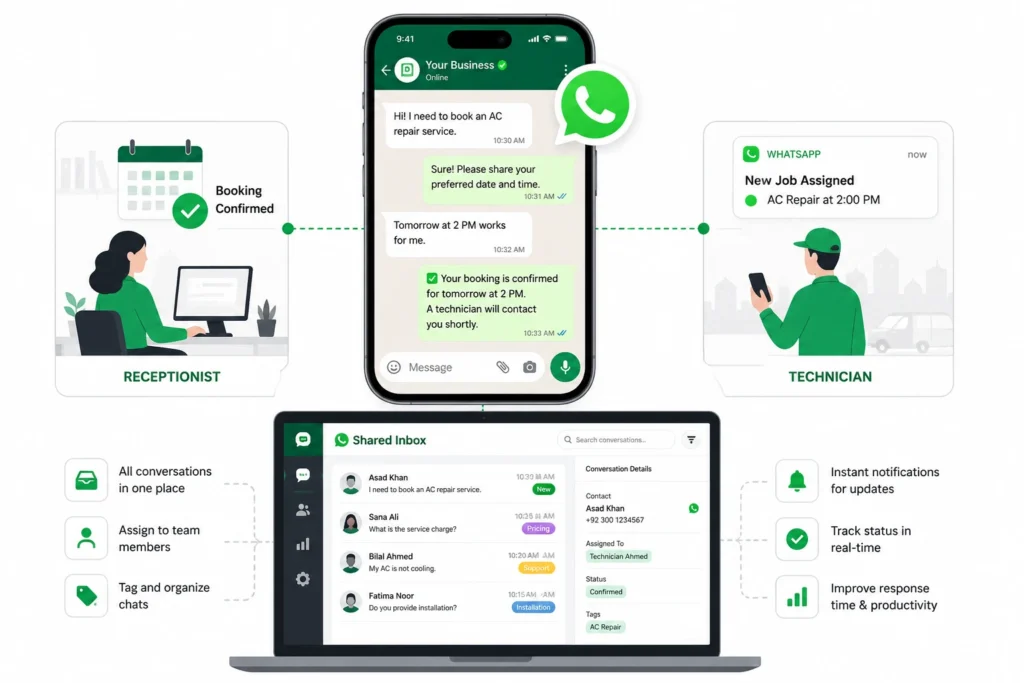
What Is a WhatsApp CRM for Appointment Booking? A WhatsApp CRM for appointment booking is a system that lets customers book appointments, confirm their time, and manage changes directly inside a WhatsApp conversation instead of calling your office or filling out a form. The booking gets logged into your calendar and CRM at the same time, so nothing falls through the cracks between reception and your service team. I’ve watched businesses try to run this off the standard WhatsApp Business app first. It never works for long. The moment more than one person needs to reply to customers, or you need bookings to sync automatically with a calendar, the basic app runs out of road. There’s no way to assign a conversation to a specific staff member. There’s no way to see who already replied. Two people end up typing to the same customer at the same time, and the customer notices. That’s the actual problem a WhatsApp CRM solves. Not just booking automation. Coordination. ⚡ GET IN TOUCH Book More. Miss Nothing. Automate on WhatsApp. 💬 Chat on WhatsApp 📞 Call 0307 3319555 How It Differs from the Standard WhatsApp Business App The standard WhatsApp Business app is built for one person managing one phone. A WhatsApp CRM runs on the WhatsApp Business API, which is a different infrastructure entirely. Here’s what changes: I usually tell clients this straight: if you’re still using the free app and you have more than one person answering messages, you’re already losing bookings somewhere. You just haven’t traced them yet. Feature WhatsApp Business App WhatsApp CRM for Appointment Booking Customer conversations Primarily managed through the app Centralized WhatsApp conversations in a shared inbox Multiple team members Limited for structured team workflows Multiple agents can work from the same business number Conversation assignment No structured assignment workflow Conversations can be assigned to specific staff Internal notes Limited Team members can add private notes Tags Basic labels Structured booking and customer-status tags Calendar integration Limited/manual workflows Can connect booking flow with calendars Automated reminders Limited Appointment reminders can be automated Booking workflow Mostly manual Customer can book appointments through a guided flow Team performance tracking Limited Response times and booking metrics can be monitored Role-based access Limited Access can be controlled by team role Why Businesses Are Switching to WhatsApp for Appointment Booking Businesses are switching because customers read WhatsApp messages. They don’t read email, and they don’t answer calls from numbers they don’t recognize. That single fact changes how bookings behave. A confirmation sent by email might sit in a promotions folder for two days. The same confirmation sent on WhatsApp gets seen in minutes, most of the time before the customer even finishes their coffee. And when a customer sees the confirmation fast, they act on it fast. They add it to their calendar. They show up. vs.Higher Read & Response Rates vs Email or Calls WhatsApp messages get read far more often, and far faster, than emails or missed calls with a voicemail attached. Email confirmations rely on the customer checking their inbox, which many people do once or twice a day at best. WhatsApp doesn’t have that lag. Phone calls have a different problem. Most people don’t pick up numbers they don’t recognize, especially during work hours. A missed call turns into a voicemail nobody listens to, followed by a callback that misses the window, followed by a booking that quietly disappears. A message sitting in someone’s WhatsApp doesn’t get ignored the same way. It sits right next to messages from their friends and family, and people check it constantly through the day. Reduced No-Shows with Automated Reminders Automated WhatsApp reminders can help reduce no-shows by giving customers a timely opportunity to confirm, reschedule, or cancel before the appointment. The pattern that works is simple. Send one reminder a day before the appointment, then a second one an hour or two before. Both should let the customer confirm, reschedule, or cancel with a single tap, not force them to call back. Most no-shows aren’t customers being careless. They forgot, because the reminder they got wasn’t in a place they check. Fix where the reminder lands, and the no-show rate drops on its own. The Real Bottleneck: Booking Automation Alone Isn’t Enough Automating the booking flow fixes one problem and quietly ignores another. The customer books fine. What happens after that message lands is where things start breaking down. I’ve walked into more than one business where the chatbot worked perfectly, and the team behind it was still a mess. The bot confirmed the appointment. Nobody told the technician. The customer showed up to a service that wasn’t scheduled on anyone’s actual calendar. That’s not a booking problem. That’s a people problem wearing a booking costume. Most businesses buy automation expecting it to fix coordination. It doesn’t. It just moves the coordination problem one step further down the chain, where it’s harder to spot until a customer is standing at the door. Why Reception and Service Teams Still Struggle After Automation Reception and service teams struggle after automation because the booking gets confirmed automatically, but the internal handoff still depends on someone remembering to check, forward, or update it manually. Here’s what that looks like on a normal day. A booking comes in through WhatsApp at 9am. The confirmation goes out to the customer instantly. Reception sees it. The service team doesn’t, because nobody forwarded it, or it got buried under twelve other conversations in the same thread. By 2pm, the customer texts asking where the technician is. This happens constantly in businesses running WhatsApp through a single shared login with no internal structure. Everyone can see the messages. Nobody owns them. And that’s the part most automation vendors never mention. They’ll sell you a booking bot and call the problem solved. Replies, andThe Cost of Poor Handoffs, Missed Bookings, Duplicate Replies, Slow Response Times Poor handoffs between reception and service teams cost businesses missed bookings, duplicate replies, and slower response