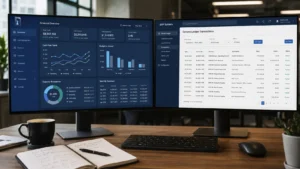
Tecveq is a software development company which builds cash management software to track cash, automate payments, and reconcile accounts in one place. Whether you run a retail chain, a restaurant group, a fuel network, or a growing finance business, we design and develop a system around your workflow, not the other way around.
The real challenge isn’t understanding what a cash management system does. It’s finding a cash management system development company that understands your business. Many companies struggle with cash tracking across multiple locations, reconciliation errors, and reporting delays. We solve these problems by building software that fits how you actually work.
Custom Cash Management System Development Services
Ready-made software often forces you to change how you operate. That’s backward. We build custom cash management systems that align with your existing processes, integrate with your current tools, and scale as your business grows.
When you work with a cash management system development company, you’re making an investment in how your business handles money. That investment should pay off in faster reconciliation, fewer errors, better visibility, and time saved on manual processes. Too many companies settle for software that does most of what they need, then spend years working around its limitations.
We take a different approach. We start by understanding your business completely. What does a typical day look like? Where does cash come from? How many locations do you have? What reporting do you need? Which systems are you already using? Only after answering these questions do we design a system that actually fits.
Custom Cash Management Software Development
Every business handles cash differently. A retail chain needs to track sales across branches. A restaurant tracks petty cash, employee advances, and daily settlements. A fuel distribution network manages cash across remote stations. We start by understanding your exact workflow, then build software that automates the parts causing problems today.
Custom cash management software isn’t about building something complicated. It’s about building something that works the way you work. Maybe your current system requires someone to manually enter data from three different sources every morning. Maybe you can’t see cash positions across all your branches without calling each location. Maybe you’re spending hours every month reconciling accounts because data doesn’t flow between systems automatically.
These aren’t technology problems—they’re workflow problems. And custom software solves them by automating the workflow instead of forcing you to change it.
We’ve built cash management systems for businesses with a single location and systems for networks with fifty locations across multiple countries. The principle is always the same: understand the workflow, build software that automates it, and make sure everyone who needs to see the data can see it.
Cash Flow Management System Development
Forecasting cash flow is difficult when you’re pulling data from multiple sources. You’re opening spreadsheets, calling branch managers, checking accounting software, and trying to piece together a complete picture. By the time you have the picture, it’s out of date.
Cash flow management systems solve this by consolidating data from all accounts and branches in real time. You see your cash position as it actually is right now. You can project forward based on historical patterns and upcoming obligations. You can make decisions about cash deployment, investments, or expense timing with actual data instead of guesses.
The business value is real. Better cash forecasting helps you avoid overdrafts. It helps you deploy cash strategically instead of letting it sit idle in low-interest accounts. It helps you identify cash shortages early enough to address them.
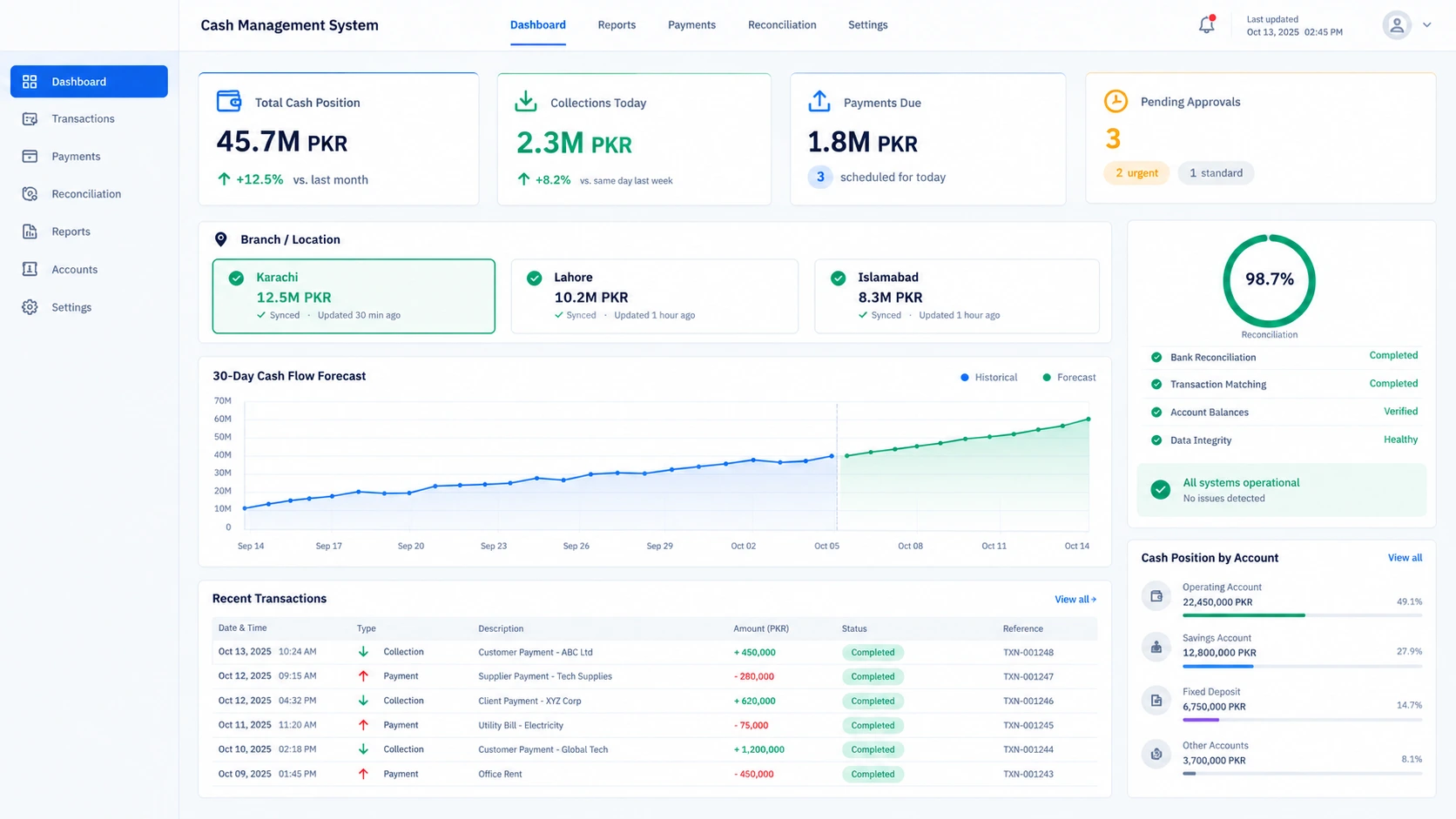
We build cash flow management systems that pull data from your banks, accounting software, and operational systems. The system consolidates everything into one dashboard, runs forecasts based on your historical patterns, and alerts you when predicted cash falls below thresholds you define.
Petty Cash and Advance Control Modules
Petty cash management sounds simple until you’re trying to track hundreds of small transactions across multiple locations. Without proper controls, petty cash becomes a black hole where money disappears without clear documentation. Employee advances turn into informal loans with vague repayment terms.
We build modules that log every petty cash transaction—who took it, when, what it was for, and when it was replenished. We automate employee advance requests, track repayments, and reconcile against payroll. We set spending limits by role and location so a junior staff member can’t take a large advance without approval.
The result is control without complexity. Your finance team can account for every dollar. Auditors can see complete trails. Staff members know the process and don’t feel like they’re being watched—they’re just following a clear system.
Bank and ERP Integration
Your cash management system needs to talk to your bank, accounting software, and existing ERP. We integrate with major platforms so data flows automatically instead of requiring manual entry and reconciliation.
Bank integration pulls transaction data directly from your bank’s API, eliminating manual feeds and data entry errors. If you use QuickBooks, Xero, or a custom ERP, we connect your cash system so information flows both directions—payments recorded in cash management appear in accounting, and accounting entries update cash forecasts.
Integration isn’t simple technical work. Each bank has different APIs. Each accounting platform has different data structures. We’ve done this work many times, so we know the pitfalls, the data quality issues, and how to build integrations that work reliably day after day.
Legacy System Upgrade and Migration
If you’re running cash management on outdated systems or spreadsheets, migration to modern software doesn’t have to be painful. We handle data migration, staff training, and parallel running to ensure zero disruption.
Migration is often the scariest part of a software project. You’re worried about data loss, staff confusion, and business interruption. We’ve migrated companies from legacy systems to modern cloud platforms many times. Here’s how we do it:
First, we extract data from your old system and validate it. Bad data causes problems downstream, so we clean and standardize everything. Second, we build data mappings that transform your old system’s structure into the new system’s structure. Third, we run the migration in parallel—both systems running simultaneously so you can verify the new system works before fully switching over. Finally, we train your team, monitor the transition closely, and provide intensive support for the first week.
The result is a smooth transition with zero financial data lost.
GET IN TOUCH
Talk to Tecveq and get a free consultation for your custom cash management system.
Features of Our Cash Management Software
Real-Time Cash Tracking Across Branches and Accounts
Every dollar matters. Our systems show you your cash position across all bank accounts and branches in real time. You see where cash is, how much is coming in, and when payments are due—all in one dashboard. This visibility helps you avoid overdrafts and make smarter decisions about cash deployment.
Real-time cash visibility changes how you operate. Instead of calling branch managers to ask how much cash they have, you check the dashboard. Instead of waiting for daily reports, you see transactions as they happen. Instead of discovering cash shortages when you try to pay a supplier, you see them coming and address them proactively.
The technical challenge is connecting to multiple banks. Some banks offer real-time APIs. Others provide daily feeds. Some use outdated protocols. We build systems that work with whatever your banks provide, consolidate the data, and present it clearly.
We also handle multi-currency scenarios. If you operate in Pakistan, the UK, and the Middle East like many of our clients do, you might have accounts in PKR, GBP, and AED. Our systems show you balances in each currency and convert to your base currency for consolidated reporting.
Automated Bank Reconciliation
Manual bank reconciliation is error-prone and time-consuming. Reconciliation errors create audit headaches and cash visibility gaps. Your finance team spends hours comparing bank statements to ledger entries, trying to find where the penny went wrong.
Our systems automatically match transactions to bank statements, flag discrepancies, and handle routine reconciliation so your team focuses on investigating real problems instead of data entry.
Here’s how it works: Transactions come in from your bank’s API or a daily feed. Your accounting system also records these transactions. Our system compares them automatically—matching amount, date, and reference information. When everything matches, reconciliation is complete. When there’s a difference, the system flags it with the specific discrepancy so your finance team can investigate only the actual problems.
In practice, this means that routine reconciliation that used to take a day happens overnight automatically. Your finance team comes in the next morning to a completely reconciled account. They only need to investigate the few transactions that don’t match—maybe three or four out of thousands.
This saves time, reduces errors, and means you close your books faster at month-end.
Cash Flow Forecasting and Reports
Predicting cash needs helps you manage working capital efficiently. Our reporting tools show historical cash patterns, upcoming obligations, and forecasted positions. You can plan for seasonal variations, large payments, or growth without guessing.
Cash flow forecasting uses historical data to predict future patterns. If you know that November is always your biggest sales month and January is always slow, the forecast shows that. If you know you have a quarterly tax payment due, the forecast accounts for it. If you know a supplier payment is coming, it’s in the projection.
The system can run multiple scenarios. What if sales grow 20%? What if you take on a large contract? What if you need to invest in inventory? Each scenario shows you the cash impact so you can plan appropriately.
Forecasting helps you make strategic decisions. Maybe you discover you need a line of credit during certain months. Maybe you see that you’re deploying cash inefficiently and could invest more strategically. Maybe you realize you need to improve collections to support growth.
We build forecasts that are specific to your business. If you’re seasonal, the forecast accounts for that. If you have irregular large payments, they’re included. If you have predictable customer payment delays, the forecast reflects them.
Approval Workflows and Alerts
Cash handling needs controls. Our systems enforce approval workflows for large payments, flag unusual transactions, and alert you when cash positions hit thresholds you define. This protects your business from errors and unauthorized transactions.
Workflows vary by organization. Maybe any payment over 100,000 PKR needs approval from a manager. Maybe payments to new vendors need approval from a senior finance person. Maybe wire transfers always need two approvers. We build workflows that match your approval requirements.
Alerts keep management informed. You can set alerts for cash falling below minimum levels, payments that exceed budgets, or unusual activity patterns. You can receive alerts by email, SMS, or in the system itself.
Controls protect you from fraud, but they also protect you from mistakes. A junior staff member can’t accidentally transfer too much money to a vendor. A manager can’t approve a payment they shouldn’t have authority over. The system enforces the controls you define.
Role-Based Access, Audit Trails, and Security
Not everyone needs access to everything. We build systems with role-based permissions so managers see what matters to them, junior staff have limited access, and administrators control who does what. Every action is logged for audit purposes, and all data is encrypted both in transit and at rest.
Role-based access control means a branch manager sees cash for their branch but not other branches. A controller sees financial reports but can’t authorize payments. An accountant can record transactions but can’t delete them. A system administrator manages users and settings.
Audit trails log everything. Who logged in? What data did they view? What changes did they make? When? From where? If something goes wrong, you can see exactly what happened and who was involved. If an auditor asks questions, you have complete records.
Security is built in from the start. Data is encrypted when it’s stored on our servers. Data is encrypted when it’s transmitted to your computer or phone. Passwords are hashed so even we can’t see them. Sessions time out if you’re inactive. Two-factor authentication can be required for sensitive actions.
Financial data is sensitive. We treat it that way.
Automated Cash Management System to Replace Manual Work
Spreadsheets and manual processes slow your business down. Every time someone enters data twice, a reconciliation error happens, and a report takes hours to generate, you’re losing time and accuracy.
Let’s be honest about what spreadsheets are good for: quick one-time analysis, small datasets, and calculations that don’t change. What spreadsheets are terrible for: managing financial data across multiple locations, enforcing controls, creating audit trails, and handling thousands of transactions.
Yet many businesses run their cash management on spreadsheets because they grew into the role over time. Someone created a simple cash tracking sheet. It worked for a while. Then more locations were added, more transactions happened, and the sheet became increasingly complex. Now someone spends hours every week maintaining it, but it’s still not accurate.
An automated cash management system fixes these problems at their root.
Faster Collections and Payments
When your system automatically pulls transaction data, matching invoices to payments happens in seconds instead of days. You close your books faster, identify unpaid invoices sooner, and optimize your payment timing without manual tracking.
Collections improve because you can see exactly which invoices are outstanding, how old they are, and which customers are habitually late. You can automate payment reminders. You can identify customers who need follow-up. You can negotiate better payment terms because you have data backing your discussions.
Payments improve because you can optimize timing. You see cash coming in, so you know when you can pay suppliers. You can take advantage of early-payment discounts because you can see the cash impact. You can schedule payments to preserve cash when it’s tight.
Both of these things are possible with manual tracking, but it’s slow and error-prone. Automation makes it fast and reliable.
Fewer Reconciliation Errors
Manual entry introduces mistakes. Automated data import from banks and accounting software eliminates most reconciliation errors. The few discrepancies that do appear are easier to find because the system flags them, not because someone’s checking spreadsheets manually.
Reconciliation errors have real costs. They delay closing your books. They create confusion about your actual cash position. They can cause you to make decisions based on incomplete information. They create extra work for your finance team trying to track down the discrepancy.
Most reconciliation errors come from three sources: data entry mistakes, data entry delays (something posted to the bank but not to accounting yet), and legitimate but unfamiliar transactions. Automation eliminates the first source and manages the other two.
When data flows directly from your bank to your system, data entry mistakes don’t happen. When reconciliation is automatic and immediate, timing differences are obvious and expected. When the system flags something unusual, your finance team can investigate informed instead of confused.
Better Audit Readiness
Auditors ask to see transaction trails, approval chains, and system controls. Our systems log everything, making audit preparation straightforward. You’re not scrambling to reconstruct what happened three months ago or hunting for missing documentation.
Audit preparation with spreadsheets is a nightmare. You’re gathering data from multiple sources, reconstructing processes, and hoping nothing was changed without documentation. Audit preparation with a system that logs everything is straightforward—you run an audit report and everything is there.
Auditors like seeing system controls. They like seeing that large transactions require approval. They like seeing that access is restricted by role. They like seeing complete audit trails. Systems provide all of this automatically.
This makes your audit process faster, less stressful, and more likely to result in clean findings.
Cash Flow Management System for Your Industry
Different businesses have different cash challenges. Here’s how our systems adapt to yours.
We’ve built cash management systems for dozens of business types, and we’ve learned that one-size-fits-all doesn’t work. A retail business’s cash challenges are fundamentally different from a fuel distribution network’s challenges. A microfinance institution’s needs are different from a restaurant’s.
Understanding your industry helps us build systems that work for you instead of against you.
Retail and Multi-Branch Businesses
Retail operations move cash constantly—from registers to safes to bank deposits. Branch managers need to see local cash positions. Head office needs consolidated views. Our systems track daily sales, cash movements between branches, and bank deposits so you see the full picture while giving each location the visibility it needs.
A typical retail system we’ve built tracks:
- Daily sales by register, showing cash, card, and check transactions
- Cash counted at end of day and reconciled to register readings
- Cash movements between the register, safe, and bank deposits
- Petty cash for store operations
- Cash floats between branches when needed
- Bank deposits with photo verification
- Head office views consolidating all branches
Each store manager can see their store’s data. Regional managers can see multiple stores. Head office sees everything. The system generates daily reports, alerts on discrepancies, and provides data for audits.
Restaurants and Hospitality
Restaurants handle hundreds of daily transactions, tips, employee advances, and vendor payments. Our systems track daily revenue, manage petty cash, automate tip distribution, and simplify supplier payments. End-of-day reconciliation that used to take an hour happens automatically.
Restaurant cash management is complex because of tips. A customer pays 5,000 PKR with card and adds a 500 PKR tip. That tip needs to be tracked, potentially pooled with other tips, and distributed to staff according to your system. Our cash management systems handle this automatically.
We also track petty cash—cash floats given to staff for daily operations like small supplier payments or emergency needs. We track employee advances—staff might need money before payday. We reconcile it all at the end of the day.
We’ve built systems for restaurant groups with 5 locations and groups with 50. The principle is the same: automate routine cash handling and give managers the visibility they need.
Fuel Stations and Distribution
Distribution networks with multiple station locations face unique cash challenges—remote deposits, frequent small transactions, and delayed reporting. We build systems that track pump sales in real time, reconcile against bank deposits, and give you visibility into cash across all stations from one dashboard.
A fuel distribution system we built tracks:
- Pump sales by nozzle and grade, reconciling to fuel tank levels
- Card transactions processed through payment gateways
- Cash collected from pumps
- Daily deposits to bank
- Reconciliation of collections to deposits
- Alerts for discrepancies between expected and actual fuel sales
- Cash projections across the network
Each station manager can see their station’s activity. Regional managers can see multiple stations. Head office sees the entire network with alerts for any station that’s out of sync.
Finance and Microfinance
Financial institutions handle strict cash controls and regulatory requirements. Our systems enforce approval hierarchies, maintain complete audit trails, manage customer transactions, and generate compliance reports automatically. Security and control are built in from the start.
Financial institutions need systems that governments, regulators, and auditors will accept. This means:
- Complete transaction logging with immutable records
- Approval hierarchies enforced at every level
- Segregation of duties built into the workflow
- Regulatory compliance reporting built in
- Security that exceeds industry standards
- Disaster recovery and business continuity
We’ve built systems for banks, microfinance institutions, and finance companies. The core principles are the same even though the specifics vary by institution.
Startups and SMEs
You need the same cash visibility as larger companies but without the complexity or cost. Our MVP approach lets you launch a working system in 30 to 60 days with core features, then expand from there.
Startups and SMEs often think they need to wait until they’re larger to invest in proper systems. That’s a mistake. A good cash management system is even more critical for a growing company because visibility helps you make better decisions, and mistakes are more costly relative to your size.
We’ve built systems for startups just launching and SMEs generating millions in annual revenue. We’ve also designed a 30-day MVP program that lets you launch the essentials immediately and expand from there.
Why Businesses Choose Tecveq as Their Cash Management System Development Company
We compete with larger consulting firms and offshore development companies. Here’s why cash management clients choose us.
Experienced Full Stack and Backend Team
We don’t build flashy interfaces and hope the backend works. Our developers understand database design, system scalability, and integration complexity. They’ve built accounting and finance systems for years, so they know where problems hide and how to prevent them.
Our team includes developers with specific experience in:
- Financial systems architecture and design
- Bank API integrations and payment processing
- Large-scale database design for transaction processing
- Real-time data synchronization
- Security and compliance in financial systems
- Multi-currency and multi-location systems
This matters because building a financial system is different from building other software. The stakes are higher. Errors have real financial consequences. Auditors will scrutinize it. Regulations may govern it.
We’ve made every mistake possible on earlier projects and learned from them. We don’t make those mistakes on your project.
Security-First Development
Cash management systems hold financial data. We build with security embedded from the start—encrypted data, secure authentication, role-based access, and audit logging. We follow financial industry standards and conduct security reviews before launch.
Our security practices include:
- Data encrypted at rest using industry-standard encryption
- Data encrypted in transit using TLS/SSL
- Passwords hashed with strong algorithms
- API authentication using tokens and signatures
- Role-based access control enforced at every level
- Audit logging of every financial transaction
- Regular security testing and vulnerability scanning
- Two-factor authentication available for sensitive operations
- Automatic session timeout for security
- Regular security training for our development team
We also follow compliance standards for financial systems. We understand what auditors expect and build systems that exceed those expectations.
Scalable Cloud Architecture
Your system needs to grow with your business. We build on AWS and containerize with Docker so your system scales when you add users, branches, or transaction volume. You pay for what you use and expand without rearchitecting.
Scalability isn’t just about performance. It’s about being able to grow without expensive redevelopment. If you launch with 10 users and 2 locations, then grow to 100 users and 20 locations, your system should grow with you.
We design systems that scale horizontally—adding more servers as load increases—rather than vertically, which has limits. We use containerization so moving to larger infrastructure is straightforward. We use databases designed for scale. We build APIs that can handle increasing transaction volume.
The result is a system that serves you whether you’re small today or large tomorrow.
Clear Milestones and Regular Updates
Custom development can feel like a black box. We work in sprints with clear deliverables, regular demos, and transparent timelines. You see progress every week and can adjust direction based on what you learn.
Our typical project timeline:
- Week 1: Discovery and requirements gathering, documenting your needs
- Weeks 2-3: Design phase with UI/UX mockups and technical architecture
- Weeks 4-8: Development sprint 1, building core features and internal APIs
- Weeks 8-10: Development sprint 2, integrations and advanced features
- Weeks 10-12: Testing, security review, and fixes
- Weeks 12-13: Data migration, training, and parallel running
- Week 13+: Launch and ongoing support
Throughout this process, you see the system developing. You can adjust requirements based on what you learn. You’re not surprised by the final product because you’ve been seeing it develop.
24/7 Support After Launch
Launch day isn’t the end—it’s the beginning. We provide ongoing support, monitor system performance, handle updates, and fix issues quickly. If something breaks, we’re there to fix it.
Our support includes:
- 24/7 monitoring of system health and performance
- Bug fixes within hours for critical issues, same day for non-critical
- Regular updates and security patches
- Performance optimization as transaction volume grows
- Feature enhancements based on your requests
- Scheduled downtime for maintenance, coordinated with you
- Quarterly business reviews to discuss usage and improvements
We measure our success by whether your system works well, not by how much additional work we can sell you. A working system means you might need less support over time, and we’re comfortable with that.
Our Development Process
We follow a structured process that delivers on time, on budget, and to your satisfaction.
Discovery and Requirements
We start by understanding your business, not by selling you features. We observe how you currently handle cash, interview key team members, and document your exact workflow. This becomes the foundation for everything we build.
Our discovery process typically takes one to two weeks and includes:
- Multiple meetings with your finance team, operations team, and management
- Observation of actual workflows and processes
- Documentation of current pain points and desired improvements
- Competitive analysis if you’re considering alternatives
- Technical assessment of your existing systems and integration points
- Documentation of regulatory or compliance requirements
The output is a detailed requirements document that you approve before we design anything. This document becomes the foundation for design, development, and testing.
GET IN TOUCH
Ready to take control of your cash flow?
UI/UX Design and Prototype
Before writing code, we design the system’s interface and build a clickable prototype. You see how the system looks and works, can provide feedback, and approve the design before development starts. This prevents expensive changes later.
Our design process includes:
- Wireframes showing the layout and flow of each screen
- High-fidelity mockups showing the actual look and feel
- Clickable prototypes so you can actually interact with it
- Documentation of how each feature works
- Accessibility review to ensure the system is usable for people with disabilities
You can provide feedback on the design before any code is written. Changing a design at this stage takes hours. Changing it after development has started takes weeks. Getting design right early is a huge time and money saver.
Development and Integration
Our team builds the core system, integrates with your banks and accounting software, and develops the databases and APIs that connect everything. Work happens in two-week sprints with regular demos so you see progress.
During development:
- Your system architecture is built to be scalable, secure, and maintainable
- Core features are developed first, advanced features second
- Integrations are tested as they’re built, not after
- Code is reviewed by our senior developers for quality
- Regular demos show you what’s been built
- Your feedback is incorporated in the next sprint
By the end of development, you have a working system that’s been integrated with your banks and accounting software.
Testing and Security Review
We test extensively—functional testing to ensure features work, integration testing to verify data flows correctly, and security testing to find vulnerabilities. We fix issues before launch, not after.
Our testing includes:
- Functional testing of every feature against requirements
- Integration testing with your bank and accounting systems
- Performance testing to ensure the system handles your transaction volume
- Security testing for vulnerabilities and compliance issues
- User acceptance testing with your team using real data
- Stress testing to ensure the system handles peak loads
Issues found during testing are logged, prioritized, and fixed. Critical issues are fixed immediately. Non-critical issues are scheduled for resolution. Nothing launches with known critical issues.
Deployment and Training
We handle the technical deployment to your cloud environment. Your team gets training so everyone understands the system and can use it on day one. We set up data migration and run in parallel with your old system if needed.
Our deployment process:
- Infrastructure setup in AWS or your chosen cloud provider
- Database setup with proper backup and recovery processes
- Security configuration including SSL certificates and firewalls
- Data migration from your old system
- Testing of data migration accuracy
- Training sessions for different user roles
- Documentation provided for reference
- Parallel running with your old system to verify accuracy
- Gradual cutover to the new system
Your team is trained before launch, so they can use the system from day one. We provide intensive support during the first week to answer questions and address any issues.
Ongoing Maintenance
After launch, we monitor performance, apply updates, fix bugs, and add enhancements. You focus on your business while we maintain the system.
Ongoing maintenance includes:
- 24/7 monitoring of system health and performance
- Regular backups and disaster recovery testing
- Security updates and patches applied promptly
- Performance optimization as usage grows
- Bug fixes and enhancements based on your feedback
- Documentation updates as the system evolves
- Quarterly reviews to discuss improvements and future enhancements
We’re here to support the system as it evolves and grows with your business.
Cost and Timeline for Cash Management System Development
Custom software costs vary based on what you’re building. Here’s what influences your budget and timeline.
There’s no magic formula for custom software costs. The final price depends on complexity, scope, and integration requirements. But understanding the factors helps you plan your investment.
Factors That Affect Your Budget
Scope of Features — A system that tracks cash across branches costs more than a single-location setup. More features mean more development time. Basic cash tracking might take 4-6 weeks. A system with forecasting, approvals, and advanced reporting might take 12-16 weeks.
Number of Integrations — Connecting to your bank, accounting software, and ERP takes time. Each integration is different and requires testing. Integrating with one bank might add 1-2 weeks. Integrating with a bank, accounting software, and ERP might add 4-6 weeks.
Number of Users and Branches — Scaling for 50 users across 10 branches affects architecture, database design, and infrastructure costs. A single-location system for 5 users costs less than a multi-location system for 100 users. We factor in user load, branch count, and transaction volume.
Security and Compliance — Financial systems need stronger security, audit logging, and compliance features than typical business software. This adds development time. If you need to comply with specific financial regulations, that adds time and complexity.
Design Complexity — Custom designs and specialized reporting dashboards require more design and development work than standard interfaces. A standard interface might take 2 weeks to design. A highly customized interface with specialized reporting might take 4-6 weeks.
Data Migration — Moving existing data from old systems, cleaning it, and validating it adds time and complexity. Migrating from a simple spreadsheet might take 1 week. Migrating from a legacy system with millions of transactions might take 3-4 weeks.
Technology Stack — Some choices are faster than others. Building on established platforms with existing templates is faster than building from scratch. Choosing technologies your team is familiar with is faster than choosing new ones.
Timeline by Project Size
MVP (Core Features) — 30 to 60 days for essential cash tracking, basic reconciliation, and reporting across 1 to 3 locations.
What’s included in an MVP:
- User management and role-based access
- Basic cash tracking for one or two locations
- Manual transaction entry
- Basic reconciliation with one bank
- Simple reporting and dashboards
- Mobile access for checking balances
- Basic alerting
What’s not included:
- Advanced integrations
- Complex workflows
- Multi-currency support
- Advanced forecasting
- Custom reporting
An MVP gets you the essentials quickly so you can see the system in action, gather feedback, and plan for phase 2.
Standard System (Medium Scope) — 3 to 4 months for multiple branches, integrations, approval workflows, and advanced reporting.
What’s included in a standard system:
- All MVP features
- Multiple branch support with consolidation
- Bank API integrations for automatic transaction feeds
- Accounting software integration
- Approval workflows for payments and advances
- Advanced reporting and dashboards
- Cash flow forecasting
- Mobile app for cash handlers
- Audit logging and compliance reporting
What’s not included:
- Specialized integrations with custom systems
- Complex regulatory reporting
- Multi-currency support across multiple accounting standards
- Advanced analytics and BI capabilities
A standard system gives you everything most businesses need to manage cash effectively.
Full-Featured System (Large Scope) — 5 to 6 months or more for complex integrations, custom reporting, regulatory compliance, and extensive features.
What’s included in a full-featured system:
- All standard features
- Multiple specialized integrations
- Custom reporting tailored to your needs
- Regulatory compliance modules
- Multi-currency and multi-entity support
- Advanced analytics and business intelligence
- Customizations for your specific workflow
- Specialized features for your industry
What’s not included:
- Features you don’t actually need
- Integration with every possible system
- Custom development that doesn’t solve real problems
A full-featured system is built for organizations with complex needs and existing sophisticated systems.
These timelines assume clear requirements and reasonable scope changes. Significantly expanded scope or changing requirements extend timelines. Tight cooperation from your team, particularly during discovery and testing, helps keep projects on track.
MVP-First Approach in 30 or 60 Days
You don’t need everything on day one. Start with core features—cash tracking, basic reconciliation, essential reports—and launch in 30 days. Then add integrations, advanced reporting, and additional features based on what you learn.
We recommend the MVP approach for several reasons:
First, you start seeing value quickly. Instead of waiting six months for a perfect system, you have a working system in 30 days that you can start using and learning from.
Second, you can gather real feedback. A theoretical system might seem to need feature X, but once you start using the actual system, you discover you need feature Y instead. Real feedback improves the system.
Third, you reduce risk. If something isn’t working as expected, you discover it after 30 days instead of after 6 months. You can adjust direction quickly with less sunk investment.
Fourth, your team can start adopting the system gradually. New systems often fail because adoption is sudden and complete. Gradual adoption with an MVP gives people time to learn and adjust.
We typically follow an MVP with phase 2 development covering integrations and advanced features, then phase 3 covering specialized features and optimizations.
For exact pricing based on your specific needs, contact us for a free consultation.
Integrations With Banks, ERPs, and Accounting Tools
Your cash management system needs to work with your existing tools. We integrate with:
Banks — We support API integrations for real-time transaction feeds from major Pakistani banks including Meezan Bank, Bank Islami, National Bank of Pakistan, and Bank Alhabib. We also support international banks if you have accounts in the UK or UAE.
Payment Gateways — We integrate with Stripe, 2Checkout, and local payment processors so card transactions are automatically recorded in your cash system.
Accounting Software — We integrate with QuickBooks, Xero, and custom ERP systems so your cash management data flows into accounting automatically.
Business Systems — We integrate with point-of-sale systems, e-commerce platforms, and internal tools specific to your business.
The specific integrations depend on your setup. We handle the technical work so data flows automatically instead of requiring manual export and import.
Each integration requires understanding the other system’s data structure, API capabilities, and constraints. We’ve done hundreds of integrations, so we understand the common challenges and how to work around them.
Integration complexity varies. Bank APIs are standardized but each bank implements them slightly differently. Accounting software has similar structures but differences in how they handle transactions. Custom systems have unique challenges.
We assess integrations during discovery so you know exactly what’s possible and what effort they require.
Technologies We Use
We build systems using proven, scalable technology:
Backend — Node.js and Python for reliable, fast servers that can handle thousands of transactions per second.
Frontend — React and Angular for responsive, user-friendly interfaces that work on desktop, tablet, and mobile.
Databases — PostgreSQL for secure, reliable data storage with ACID compliance for financial transactions.
Cloud Infrastructure — AWS for scalability, security, and reliability with automatic backups and disaster recovery.
Containerization — Docker for consistent deployment across development, testing, and production environments.
Additional Tools — Laravel, Vue, and other specialized frameworks based on project needs.
These technologies are industry-standard for financial systems because they’re secure, performant, and maintainable. They’re also well-supported with active communities and extensive documentation.
We choose technologies that you can support long-term. If we built your system with obscure technologies that only we know, you’d be dependent on us forever. Instead, we use mainstream technologies that other developers can support.
Case Studies and Client Results
We’ve built cash management systems for retail chains, restaurants, fuel distribution networks, and financial institutions across Pakistan and beyond.
Retail Chain Case Study
A retail company with 15 locations was managing cash with a combination of spreadsheets and manual processes. Each store manager maintained local records, and head office tried to consolidate them weekly—a process that took hours and often contained errors.
We built a system that tracks daily sales, cash reconciliation, and deposits for all 15 locations. Each store manager can see their store’s data in real time. Head office sees a consolidated dashboard showing cash position across all stores, alerts for discrepancies, and automatic reporting.
The result: Daily reconciliation that used to take an hour now happens automatically. Weekly cash reporting that used to take four hours now takes 15 minutes. Cash visibility improved so managers could optimize deployments and reduce cash carrying costs.
Restaurant Group Case Study
A restaurant group with 8 locations was struggling with tip distribution, employee advance management, and daily cash reconciliation. Each location had a different system, and corporate couldn’t see consolidated financial data.
We built a unified system that tracks sales, tips, petty cash, employee advances, and bank deposits for all locations. Each restaurant manager can see their location’s data. Corporate can see consolidated reports and identifies trends across locations.
The result: End-of-day reconciliation improved from 45 minutes to 10 minutes. Tip distribution became automatic and consistent. Employee advances are tracked and reconciled automatically. Corporate now has the visibility it needs to manage the business
Cash Management System Development FAQs
Which company develops custom cash management software in Pakistan?
Tecveq develops custom cash management systems for businesses across Pakistan, the UK, and the Middle East. Unlike off-the-shelf vendors, we design systems around your workflow and integrate with your existing tools.
We have specific experience with Pakistani banking systems, regulatory requirements, and business practices. We understand the challenges Pakistani companies face managing cash across multiple locations and currency environments.
What are the development costs and timeline?
Costs depend on scope, integrations, and features. A basic system in 30 to 60 days starts at one level. A comprehensive system with multiple integrations and advanced features takes longer and costs more.
We provide detailed quotes after understanding your requirements. The quote includes development, integrations, training, and first month of support. It doesn’t include ongoing support, which is a separate monthly fee.
A typical project costs between 50,000 to 50,000PKR depending on scope. We also offer flexible engagement models if you want to spread costs across phases.
Can the system integrate with our existing ERP or accounting software?
Yes. We build integrations with most major platforms—QuickBooks, Xero, SAP, and custom systems. We assess your existing tools during the discovery phase and design integrations accordingly.
Is a custom-built system better than ready-made software?
It depends. Ready-made software is faster to deploy and lower upfront cost, but you adapt your processes to fit the software. Custom systems take longer and cost more, but they’re built around your workflow and can do things ready-made software can’t. We help you decide during consultation.
Start Your Cash Management Project With Tecveq
Ready to move beyond spreadsheets and manual processes? Let’s talk about your cash management challenges and build a system that solves them.
The first step is a conversation. We’ll understand your current process, identify your pain points, and outline how a custom system could help. This consultation is free and doesn’t obligate you to anything.
Contact us:
- WhatsApp: +44 7721 716507
- Email: info@tecveq.com
We typically respond within 24 hours. Describe your current cash management process and what’s not working, and we’ll outline how a custom system could help.
What to Expect in Our First Conversation
When we talk, we’ll ask questions about:
- How many locations do you have?
- How much transaction volume do you process?
- What’s causing the most problems with your current system?
- Which systems do you need to integrate with?
- What’s your timeline and budget?
- Who are the stakeholders who need to be involved?
Based on your answers, we’ll give you a preliminary assessment of effort, timeline, and cost. We’ll explain how we work and answer your questions about the process.
Next Steps
If you want to move forward, we’ll schedule a discovery workshop where we dive deeper into your requirements. We’ll observe your current processes, document your needs, and develop a detailed proposal.
If custom development isn’t the right solution for you, we’ll tell you that. We’re not trying to sell custom development to everyone. We’re trying to help you solve your cash management problem in the most effective way.
Let’s start the conversation. Contact Tecveq today.