Why This Choice Could Make or Break Your UK Startup in 2026
You have a business idea. You know the problem you want to solve. You might even have your first potential customers ready.
Then someone asks the one question that makes every UK startup founder pause:
“So… how are you going to build the software?”
Suddenly, you have too many options. Should you hire developers and build it yourself? Should you buy an off-the-shelf SaaS tool and get started? Or should you outsource everything to a software agency so you can focus on growing your business?
Here is something most people do not tell you: this one decision affects everything. It impacts your budget, your timeline, your chances of raising investment, how quickly you reach product-market fit, and even your stress levels late at night.
Many UK startup founders make the wrong software decision early on. Some invest £40,000 building custom software before validating their idea. Others rely on SaaS tools that break once their startup begins to scale.
In 2026, with less funding, higher development costs, and more SaaS tools than ever, making the right choice is even more important for UK startups.
Table of Contents
The Real Cost of Making the Wrong Software Decision
Most founders focus only on the upfront cost. That is their first mistake.
The real problems show up later. This is known as the total cost of ownership.
Total cost of ownership is the full price you pay over time. It is not just what you spend at the start, but every pound you spend on maintenance, fixes, upgrades, and scaling your software over the next few years.
Here is what making the wrong choice can actually cost UK startups:
If you build too early:
- Average custom software project for a UK startup costs between £25,000 and £80,000 to build
- Add £800 to £2,000 per month for ongoing maintenance
- If your product idea changes and it will you pay to rebuild
- Your time to market stretches from weeks to 6 to 12 months
- All of this happens before you have even proven that anyone will pay for your product.
If you buy the wrong SaaS tool:
- Subscription costs start small but grow quickly. £50 per month can turn into £2,000 per month as your business grows.
- You hit feature limits exactly when your business is growing fastest
- You build your whole business on someone else’s platform. That is called vendor lock-in.
- If that vendor raises prices or shuts down, your business is suddenly at risk.
- You do not own anything not the code, not the intellectual property, nothing.
Why Most build vs buy vs outsource software Guides Miss the Point for UK Founders
I have read nearly every build vs buy vs outsource software guide online while researching this topic. I want to be honest with you about something.
Most of them are written for the wrong person.
They are written for CTOs at Series B companies. For enterprise IT managers with a team of 20 developers. For American tech companies with $2 million seed rounds.
They are not written for you, a UK startup founder who might not be technical, working with a tight budget, and trying to reach product market fit before your runway ends.
Here is what those guides consistently miss:
They also ignore the UK market.
Development costs and funding in the UK are different. The startup scene in London, Manchester, and Birmingham is not the same as Silicon Valley. Guides written for a US audience give you the wrong numbers, assumptions, and advice.
Many guides are written for enterprise teams rather than early stage founders.
Real experience matters. The best software decisions I have seen UK founders make come from knowing their own stage, budget, and technical skills not from following a generic checklist made by a content team.
They treat it like a one time decision.
But the build vs buy vs outsource choice is not something you make once and forget. Bootstrapped startups often start with SaaS tools, then outsource their first custom build, and later hire in-house developers once they have revenue and proof. The smartest early-stage software strategies change as your business grows.
This guide is different. It is written specifically for UK startup founders in 2026. It covers all three options honestly. And it gives you a clear decision framework you can actually use whether you are technical or not.
Understanding Your 3 Options: Build vs Buy vs Outsource software
Every UK startup founder faces the same software development decision at some point.
This decision can feel overwhelming at first.
Online research often leads to technical jargon, complex frameworks, and advice tailored to large enterprises rather than early stage UK startups.
Let me simplify your options.
When it comes to software for your startup, you have exactly three options. For most startups, the software decision ultimately comes down to three choices.
Build it yourself. Buy an existing tool. Or outsource it to experts.
These are the core options; all other considerations are secondary.
I will outline each option, including the experience, costs, and suitability, based on real examples from UK startups.
Option 1 Build: When You Develop Software In House
Building software in house means your startup hires developers either full time employees or freelancers and they create your software from scratch inside your own company.
You own everything. The code, the design, the decisions, the direction.
This option offers complete control and customization, allowing you to build software to your exact specifications without external limitations.
However, a review of actual costs for UK startups reveals significant challenges.
What building in house actually looks like:
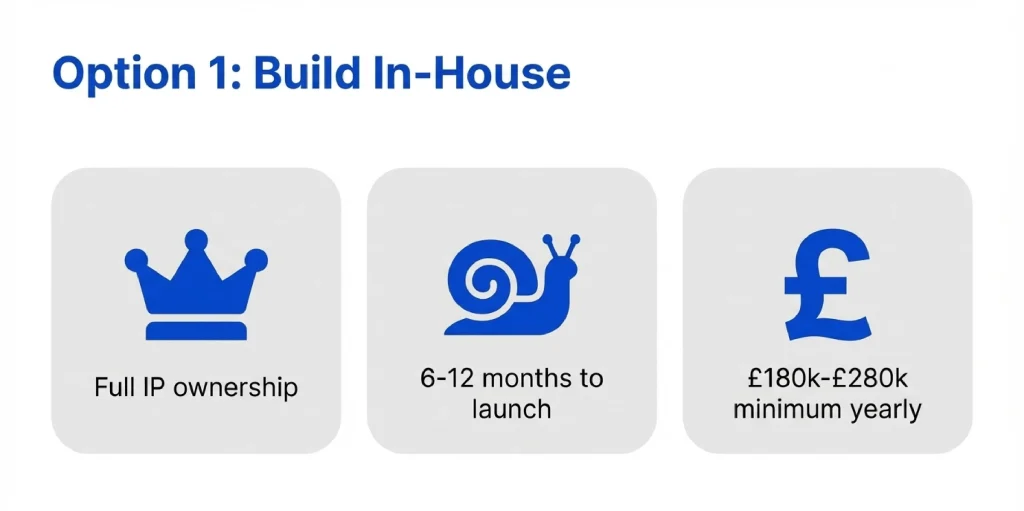
Hiring a mid-level developer in the UK costs between £45,000 and £75,000 per year in salary alone. Add national insurance, pension contributions, equipment, and management time and you are looking at £60,000 to £90,000 per developer annually before they write a single line of code.
Most startup software projects need at least two to three developers to build properly. That is £180,000 to £270,000 per year in team costs alone.
Building in house makes sense when:
- Your software IS your product it is the core thing you are selling
- You have already raised significant investment and have the runway to support a dev team
- Your competitive advantage lives entirely inside how your software works
Building in house does NOT make sense when:
- You are pre revenue or at MVP development stage
- You have less than 12 months of runway
- You are a non technical founder without a strong technical partner
In house development offers the greatest long-term potential but is also the most expensive, slowest, and riskiest option for early-stage UK startups. Many founders exhaust their resources before achieving product-market fit.
Option 2 Buy: When You Use SaaS Tools and Off the Shelf Solutions
Buying software means using tools that already exist. SaaS tools, off-the-shelf solutions, ready-made platforms that other businesses already use every day.
Think Shopify for ecommerce. Salesforce for CRM. Bubble for no-code apps. Xero for accounting. These are all “buy” options.
Early stage startups adopting this approach benefit from rapid deployment, moving from concept to live product in days rather than months, without the need for hiring or lengthy development.
For many UK startups, especially in the initial stages, this is often the most practical choice.
What buying off the shelf software actually looks like:
Subscription costs start low. Most SaaS tools charge between £20 and £200 per month at starter tier. You get a working product immediately. You get customer support from the vendor. You get regular updates and new features without paying extra.
The advantages and disadvantages of off-the-shelf software become more apparent as your business grows.
At small scale, buying is cheap and fast. But as your startup grows, the problems appear:
- Subscription costs can increase rapidly. For example, one startup paid £4,200 per month for seven SaaS tools before reaching 1,000 users.
- You cannot customise deeply you work within the limits the vendor sets
- Vendor lock in becomes a real risk your entire operation depends on someone else’s platform
- When your needs become unique, off-the-shelf solutions simply cannot keep up
Buying off the shelf makes sense when:
- You are at idea or validation stage and need to test fast
- Your business model is still evolving and you are not ready to commit to custom software
- The tool you need is not your competitive advantage it is just infrastructure
- You have a very tight budget and need to conserve cash for sales and marketing
- You need to launch in weeks not months
Buying does NOT make sense when:
- You need features the existing tools do not offer
- Your competitors are using the exact same tools you have no differentiation
- You are scaling fast and subscription costs vs development costs no longer favour buying
- Your customers have specific compliance or security requirements the tool cannot meet
The key consideration is whether the tool meets your immediate needs and milestones. If it does, buying is appropriate; if not, consider other options.
Option 3 Outsource: When You Partner With a Software Development Agency
This is the option that almost every build vs buy vs outsource software guideThis option is often overlooked in most build versus buy discussions. startups actually use.
Outsourcing means you partner with a software development agency a team of experienced developers, designers, and tech strategists who build your custom software for you. You get all the benefits of custom software without needing to hire an in house team.
Outsourcing is often misunderstood. Many founders believe it is either too expensive or involves working with unengaged overseas teams, but this is not necessarily the case.
Modern software outsourcing, particularly with UKbased agencies, differs significantly from common negative perceptions.
What outsourcing to a software development agency actually looks like:
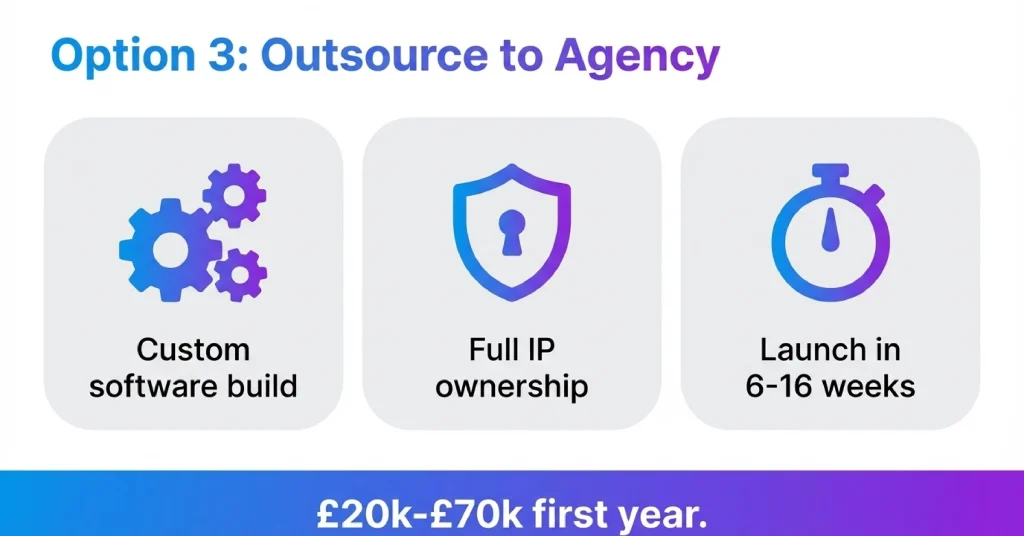
You work directly with a dedicated team who understand your business, your users, and your goals. You get custom software built to your exact specification. You own the code completely. You retain full intellectual property ownership from day one.
For UK startups, outsourcing a custom software project typically costs between £15,000 and £50,000, depending on complexity. This is significantly less than building an in-house team over the same period.
Outsourcing makes sense when:
- You are a non-technical founder who needs custom software without hiring a full dev team
- You have validated your idea and are ready to build properly but cannot afford in house developers yet
- You need to move fast without sacrificing quality
- You want custom software that you fully own not a SaaS tool with limits
- You are an early stage startup that needs expert guidance on technical decisions, not just code
Outsourcing does NOT make sense when:
- You have no clear brief or product specification agencies need direction to deliver well
- Your software requires constant real-time changes every single day in house suits this better long term
For most UK startups in 2026, partnering with a reputable software development agency is often the most effective initial step.
The Hybrid Approach: Combining All 3 for Maximum Efficiency
This is an important consideration that is often overlooked.
The most successful UK startups often combine all three options rather than relying on a single approach.
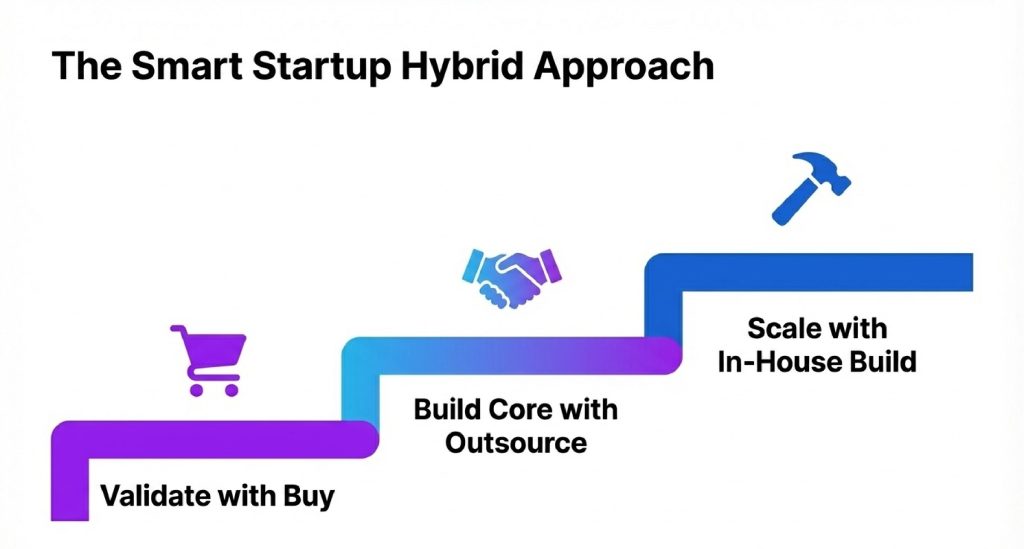
This is called the hybrid software approach and it is exactly how the most capital-efficient early stage startups operate in 2026.
Here is what a smart hybrid approach actually looks like in practice:
Stage 1 Validate with Buy: At the idea stage, use affordable
SaaS tools and off-the-shelf solutions to quickly build your MVP. This approach allows you to test demand, engage with customers, and secure your first paying users at minimal cost.
Stage 2 Build the Core with Outsource
You have proof. People are paying. But your SaaS tools are starting to hold you back you have hit feature limits, vendor lock in is becoming a real concern, and your product needs to do things no off-the-shelf tool can do. This is the moment to outsource. Partner with a trusted software development agency UK and build the custom core of your product. You own it. You control it. You built it for a fraction of the in-house cost.
Stage 3 Scale with build vs buy vs outsource software:
With established revenue, product market fit and investment, begin hiring in-house developers. This enables greater control over the codebase, faster feature development, and long term technical growth within your company.o validate. Outsource to build. Hire to scale.
This hybrid strategy is rarely discussed but is commonly adopted by the most efficient UK founders.
This approach preserves your financial runway, accelerates progress and prevents over investment in software before your business is validated.
The hybrid approach is a deliberate strategy andfor UK startups in 2026 represents the most practical path from idea to scale.
Build vs Buy vs Outsource: A Complete Comparison for UK Startups
Let’s focus on the most important considerations.
You now know your three options. Which is most cost effective, fastest to launch, and best for long term business protection?
I have compared all three options for UK startups using real projects, invoices, and founder experiences. The data reflects actual UK startup figures from 2026.
Below is a clear, side-by-side comparison to help you make an informed decision.
Cost Comparison: What Do UK Startups Actually Pay in 2026?
This is the primary question for most founders as subscription and development costs vary significantly depending on your startup’s stage.
Let me give you the real numbers.
🔵 Build In House: Full Cost Breakdow
| Junior Developer salary | £35,000 — £50,000 per year |
| Mid-level Developer salary | £50,000 — £75,000 per year |
| Senior Developer salary | £75,000 — £110,000 per year |
| Employer NI + pension | Add 15% on top of salary |
| Equipment + tools | £2,000 — £5,000 per developer |
| Project management | £40,000 — £65,000 per year |
| Minimum realistic team cost | £180,000 — £280,000 per year |
| Time before first launch | 6 — 12 months |
Total first year cost for a basic in house build: £180,000 — £350,000
This estimate excludes the additional costs of errors, rebuilds, and extended development timelines.
🟢 Buy Off the Shelf: Full Cost Breakdown
| Starter SaaS tool | £20 — £200 per month |
| Mid-tier SaaS tool | £200 — £800 per month |
| Enterprise SaaS tier | £1,000 — £5,000 per month |
| Multiple tools combined | £500 — £4,500 per month |
| Setup and configuration | £500 — £3,000 one-off |
| Third party integrations | £1,000 — £8,000 one-off |
| Year 1 total (typical startup) | £8,000 — £35,000 |
| Time before first launch | Days — 2 weeks |
Total first year cost for buying SaaS tools: £8,000 — £35,000
Looks amazing at the start. But watch what happens at year two and three when you scale. That £200 per month starter plan becomes a £2,000 per month growth plan. Suddenly you are spending £24,000 per year on a tool you do not own and cannot customise.
🟡 Outsource to Agency: Full Cost Breakdown
| MVP development (basic) | £12,000 — £25,000 |
| Full custom web app | £25,000 — £60,000 |
| Complex platform build | £60,000 — £120,000 |
| Monthly maintenance | £800 — £2,500 per month |
| Hosting and infrastructure | £100 — £500 per month |
| Year 1 total (typical startup) | £20,000 — £70,000 |
| Time before first launch | 6 — 16 weeks |
Total first year cost for outsourcing: £20,000 to £70,000
You get custom software. You own it completely. You have a working product in weeks not months. And your ongoing costs drop dramatically after launch because you are not paying developer salaries every single month.
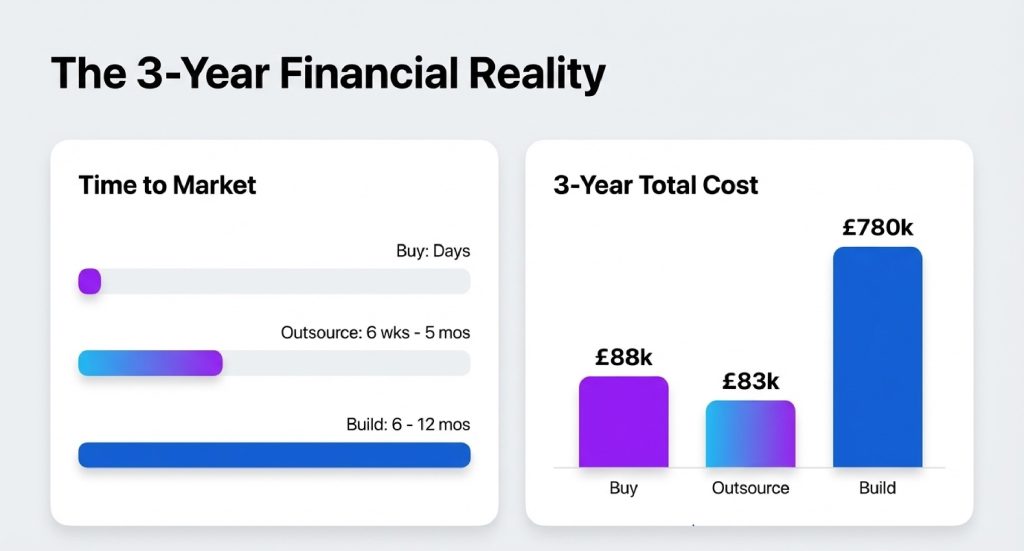
The Real Cost Comparison Over 3 Years:
| Build In-House | £280,000 | £260,000 | £240,000 | £780,000 |
| Buy SaaS Tools | £15,000 | £28,000 | £45,000 | £88,000 |
| Outsource | £45,000 | £18,000 | £20,000 | £83,000 |
Over three years, outsourcing and buying have similar costs. However, outsourcing gives you custom software with full ownership, while buying only gives you tools you do not own or control. This difference matters.
Time to Market: Which Option Gets You Live Fastest?
Speed is money for UK startups. Every week you spend building is a week your competitors are talking to your customers.
Here is the honest time to market reality for each option:
🔵 Build In House
Hiring developers in the current UK market typically requires at least four to eight weeks, as skilled professionals are in high demand and limited supply.
Once hired on boarding takes two to four weeks. After that, you move on to planning development, and testing. The whole process takes six to twelve months.
I spoke with a London fintech founder who decided to build in-house at the start of 2025. They were still in development nine months later when a competitor launched a nearly identical product using an outsourced agency. That competitor had paying customers before this founder had finished building.
Time to market is where building in house is most challenging for UK startups.
🟢 Buy Off the Shelf
Buying off the shelf solutions offers the fastest time to market.
You can sign up, configure the solution over a weekend, and launch within days.
Realistic time from decision to live product: 3 days to 2 weeks
If you need to validate quickly, and at an early stage you absolutely should, buying an off the shelf SaaS tool is the fastest way to reach customers. Period.
🟡 Outsource to Agency
Engaging an experienced software development agency results in a significantly shorter timeline compared to building in house.
There are no hiring or onboarding delays; the agency team begins work immediately.
A good UK agency will deliver an MVP in six to twelA reputable UK agency can deliver a minimum viable product in six to twelve weeks and a full custom platform in three to five months.eeks to 5 months
That is two to three times faster than building in house and costs much less.
Time to Market Summary:
| Buy SaaS | 3 days — 2 weeks ⚡ |
| Outsource | 6 weeks — 5 months ✅ |
| Build In-House | 6 — 12 months 🐢 |
Control and Intellectual Property Ownership
This section is often overlooked in most build versus buy guides.
However, it is a critical factor for UK startups considering investment, acquisition, or long-term value creation.
Intellectual property ownership means who legally owns the software, the code, and the technology your startup runs on.
Here is a direct comparison of how intellectual property ownership works for each option.
🔵 Build In House: IP Ownership
You retain full ownership of all code, design files, and databases from the outset.
This is the strongest IP position a startup can have. When investors do due diligence on your company, seeing clean in-house IP with no third-party dependencies is a green flag. It increases your valuation and makes acquisition conversations much simpler.
This provides complete control and ownership.
🟢 Buy Off the Shelf: IP Ownership
You do not own any of the underlying software.
This distinction is critical.
When you build your startup on SaaS tools and off-the-shelf solutions, you do not own any of that software. You are renting access to someone else’s technology. You are a tenant, not an owner.
That Shopify store? Shopify owns the platform. That Salesforce CRM? Salesforce owns it. That no-code app you built on Bubble? Bubble’s terms and conditions govern everything.
I have seen UK startups get to Series A conversations with investors only to be told their IP position is too weak because their entire product sits on a third party platform they do not control.r.
🟡 Outsource to Agency: IP Ownership
Selecting the right agency is essential.
With a reputable software development agency and a clear contract, you retain full ownership of all code developed for your business.
Tecveq, for example, transfers full intellectual property ownership to every client on delivery. The code is yours. The designs are yours. Everything is yours.
Outsourcing can provide the same intellectual property strength as building in-house, but without the high annual team costs.
Always check your contract before signing with any agency.
Make sure it explicitly states that all intellectual property created during the project transfers to your company on completion and payment. Any reputable UK agency will have no problem confirming this.
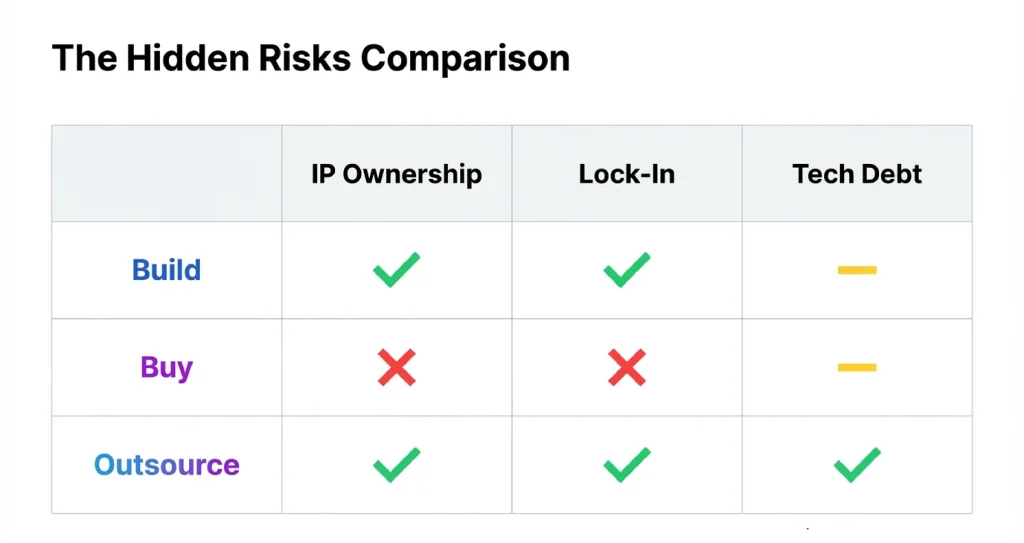
Vendor Lock In: The Hidden Risk for UK Startups. Vendor lock in is a significant risk that is often overlooked by UK startups. It might sound like technical jargon.
In reality, it is a major risk for UK startups in 2026, often discovered only when mitigation becomes costly.
What is vendor lock in?
Vendor lock-in happens when Vendor lock in occurs when your startup becomes so reliant on a single tool or platform that switching becomes extremely difficult, expensive, or nearly impossible .omer database inside a SaaS tool. Your workflows all run through one platform. Your team has been trained on one system for two years. And now that vendor is raising prices by 300%, changing their terms, or worst of all shutting down.
What do you do? You pay. BecIn such cases, you are often forced to accept increased costs or unfavorable terms due to lack of alternatives. UK startups in three painful ways:
Way 1: The Price Trap.
A Birmingham ecommerce startup built everything on a popular SaaS platform. At £99 per month it was perfect. Two years later, as their volume grew, they were forced onto an enterprise plan at £3,400 per month. Same product. Same features. Eleven times the price. They could not switch easily because two years of customer data and integrations were locked inside that platform.
Way 2: The Feature Freeze.
A London HR startup needed a specific compliance feature for UK employment law. Their SaaS vendor did not offer it and had no plans to build it. They were stuck. They could not add the feature themselves because they did not own the code. They had to either stay limited or rebuild from scratch.
Way 3: The Shutdown.
A Manchester startup built their entire onboarding flow inside a no-code tool. That tool was acquired by a larger company and discontinued eighteen months later. The startup had four months to rebuild everything or lose their product entirely.
How can you avoid vendor lock in?
While it is not possible to avoid vendor lock-in entirely when using SaaS tools, you can manage the risk effectively:
- Never build your core competitive feature inside a tool you do not own
- Always export your data regularly and keep backups outside the platform
- Read the terms of service carefully, especially regarding data portability and exit clauses
- Plan your outsource or build timeline before you hit the lock-in ceiling
Outsourcing custom software is the cleanest solution to vendor lock-in because you own the code completely. You can host it anywhere. You can modify it anytime. You are never at the mercy of someone else’s pricing or product decisions.
Technical Debt: What Happens After Launch?Technical debt is a crucial aspect of this comparison and often surprises UK startup founders.
What is technical debt in simple terms?
Technical debt refers to hidden costs that accumulate when software is developed rapidly, inexpensively, or without adequate planning. It is similar to financial debt: shortcuts taken now result in greater costs later.
Every shortcut taken during development becomes a problem you have to fix later. And the longer you leave it, the more expensive and painful it becomes.
Below is how technical debt manifests across each option:
Build In House: Building in house gives you the most control over technical debt, as long as your developers are experienced and your processes are strong.ior developers under pressure to ship fast will cut corners. Features get bolted on without proper architecture. The codebase becomes messy and fragile. Six months after launch, making a simple change takes three times longer than it should because nobody wants to touch the fragile code underneath.
Technical debt from in-house builds is very common in early stage startups where founders push developers to move fast without enough planning.
Risk level: Medium to High, depending entirely on your team’s quality
🟢 Buy Off the When purchasing SaaS tools, you do not incur traditional technical debt since you are not developing code internally. no However, you may accumulate integration debtebt. Call it integration debt.
You add tool after tool after tool. Your Zapier automations get more and more complex. Your data lives in five different places. Your team spends more and more time managing tools instead of building the business.
One UK startup I spoke with had seventeen different SaaS subscriptions running simultaneously. When one tool updated its API, three of their Zapier automations broke overnight. Their CTO spent a full week fixing connections between tools instead of building new features.
This integration debt can be as challenging as traditional technical debt.
Risk level: Low traditional debt, but high integration debt at scale
🟡 Outsource to Agency: Technical Debt Risk
Selecting the right agency is crucial in managing technical debt.
A reputable software development agency will deliver clean, well-documented, and scalable code, adhering to established development standards and ensuring future teams can build upon it efficiently.
A bad agency rushes the build, skips documentation, and hands you a codebase that looks finished on the outside but is fragile underneath. This is the horror story version of outsourcing that gives
How can you avoid technical debt when outsourcing?debt from outsourcing?
- Ask to see examples of previous codebases before hiring
- Request that documentation is included in your contract
- Agree on code quality standards upfront
- Choose an agency that uses modern, widely-understood technologies, not obscure frameworks that only they understand
- Make sure the handover process includes a full technical walkthrough
When outsourcing is done right with a reputable UK agency that takes pride in clean code, your technical debt risk is actually lower than building in house with a rushed junior team.
Risk level: Low with the right agency, high with the wrong one
Technical Debt Summary:
| Build In-House | Medium — High | Low |
| Buy SaaS Tools | Low | High at scale |
| Outsource (good agency) | Low | Low |
| Outsource (bad agency) | Very High | Medium |
How to Choose the Right Option The Tecveq Decision Framework
Reading about all three options is one thing.
Actually making the decision for your specific startup is another.
That is why we created this. The Tecveq Decision Framework is a simple five-step process we use with every UK startup founder we meet. It helps you focus on your real situation and gives you a clear answer, not just a generic checklist for someone else’s business.
Go through each step honestly. By the end, you will know exactly which option is right for you at this moment.
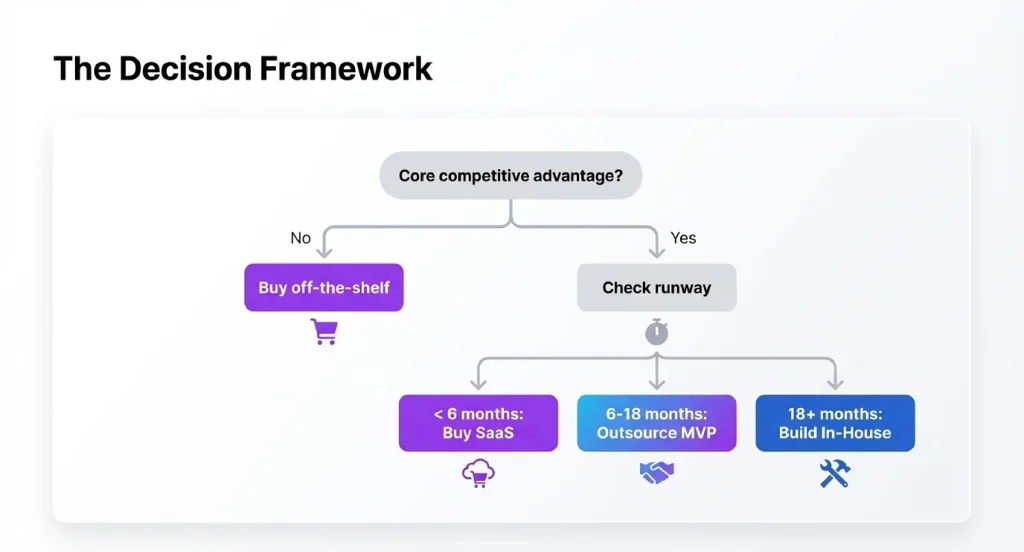
Step 1 Is This Software Your Core Competitive Advantage?
This is the most important question you will answer in this entire framework.
Ask yourself honestly: is the software itself the reason customers will choose you over everyone else? Or is it just a tool that helps you deliver your real value?
If yes, and the software IS your competitive advantage,
then building custom software makes sense. Your unique technology is what you are selling. Outsourcing is still a smart first move to get to market quickly, but in the long run, you will want to fully own it.
If no the software If no, and the software supports your business but is not the product, buy an off-the-shelf tool or outsource a simple custom build. Do not spend £200,000 building something that does not directly make you money.your competitor could use the same software tomorrow and it would not hurt you, it is not your competitive advantage.
Step 2: What Is Your Current Runway and Budget?
Money tells the truth faster than anything else.
Be honest about how much runway you have right now. Not how much you hope to raise. How much you actually have sitting in your bank account today.
Less than 6 months runway: Buy SaaS tools immediately. Preserve every penny. Validate your idea fast and cheap before spending anything on custom development 6 to 18 months runway: Outsourcing is your best option. You have enough budget for proper MVP development without the huge cost of building an in-house team. A well planned outsourced MVP usually costs between £12,000 and £35,000, giving you a custom product you fully own while protecting your remaining runway.way.
18 months or more: You have options. Outsource for speed now. Begin planning your in-house team for later.
Step 3: Do You Have In House Technical Expertise?
This is the question most founders feel uncomfortable answering honestly.
Software outsourcing for non-technical founders is not a weakness. It is a completely legitimate and smart business decision. Some of the most successful UK startups were built by non-technical founders who outsourced their entire first product.
You have a strong technical co founder or CTO:
Building in house becomes a real option. You have the leadership to make it work without wasting money.
You are a non technical founder without a tech lead: Outsource. Do not hire developers you cannot properly manage or evaluate. A trusted software development agency brings their own technical leadership, project management, and quality control everything a non technical founder needs without the hiring risk.
Step 4: How Fast Do You Need to Reach Product Market Fit?
Product market fit is the moment your product clicks with your customers. People are paying. Retention is strong. Word of mouth is growing. Everything before this moment is just expensive guesswork.
The faster you reach product-market fit, the less money you burn getting there.
You need to validate in the next 60 days: Buy off-the-shelf tools. Launch something imperfect. Talk to customers. Learn fast.
You have 3 to 5 months to build properly:
Outsource a focused MVP. Get a real custom product in front of real customers. Iterate based on genuine feedback rather than working around the limits of a SaaS tool.
Speed is your most important asset before product market fit.
Every month you spend building instead of learning is a month your competitors are talking to your customers.
Step 5: What Does Your 12 Month Scaling Plan Look Like
Your early-stage startup software strategy should always look 12 months ahead, not just at launch day.
Ask yourself where do you need to be in 12 months and will your software choice get you there?
Staying lean and validating:
Stick with SaaS tools and outsourced builds. Keep costs low and stay flexible.
If you are raising a Seed or Series A round,
make sure you own your intellectual property. Investors will ask about this. Outsourcing with full IP transfer puts you in a strong position.
If you are scaling to thousands of users
start planning your transition from outsourced to in-house now. Hire your first in-house developer around month nine or ten while your agency partner is still available for knowledge transfer.
Your 12 month plan changes everything about which option you choose today.
When Should a UK Startup Build Software In House?
Building in-house can be highly effective, but timing is critical.
Most UK founders who build too early do not lack ideas; they run out of funding.
Below are the conditions when building in house is appropriate and when it can jeopardize your startup before it launches.
Signs You Are Ready to Build Custom Software
You are ready to build inhouse only when all of the following are true:
- You have established paying customers, with actual revenue rather than just expressions of interest.
- You have a strong technical co-founder or experienced CTO already on your team
- You have secured investment that provides at least 18 months of runway.
- Your software is the core product, not merely a supporting tool.
Real Risks of Building Too Early as a Bootstrapped Startup
Bootstrapped startup software tools are designed to help you sustain operations until you achieve success.
I have watched promising UK startups collapse not because their idea was wrong but because they built too early.
Here is what actually happens:
- You invest £60,000 in software development before achieving product market fit.
- After engaging with customers, your idea evolves, requiring you to rebuild.
- Runway disappears. Pressure mounts. Shortcuts get taken
- Technical debt accumulates beneath a product that has not yet gained users.
When Should a UK Startup Buy Off the Shelf SaaS Tools?
Buying software is not settling for less. For many UK startups, it is actually the smartest first move.
At the early stage, your main goal is to learn quickly while keeping costs low. Off-the-shelf SaaS tools help you do just that.
Best SaaS Tools UK Startups Use in 2026
These tools have proven to work well for UK startups:
- Notion: project management and internal documentation
- Xero: accounting and financial management designed for UK businesses
- Intercom: customer support and user onboarding
- Webflow: create professional websites without writing code
- Zapier: connect your tools and automate repetitive tasks
- Stripe: payment processing trusted by thousands of UK startups
- HubSpot CRM and markHubSpot: CRM and marketing tools for early-stage growthve fast without a single developer on your payroll.
When Off the Shelf Software Starts Holding You Back
SaaS tools work great until they suddenly do not.
Here are some clear signs that your off the shelf solution is no longer enough:
- You find yourself doing manual work to get around missing features
- Subscription Your subscription costs are rising faster than your revenue errors are using identical tools you have zero differentiation
When you notice these signs, it is time to consider outsourcing a custom build
When Should a UK Startup Outsource Software Development?
Outsourcing is an option that doesn’t get enough attention in the UK startup scene.
It’s a middle ground between buying affordable SaaS tools and hiring an expensive in-house team. For most early-stage UK startups in 2026, it’s often the smartest choice.
Here’s what you need to know.
Should I Build or Buy Software for My Startup?
Honestly, neither option on its own is usually the best answer.
Building is too expensive and too slow at early stage. Buying limits you the moment you start growing.
Outsourcing gives you the best of both worlds. You get custom software made just for your business, and you fully own it. Plus, you can have it ready in weeks instead of months.
For most UK For most UK startup founders, especially those without a technical background, outsourcing to a trusted software development agency is the best way to protect your budget, timeline, and intellectual property ownership all at once. the Cost of Outsourcing Software Development in the UK?
Based on real UK agency projects in 2026, here are some honest numbers:
| MVP — basic web app | £12,000 — £25,000 |
| Full custom platform | £25,000 — £60,000 |
| Complex multi-feature build | £60,000 — £120,000 |
| Monthly retainer support | £800 — £2,500 |
These numbers cover design, development, testing, and launch support.
Compare Compare that to at least £180,000 for just one in-house developer for a year, and it’s clear why outsourcing is often the best financial choice for bootstrapped UK startups.w Do I Choose a Software Development Agency in the UK?
I’ve seen UK founders make costly mistakes at this stage. Use this checklist before you sign any contracts:
- Check their portfolio. Have they built something similar to what you need?
- Read real client reviews, not just testimonials on their website.
- Confirm IP ownership in writing. Your contract should clearly state that all code will be transferred to you when the project is complete.
- Ask about their communication process weekly updates clear milestones, direct developer access
- Understand their tech stack. Make sure they use widely adopted technologies that your future team can maintain.
- Get a fixed price or a clear milestone-based quote. Avoid open-ended hourly arrangements with no spending limit.
A great software ageA great software agency partner for your UK startup should feel like part of your team, not just a supplier.hat Tell You It Is Time to Outsource
Don’t leave it to guesswork. If you notice these five signs, it’s time to consider outsourcing:
🟢 Green Flag 1 Your SaaS tools cannot do what your customers are asking for
🟢 Green Flag 2 You are non technical and cannot afford to hire a full in-house dev team yet
🟢 Green Flag 3 You have validated demand and need to build properly before competitors catch up
🟢 Green Flag 4 An investor has asked about your intellectual property and you do not own your core technology yet
🟢 Green Flag 5 Your subscription costs vs development costs calculation now favours building custom software
If two or more of these apply to you right now, it’s time to talk to a software development agency.
Build vs Buy vs Outsource: The UK Startup Decision Matrix
Don’t overthink it. Just use this table.
See where your startup fits right now and you’ll find your answer.
| Budget | £180k+ per year | £8k — £35k per year | £12k — £70k one-off |
| Time to Launch | 6 — 12 months | 3 days — 2 weeks | 6 weeks — 5 months |
| You Own the Code | ✅ Yes | ❌ No | ✅ Yes |
| Technical Team Needed | ✅ Yes | ❌ No | ❌ No |
| Customisation Level | ✅ Full | ❌ Limited | ✅ Full |
| Vendor Lock-In Risk | ✅ None | 🔴 High | ✅ None |
| IP Ownership | ✅ Full | ❌ None | ✅ Full |
| Best Startup Stage | Post Series A | Idea — Validation | MVP — Seed |
| Technical Debt Risk | Medium | High at scale | Low — right agency |
| Scales With Business | ✅ Yes | ❌ Limited | ✅ Yes |
Common Mistakes UK Startups Make With Software Decisions
Each mistake I’ll describe here is something I’ve actually seen happen to a UK startup.
Take these as lessons you don’t have to pay for yourself.
Mistake 1: Building When You Should Be Validating First
I once talked to a Leeds startup founder who spent £55,000 on custom software before talking to even one paying cusSix months later, he found out his target customers actually wanted something completely different.fferent.
He had to start over from scratch, which cost another £40,000 and nine more months.
The rule is simple: validate your idea with affordable SaaS tools first. Only start building once customers are already paying.e product market fit is to learn. Not to build.
Mistake 2: Relying on the Cheapest SaaS Tool at the MVP Stage
Choosing the cheapest option can seem smart when money isBut picking the wrong SaaS tool at the MVP stage can lead to bigger problems, like vendor lock in and integration issues that end up costing much more to fix than you saved at the start. upfront.
I’ve seen UK startups spend £18,000 just to move their data out of a cheap tool they outgrew in eight monFrom day one, pick tools that let you easily export your data and have flexible APIs.
Mistake 3: Outsourcing Without a Clear Brief or Milestone
There’s one main reason outsourcing fails.
The founder didn’t have a clear brief.
Vague briefs produce vague software. When you cannot clearly describe what you are building, what problem it solves, and who uses it no agency in the world can save you from a bad outcome.
I’ve seen UK startups waste £30,000 on outsourced projects that delivered the wrong product, just because no one wrote down exactly what was needed before development began.
Before you reach out to any software development agency, write your brief first. Define every feature and agree on every milestone in writing. Protect your budget before you spend anything.
How Tecveq Helps UK Startups Make the Right Software Decision
Most software development companies want to sell you a build.
Tecveq is different.
Before we write any code, we sit down with you as fellow founders and help you decide if building, buying, or outsourcing is the best choice for your situation right now.
If buying a SaaS tool is the best option for you today, we will tell you honestly. Even if that means you do not hire us yet.
Why UK Startups Choose Tecveq as Their Software Partner
Tecveq is a software development company built specifically for UK startups.
We understand tight budgets. We understand short runways. We understand what it feels like to make a £40,000 decision without being completely sure it is the right one.
Here is what makes Tecveq different from every other agency you will speak to:
- Affordable software development UK startups can actually budget for, with transparent fixed pricing and no surprise invoices.
- Full intellectual property ownership is transferred to you on every project. Your code is your asset, always.
- UK based project management with developers across the UK and Pakistan gives you quality without the London agency price tag.
We are not just a software agency. We are the UK startup tech partner that grows with you from your first MVP all the way to your Series A.
Get a Free Software Strategy Consultation Today
You have read the full guide. You understand your options.
Now it is time to make the decision that moves your startup forward.
Book a free 30 minute software strategy consultation with the Tecveq team today. We will look at your specific situation, including your budget, timeline, and idea, and give you an honest recommendation on whether to build, buy, or outsource your software in 2026.
No sales pressure. No jargon. Just straight advice from a team that has helped dozens of UK startups make this exact decision.
Outsource app development in the UK for 2026, done properly with a partner who puts your startup first.
👉 Book Your Free Consultation at tecveq.com
Frequently Asked Questions
Should I Build or Buy Software for My Startup?
It depends on your stage. If you are still validating your idea buy SaaS tools and move fast. If you have paying customers and need custom features outsource to a trusted software development agency. Only build in-house when you have investment, revenue, and a technical team ready.
When Should a Startup Outsource Software Development?
Outsource when you have validated demand but cannot afford an in house team. If you are a non technical founder, have 6 to 18 months runway, and need custom software you fully own outsourcing is your smartest move right now.
Is It Cheaper to Build or Buy Software?
Buying SaaS tools is cheaper short term. Building or outsourcing is cheaper long term. A typical SaaS stack costs £8,000 to £35,000 in year one but grows fast. An outsourced custom build costs £12,000 to £60,000 once then you own it forever with no monthly licensing fees.
What Is Vendor Lock In and How Do Startups Avoid It?
Vendor lock in happens when your entire business depends on one platform you do not own or control. Avoid it by never building your core product inside a SaaS tool, always keeping data backups outside the platform and outsourcing custom software you fully own as soon as your budget allows.
What Is the Cost of Outsourcing Software Development in the UK?
A basic MVP costs £12,000 to £25,000. A full custom platform costs £25,000 to £60,000. Complex builds start at £60,000. Monthly maintenance runs £800 to £2,500. All figures vary by scope, complexity, and the agency you choose.
How Do I Choose a Software Development Agency in the UK?
Check their portfolio. Read independent reviews. Confirm IP ownership transfers to you in your contract. Ask for fixed milestone-based pricing. Make sure they communicate clearly and build in widely used technologies your future team can maintain easily.