Pakistani Businesses Are Moving Toward Custom Accounting Software in 2026
We build accounting software specifically for your business because off-the-shelf solutions no longer keep up with what Pakistani companies actually need. The best accounting software in Pakistan is not something you download and force your workflow into. It is software designed around how your business already operates.
Most businesses we talk to started with generic accounting tools. They seemed fine at first. Then the problems started showing up. The software could not handle their inventory the way they tracked it. Reports did not match what their accountant needed for tax filing. Multi-branch syncing broke constantly. FBR compliance became a guessing game.
And when they called support, they got generic answers that did not solve Pakistan-specific problems.
Custom-built accounting software solves this completely. We sit down with you and map out exactly what your business does. How you invoice clients. How you track stock across warehouses in Karachi and Lahore. What reports does your CFO need every Monday morning? What FBR filing requirements do you have to meet without errors?
Then we build the software to do exactly that.
No forcing your process into someone else’s template. No paying for features you will never use. No waiting months for a vendor to maybe add the one feature that would save you 10 hours a week.
Top accounting software in Pakistan is shifting toward this model because businesses are tired of adapting to software instead of software adapting to them. We have built systems for manufacturers tracking raw materials and finished goods simultaneously. Retail chains running 15 locations with different pricing models. Service companies managing project budgets and client retainers across teams.
Each one is different. Each one built to fit.
The companies growing fastest right now are the ones using tools built specifically for their operation. Not generic solutions their competitors also use.
FBR Digital Invoicing Compliance Now Defines “Best” in Pakistan
FBR compliance is not optional anymore, and it is not something you can patch onto old accounting software at the last minute. The Federal Board of Revenue has made integrated e-invoicing and digital tax reporting mandatory for businesses across Pakistan, fundamentally changing what makes accounting software actually usable. Which accounting software is used in Pakistan successfully right now depends entirely on whether it handles real-time e-invoicing, automated tax reporting, and audit-ready record keeping without manual workarounds.
We build FBR compliance directly into every accounting system we create. Not as an add-on feature. As the foundation.
Real-Time E-Invoicing Requirements for 2026
Every invoice your business generates must sync with FBR systems in real time starting this year. The requirement is not just about uploading files at month-end. It means live integration so every sale you record gets reported to FBR immediately with the correct tax breakdown and client details.
We integrate this directly into your invoicing workflow. When your team creates an invoice in the system, it automatically formats everything according to FBR standards, assigns the correct tax codes, validates the client NTN, and transmits the data instantly.
No separate upload process. No month-end reconciliation panic. No rejected filings because someone forgot to include a required field.
Most businesses using older software are still doing this manually. They generate invoices in their system, then recreate the same data in a separate FBR portal. That doubles the work and doubles the chance of errors. And when FBR audits your records, any mismatch between your internal invoices and what you filed triggers immediate red flags.
We eliminate that completely. One invoice. One entry. Automatically compliant.
Penalties and Risks of Non-Compliant Systems
FBR penalties for non-compliant invoicing start at PKR 20,000 per missed or incorrect filing and scale up fast. We have talked to businesses hit with penalties exceeding PKR 500,000 because their accounting software could not generate audit-compliant reports and they missed filing deadlines trying to fix it manually.
But the real risk is not just fines. It is the operational damage that happens when you cannot trust your own financial data.
Non-compliant systems force your team to maintain two sets of records. One in your accounting software. One for FBR. Those records drift apart over time. Then when your accountant needs accurate numbers for tax filing or your bank needs verified financials for a loan application, you spend days reconciling conflicting data.
And you still are not sure which version is correct.
We build the system so compliance is automatic. Every transaction you record is structured correctly from the start. Tax calculations happen in real time based on current FBR rates. Reports generate in the exact format FBR requires. When audit season comes, you pull the report and submit it. Done.
No last-minute data cleanup. No paying your accountant extra hours to reverse-engineer compliant records from non-compliant software. No wondering whether you will pass the audit.
The companies we work with sleep better during tax season because their software handles compliance automatically and they know their numbers are accurate.
GET IN TOUCH
Build FBR-Compliant Accounting Software for Your Business | Free Consultation with Tecveq
Core Features That Separate Reliable Accounting Software From the Rest
We have built accounting systems for over 200 Pakistani businesses, and the pattern is always the same. Companies do not fail because their software lacks fancy features. They fail because their software cannot handle the basics flawlessly under real business pressure.
The best bookkeeping software is not the one with the longest feature list. It is the one that handles your daily accounting workload without breaking, without requiring workarounds, and without forcing you to double-check everything manually because you do not trust the numbers.
Here is what actually matters when you are running a business in Pakistan and need software that works every single day without fail.
Invoicing and Automated Tax Reporting
Your invoicing system should create a complete audit trail from quote to payment without you thinking about it. We build invoicing modules that generate sequential invoice numbers automatically, apply the correct GST rates based on product type and client location, calculate withholding tax when required, and track payment status in real time.
When a client pays, the system records it against the right invoice, updates your cash flow automatically, and marks the tax liability as collected. No manual entries. No spreadsheet cross-referencing.
And because every invoice feeds directly into your tax reporting system, your monthly GST returns generate automatically with complete backup documentation. You review it, approve it, and submit it to FBR. The math is already done. The records are already organized. The compliance is already built in.
Most businesses waste 10 to 15 hours every month reconciling invoices with tax filings because their software treats these as separate functions. We build them as one integrated process so the work happens once and the results flow everywhere they need to go.
Multi-User Access and Role-Based Permissions
Your accountant needs full access to financial reports. Your sales team needs to create invoices but should not see profit margins. Your warehouse manager needs inventory control but should not access payroll data. Your branch managers need to see their location performance without accessing other branches.
We build role-based permission systems that let you control exactly who sees what and who can change what. You define the roles once based on job function. Then every user gets access to exactly the tools and data they need to do their work. Nothing more.
This is not just about security. It is about workflow efficiency.
When your sales rep opens the system, they see a clean interface with invoicing, client history, and inventory availability. No confusing accounting menus they will never use. No risk of them accidentally posting something to the wrong ledger account.
When your CFO logs in, they see complete financial oversight across every department and location with drill-down access to transaction details when they need to investigate something.
And the audit trail tracks every action anyone takes. Who created the invoice? Who approved the expense? Who adjusted the inventory count? When something does not look right, you know exactly where it came from.
Inventory, POS, and Manufacturing Integration
Inventory tracking fails in most accounting software because it was designed as an afterthought. Generic systems let you track stock quantities, but they cannot handle the complexity real businesses deal with daily.
We build inventory modules that sync with your actual operations. Multiple warehouses with different stock levels. Batch tracking for expiry dates. Serial number tracking for warranty claims. Raw material consumption tied to production orders. Finished goods are automatically added to inventory when manufacturing completes.
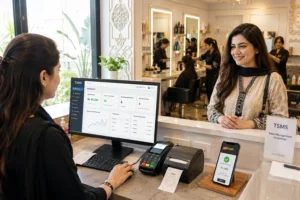
For retail businesses, we integrate POS systems directly so every sale at the counter updates inventory in real time and flows into your accounting automatically. Your staff processes the sale. The system handles everything else. Inventory adjusts. Revenue records. Tax calculates. Cash balance updates.
For manufacturers, we track raw materials through production stages to finished goods. When you create a production order, the system reserves raw materials, tracks work in progress, calculates production costs including labor and overhead, and adds finished inventory when the batch completes.
Your cost of goods sold calculates automatically based on actual material usage and production costs. Your inventory valuation is always accurate. Your financial statements reflect real operational performance without manual adjustments.
One textile manufacturer we built a system for was spending 40 hours a month reconciling raw material purchases with production output with finished goods inventory. Nothing ever matched because they were tracking it in three separate systems.
We integrated everything. Now production managers enter one manufacturing order, and the entire chain updates automatically from material draw to finished inventory to cost accounting. Zero reconciliation time.
Payroll and HR Sync
Payroll is accounting. When you process salaries, you are recording expenses, calculating tax withholdings, managing statutory deductions for EOBI and social security, and creating payment obligations that affect your cash flow.
We build payroll systems that integrate completely with your accounting. Employee salaries, bonuses, overtime, deductions, and advances all flow into your general ledger automatically with correct expense allocation to departments or projects.
Tax withholdings calculate based on current FBR salary tax slabs and generate monthly withholding statements ready for filing. EOBI and social security contributions calculate automatically and track your payment obligations. Provident fund deductions record as liabilities until you transfer them.
When you process payroll, the system posts all entries to accounting automatically. Salary expense by department. Tax withholding liability. Provident fund liability. Net salary payable. Then when you make bank transfers, those payments clear against the liabilities, and your books stay balanced.
No manual journal entries. No forgetting to record a deduction. No month-end surprises when your accountant finds payroll that was never posted to expenses.
And if you need payroll reports for bank loan applications or audits, the system generates complete salary history with tax compliance documentation instantly.
Real-Time Financial Reports and Dashboards
Financial reports only help you make decisions if they are accurate and available when you need them. Not two weeks after month-end when your accountant finishes reconciling everything manually.
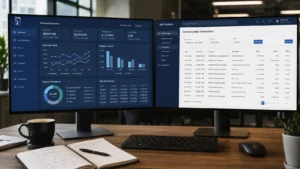
We build real-time reporting dashboards that show your current financial position based on live transaction data. Revenue by product line or location. Expense tracking against budget. Cash flow projections based on pending invoices and upcoming bills. Profit margins by customer or project.
Every transaction that happens anywhere in your business updates these reports immediately. When your sales team closes a deal, revenue projections update. When your warehouse receives inventory, your cash flow forecast adjusts for the payment due date. When payroll processes, your expense reports reflect it instantly.
You can open your dashboard at 10 AM on a Tuesday and see exactly where your business stands financially at that moment. Not where it stood last month. Right now.
And because the system tracks everything at the transaction level, you can drill down into any number. Click on total expenses and see it broken down by department. Click on a department and see individual transactions. Click on a transaction and see who entered it and when.
This is how you catch problems early instead of discovering them during annual audits. One client found they were losing PKR 80,000 monthly on a product line because their old software could not track profitability by product. They thought it was profitable because revenue looked good. But when we built detailed cost tracking, they discovered material costs and labor time made that product a consistent loss.
They discontinued it and shifted resources to profitable products. That decision paid for the entire software development in four months.
Cloud-Based vs. Desktop Accounting: What Pakistani SMEs Are Choosing
We deploy accounting software in the cloud for nearly every client now because desktop systems create problems that cloud systems solve completely. Your accounting data lives on secure servers you can access from anywhere with the internet instead of being locked to one computer in your office.
The shift happened fast. Three years ago most businesses we talked to wanted desktop software because that is what they knew. Now the question is not whether to go cloud. It is how quickly we can migrate their desktop data to the cloud so their teams can work remotely without restrictions.
Here is why cloud-based accounting became the standard in Pakistan and what it means for your business.
Access your financial data from anywhere in Pakistan or anywhere in the world. Cloud accounting works from any device with internet. Your accountant in Karachi can review reports while you are meeting a supplier in Lahore. Your branch manager in Islamabad can generate sales reports from their phone. Your CFO can approve expenses while traveling internationally.
Desktop software ties you to one location. If the data is on the office computer, you have to be in the office to access it. Or you set up complicated remote desktop connections that break constantly and create security holes.
We build cloud systems that work seamlessly across locations and devices. Log in from your laptop, tablet, or phone, and the interface adapts automatically. Same data. Same features. Different screen size.
Automatic backups mean you never lose financial records even if hardware fails. Every transaction you enter in cloud accounting backs up immediately to multiple secure servers. If your office computer crashes, catches fire, or gets stolen, your accounting data is completely safe and accessible within minutes from any other device.
Desktop accounting requires manual backups that most businesses forget to do regularly. We have talked to companies that lost months of financial records because their office computer died and their last backup was from four months earlier. They had to recreate invoices from email records and try to rebuild their books from bank statements.
That is not a recoverable situation during tax season.
Cloud backups happen automatically every time data changes. You never think about it. Your records are always protected.
Multiple team members work in the system simultaneously without conflicts. Cloud accounting lets your entire finance team work at the same time. Your accountant posts expenses while your sales team creates invoices while your warehouse manager updates inventory while your payroll officer processes salaries.
Desktop systems lock the file when one person is using it. Everyone else waits. Or you buy expensive server licenses and deal with network configuration problems that break whenever someone updates Windows.
We build multi-user cloud systems where everyone works simultaneously and the software handles all the syncing and conflict resolution automatically. Twenty people can work in the system at once without slowing down or creating data conflicts.
Security updates and FBR compliance changes deploy automatically. When FBR changes tax rates or filing requirements, we update your cloud accounting system, and the changes go live for everyone instantly. You log in the next day, and the new tax rates are already configured. New FBR report formats are already available.
Desktop software requires manual updates that you have to remember to install. Most businesses run outdated versions for months because updating is complicated and they worry about breaking something. Then tax season arrives, and their software does not support the current FBR filing format.
Cloud systems stay current automatically without you managing updates or worrying about version compatibility.
Lower upfront costs and predictable monthly expenses. Cloud accounting eliminates the large upfront software purchase and the expensive server hardware to run it on. You pay a monthly service fee based on users and features. Add users when you hire. Remove them when someone leaves. Scale up or down as your business changes.
Desktop systems require buying software licenses, server hardware, backup systems, and often IT staff to maintain everything. That investment sits idle when you do not need full capacity and becomes insufficient when you grow.
And the truth every desktop software vendor hides is this. Hardware fails. Usually right when you need it most. Then you are buying emergency replacement servers and paying rush fees to get your accounting system running again before month-end closing.
Cloud hosting means server maintenance is our problem, not yours.
Top 10 accounting software in Pakistan discussions online still mention desktop options, but the businesses actually growing and scaling profitably are the ones who moved to the cloud years ago. They can open new branches without buying new servers. Hire remote accountants without complicated VPN setups. Work through internet outages using mobile data as backup.
One manufacturing client we moved to cloud accounting was spending PKR 180,000 annually on server maintenance, backup drives, and IT support just to keep their desktop accounting system running. We migrated them to the cloud for less than half that cost, and their team can now access financial data from all six factory locations simultaneously instead of calling the head office to request reports.
The productivity gain paid for the migration in two months.
GET IN TOUCH
Custom Accounting Software Built for Pakistani Businesses | Talk to Tecveq Today
Free and Budget Accounting Tools Come With Hidden Compliance Costs
Free accounting software looks attractive until FBR audits your books and finds gaps that generic tools cannot fix. We have helped dozens of businesses migrate away from free solutions after they discovered the compliance problems those tools created cost far more than proper software would have.
The math seems simple at first. Download free accounting software and save money on bookkeeping. But free tools are built for generic businesses in other countries with different tax systems and different reporting requirements. They do not understand Pakistani FBR compliance, and they cannot adapt to it.
Here is what actually happens when you run your Pakistani business on free accounting software built for foreign markets.
FBR e-invoicing integration does not exist in free tools. Most free accounting software has no connection to FBR systems because the developers are not tracking Pakistani tax law changes. You generate invoices in the software and then manually recreate the same data in FBR portals. That doubles your workload and creates constant reconciliation problems when the two systems do not match.
We talked to a retail chain using free software that spent 60 hours every month manually transferring invoice data to FBR filing systems. They hired a full-time person just to handle that reconciliation. The salary cost alone was more than custom accounting software would have cost them, and they still filed incorrect returns twice because of data entry errors during manual transfer.
Free downloads do not save money when you pay people to work around what the software cannot do.
Sales tax calculations fail on Pakistani-specific scenarios. Generic accounting tools cannot handle the complexity of Pakistani GST properly. Different rates for different product categories. Withholding tax requirements that change based on client registration status. Special economic zone exemptions. Reduced rates for specific industries.
Free software gives you one tax rate field and expects you to calculate everything manually. That works until FBR audits you and finds your returns do not match the actual tax liability based on transaction details. Then you are paying penalties plus the extra tax plus your accountant’s time to reconstruct accurate records.
The best accounting software in Pakistan free download results do not include the cost of failed audits and compliance penalties that show up six months later.
Multi-location inventory tracking breaks completely. If you operate branches in Karachi, Lahore, and Islamabad, free accounting software cannot sync inventory across locations accurately. The tools are designed for single-location businesses. When you try to track stock transfers between branches, the software either loses transactions or double-counts inventory.
One distributor we worked with ran free software for eight months before discovering their inventory records were off by PKR 2.4 million because inter-branch transfers were not posting correctly. They thought they had stock they did not actually have. They promised deliveries to clients they could not fulfill. They reordered products they already had sitting in another warehouse.
The operational chaos from bad inventory data cost them client relationships that took years to rebuild.
No audit trail means FBR rejects your records as unreliable. Free accounting tools often let users edit or delete transactions without tracking who made changes and when. That sounds convenient until FBR audits you and asks for a complete transaction history with user accountability.
Pakistani tax law requires proper audit trails showing who entered every transaction and who modified anything. Free software does not enforce this because it is not built with FBR audit requirements in mind. When you cannot prove transaction authenticity during an audit, FBR can reject your entire accounting record and assess taxes based on their estimation instead of your actual numbers.
That estimation is never in your favor.
Budget tools lack customization for Pakistani business workflows. Your business processes orders, fulfills them from inventory, bills clients with staged payments, tracks post-dated checks, manages sales representative commissions, and handles dozens of other workflow details specific to how Pakistani businesses actually operate.
Free software gives you generic invoicing and expense tracking. Nothing more. You end up maintaining spreadsheets alongside the accounting software to track everything the software cannot handle. Then your actual financial data is split across multiple systems that do not talk to each other, and reconciliation becomes a nightmare.
We have migrated clients off free tools where they were running the accounting software, plus seven different Excel files, plus a separate inventory system, plus manual sales tracking. They thought they were saving money on software while spending 40 hours a week on manual reconciliation that custom software would handle automatically.
Support does not exist when you need help. Free accounting software comes with no support obligation. When something breaks or you cannot figure out how to handle a transaction properly, you search forums and hope someone else has had the same problem. During month-end closing or tax filing deadlines, that is not acceptable.
We build support directly into every system we create. When you have a question, you contact us and we answer it. When FBR changes a requirement, we update your system and notify you what changed. When you need a new feature for business growth, we build it instead of telling you to work around what the software cannot do.
The real cost of free accounting software in Pakistan shows up as FBR penalties, failed audits, operational inefficiencies, lost inventory, incorrect financial reports, and dozens of hours spent every month working around software limitations. Those costs are never visible in the free download page, but they are very real when you are running an actual business trying to stay compliant and profitable.
Custom-built accounting software costs more upfront. But the cost is predictable, the software actually solves your problems instead of creating new ones, and you own a system built specifically for your business instead of fighting with generic tools designed for someone else’s workflow in another country.
Industry-Specific Accounting Needs Across Pakistan
Every industry handles money differently, and generic accounting software fails the moment your business does something the template was not designed for. We build accounting systems tailored to how specific industries actually operate in Pakistan because retail needs are completely different from manufacturing needs, which are completely different from service business needs.
The best ERP software in Pakistan is not one-size-fits-all. It is purpose-built for your industry workflow so the software supports your operations instead of forcing you to change how you work just to fit what the software can do.
Here is how we customize accounting for the industries we work with most across Pakistan.
Retail and POS-Heavy Businesses
Retail accounting fails in generic software because transactions happen too fast and inventory moves too quickly for manual entry systems to keep up. You need point-of-sale integration that records every sale automatically, updates inventory in real time, tracks cash and card payments separately, manages customer loyalty programs, and handles returns and exchanges without creating accounting chaos.
We build POS-integrated accounting for retail businesses where the sale at the counter triggers everything else automatically. Your cashier scans items and processes payment. The system records revenue, adjusts inventory, calculates tax, updates daily sales reports, and tracks payment method all in one transaction.
No end-of-day manual entry. No reconciling POS sales with accounting records. No inventory counts that never match your books.
For clothing retailers, we add size and color variant tracking so you know exactly which SKUs are selling and which are sitting in inventory too long. For electronics shops, we add serial number tracking for warranty management. For grocery stores we add expiry date tracking and automatic alerts when products are approaching expiration.
One retail chain in Karachi was running separate POS software and accounting software and spending three hours every night reconciling the two systems. Sales numbers never matched exactly because of timing differences and transaction categorization mismatches. We integrated everything into one system, and their end-of-day closing now takes 15 minutes instead of three hours.
Retail accounting software in major cities like Karachi, Lahore, and Islamabad must also handle multi-location inventory visibility. Your store manager needs to see stock levels across all branches so they can transfer inventory from overstocked locations to stores running low. We build centralized inventory dashboards that show real-time stock levels across every location with one-click transfer requests between branches.
Manufacturing and Supply Chain Firms
Manufacturing accounting requires tracking costs through multiple stages that retail and service businesses never deal with. Raw material purchases. Work-in-progress inventory. Finished goods. Material waste and scrap value. Labor costs allocated to production batches. Overhead absorption rates. Bill of materials for complex products with dozens of components.
We build manufacturing accounting systems that track every cost from raw material receipt through production to finished inventory. When you create a production order, the system reserves raw materials, calculates expected costs based on your bill of materials, tracks labor hours against the batch, applies overhead allocation, and moves finished goods into inventory with accurate per-unit cost calculation.
Your cost of goods sold reflects actual production costs instead of estimated averages. Your inventory valuation is precise. Your profit margins by product are accurate enough to make real pricing decisions.
For textile manufacturers, we track raw fabric through cutting, stitching, dyeing, and finishing with separate costing at each stage. For food processing plants, we track batch numbers for regulatory compliance and recall management. For assembly operations we track component shortages that are blocking production and generate automatic purchase requests when materials run low.
One surgical instrument manufacturer in Sialkot was tracking production costs manually in Excel, and their cost calculations were consistently 8% to 12% off actual costs. They were pricing products based on bad data and losing money on items they thought were profitable. We built them a complete production costing system, and within two months they had repriced their entire product line based on accurate cost data. Profit margins improved by 7% without changing a single operational process.
Manufacturing ERP software must also handle supply chain complexity. Multi-level bills of materials where finished products contain sub-assemblies that themselves contain multiple components. Vendor management with quality tracking and delivery reliability scoring. Purchase order management with partial receipts and back-order tracking.
We integrate all of this so your procurement, production, inventory, and accounting systems share the same real-time data instead of requiring manual coordination across disconnected tools.
Service-Based and Freelance Operations
Service businesses and freelancers need accounting software that tracks time, projects, client retainers, milestone billing, and receivables management instead of physical inventory. A consulting firm bills clients based on hours worked by different team members at different rates. A digital agency tracks project budgets and compares actual costs against estimates. A law firm manages client retainers and draws against them as work progresses.
We build service-focused accounting that integrates time tracking with billing. Your team logs hours against client projects. The system calculates billable amounts based on hourly rates or fixed project milestones. Invoices generate automatically with detailed time breakdowns. Client payment tracking shows outstanding receivables and overdue accounts.
For project-based businesses, we add budget tracking that compares actual costs against project estimates in real time. You see immediately when a project is running over budget and can adjust scope or billing before losses accumulate. For retainer-based services, we track client account balances and automatically deduct from retainers as invoices generate.
One consulting firm in Islamabad was tracking billable hours in one system, generating invoices in another system, and managing accounting in a third system. They regularly missed billable hours because the tracking and invoicing were disconnected. We integrated everything so logged hours automatically become invoice line items, and every client engagement has complete financial visibility from time tracking through payment collection.
Service accounting software must also handle multi-currency billing for businesses working with international clients. We build currency conversion that uses current exchange rates at the invoice date and tracks foreign exchange gains or losses when payments arrive in different currencies.
Multi-Branch Enterprises (Lahore, Karachi, Islamabad, Sialkot)
Businesses operating across multiple cities face accounting challenges that single-location companies never encounter. Each branch generates revenue and incurs expenses independently, but the head office needs consolidated financial reporting. Inter-branch inventory transfers must track properly without losing stock or double-counting. Branch managers need autonomy to run their location while the head office maintains financial oversight and control.
We build multi-location accounting systems with branch-level and consolidated reporting. Each location operates as a separate profit center with its own income statement. The head office sees consolidated financials across all branches plus drill-down capability to investigate any location’s performance in detail.
Inter-branch transactions are handled automatically. When your Lahore warehouse transfers inventory to your Karachi branch, the system records the transfer, adjusts inventory at both locations, and handles the accounting entries without manual journal posting. Stock levels stay accurate across the entire organization, and financial statements reflect the true position at each location.
Role-based permissions give branch managers access to their location’s data while restricting access to other branches. Your Sialkot branch manager sees Sialkot sales, inventory, and expenses but cannot view Islamabad branch operations. Your CFO sees everything across all locations.
One distribution company with warehouses in five cities was reconciling inter-branch transfers manually every month, and the process took a full week of staff time. Transfers were often recorded incorrectly at one end or the other, creating phantom inventory gains and losses. We automated the entire inter-branch transfer process, and their monthly reconciliation time dropped to under two hours with zero discrepancies.
Accounting software for Karachi-based businesses with operations in other cities must also handle regional tax variations and location-specific reporting requirements. We configure different tax rates and compliance rules by branch location so the software applies the correct treatment automatically based on where the transaction originates.
Why a Custom-Built System Outperforms Generic Accounting Software
Custom accounting software adapts to your business instead of forcing your business to adapt to software limitations. Through bespoke software development services in Pakistan, we build systems specifically for your operation where every feature exists because you actually need it, and every workflow matches how your team already works instead of requiring them to learn unnatural processes designed for someone else’s business.
Which software is good for accounting depends entirely on whether the software was built for your specific needs or for a generic market average that does not actually exist. Most accountants use whatever software their clients can afford or whatever they learned in university. But the accountants we work with prefer custom systems because the software produces accurate reports without manual adjustments and handles complexity that generic tools cannot touch.
Here is why custom-built accounting outperforms off-the-shelf solutions for businesses serious about growth and profitability.
The software scales with your business instead of becoming a limitation. When you buy packaged accounting software, you get the features that exist today and maybe some updates the vendor decides to release eventually. When your business grows or changes, you either work around what the software cannot do or you migrate to completely different software and lose months rebuilding everything.
We build systems that scale with you. Start with core accounting and basic invoicing. Add inventory management when you need it. Integrate manufacturing costing when you expand into production. Connect multiple branches when you open new locations. Each addition builds on what already exists instead of replacing it.
One client started with simple invoicing and expense tracking for their small import business. Two years later they were manufacturing locally, running three warehouses, and managing 40 employees. We added each capability as they needed it, and their accounting data and workflows stayed consistent throughout the entire growth period. No migration. No data loss. No retraining staff on completely new software.
Generic software forces you into their growth path. Custom software follows yours.
You own your data completely with no vendor dependencies. Packaged accounting software locks your financial data in proprietary formats controlled by the vendor. Want to switch to different software? You export CSV files and lose all your transaction history, customer relationships, and report formatting. Want to integrate with other business systems? You pay the vendor for API access or discover integration is not possible at all.
We build systems where you own everything. The database. The code. The hosting infrastructure. Your data exports in any format you need for any purpose you want. Integration with other systems happens because you control the software, not because you are asking permission from a vendor with different priorities.
And if you ever want to stop working with us, you keep the entire system and all your data. No vendor lock-in. No forced subscription renewals. No losing access to your own financial records because you stopped paying a monthly fee.
Every feature solves an actual problem your business has. Generic accounting software includes hundreds of features built for the average user across thousands of different businesses. You use 15% of the features and pay for the other 85% you will never touch. And the specific thing your business needs most is missing because you are not the average user.
Custom software includes exactly what you need and nothing you do not. We do not build features to check boxes on a comparison chart. We build features because you told us this specific process wastes your team’s time, and software could handle it automatically.
Need invoice approval workflows where branch managers approve up to PKR 50,000 and anything above requires CFO approval? We build that exact workflow with the exact thresholds you specified. Need automatic alerts when any supplier invoice is 10% above the purchase order amount? We build that specific alert with your specific threshold. Need profit margin calculation that excludes certain overhead costs for specific product categories? We build your exact margin formula.
What software do most accountants use is the wrong question. The right question is what software actually solves the problems slowing your business down and costing you money every month through inefficiency.
The interface matches how your team actually works. Off-the-shelf software has interfaces designed by people who never watched your team do their daily work. Fields are in the wrong order. Required information is buried three clicks deep. Common tasks require too many steps. Uncommon tasks clutter the main screen.
We design interfaces by watching your teamwork and building screens that match their actual workflow. Your invoice entry screen shows fields in the exact order your team fills them. Common tasks are one click from the main dashboard. Reports you check daily are instantly available. Features you rarely use stay accessible but do not clutter the daily workflow.
And when we design the interface, we use your language. Not accounting textbook terms. The words your team already uses. If you call them “projects” instead of “jobs” or “cost centers,” the software calls them projects. If you track “advance payments” instead of “deposits,” that is what the label says.
Software that speaks your language and works like your team works requires almost no training. People sit down and know where to click because the interface makes sense to them immediately.
Changes happen when you need them, not when a vendor schedules them. FBR changes a tax filing requirement, and you need the software updated this week. Your business adds a new product line with different margin tracking requirements. You open operations in a special economic zone with unique tax treatment. You want to add a new report format your bank requires for loan applications.
With packaged software, you submit feature requests and wait. Maybe the vendor builds it eventually. Probably they do not because you are one customer out of thousands and your specific need does not affect enough other users to justify development time.
With custom software, you tell us what changed, and we update the system. Changes deploy in days or weeks, not months or never. The software stays current with your business reality instead of forcing you to wait for vendor roadmaps that may never address your needs.
Integration with your other business systems happens smoothly. Your accounting software needs to talk to your website for online payment processing. Your CRM for customer invoice history. Your warehouse management system for inventory sync. Your HR platform for payroll integration. Your bank for automatic transaction imports.
Generic software either does not integrate with the specific tools you use or charges expensive add-on fees for each integration, and then the integration breaks whenever either vendor updates their system.
We build integrations as part of the core system using direct API connections or database sync. When something changes, we fix it immediately because we control both the accounting software and the integration layer. No waiting on third-party vendors to update plugins. No paying monthly fees for integrations that should be standard functionality.
Support means talking to people who built your system and understand your business. When you call support for packaged software, you talk to someone reading from a script who has never seen your business and does not understand your industry. They know the generic software features. They do not know why you use it the way you do or what you are actually trying to accomplish.
When you contact us, you talk to the people who built your system. We sat with your team during requirements gathering. We watched your workflow. We understand why certain features work the way they do because we designed them specifically for your needs.
Questions get answered in minutes, not hours. Problems get fixed immediately because we have complete access to the code and database. New feature requests turn into actual features instead of getting lost in a vendor’s suggestion box with 10,000 other requests.
The total cost of custom accounting software is higher than buying a PKR 15,000 annual subscription to generic software. But the value is not comparable. Generic software costs you hours of workaround time daily, limits your growth, locks you into vendor dependencies, and forces your business to adapt to software constraints.
Custom software eliminates the workarounds, scales with your growth, gives you complete control, and adapts to your business. The ROI shows up in operational efficiency, accurate financial data, faster decision-making, and the ability to grow without software becoming the bottleneck.
How Tecveq Builds Accounting Software for Pakistani Businesses
We build accounting software by understanding your business first and writing code second. Every system we create starts with weeks of requirement mapping where we sit with your team, watch how they work, identify what breaks in their current process, and design software that fixes those specific problems instead of generic ones.
Tecveq’s development process eliminates the biggest risk in custom software projects: building something that works technically but fails practically because it does not match how your business actually operates. We do not start coding until we know exactly what success looks like for your specific operation.
Here is our complete process from initial consultation to running the system.
Requirement Mapping and FBR Compliance Audit
We start every project by mapping your complete financial workflow from transaction origin to final reporting. Your team walks us through a typical month of operations. How quotes become orders. How orders become invoices. How inventory moves between locations. How expenses get approved. How payroll processes. How tax filing happens. Where manual work creates bottlenecks. Where errors occur most frequently.
We document everything. Not as generic accounting requirements. As your specific workflow with your specific business rules.
Then we audit your FBR compliance requirements based on your industry, business structure, and transaction types. What e-invoicing integration do you need? What tax rates apply to your products? What withholding obligations do you have? What monthly and annual filing requirements exist? What audit trail documentation FBR expects during inspections.
This audit catches compliance gaps before we write any code. One manufacturing client thought they were handling sales tax correctly until our compliance audit revealed they were applying the wrong GST treatment to export sales. We built the correct tax logic into their new system, and they avoided what would have been significant penalties during their next FBR audit.
The requirement mapping typically takes two to three weeks depending on business complexity. We deliver a complete specification document that describes exactly what the system will do, what reports it will generate, how workflows will function, and how FBR compliance will be automated. You review it. We adjust based on your feedback. Then we both sign off that this specification defines the system we are building.
No surprises later. No discovering six months into development that we misunderstood a critical requirement.
Custom Module Development (Invoicing, Inventory, Payroll)
We build your accounting system in modules that integrate completely but develop independently so you see progress throughout the project instead of waiting months for a big reveal at the end. Core financial accounting comes first. General ledger, accounts receivable, accounts payable, bank reconciliation, and basic reporting.
Once the financial foundation works and you have tested it with real transaction data, we add the modules specific to your operation.
Invoicing modules generate quotes, convert approved quotes to invoices, apply customer-specific pricing and payment terms, calculate taxes automatically based on product type and customer location, track payment status, send automated reminders for overdue invoices, and integrate with your payment gateway for online payments. Every invoice feeds financial data directly into the accounting core so revenue recognition happens automatically without manual posting.
Inventory modules track stock across multiple warehouses, handle purchase orders and goods receipt, manage stock transfers between locations, calculate reorder points based on sales velocity, support batch and serial number tracking, integrate with barcode scanners for physical counts, and post inventory transactions to accounting automatically. For manufacturers we add bill of materials, production orders, raw material allocation, and finished goods costing.
Payroll modules calculate employee salaries, including overtime, bonuses, and deductions; apply current FBR income tax slabs automatically; calculate EOBI and social security contributions; generate payslips and payment files for bank transfers; track leave balances and advance payments; and post payroll expenses to accounting with correct department allocation. Every payroll run updates your financial statements automatically so salary expenses reflect immediately in management reports.
We develop using agile methodology with two-week sprints. Every two weeks you see working software demonstrating completed features. You test it with real data. You give feedback. We adjust and continue to the next sprint. This iterative approach means you influence development throughout the project instead of hoping the final result matches what you imagined months earlier.
The development timeline depends on scope. A basic accounting system with invoicing takes eight to twelve weeks. Adding inventory, payroll, and multi-location support extends the timeline to four to six months. Complex manufacturing or distribution systems with full ERP integration can take six to nine months.
But you start seeing value long before full completion. Many clients begin using core modules in production while we continue building advanced features.
Cloud Deployment and Security
We deploy your accounting software on secure cloud infrastructure hosted in data centers with redundant power, network connectivity, and backup systems. Your data replicates across multiple servers, so hardware failure never causes data loss or system downtime.
All data is transmitted encrypted between your devices and our servers. All data is stored encrypted in the database, so even if someone gained physical access to server hardware, they could not read your financial information. All user access requires authentication, and we enforce strong password policies with optional two-factor authentication for sensitive accounts.
We configure automated backups that run every six hours and retain backup history for 90 days. If you ever need to restore data from a previous point in time because of user error or any other reason, we can roll back to any backup within that 90-day window. Backup files are stored in geographically separate locations from the primary servers so regional disasters cannot destroy both your live data and your backups simultaneously.
Security updates deploy automatically without disrupting your work. When operating system patches or security fixes release, we apply them during off-peak hours, and your team never experiences downtime or workflow interruption.
You access the system through a web browser from any device with the internet. No software to install. No version compatibility issues. No worrying whether your laptop has the current update. The latest version is always available instantly when you log in.
For businesses with compliance requirements around data residency, we can deploy on Pakistan-based hosting infrastructure instead of international data centers. This keeps all your data physically within the country for regulatory purposes while maintaining the same security and reliability standards.
GET IN TOUCH
Stop Fighting Generic Software | Get Custom Accounting Built for Your Workflow
Post-Launch Support and Scaling
Software launch is not project completion. The real test starts when your team uses the system daily under actual business pressure. We provide unlimited support for the first three months after launch so your team can ask questions, report issues, and request clarification on any feature without worrying about support ticket limits or hourly billing.
Most questions arrive in the first two weeks as staff adapt to new workflows. We respond to every support request within four business hours and typically much faster. Critical issues that prevent work get immediate attention regardless of time or day.
After the initial support period, we transition to ongoing support agreements that include software maintenance, security updates, FBR compliance updates, bug fixes, and a certain number of minor enhancement hours per month. Major new features or modules beyond the support agreement scope are quoted separately as mini-projects.
As your business grows, the software grows with you. Need to add users? We enable additional accounts. Opening new branches? We replicate the branch structure and configure location-specific settings. Adding product lines? We extend the inventory module with new categorization. Expanding internationally? We add multi-currency support and foreign exchange tracking.
We have maintained accounting systems for clients for over five years continuously. The software they use today has evolved dramatically from what we launched initially, but the foundation remains the same, and their historical financial data has never been lost or migrated. Every enhancement builds on the existing system instead of requiring periodic replacement.
One distribution client started with basic invoicing and inventory for their single Karachi warehouse. Over four years they opened six new locations, added manufacturing capability, integrated e-commerce, and grew from 12 employees to 85. The accounting software scaled through every growth phase without requiring migration to a different platform. We added each capability when they needed it, and their financial data stayed consistent and accessible throughout the entire journey.
Tecveq builds accounting software that solves Pakistani business problems with Pakistani compliance requirements and Pakistani workflows. We are not reselling foreign software or adapting generic tools. We build custom systems from scratch designed specifically for how your business operates today and how it will grow tomorrow.
Frequently Asked Questions
What are the top-rated accounting software options available in Pakistan?
The most effective accounting solutions in Pakistan are custom-built systems designed specifically for your business workflow and FBR compliance requirements. Off-the-shelf options force Pakistani businesses to adapt their operations to foreign software templates that do not understand local tax complexity or multi-branch inventory management needs.
Which accounting software is best suited for small businesses in Pakistan?
Small businesses and startups in Pakistan benefit most from scalable custom accounting systems that start with core invoicing and expense tracking, then add inventory, payroll, and multi-user features as the business grows. Generic software either lacks essential FBR integration or includes expensive enterprise features startups will never use.
What are the recommended financial management tools for Pakistani SMEs?
Growing SMEs across Lahore, Karachi, and Islamabad need cloud-based accounting systems built around their specific industry workflows with automated FBR compliance and multi-location support. Custom development eliminates the forced software migrations that disrupt operations when businesses outgrow starter packages and need enterprise capabilities.
Where can I buy reliable accounting software for startups in Pakistan?
Pakistani startups source reliable accounting software through custom development partners like Tecveq, who build FBR-compliant systems tailored to specific business needs rather than downloading generic tools that create compliance gaps. Custom-built solutions provide complete data ownership and scale with business growth without vendor lock-in or subscription dependencies
Build Accounting Software That Fits Your Business—Talk to Tecveq
Your business deserves accounting software built around how you actually work, not generic templates designed for someone else’s workflow in another country. We build custom accounting systems for Pakistani businesses that handle FBR compliance automatically, scale as you grow, and eliminate the manual workarounds you waste hours on every week with off-the-shelf solutions.
Stop fighting with software that does not understand Pakistani tax requirements or your industry-specific needs.
Schedule a free consultation and we will show you exactly how custom accounting software solves the problems slowing your business down. We start by understanding your current workflow, identifying compliance gaps, and mapping out what a purpose-built system would do for your operation. No sales pressure. No generic demos. A real conversation about your specific accounting challenges and how software built specifically for your business eliminates them.
Call us now or fill out the contact form below with details about your business. We will respond within four business hours to schedule your consultation at a time that works for you. Most consultations take 45 to 60 minutes, and you will leave with a clear understanding of what custom accounting software costs, how long development takes, and what specific improvements you can expect in your daily operations.
Businesses across Karachi, Lahore, Islamabad, and Sialkot trust Tecveq to build the accounting systems that run their operations. Manufacturing firms tracking complex production costs. Retail chains managing inventory across dozens of locations. Service companies billing clients based on project milestones. Distribution businesses coordinating multi-city warehouses.
We have built accounting software for all of them. We can build it for you.
Ready to stop adapting your business to software limitations? Contact Tecveq today and let us build accounting software that adapts to your business instead. Your financial data will be more accurate, your team will be more productive, and your FBR compliance will be automatic. That is what happens when software is built specifically for how you work instead of how a generic template thinks you should work.