What Happens When Your Support Team Can’t Keep Up (And How an AI Chatbot Development Company Fixes It)
Your support team is good at their jobs. That is not the problem.
The problem is the volume. Hundreds of the same questions land every day—order status, account details, pricing, basic troubleshooting, and every one of them ends up in front of a human who could be doing something that actually needs a human. Response times stretch. Quality gets inconsistent. Good people burn out answering the same script over and over.
We see this pattern constantly. One e-commerce brand we worked with was logging 2,000 support tickets a week, and 70% of them were questions already answered on the website. A SaaS client watched onboarding questions eat three hours out of every customer success rep’s day. And a healthcare provider we spoke with had front desk staff so buried in appointment scheduling that patient care was the thing getting squeezed.
The cost is real. Not just in payroll. It is missed leads, slow follow-ups, and customers who get frustrated and leave before anyone responds.
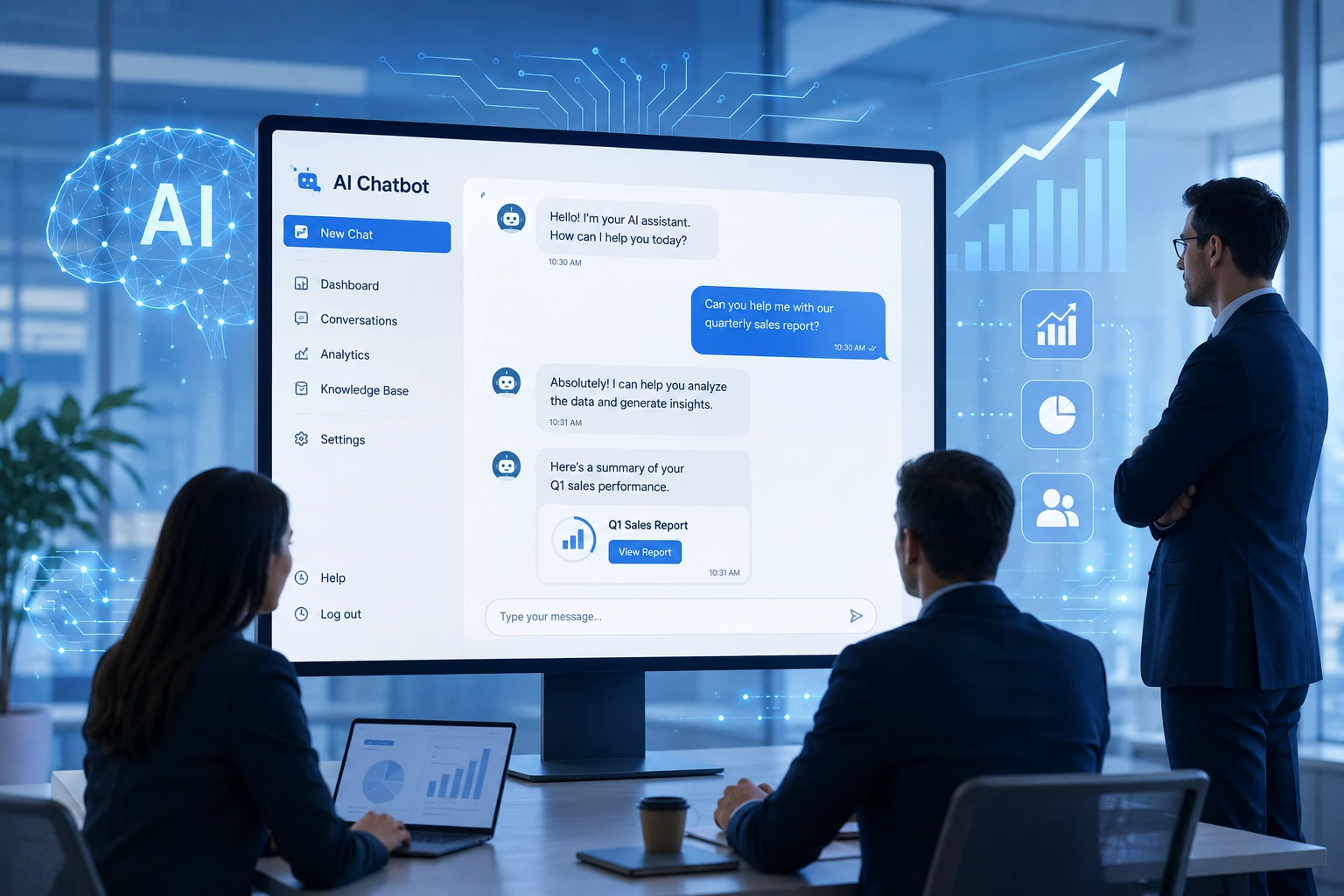
This is where AI chatbot development changes the math. It does not replace your team—it takes over the repetitive, high-volume layer of customer interaction so your people can focus on the work that actually needs a human. A well-built conversational AI solution answers common questions instantly, qualifies leads before they reach a salesperson, and escalates complex cases to the right person at the right time.
That is exactly what we build as an AI chatbot development company: chatbots that run in real production environments, connected to your actual systems, and trained on your actual data. Not a demo that looks impressive in a sales call and breaks in week two.
If your support team is stretched and response times are climbing, book a call. We will tell you in 30 minutes whether this is the right fit.
GET IN TOUCH
Ready to cut your support tickets in half? Book your free AI chatbot strategy call today
What Our AI Chatbot Development Company Builds—And What We Don’t
Not every business needs a custom-built chatbot. Some do perfectly well with an off-the-shelf platform, and we will tell you that upfront if that is what fits your situation. But there are specific circumstances where a pre-built AI chatbot platform hits a wall fast. Forcing it past that wall usually costs more in workarounds and compromises than building the right thing from the start.
Here are the five situations where that wall shows up most often—and where custom development earns its cost.
When Custom AI Chatbot Development Is the Right Choice
Custom AI chatbot development makes sense in five situations we see consistently across the businesses we work with.
The first is proprietary data… The second is integration depth… Third: regulation… Fourth, when your brand voice actually matters in the conversation… And fifth—this one comes up constantly—when volume or complexity has already broken a platform solution you tried.
Second, when your integration requirements go beyond standard connectors. Platforms like Intercom or Drift connect well to common tools. But if you need deep CRM integration with a custom-built system, or a connection to an ERP that does not have a pre-built API, a custom build handles that directly.
Third, when you operate in a regulated industry. Healthcare, finance, and legal businesses have compliance requirements that generic AI chatbot platforms are rarely built to meet. Custom architecture means compliance is designed in, not patched on.
Fourth, when the conversation design needs to match your brand exactly. Off-the-shelf bots follow their own logic patterns. A custom-built chatbot is trained on your terminology, your tone, and the way your customers actually phrase their questions.
And fifth, when volume or complexity has already broken a platform solution you tried. That happens more often than most vendors will admit.
AI Chatbot Strategy and Consulting
Before we build anything, we spend time figuring out what you actually need… One financial services client came to us wanting a customer-facing FAQ bot. Two weeks into the AI consulting work, it became clear the bigger opportunity was internal: their compliance team was burning hours every week manually searching regulatory documentation. We shifted the scope. The build ended up simpler, and the team felt the difference within the first month.
Our AI chatbot consulting work covers use case definition, data availability assessment, integration mapping, and platform selection. We look at your current support or sales workflow, identify where a chatbot creates the most measurable value, and document the scope clearly before development begins.
This step has changed the direction of many projects we have worked on. A financial services client came to us wanting a customer-facing FAQ bot. After two weeks of AI consulting work, the bigger opportunity turned out to be an internal chatbot for their compliance team that was spending hours manually looking up regulatory documentation. The scope shifted, the build was simpler, and the impact was immediate. That kind of clarity only comes from doing the consulting work before touching the development roadmap.
Custom Chatbot Design and Development
This is where our AI chatbot development services move from planning into the actual build—and it involves more than writing code. We design the conversation experience, connect the chatbot to the required business systems, train it on your domain data, and prepare it to handle real customer interactions.
On the technical side, large language model chatbot development involves working with GPT-based chatbot frameworks fine-tuned on your domain data, so the bot understands how your customers actually talk—not how a generic dataset talks. Our development teams also apply natural language processing to handle variation such as slang, abbreviations, and multi-turn conversations where context has to carry across messages. Machine learning chatbot training does not stop at launch. We keep refining the system based on real usage.
On the technical side, we work with large language model chatbot development using GPT-based chatbot frameworks, fine-tuned on your specific domain data so the bot understands how your customers actually talk. We apply natural language processing techniques to handle variation in phrasing, slang, abbreviations, and multi-turn conversations where context carries across messages.
For businesses evaluating their chatbot technology options, OpenAI’s documentation on fine-tuning GPT models provides detailed technical insights into how domain-specific training improves conversational accuracy. Machine learning chatbot training is done iteratively, not once at launch and never again.
The result is a chatbot that understands your business, not just a generic version of your industry.
Chatbot Integration With Your Existing Systems
The chatbot is only useful if it connects to the systems that hold your actual business data. Businesses need to integrate AI chatbots with the tools they already use so the bot can check a real order status, pull a live account record, or retrieve relevant customer information instead of functioning as just a sophisticated FAQ page.
Our chatbot integration services cover the full range of what businesses typically need: CRM and ERP integration for customer records, inventory, order, and logistics queries; connections with platforms like Salesforce, HubSpot, Zoho, Zendesk, ServiceNow, and Freshdesk; payment and e-commerce platform connections; and internal knowledge base retrieval for support and HR use cases.
What clients worry about most is disruption. Almost every first call includes some version of “we cannot afford for our current systems to go down during this.” Our chatbot API integration process is built around exactly that concern… The honest answer is that integration complexity is the biggest variable in any chatbot project. That is exactly why we map it out during the consulting phase, before a contract is signed and before any timeline gets promised. No surprises mid-build
But the honest answer is that integration complexity is the biggest variable in any chatbot project. We find out what we are working with during the consulting phase so there are no surprises mid-build.
Ongoing Chatbot Optimization and Support
Launch day is not the finish line. It is closer to the starting line.
Every chatbot we build goes through a post-launch optimization cycle because real users interact differently than the training data predicted. That is not a failure—it is expected. What matters is catching it quickly and fixing it.
After launch, we review conversation logs every week for the first month, then on a schedule we set with you, looking for intent mismatches… One example: a logistics client launched a shipment tracking bot that handled about 60% of queries correctly in the first week. Solid for a first week, but not where we wanted it… We retrained on that category. Accuracy moved to 88% within the next ten days.
One example: a logistics client launched a shipment tracking bot that was handling about 60% of queries correctly in the first week. Solid for a first week. But after reviewing the first two weeks of conversation logs, we identified that a specific phrasing pattern around international shipments was consistently triggering the wrong intent. We retrained on that category, and accuracy moved to 88% within the following ten days.
The chatbot ROI compounds over time when the optimization work is done consistently. Most vendors stop after launch. We build the optimization cycle into every engagement from the start.
What Your Chatbot Will Actually Be Able to Do
Most businesses we talk to have a rough idea of what they want a chatbot to do. Answer questions. Handle support. Maybe qualify leads. But the specifics—what happens when a customer switches channels mid-conversation, or asks something the bot was not trained on, or speaks a different language—those details are what separate a chatbot that earns its keep from one that frustrates people and gets turned off after three months.
Here is what the chatbots we build are actually capable of doing for your business.
Chatbots That Work Across Every Channel Your Customers Use
Your customers do not pick a single channel and stick to it. They start on your website, follow up on WhatsApp, and sometimes call in expecting the next person to already know their situation. An omnichannel chatbot handles that reality instead of ignoring it.
What that means in practice: a customer opens a chat on your website, asks about their order, and then closes the browser. When they come back via your mobile app two hours later, the conversation picks up where it left off. No starting over. No re-explaining. The chatbot remembers the context because the session carries across channels, not just within one.
We build omnichannel chatbots that deploy across web, WhatsApp, Facebook Messenger, mobile apps, and SMS from a single conversation management layer. Your team sees everything from one place, while your customers get consistent responses regardless of where they reach you. This connected experience helps enhance user experience by reducing repeated questions, preserving conversation context, and making support easier across channels.
And for businesses serving customers across different countries, multilingual chatbot support is built into the same architecture. The chatbot detects the language the customer is writing in and responds accordingly—without routing them to a separate regional system.
Chatbots Connected to Your Data, Not Just a Script
A scripted chatbot matches keywords to pre-written responses. That works for a very small set of predictable questions. But the moment a customer phrases something slightly differently or asks a follow-up that the script did not anticipate, the experience falls apart.
The chatbots we build use intent-based recognition and can connect to business data in real time—which means the bot understands what the customer is trying to accomplish while retrieving current information when needed. A customer asking “where is my package” and a customer asking “has my delivery left the warehouse yet” are expressing the same intent. An intent-based chatbot handles both without needing a separate script entry for every possible phrasing.
For businesses with large internal knowledge bases—product documentation, policy manuals, support articles, compliance databases—we build retrieval-based chatbot solutions that pull accurate answers directly from your existing content. The bot does not guess. It retrieves. And because the retrieval layer is connected to your actual data source, when your documentation changes, the answers update without rebuilding the bot from scratch.
Both capabilities rely on natural language processing trained specifically on your domain. Not general internet text. Your terminology, your product names, the way your specific customers ask questions.
That specificity is what makes the difference between a chatbot that helps and one that creates more work.
Voice, Text, and Everything In Between
Not every business interaction happens through a text chat window.
Virtual assistant development for voice-based interactions is a growing part of what we build—particularly for healthcare providers handling phone-based appointment triage, HR teams deploying voice-enabled onboarding assistants, and operations teams that need hands-free access to system data on a warehouse floor or field site.
A voice-enabled chatbot can answer an incoming call, understand the caller’s request through natural speech, pull the relevant information from your system, and respond in a natural voice—all without a human agent on the line for routine requests. For calls that need a person, the chatbot collects the context first so the agent starts the conversation already knowing the situation.
Text-based chat is still where most volume happens, and our conversational AI solutions handle the full range there too—structured Q and A, multi-turn conversations where context builds across messages, form completion through chat, lead qualification flows, and transactional functions like booking, rescheduling, and status updates.
The right combination of these capabilities depends on your actual use case. We scope that during the consulting phase rather than defaulting to a standard configuration—because what works for a healthcare provider fielding patient calls looks very different from what a SaaS company needs to qualify inbound leads.
How Our AI Chatbot Development Process Works — From First Call to Live Deployment
Our AI chatbot development process starts with discovery and scoping, which typically takes one to two weeks. This is where we map your current systems, define the use case clearly, and document the full scope before any development begins. That scoping work is what prevents mid-project surprises and scope creep.
From there we move into architecture and design—another one to two weeks—where we plan the conversation flows, map the integration points, and get your approval on the chatbot development roadmap before we write code.
Development and integration runs four to twelve weeks depending on complexity. We work in sprints with demos at every milestone so you see progress throughout. The dedicated chatbot development team handles the build, trains the models on your data, and integrates with your CRM, ERP, or internal systems during this phase.
Launch happens in stages, not all at once. We pilot on one channel or one team first, monitor the conversation logs, track accuracy, and make adjustments based on real usage. Chatbot maintenance and support continue after go-live—retraining happens when patterns show the bot needs it, not on a fixed schedule.
Want to see how this timeline fits your project? Book a 30-minute discovery call no commitment required.
Results From Businesses That Have Already Made This Move
Here is what happened for three businesses that deployed AI chatbots for customer support and customer service operations—with the actual numbers we measured after go-live.
Support Ticket Volume Cut by 62% in 90 Days
A mid-market SaaS company was handling 4,800 support tickets a month, and 70% of them were account status, password resets, and billing questions the documentation already covered. We built an AI chatbot for customer support connected to their knowledge base and helpdesk. The chatbot handled 2,976 tickets in the first 90 days without human escalation. Support response time dropped from six hours to under three minutes for those queries. The chatbot ROI showed up in month two when they stopped the contractor hiring plan they had scheduled to handle the volume growth.
Patient Appointment No-Shows Reduced by 41%
A regional healthcare network was losing nearly $300,000 a year to missed appointments that were never rescheduled. We deployed an AI chatbot for healthcare that sent appointment reminders via text, handled rescheduling requests conversationally, and confirmed patient attendance 24 hours before each visit. No-show rates dropped from 18% to just over 10% within the first quarter after launch. The system now handles over 1,200 appointment confirmations and reschedules every week with no administrative staff time required.
What Our Clients Say
“We went from spending three hours a day answering the same questions to having our team focus on the issues that actually needed them. The chatbot handled everything else. Best operational decision we made this year.”
— Director of Customer Experience, enterprise SaaS provider.
Why Enterprise Teams Choose Us Over Every Other Option
Enterprise AI chatbot development requires more than technical capability. You need a partner who protects your IP, understands compliance from the start, and stays committed after launch. Here is why businesses with real procurement requirements choose to work with us instead of running the same evaluation process again with someone else.
Your IP Stays Yours—Full Legal Protection From Day One
Before any discovery work begins, we sign a Master Service Agreement that includes full IP assignment to you, a Non-Disclosure Agreement covering all proprietary data and project details, and Employee Confidentiality Contracts for every team member who touches your project. These are not negotiable. They are standard on every engagement we take.
When the project completes, 100% of the code, trained models, conversation data, and all deliverables transfer to you. We retain nothing. No shared code libraries that tie you to us long-term. No licensing arrangements. Full ownership passes to you on final delivery, documented in writing as part of the closeout process.
For businesses operating under strict chatbot data security and compliance requirements, this legal framework is non-negotiable—and it is exactly what we provide before the first line of code gets written.
Security and Compliance Built Into the Architecture
We design enterprise chatbot solutions with compliance addressed in the architecture phase, not patched on at the end. For healthcare organizations, we build HIPAA-compliant environments from the ground up. For SaaS and technology businesses handling customer data, we align with SOC 2 control requirements. For companies serving EU markets, GDPR data handling is structured into the chatbot’s data flow before development begins. And for any AI chatbot for finance or payment-handling applications, PCI DSS requirements shape how the system accesses and processes transaction data.
Compliance is not a checklist we run at the end. It is a design constraint we work within from day one—which is the only way it actually works in production.
No Surprise Costs, No Disappearing After Launch
Before development starts, we document the full scope in a Statement of Work that defines exactly what gets built, what the timeline looks like, and what the cost will be. That scope is fixed unless you ask us to add something — and if you do, we document the change and the cost impact before we proceed.
Throughout the project, our dedicated chatbot development team sends weekly progress reports showing what was completed, what is next, and where we are against the timeline. No guessing. No silence for three weeks, followed by a vague update call.
And after launch, we do not disappear. Chatbot maintenance and support is built into every engagement — ongoing conversation log review, retraining when accuracy slips, performance reporting on the schedule we agree to upfront. The chatbot improves after launch because someone is actually monitoring it and making it better.
Here is what working with us actually looks like.
AI Chatbots We Build Across Every Major Industry
The AI chatbot use cases that make sense for one business do not always map to another. What a healthcare provider needs from an AI chatbot for healthcare looks nothing like what a SaaS company needs for lead qualification, and the enterprise chatbot solutions we build reflect that difference. Here is how we approach chatbot development across the industries where we work most often.
Healthcare: Patient appointment scheduling, prescription refill requests, and post-visit follow-up handled conversationally without tying up front desk staff or nursing time.
Financial Services: Account balance inquiries, transaction history lookup, fraud alert response, and basic advisory questions answered instantly through an AI chatbot for finance connected to secure customer data.
Ecommerce and Retail: Ecommerce businesses can use chatbots for product recommendations based on browsing behavior, order status tracking, return and exchange processing, and cart recovery conversations that turn abandoned sessions into completed purchases.
SaaS and Technology: Onboarding new users through account setup, answering product feature questions during trial periods, and routing technical support cases to the right tier based on issue complexity.
For SaaS companies specifically looking to grow their organic visibility alongside chatbot implementation, our SaaS SEO agency services help turn search traffic into qualified leads that your chatbot can then nurture through the conversion funnel.
Insurance: Policy lookup, claims status tracking, coverage questions, and document upload assistance that reduces call center volume and speeds up the intake process.
Real Estate: Property inquiry qualification, showing requests, application status updates, and maintenance request routing for property management companies handling hundreds of units.
Manufacturing and Logistics: Shipment tracking, inventory availability checks, order modifications, and supply chain status updates delivered through chat instead of phone calls.
HR and Internal Operations: Employee onboarding task guidance, benefits enrollment support, IT helpdesk triage, and policy question answering for internal teams.
| Category | Details |
|---|---|
| Company Name | Tecveq |
| Location | 2 Idmiston Road, London, England, E15 1RG |
| Core Services |
• Custom AI Chatbot Development • AI Chatbot Strategy & Consulting • Conversational AI Solutions • Chatbot Integration Services • Enterprise Chatbot Solutions • Virtual Assistant Development • Ongoing Chatbot Optimization & Support |
| AI & Language Models |
• OpenAI GPT-4 • Google Gemini • Large Language Model (LLM) Fine-tuning • Natural Language Processing (NLP) |
| Chatbot Frameworks |
• Rasa (Open-source) • Google Dialogflow • Microsoft Bot Framework • Custom-built frameworks |
| Development Languages |
• Python (Primary for ML/AI) • JavaScript/Node.js • PHP (WordPress integration) • TypeScript |
| Cloud & Deployment |
• Microsoft Azure Bot Service • AWS Lex & Lambda • Google Cloud Platform • Private/On-premise deployment |
| WordPress Integration |
• Custom WordPress plugin development (PHP) • REST API integration • WooCommerce chatbot connectivity • JavaScript widget deployment |
| Integration Capabilities |
• CRM (Salesforce, HubSpot, Zoho) • Helpdesk (Zendesk, ServiceNow, Freshdesk) • ERP Systems (SAP, custom-built) • Payment Gateways • Knowledge Base Systems |
| Supported Channels |
• Website (Web Chat Widget) • WhatsApp Business • Facebook Messenger • Mobile Apps (iOS/Android) • SMS • Voice (Phone/IVR) |
| Compliance & Security |
• HIPAA (Healthcare) • GDPR (EU Data Protection) • SOC 2 • PCI DSS (Payment processing) • Full IP assignment & NDA |
| Industries Served | Healthcare • Financial Services • SaaS & Technology • Ecommerce & Retail • Insurance • Real Estate • Manufacturing & Logistics • HR & Internal Operations |
| Project Timeline |
• Basic Implementation: 6-10 weeks • Mid-Complexity: 10-16 weeks • Enterprise: 16-24 weeks |
| Pricing Range |
• Simple Deployments: From $20,000 • Enterprise Solutions: $35,000 – $100,000 • Custom quote provided within 48 hours |
| Contact |
Phone: ++44 7721 716507 WhatsApp: wa.me/+44 7721 716507 |
The Technology Behind Every Chatbot We Build
The chatbot tech stack we use is not fixed across every project. The right tools depend on what you need the chatbot to do, where your data lives, and what compliance or security requirements you operate under. But here is what goes into most of the machine learning chatbot systems we build and why each category matters.
Language Models: We work primarily with GPT-4 from OpenAI and Google Gemini for projects that need strong general conversational ability, and we fine-tune these models on your specific domain when generic training data is not enough. The language model is what determines how naturally the chatbot understands and responds to variation in phrasing.
Natural Language Processing Frameworks: For businesses that need full control over data and cannot use cloud-based LLMs, we build using Rasa, an open-source chatbot framework that runs entirely on your infrastructure. Dialogflow works well for clients already in the Google Cloud ecosystem. These frameworks handle the intent recognition and entity extraction that make conversations feel accurate instead of scripted.
Cloud and Deployment Platforms: We deploy on Microsoft Azure Bot Service for enterprise clients with existing Microsoft infrastructure, AWS Lex for AWS-native businesses, and private cloud or on-premise environments when data cannot leave your network. Where the chatbot runs affects latency, cost, and compliance alignment.
Integration Tools: API connectors, webhook handlers, and middleware layers are what let the chatbot pull live data from your CRM, ERP, or internal systems instead of working from static content.
We choose tools based on your architecture, not ours.
GET IN TOUCH
Stop losing customers to slow responses get your custom AI chatbot quote in 48 hours.
Questions We Hear Before Every Project Starts
How much does it cost to build a custom AI chatbot?
Cost depends on five main factors: integration complexity, conversation flow depth, data training requirements, compliance specifications, and ongoing support scope. Simple deployments typically start around $25,000. Enterprise-grade builds with full system integration range from $75,000 to $200,000. The discovery call gives us enough detail to provide an accurate custom quote within 48 hours.
How long does development take from start to finish?
Basic implementations take 6 to 10 weeks. Mid-complexity projects with CRM integration run 10 to 16 weeks. Enterprise deployments with multiple systems and compliance requirements typically span 16 to 24 weeks. The timeline depends mainly on data availability and how quickly your team can review milestones. The chatbot ROI usually becomes visible within the first month after launch.
What happens if the chatbot doesn’t perform as expected?
We monitor conversation accuracy for the first 90 days and retrain when patterns show mismatches. If performance falls below agreed benchmarks, we optimize at no charge until it meets specifications. Launch is the beginning of the optimization cycle, not the end—most chatbots improve significantly in months two and three as they learn from real usage data.
Can you integrate with our existing CRM, ERP, and internal systems?
Yes. Our chatbot integration services cover Salesforce, HubSpot, ServiceNow, SAP, Zendesk, and custom-built platforms. We assess integration complexity during discovery and test all connections in staging before touching production systems. The integration work happens during development so everything goes live together.
Who owns the chatbot code and data after completion?
You own 100% of the code, trained models, and conversation data. Full ownership transfers to you at project completion with documentation. We retain nothing and sign IP assignment agreements before work begins. Your chatbot data security and compliance requirements are built into the architecture from day one.