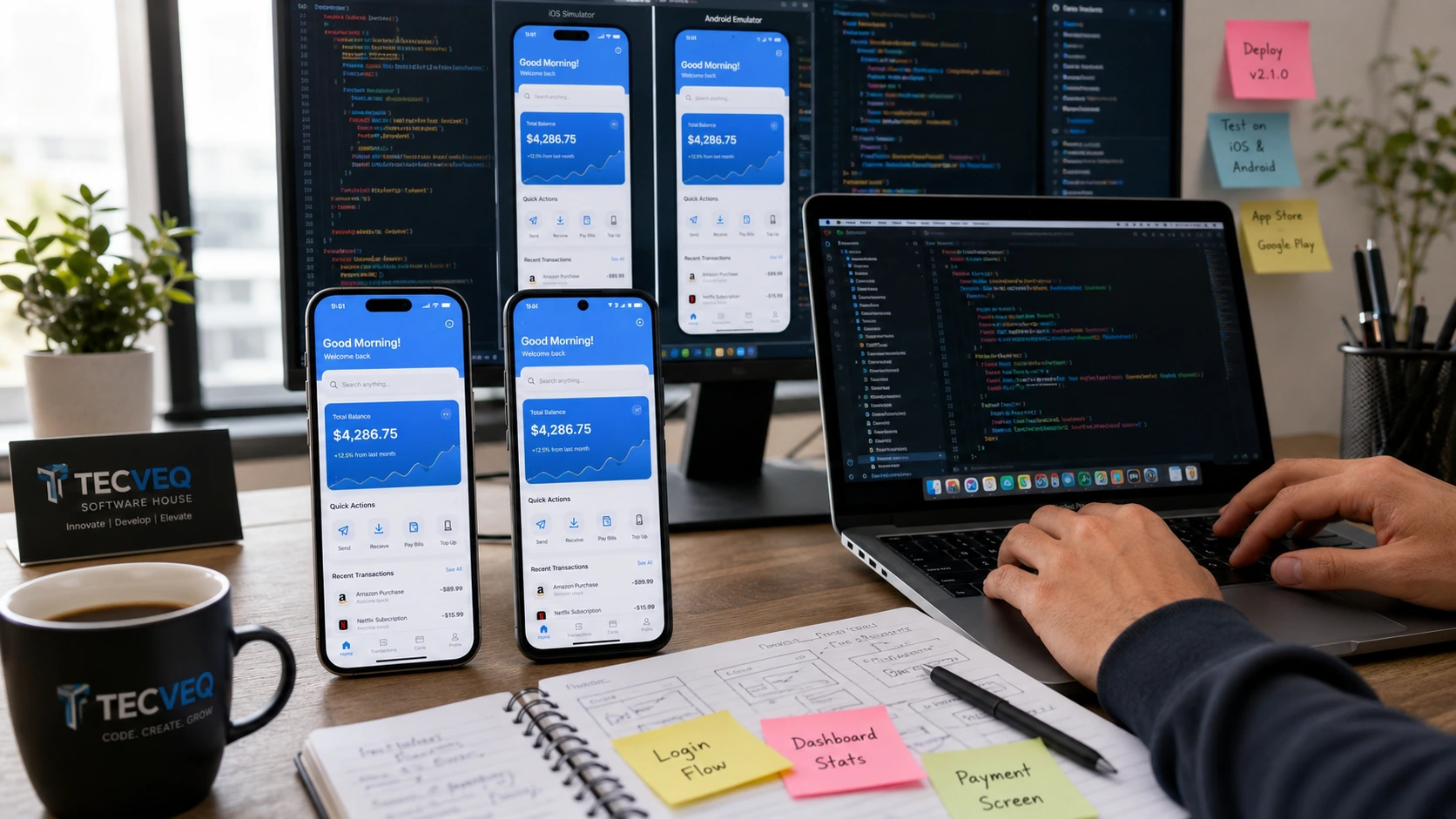
You Have One App Idea We Build It for iOS and Android at Once
Most businesses come to us after getting two separate quotes one for an iOS app, one for Android and realizing the combined cost is twice what they budgeted. There is a better way.
Our cross platform app development services build your application once and deploy it to both platforms from a single codebase. Same features. Same performance. One development team, one project timeline, and one budget instead of two.
That is not a shortcut. It is a smarter architecture.
When we build for iOS and Android app development using a shared codebase, you typically save 30 to 50 percent on initial development costs compared to building two separate native apps. Updates roll out to both platforms at the same time. Bug fixes happen once, not twice. And your users on both platforms get the same experience from day one.
Hybrid app development used to mean compromising on quality. That is no longer true. Modern frameworks like Flutter and React Native produce apps that look and feel native on every device because they are built to render natively, not to simulate it through a browser layer.
We handle the full build from first wireframe to app store launch. You get one point of contact, one delivery timeline, and an app that works exactly where your users are.
GET IN TOUCH
Ready to Build Your Cross-Platform App? Get Your Free Strategy Call Today
What Our Cross Platform App Development Services Include
We are a mobile app development company that handles the full build not just the coding part. From the first strategy conversation to post-launch support, every service below is something we do in-house, on every project.
Here is exactly what working with us covers.
Consulting and Technology Strategy
Before we write a single line of code, we sit down with you and map out the right approach for your specific project. That means reviewing your requirements, your target users, your existing systems, and your budget — then recommending the framework and scalable app architecture that actually fits your situation.
Not every app needs Flutter. Not every team should use React Native. We tell you which direction makes sense and why, in plain terms, before you commit to anything.
UI/UX Design for Every Platform
Cross-platform apps have a reputation for looking generic. Ours do not.
Our design team builds interfaces that meet Apple Human Interface Guidelines for iOS and Google Material Design standards for Android at the same time. That means your app feels native to each platform — not like a one-size-fits-all template dropped onto two different devices. UI/UX design is not an afterthought in our process. It runs alongside development from day one.
Custom App Development and API Integration
This is where the build happens. We develop your application against the agreed scope, connect it to your backend systems, payment gateways, third-party APIs, and cloud infrastructure and we handle app store deployment for both iOS and Android when the build is ready.
For startups, we build focused MVP app development releases that get you to market fast and give you something real to test with users. For enterprises, we build against more complex integration requirements across existing platforms and internal tools.
Fintech, healthcare, e-commerce the integration requirements are different in each industry and we plan for those differences from the architecture stage, not after the problems show up.
TecVeq – Cross-Platform App Development Company
| Company Information | Details |
|---|---|
| Company Name | TecVeq Technologies |
| Headquarters | Pakistan |
| Phone Number | 0307 3319555 |
| Email Address | info@tecveq.com |
| Website | tecveq.com |
| Primary Services | Cross-Platform App Development, Native Mobile Apps, UI/UX Design, API Integration, QA Testing, Post-Launch Support |
| Industry Specializations | Fintech, Healthcare, E-commerce, Enterprise Applications |
| Technology Stack | Flutter, React Native, .NET MAUI, Ionic, Kotlin Multiplatform |
| Development Languages | Dart, JavaScript, TypeScript, C#, Swift, Kotlin |
| Project Timeline | MVP (4-8 weeks), Standard Apps (10-16 weeks), Enterprise (16+ weeks) |
| Pricing Range | MVP: $10K-$25K | Standard: $25K-$60K | Enterprise: Custom Quote |
| Free Consultation | 30-minute strategy call with framework recommendation and budget estimate |
| Response Time | Within 1 business day for all inquiries |
QA, Testing and Multi-Device Validation
Most cross-platform quality issues are not framework problems. They are testing gaps.
We run every app through manual and automated QA and testing across real device configurations — different screen sizes, operating system versions, and hardware specs — before anything reaches your users. An app that works perfectly on a current iPhone and breaks on a mid-range Android from two years ago is not ready to ship. We check both.
Post Launch Support and App Maintenance
Launch is not the finish line.
When iOS or Android releases a major OS update, apps that are not actively maintained start breaking in ways that frustrate users and damage reviews. Our app maintenance and support plans cover ongoing bug fixes, OS compatibility updates, performance monitoring, and planned feature additions after launch with clear response times so you know exactly how fast we move when something needs attention.
Most agencies hand you the code and disappear. We stay on. That distinction matters more than most clients realize until something goes wrong six months after launch.
Not sure which of these services you need or where your project fits? Tell us about your app and we will put together a custom scope no generic proposals, just a clear breakdown of what your specific build actually requires.
Cross-Platform vs Native An Honest Answer, Not a Sales Pitch
The question you are actually asking is whether a cross-platform build will compromise quality to save money. Fair question. Here is the real breakdown.
Cross-platform development and native app development solve different problems. For most business applications, cross-platform delivers better ROI because the trade-offs do not matter to your users. But there are specific situations where native is the only responsible choice.
We recommend whichever one actually fits your project. Not whichever one is easier for us to sell.
What Cross Platform Does Better (With Real Numbers)
When you build from a single codebase instead of maintaining separate iOS and Android code, three major business advantages show up immediately.
Cost. You typically save 30 to 50 percent on initial development costs compared to building two separate native apps. One team instead of two. One QA cycle instead of two. One budget instead of two invoices.
Speed. Cross-platform builds deliver 40 to 60 percent faster time to market because developers are not duplicating work across platforms. Code reusability means writing business logic once and deploying it everywhere not rewriting the same feature in Swift and then again in Kotlin.
Maintenance. When you need to push an update, fix a bug, or add a feature, the work happens once and rolls out to both platforms at the same time. Native app development requires parallel updates for iOS and Android, which doubles the timeline and doubles the cost every time something changes.
For businesses evaluating ROI, the math is straightforward. If your app does not require platform-exclusive technical capabilities, cross-platform development gets you to revenue faster and keeps your operating costs lower after launch.
When Native Development Is Actually the Better Call
And here is the part most agencies will not say directly.
If your app requires heavy 3D graphics or real-time rendering with game engine performance, native app development will give you better frame rates and more reliable GPU access. Cross-platform frameworks handle this, but native handles it better.
If your app depends on deep hardware integration with specialized Bluetooth devices, proprietary sensors, or medical-grade equipment connectivity, native gives you lower-level access to device APIs without the abstraction layer that cross-platform frameworks introduce.
If your entire value proposition is built around platform-exclusive features that only exist on iOS or only exist on Android, building cross-platform makes no sense. You would be building for compatibility you do not need.
Those three scenarios represent less than 10 percent of the business apps we evaluate. For the other 90 percent fintech platforms, healthcare apps, e-commerce tools, internal enterprise systems cross platform delivers the same user experience your customers expect at a fraction of the cost and timeline native requires.
We will tell you which direction makes sense for your specific project in the first conversation. No pressure to choose the more expensive option just because it sounds more technical.
GET IN TOUCH
Start Your Cross Platform App Development Project — Free Consultation, Real Timeline & Budget
The Frameworks We Use and Why We Choose Them for Your Project
Our dedicated app developers work with four primary frameworks for cross-platform builds. Which one we recommend depends entirely on your project type, your existing tech stack, and where your team already has expertise.
Not every framework fits every project. Here is how we choose.
Flutter Best for Speed, Polish and Multi-Platform Reach
Flutter app development is our go-to for most consumer apps, fintech app development projects, and any build where visual consistency across iOS, Android, and web matters from day one.
Google built Flutter with its own rendering engine, which means 60fps performance and complete control over every pixel on screen. According to Flutter’s official documentation, this architecture delivers native performance without the overhead of traditional cross-platform solutions.
Real proof: eBay Motors shipped a beta release in three months using Flutter with 98 percent code reuse across platforms. That kind of timeline is why we default to Flutter for speed-to-market builds.
React Native Best When Your Team Knows JavaScript
If your internal team already works in JavaScript or TypeScript, React Native development makes the most sense. Your developers can contribute to the mobile codebase without learning an entirely new language, and you avoid the friction of managing separate skill sets.
React Native powers apps for major commerce platforms and enterprise tools. As a specialized React Native mobile app development company, we have built dozens of production apps using this framework for clients across Pakistan and internationally.
Over the air updates via Expo mean you can push bug fixes and feature tweaks without waiting for app store review cycles, which matters when you need to iterate fast post-launch.
Shopify rebuilt their entire mobile app in React Native and maintains better than 99.9 percent crash-free sessions. That kind of reliability at scale is why we recommend it for teams already invested in the JavaScript ecosystem.
.NET MAUI Best for Enterprises Already on Microsoft Stack
When your backend is already built on .NET and your apps need tight integration with Microsoft Azure, Entra ID, or existing C# business logic, .NET MAUI development is the only choice that makes architectural sense.
This framework is the official successor to Xamarin development, which means companies with legacy Xamarin apps can migrate without a full rewrite. For enterprises with existing .NET infrastructure, building mobile on the same stack reduces complexity and keeps your team working in one language across the entire platform.
If you are running on Microsoft tools already, forcing a different framework onto mobile creates unnecessary technical debt.
Ionic Best for Web Teams Who Need Mobile Fast
Ionic app development runs on standard HTML, CSS and JavaScript. If your team built the web version of your product and now needs mobile apps without hiring an entirely new team, Ionic lets your existing web developers ship to iOS and Android without learning Flutter or React Native.
This approach works particularly well for content-driven apps, internal enterprise tools, and e-commerce experiences where the mobile interface mirrors the web closely. One team. One skillset. Two additional platforms.
For companies with strong web development teams but limited mobile experience, Ionic removes the hiring barrier.
For enterprise clients managing complex integrations across multiple platforms, we sometimes recommend Kotlin Multiplatform. That framework lets you share business logic across iOS and Android while keeping fully native UIs when platform-specific design is non-negotiable.
Not sure which framework makes sense for your specific project? Book a free 30-minute strategy call and we will walk through your requirements, your existing stack, and your timeline to recommend the best technical fit no sales pitch, just honest guidance on what actually works for your situation.
What Happens From Your First Call to Your App Store Launch
The biggest source of anxiety for most clients is not knowing what they are actually signing up for. Here is our complete app development process, from the first conversation to the day your app goes live on both platforms.
Every project follows this sequence. No surprises.
Step 1 Discovery and Scoping (Week 1–2)
We do not start writing code on day one. The first thing we do is sit down with you and document exactly what you need built, who will use the app, what systems the app needs to connect to, and what constraints affect the project budget, timeline, compliance requirements, existing infrastructure.
At the end of discovery, you receive three things: a detailed project scope document that lists every screen and feature we agreed on, a technology recommendation with the specific framework we think fits your project best, and a realistic budget range based on the actual work required to build what you described.
You get all three before you commit to anything. If the scope or budget does not align with your expectations, we revise it in discovery not halfway through development when changes cost real money.
Step 2 UI/UX Design and Prototype (Week 2–4)
Once the scope is signed off, our designers build wireframes for every screen and an interactive prototype you can click through on your phone or desktop. You see the full user journey before our dedicated app developers write a single line of production code.
This is the approval gate most agencies skip. We never do.
You review the prototype. You test the navigation flow. You confirm the visual identity matches what you expected. If something feels wrong at this stage, we fix it in design where changes take hours, not weeks. No code gets written until you explicitly approve the UI/UX design and sign off on the prototype.
Step 3 Development Sprints With Weekly Demos (Weeks 4–12+)
Development runs in two-week sprints. At the end of every sprint, you receive a working demo build you can install on your actual device and interact with. Not screenshots. Not a progress report. A real app you can open and test.
If you spot something that needs adjustment or if priorities shift based on what you see in the demo, we address those changes in the next sprint not three months later after everything is locked. This is how the app development timeline stays predictable even when requirements evolve during the build.
Your project manager sends a sprint summary every two weeks with what shipped, what is coming next, and whether anything is blocking progress. You always know where the project stands.
Step 4 QA, Testing and Launch
Before we submit your app to the App Store or Google Play, the build goes through manual QA and testing on real devices across different screen sizes, operating system versions, and hardware configurations. We test on current iPhones and older Android devices still in wide use not just the newest flagships.
Once testing is complete, we handle app store deployment for both platforms. That includes writing the store listings, uploading builds, responding to any review feedback from Apple or Google, and confirming your app is live and available for download.
Most app store rejections happen because of missing metadata or policy violations that are easy to avoid when you know what the review teams look for. We have submitted enough apps to know exactly what each platform requires, which means your launch does not get delayed by avoidable review failures.
Industries We Build Cross-Platform Apps For
Different industries have different requirements for mobile applications. A banking app faces regulatory scrutiny a retail app never sees. A healthcare platform has compliance requirements that do not apply to e-commerce. We build cross-platform apps with those industry-specific constraints built into the architecture from day one.
Here is where we have direct experience building for iOS and Android app development in regulated and high-stakes environments.
Fintech App Development
Payment processing in mobile apps requires PCI DSS compliance, secure tokenization, and encrypted data transmission that meets banking standards. Fintech app development also demands real-time transaction syncing, biometric authentication support, and backend integration with payment gateways and banking APIs that cannot afford downtime or data leaks.
Cross-platform builds work particularly well in fintech because security and compliance requirements apply equally to both platforms. We architect the authentication layer, the transaction processing logic, and the data encryption once — then deploy it to iOS and Android with platform-level security features intact on both.
Which is exactly how you get to market faster without sacrificing the regulatory requirements that keep you from getting shut down six months after launch.
Healthcare App Development
Healthcare apps that handle patient data require HIPAA-compliant architecture, encrypted storage, secure authentication, and audit logging for every data access event. Performance matters too — an app used in a clinical setting cannot freeze or crash when a provider is accessing patient records during an appointment.
Our cross-platform healthcare builds use scalable app architecture that keeps patient data secure while maintaining consistent performance across devices, from current iPhones to older Android tablets still in use in hospital environments. We build the compliance controls into the shared codebase so both platforms meet HIPAA requirements from the first deployment.
GET IN TOUCH
Need Cross Platform App Development Services? Call Now for Instant Project Assessment
E-Commerce App Development
E-commerce apps live or die on checkout conversion rates. Load times matter. Smooth product browsing matters. Real-time inventory sync and push notifications for abandoned carts and order updates matter.
We build cross-platform e commerce apps with fast image loading, backend integration to your inventory and order management systems, payment gateway connections that work identically on iOS and Android, and notification support that keeps customers engaged after they install the app.
Cross-platform works especially well in e-commerce because the user experience requirements are the same on both platforms fast, clean, reliable checkout flows that convert browsers into buyers from day one.
Why Businesses Choose TecVeq for Cross-Platform App Development
You are evaluating multiple agencies right now. Here is what sets us apart as a mobile app development company and why clients who work with us stay with us for long-term projects instead of switching providers after the first build.
Our Cross-Platform Development Team
We are a software development agency built specifically for cross-platform work. Our team structure includes dedicated app developers who specialize in Flutter, engineers who work exclusively in React Native, UI/UX designers who understand both Apple and Google platform standards, QA engineers who test across real device configurations, and project managers who keep communication clear between your team and ours.
Each role exists because cross-platform projects fail when generalists try to handle every layer of the stack without depth in any of them. Our Flutter engineers work in Flutter daily, not occasionally. Our React Native developers write React Native code for every project, not as a side skill. Specialization matters when the build gets complex and timelines get tight.
Why Our Pakistan-Based Team Delivers Global-Quality Results
This is the question most international clients ask before they commit, so we answer it directly. Pakistan exports over $2.6 billion in tech services annually and trains engineers on the same Google Flutter and Meta React Native documentation that developers use anywhere else in the world. The frameworks are identical. The development standards are identical.
Our team offers cross platform mobile app development services in Pakistan with full English proficiency, business hours that overlap with US and UK time zones for real-time communication, and a structured delivery process that eliminates the coordination gaps offshore software development is known for. You get dedicated Slack channels, weekly video demos, and sprint summaries every two weeks — the same transparency you would expect from a domestic agency, at a cost structure that makes sense for startups and mid-sized businesses.
Offshore cross-platform app developing service partnerships fail when communication breaks down or when quality standards differ between what the client expects and what the agency delivers. We solve both by keeping our processes visible and our quality benchmarks consistent with what clients in developed markets already expect.
What Our Clients Say
Client testimonials and case studies matter more than anything we say about ourselves. If you want to see specific project outcomes, timelines, and results from past builds, we can share those during your first strategy call. Real references from real clients who have launched real apps tell you more than any service description ever will.
What our returning clients tell us is that the combination of technical depth, process transparency, and realistic cost structure is rare enough that they come back for second and third projects instead of testing other providers.
What It Costs and How Long It Takes Real Numbers, Not Guesses
Most agencies avoid pricing discussions because they want to qualify you first, negotiate later. We give you realistic ranges upfront so you can budget properly before you commit to a strategy call.
App development cost depends on four main factors: feature complexity, the number of third-party systems your app needs to connect to, custom design requirements, and whether you need ongoing support after launch. Here is how those factors typically break down across project types.
MVP App Development (4–8 weeks): 20,000–25,000
Basic cross-platform app with core features only. User registration, basic data display, simple navigation. Minimal third-party integrations. Standard UI components with light customization. Includes app store submission but not ongoing maintenance.
Standard Business App (10–16 weeks): 25,000–30,000
Full-featured application with custom UI design, payment processing, push notifications, backend dashboard, and integration with 2–3 external systems like CRM, analytics, or inventory management. Includes post-launch bug fixes for 30 days.
Enterprise Application (16+ weeks): Custom quote required
Complex apps with advanced security, multiple user roles, extensive API integrations, custom reporting, compliance requirements, or specialized hardware connectivity. Timeline and app development cost vary significantly based on scope.
The app development timeline ranges above assume normal project complexity and clear requirements from day one. Projects with changing scope, delayed client feedback, or complex compliance requirements take longer. Projects with simpler requirements sometimes finish ahead of schedule.
Want a specific estimate for your project instead of ranges? Book a free 30-minute strategy call and we will give you exact numbers based on your actual requirements no obligation, no sales pressure, just realistic planning numbers you can use to make decisions.
Start Your Cross-Platform App Development Let’s Talk About Your Project
If you have read this far, you probably have a specific app project in mind. We get it. You need to know if cross platform development is right for your app, which framework makes sense, and what this will actually cost.
Our free 30-minute strategy consultation gives you exactly that. We will review your app idea, recommend the best cross platform approach for your specific needs, and provide a realistic timeline and budget range. No sales pitch. No obligation to move forward.
GET IN TOUCH
Get Your App Built for iOS & Android at Once Free Quote in 30 Minutes
As an experienced app development agency, we have guided hundreds of businesses through this exact decision. We will tell you honestly if cross platform development fits your project or if you should consider other options.
Will a cross-platform app feel as good as a native app to my users?
Modern frameworks like Flutter use their own rendering engines, making the user experience indistinguishable from native for 95% of business apps. The only exception is if your app requires highly complex platform-specific animations tied directly to iOS or Android OS components.
How much does cross platform app development actually cost?
Check our pricing breakdown above for the three main cost tiers based on app complexity. We give you a documented cost estimate with real numbers during your free consultation, not vague ranges you have to guess about.
How long does it take to build a cross-platform app?
MVP apps take 4-8 weeks, standard business apps take 10-16 weeks, and complex enterprise apps take 16-24 weeks or more. Timeline depends on your feature count and integrations, not the framework choice.
What happens to our app after it launches do you just disappear?
No. Every project includes a defined maintenance period, guaranteed response times for bugs, and compatibility updates when iOS and Android release new versions. We have a clear process for adding features after launch too.
Is cross-platform development right if we already have a native iOS app?
Yes, we handle migration from existing native apps to cross platform codebases all the time. We start with a code audit and architecture planning, then do a phased migration so your app stays live throughout the process.