
Accounting Software for Restaurants in Pakistan | Billing, Inventory & Tax-Ready Reports
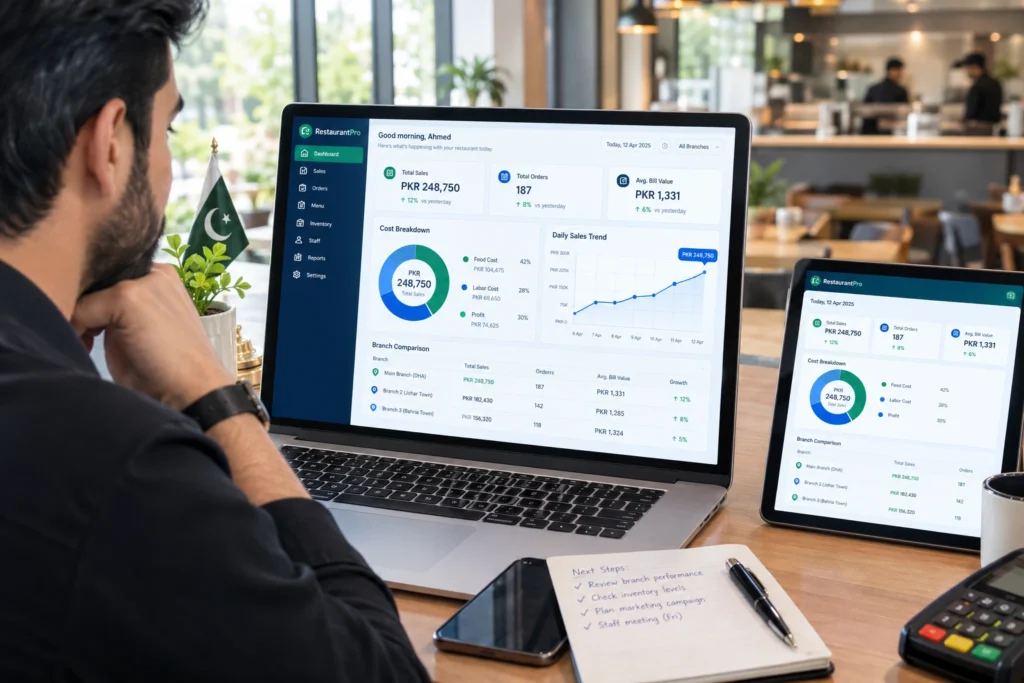
Restaurant management in Pakistan means handling dozens of moving parts every single day. Sales tracking, supplier payments, staff salaries, ingredient costs, and tax compliance—it all needs to work together, or your profit numbers become guesswork. Most restaurant owners still rely on manual spreadsheets or basic billing machines that only capture part of the picture. We build custom accounting software for restaurants that connects your POS, inventory, suppliers, and financial reports into one system. Every transaction flows into your ledger automatically. You see real profit, not just cash received. Whether you run a single café or a multi-branch chain, our software is built specifically for how restaurants actually operate in Pakistan. Let’s explore how the right software transforms your business from guessing to knowing. Restaurant Accounting Software Built by TecVeq We build custom accounting software designed specifically for restaurants operating in Pakistan. Not adapted from generic business software. Built from the ground up to handle daily sales, ingredient tracking, supplier payments, and FBR compliance exactly the way your restaurant works. Complete Accounting Control for Your Restaurant Your restaurant generates hundreds of transactions every single day. Every sale needs to be tracked. Every ingredient consumed needs to be logged. Every supplier payment needs to be recorded. Every expense needs to be categorized. Traditional accounting happens weeks later when you collect receipts and manually enter them into spreadsheets. Our software captures everything in real-time. The moment a customer pays, the sale is logged. The moment an ingredient is used, inventory is updated. The moment a supplier delivers, the invoice is recorded. Your financial position updates automatically throughout the day, not weeks later when it’s too late to make decisions. Billing, Sales, and Daily Closing in One System The end of day at your restaurant means counting cash, reconciling the register, and hoping the numbers match. Usually they don’t. You spend 30 minutes searching through receipts trying to find the discrepancy. Our software eliminates that chaos. Every bill is logged automatically. Cash and card payments are tracked separately. Tips are recorded with the transaction. At close of business, you run one report, and the system shows exactly what was sold, what was paid, and whether your cash matches the system. Discrepancies are flagged immediately with the reason why. You are done in minutes instead of spending half an hour chasing numbers that do not add up. ⚡ GET IN TOUCH Stop Manual Spreadsheets. Get Real-Time Restaurant Accounting Today. 💬 Chat on WhatsApp 📞 Call 0307 3319555 Problems We Solve for Restaurants in Pakistan Daily Sales Mismatch and Cash Handling Errors You close the register at PKR 50,000 in cash. Your billing machine shows PKR 51,200 in sales. The difference sits in your head as a mystery until closing day when you finally give up and write it off as loss. This happens at thousands of restaurants because cash handling and sales tracking are separate. You never see the full picture until it is too late. We connect everything so discrepancies are obvious immediately. Every sale links to a payment method. Every payment is reconciled to your actual cash. The system flags cash handling errors on the same day they happen, not weeks later when you are filing taxes. Supplier Credit and Unpaid Invoices Suppliers deliver on credit. You promise to pay in 15 days. But after a month you are not sure how much you actually owe each supplier, which invoices are overdue, or when you can pay next. You keep invoices in a folder, and the supplier calls asking for payment that you did not realize was due. Late payments cost you credibility with suppliers and sometimes carry penalties. Our software tracks every supplier invoice with due dates and payment status. You see at a glance who you owe, how much, and what is overdue. You can schedule payments before they become problems and avoid losing supplier relationships over missed deadlines. Unclear Food Cost and Profit Per Dish You think your biryani is profitable because you are selling 50 plates a day. But you do not know if that biryani actually costs PKR 250 or PKR 400 to make. You do not know if the selling price covers your ingredient costs and labor. You might be losing money on your bestseller without realizing it. Most restaurants operate on gut feel instead of data. We connect your recipes to ingredient costs so the system calculates automatically how much every dish costs to make. When a customer orders biryani, the software knows the exact ingredient cost. You see immediately whether that price point is profitable or if you need to adjust. This is the difference between running a restaurant and running a business that makes money. Multi-Branch Reporting Problems You own 3 branches. Every branch has a separate register and a different manager. At the end of the month you want to know total sales across all branches, which branch is most profitable, the combined food cost percentage, and consolidated profit. You call each manager, collect their numbers, enter them into a spreadsheet, and hope nobody made a data entry error. One dashboard in our software shows all your branches in real-time. You see sales, costs, profit, and trends for each location and the business as a whole. Branch A’s food cost is 32%, but Branch B’s is 35%. You can see that immediately and investigate why. No more waiting. No more spreadsheet updates. No more hidden problems at one location while profits look good overall. Features of Our Restaurant Accounting Software POS and KOT Integration Your point of sale is where every customer transaction starts. Your kitchen order ticket system is where every order gets prepared. Both systems have valuable data about what sold and what was used. But most restaurants never connect them to accounting. We integrate your POS and KOT with your accounting system so every order becomes a financial transaction automatically. The moment the customer pays, that sale is logged to the ledger. The moment the kitchen fulfills an order,