
ERP Accounting Software in Pakistan for Growing Businesses Tecveq
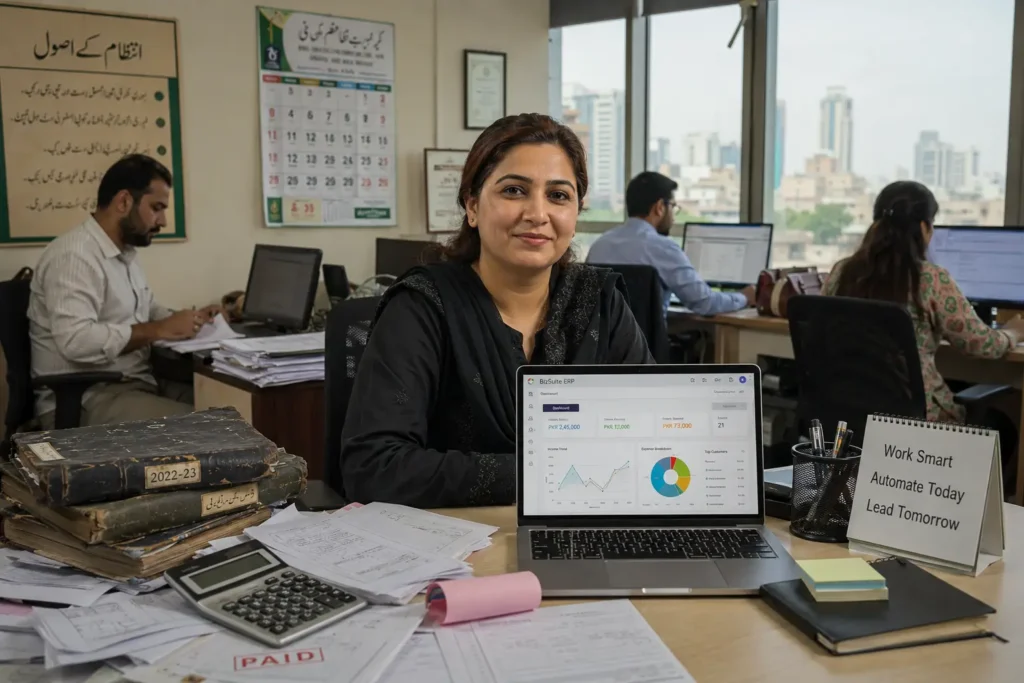
Why Pakistani Businesses Are Moving from Manual Accounting to ERP Software If you are searching for ERP accounting software in Pakistan, you have probably already identified the problem. Your accounts live in Tally. Your inventory sits in Excel. Your sales team maintains a separate sheet. And when month end arrives, someone spends three days trying to reconcile numbers from three different sources that never quite agree That is not a small business problem. That is what happens to every growing Pakistani business that outpaces its tools. We have configured Tecveq for businesses operating in textiles, pharma distribution, FMCG, and trading, and this pattern shows up consistently regardless of industry. A company starts small. Tally handles the books, Excel tracks the stock, and everything holds together. Then the second branch opens. A third salesperson joins. Purchase orders start arriving from Karachi and Lahore simultaneously, and suddenly the same data exists in four different places, nobody agrees on which version is current, and your accountant is manually copying figures from one file into another before any real analysis can happen. The cost of operating on disconnected systems is not just inconvenience. Inventory errors mean you are promising customers stock you do not have, or placing reorders for items already sitting in a warehouse no one checked. Someone has to find that mistake, trace it back through two systems, and correct it manually. In a typical Pakistani SME running on Excel and Tally, that error-finding process costs accounting staff four to eight hours per week on average, hours that should be going toward analysis and planning. When your manager is making strategic decisions based on numbers from five days ago, decisions that should cost one thing end up costing another. And then there is the FBR pressure. When an audit notice arrives, the scramble starts immediately. Purchase registers pulled from one system, sales records from another, withholding tax figures manually calculated from paper files that may or may not reflect every transaction. What should take two hours takes two weeks. Pakistani SMEs are losing staff time, management focus, and in some cases facing compliance penalties not because of intentional errors, but because their accounting tools were never built to handle FBR reporting at the scale a growing business demands. That specific problem is something Tecveq was designed to eliminate from day one. The move to ERP accounting software in Pakistan is not driven by fashion. It is driven by a simple business calculation: when the cost of staying with disconnected systems exceeds the cost of replacing them, businesses make the change. Standalone accounting tools were built for straightforward bookkeeping and they do that job genuinely well. But when your business runs multiple departments, manages stock across more than one location, and carries real FBR compliance obligations, those same tools become operational bottlenecks regardless of how comfortable your team is with them. This is why businesses across textile manufacturing, pharmaceutical distribution, retail, trading, and FMCG in Pakistan are making the switch, and most of them tell us they waited longer than they should have. Dealing with exactly these problems right now? Tecveq ERP was built specifically to eliminate them for Pakistani SMEs. Book a free 30-minute demo and we will show you how businesses in your industry handle this in the system live ⚡ GET IN TOUCH See Tecveq ERP configured for YOUR industry – Free 30-minute demo for Pakistani businesses 💬 Chat on WhatsApp 📞 Call 0307 3319555 ERP vs Basic Accounting Software: What’s the Difference for Pakistan Businesses? The difference between accounting software and ERP comes down to one practical question: how many parts of your business need to share the same data at the same time? Accounting software manages your books. ERP manages your entire operation and ensures that every department, from sales to warehouse to finance, works from identical numbers in real time. For a growing Pakistani business managing multiple departments or locations, that difference determines whether your manager makes decisions on accurate current data or on yesterday’s figures manually compiled by your accounts team. A standalone accounting management system like Tally records your transactions, maintains your ledger, and produces financial reports. It does that job reliably. But Tally has no visibility into your warehouse stock levels. Your sales team’s order register exists somewhere separate. Production floor data, payroll calculations, and branch figures from Karachi never reach Tally automatically someone has to pull them, compile them, and enter them manually. By the time your Lahore head office sees consolidated numbers from all those sources, the data is already a day or two old and it took staff hours to produce. An integrated accounting system like Tecveq ERP connects all of those departments in one shared database. Record a sale in Lahore and inventory adjusts automatically in your Karachi warehouse. Approve a purchase order and the accounts payable entry appears without your accountant retyping it. Your manager in Islamabad no longer needs to send WhatsApp messages to three offices asking for today’s cash position — the dashboard shows every branch’s figures in real time the moment they log in. That is not a feature. That is a fundamentally different way of running daily operations When Basic Accounting Software is Enough Not every business needs ERP, and we will say that clearly before recommending anything. If your business runs from a single location with straightforward operations, Tally probably still serves you well. However, if you’re unsure whether your business has outgrown basic accounting software, our comprehensive guide on selecting the best ERP software for small business covers the key indicators that signal ERP readiness and helps you evaluate your options systematically. Basic accounting software for businesses at this stage is often exactly the right fit. It is affordable, familiar and handles the core job without requiring more infrastructure than the business actually needs. If that describes where your business is today, there is no reason to change yet. But keep reading, because growth shifts that calculation faster than most Pakistani business owners anticipate.
Best ERP Software for Small Business: Complete 2026 Selection & Implementation Guide
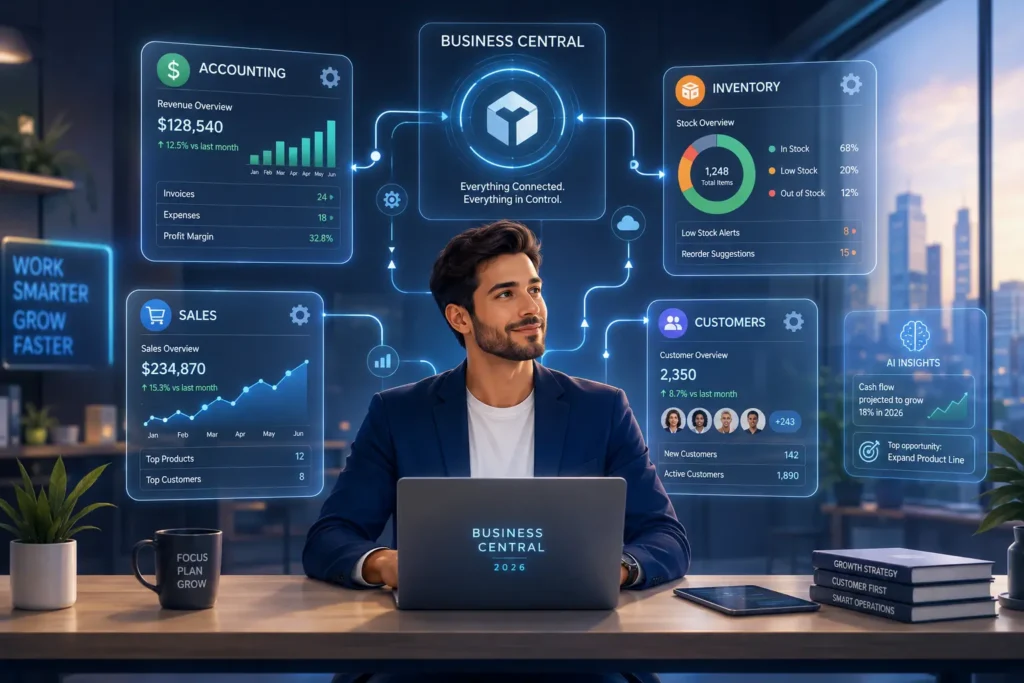
Is Your Small Business Ready for ERP Software? We speak with small business owners every week who have hit the same wall. They are buried in spreadsheets, chasing numbers across three different systems, and spending Sunday evenings doing work that should take ten minutes on a Tuesday morning. You did not build your business to babysit data. But that is exactly what disconnected software forces you to do—manually updating inventory, reconciling cash flow reports that never quite match your bank statement, and answering the same operational questions over and over again. There is a point where basic tools stop being good enough. We help small businesses figure out whether they have reached that point and what to do when they have. Over the past ten years, we have worked through ERP evaluations and implementations with businesses ranging from eight-employee distributors to 45-person professional services firms. What we have learned is that the businesses who get the most out of ERP software are not necessarily the biggest or the most technical. They are the ones who have hit a specific ceiling with tools like QuickBooks, separate CRMs, and stacks of spreadsheets that used to work fine but no longer keep up with what their operation actually needs. One concern we hear constantly is that ERP means laying people off or buying into software they will never actually use. That is not what we do and not what the right ERP implementation looks like. Business process automation at the small business level is straightforward: it stops your team from spending half their week on manual data entry and gives every department access to accurate information without waiting on someone else to compile it. The goal is not to replace your staff. It is to stop wasting their time on work that a properly configured system should handle automatically. Small business management software hits its stride at a specific point in a company’s growth. Too early and you are paying for modules you will not use for two years. But wait too long and you are genuinely losing money—not in a theoretical sense, but in actual hours spent fixing errors, delays caused by decisions made on outdated data, and customers frustrated by problems your team did not see coming. We see this timing question come up in almost every consultation we take. Most businesses are not wondering whether ERP is worth it in principle. They are wondering whether the investment makes sense right now, for their specific size and situation. That is exactly the question a proper needs assessment answers. ⚡ GET IN TOUCH Ready for better business software? Free ERP consultation.Get Help Now 💬 Chat on WhatsApp 📞 Call 0307 3319555 5 Clear Signs Your Business Has Outgrown Basic Software Sign 1: You’re entering the same customer information in multiple places.When your sales team updates a client’s address in your CRM, accounting is still sending invoices to the old one. Your team ends up spending real hours every week correcting errors that a connected system would prevent entirely. Real-time business data means one update in one place reaches every department instantly. Sign 2: Monthly reporting takes a week to complete.If you cannot get an accurate picture of your performance until the 15th of the following month, every decision you made in the first two weeks was based on old numbers. Data centralization pulls figures from every department automatically so you are never waiting on a spreadsheet someone is still updating. Sign 3: You regularly discover inventory problems after customers have already placed orders.We hear this one constantly. A customer calls to check on an order, and your team discovers there are five units in stock, not fifty. That conversation is expensive to have—and it keeps happening until the inventory system talks to the sales system in real time. Connected inventory tracking stops these surprises before they reach the customer. Sign 4: Your team asks you the same process questions every single day.Every price quote requires three spreadsheets and two approvals from people who are not always available. Your growth is being throttled not by demand but by the number of decisions that can only route through you. A properly configured ERP pushes the right information to the right people without you in the middle. Sign 5: You have hired someone whose primary job is moving information between systems.This person is sharp and reliable—you needed them because your software could not talk to itself. But you are paying a full salary for work that an integrated system handles automatically in the background. That budget should be going somewhere more valuable. What Small Business ERP Software Actually Costs (Hidden Fees Included) We are going to cover something that most ERP consultants leave out of the first conversation: the total cost of implementation is substantially higher than the monthly software fee you see on any vendor’s pricing page. We have worked with business owners who got partway through implementation before discovering that data migration, custom reporting setup, and integration with their existing tools were all quoted separately—and the combined total doubled their original budget. These are not rare edge cases. They are the standard pattern for how ERP vendors present costs, and they catch unprepared buyers off guard every single time. After a decade of helping small businesses evaluate ERP software pricing, we lead with full cost transparency because business owners who understand the real investment make better decisions—and they are far less likely to abandon an implementation halfway through when a surprise invoice arrives. After a decade of helping small businesses work through ERP software pricing, one pattern shows up consistently: the owners who come in with realistic budget expectations get better implementations than the ones who locked in a number before understanding the full scope of the project. Here is what we cover in every first consultation before any vendor is discussed: total cost of ownership (TCO) across the first three years, not just the monthly licensing fee on the website. This
Best LMS for Colleges and Universities 2026: Tecveq LMS The Complete Smart Learning Solution
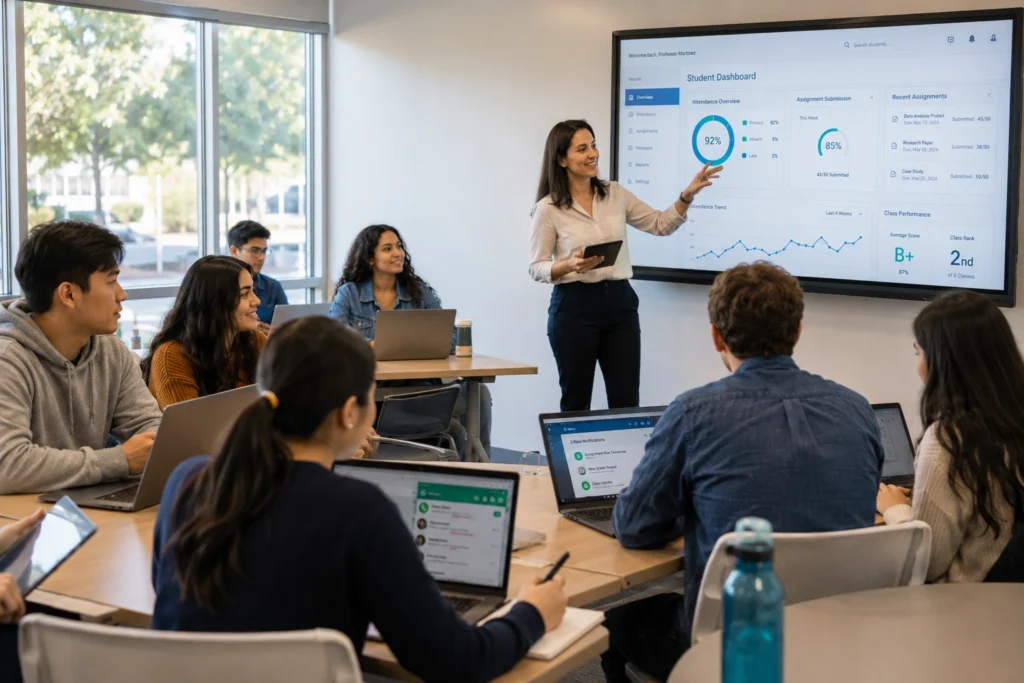
What Is a Learning Management System (LMS) and Why Do Colleges Need One in 2026? A Learning Management System (LMS) is a digital platform that helps colleges organize teaching, learning, assessment, communication, and academic records in one place. A cloud-based LMS allows authorized users to access the system through the internet without relying on a single campus computer or local server. Depending on the platform, it can support course materials, online courses, assignments, quizzes, attendance, grades, announcements, and student communication. It handles class scheduling, assignments, quizzes, attendance tracking, grade management, and student communication all through a single platform instead of juggling multiple disconnected tools. Here is what most colleges face without an LMS. Teachers email assignments to students and track submissions in spreadsheets. Attendance gets recorded on paper and transferred to Excel files. Parents call the office asking about their child’s progress because there is no easy way to check. Administrators spend entire days generating reports that should take minutes. An LMS fixes all of this by centralizing everything. One system for teachers, students, parents, and administrators. But not every LMS works the same way. Some are built for corporate training and feel clunky in an academic environment. Others focus only on course content and ignore the administrative workload that buries college staff. The best systems handle both the teaching side and the management side equally well. Colleges often need more than an off-the-shelf LMS when their academic workflows, reporting requirements, or integrations are highly specific. A custom software development solution can be designed around the institution’s existing processes, user roles, and technology stack instead of forcing staff to adapt to a rigid platform. Tecveq LMS Enterprise Specifications and Service Portfolio Specification Category Technical Details & Service Information Solution Name Tecveq Learning Management System – Enterprise Edition 2026 Industry Focus Higher Education Institutions, Colleges, Universities, Academic Organizations Service Deployment Global SaaS Platform with Regional Data Centers Geographic Coverage North America, Europe, Asia-Pacific, with 24/7 Multi-timezone Support Platform Architecture Cloud-Native, Multi-tenant, Microservices Architecture Supported Languages English, Hindi, Spanish, French, German, Mandarin (Expandable) User Interface Responsive Web Application, Progressive Web App (PWA) Compatible Scalability Enterprise-grade: 10,000+ concurrent users per institution Core Differentiators AI-Powered Academic Integrity, WhatsApp API Integration, Real-time Analytics User Management Role-based Access Control (Admin, Faculty, Student, Parent) Academic Integrity Machine Learning-based Plagiarism Detection, AI Content Analysis Communication Systems WhatsApp Business API, Email Automation, In-platform Messaging Attendance Management Biometric Integration Ready, GPS Tracking, Automated Absence Alerts Virtual Classroom Integrated Video Conferencing, Screen Sharing, Interactive Whiteboards Assessment Engine Automated Grading, Rubric-based evaluation, and Proctoring Integration Analytics & Reporting Real-time Dashboards, Predictive Analytics, Custom Report Builder Data Security ISO 27001 Compliant, GDPR Ready, SOC 2 Type II Certified API Integration RESTful APIs, Single Sign-On (SSO), Third-party LTI Compatibility Technical Support Dedicated Customer Success Manager, 24/7/365 Technical Helpdesk Business Inquiries +44 7721 716507 (Enterprise Sales) Technical Support +44 7721 716507 Enterprise Email info@tecveq.com Implementation Professional Services Team, 30-90 Day Deployment Timeline Service Level Agreement 99.9% Uptime Guarantee, <2 Second Response Time Pricing Structure Annual Subscription, Volume-based Licensing, Custom Enterprise Contracts Trial Program 30-Day Full-Feature Evaluation, Dedicated Demo Environment Data Migration Complimentary Migration from Legacy Systems, Zero Data Loss Guarantee Training Programs Administrator Certification, Faculty Training, Student Onboarding Compliance Standards FERPA, COPPA, PIPEDA Compliant, Regional Education Standards Backup & Recovery Automated Daily Backups, Point-in-time recovery, and Disaster Recovery Plan Mobile Compatibility iOS/Android Optimized, Native App Experience via PWA Students increasingly expect LMS platforms to work well on mobile devices. If an institution provides a dedicated mobile app, students can access learning tools directly from their phones; alternatively, a responsive web application or progressive web app (PWA) can provide a similar mobile-first experience without requiring a traditional native app. Tecveq should clearly state which mobile experience is currently supported. The Growing Demand for Digital Learning in Higher Education Digital learning is not optional anymore. Students expect to access course materials from their laptops and phones. They want to submit assignments online instead of printing and carrying papers to class. They want instant feedback on quizzes instead of waiting days for grades. And they want to join classes remotely when they cannot make it to campus. The pandemic accelerated this shift by about five years, with remote learning adoption jumping by 400% globally according to UNESCO. Institutions that had no remote learning infrastructure in 2020 had to build one in a matter of weeks. Most threw together temporary solutions using Zoom, email, and Google Docs. Those patchwork systems worked in an emergency, but they are not sustainable long-term. That is where a proper LMS makes the difference. It is built specifically to handle the complexity of modern college education where some students are on campus, some are remote, and everyone needs access to the same materials and communication channels. An LMS can also support collaborative learning, not just individual coursework. Teachers can use discussion areas, shared resources, group activities, feedback, and online communication to keep students involved outside the physical classroom. This is particularly useful for hybrid programs where students may not always be learning in the same place at the same time. Higher education enrollment is also changing. More adult learners are going back to school while working full time. More students are taking evening and weekend classes. More international students are enrolling remotely. A traditional classroom-only model does not serve these students. They need digital access and flexible scheduling. For colleges offering online courses, an LMS provides a central place for students to access course materials, complete assessments, communicate with instructors, and track their progress. It also gives faculty a consistent way to organize digital coursework without relying on separate tools for every class. Mobile access has also made mobile learning an important part of modern higher education. Students may review course materials, check announcements, submit work, or monitor deadlines from a phone or tablet rather than waiting until they are back at a desktop computer. A responsive LMS makes that access practical across different devices. How an LMS Transforms Traditional College Education Into Smart
Healthcare App Development in Pakistan—Custom, Compliant & Cost-Effective Solutions
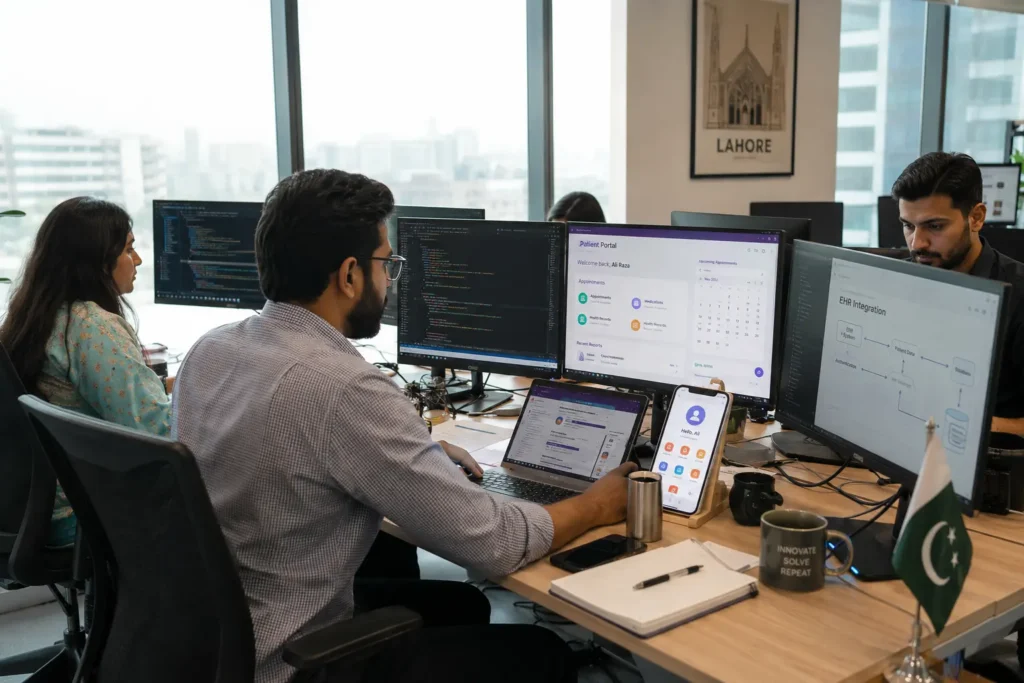
Why Choose Healthcare App Development in Pakistan Healthcare startups and hospital procurement teams consistently underestimate what Pakistani development teams deliver until they see the first working demo. The gap between expectation and reality surprises almost every new client we work with, and it comes down to one thing: the assumption that lower cost means lower quality. Pakistani healthcare app developers charge PKR 7,000–14,500 per hour. US teams doing identical compliance work bill PKR 28,000–58,000 for the same hours. That 40–60% cost difference does not come from reduced output, shorter timelines, or lighter compliance requirements. It comes from Pakistan’s lower operational costs, which our clients receive as direct project savings. Three operational factors determine whether an offshore development partnership actually works day-to-day. Communication comes first. Our senior developers and project managers completed their computer science education in English and have handled international client communication for multiple years. Requirements documents, technical specifications, and change requests get written, reviewed, and actioned without translation delays or interpretation gaps. Timezone coverage comes second. Pakistan Standard Time overlaps with UAE and UK morning business hours and connects directly with US East Coast evening hours. When a compliance issue surfaces at 2 PM London time, our team is mid-workday and can respond in the same hour. Technical depth comes third. Pakistan graduates over 25,000 software engineers annually. A meaningful portion of our team specifically studied and now works in healthcare technology. We built our first healthcare app in 2017. The HIPAA compliance work, the EHR integration patterns, and the clinical workflow research—this is not new territory for us. ⚡ GET IN TOUCH Save 60% on Healthcare Apps – Same Quality, Pakistani Pricing 💬 Chat on WhatsApp 📞 Call 0307 3319555 Here’s what makes Pakistani healthcare app development different from other offshore options. The compliance gap is the real risk in offshore healthcare app development. Most development teams understand either HIPAA requirements for US clients or local regulatory frameworks—rarely both. Our team has worked across US HIPAA environments, European GDPR requirements, and Pakistani PMDC healthcare standards. When a Pakistani clinic needs an app that handles international patient data, we do not have to choose which compliance framework to apply. We build for both from the start. Our own project portfolio reflects this expansion. We have delivered EMR integrations for US hospital clients, built telemedicine platforms for European clinical networks, and developed patient management applications for healthcare organizations across the Middle East. Each of these projects required a different compliance framework. Each one passed its respective regulatory audit. The tools are identical. The security protocols follow the same HIPAA implementation guidelines. The testing phases run the same compliance verification steps. What differs is the cost of the development hours behind them—Pakistan’s operational environment makes our rates 40–60% lower, and that difference passes directly into your project budget. Whether you are a funded health-tech startup building your first patient-facing app or a hospital network expanding its digital infrastructure, our development capacity and compliance expertise scale to fit the project. The first milestone deliverable is where offshore quality hesitation either disappears or gets confirmed. We schedule a working demo at the end of week seven, not a slide deck, not a status report. An actual functioning prototype showing your core features and compliance architecture. Most clients tell us that the first demo session is when they stopped thinking of us as an offshore vendor and started thinking of us as their development team. Healthcare App Development Cost in Pakistan—Transparent Pricing We quote exact project costs upfront before discovery calls become sales calls. Most healthcare app development companies deflect on pricing until you have already spent three meetings with their sales team and feel obligated to continue. We break that pattern. Your first conversation with us ends with a realistic cost range for your specific project type, not a promise to ‘get back to you with numbers. Not us. Healthcare app development costs in Pakistan range from PKR 8,000 for basic appointment booking apps to PKR 20,000 or more for full EHR integration platforms, assuming the figures are in full rupee amounts. The pricing gap reflects the actual complexity difference: A simple patient portal requires 200–300 development hours, while a clinical-grade EHR integration with compliance documentation can run 800–1,200 hours. Every project quote we produce breaks down into the same cost categories. Feature complexity accounts for roughly 40% of total development cost. A basic appointment scheduler takes 200–300 hours. An AI-powered diagnostic tool with machine learning components runs 800–1,200 hours—that fourfold difference is where most budget surprises come from when clients get quotes from developers who underestimate the complexity. Compliance work adds 25–35% to any healthcare app budget. HIPAA encryption, audit logging, and secure authentication are not standard mobile app features. They require specialized implementation, documentation, and verification testing that most app developers do not routinely perform. We do it on every project because healthcare data cannot be protected retroactively. Custom healthcare app development in Pakistan costs 60% less than equivalent US development while maintaining identical security and compliance standards. We use the same development tools, follow the same testing protocols, and deliver the same documentation as expensive US teams. Integration complexity affects final pricing more than almost any other factor. Apps that connect to existing hospital systems, pharmacy networks, or insurance databases require custom API development and extensive testing phases that cannot be templated. We identify all integration points during discovery and include them in the initial quote—integration surprises after development starts are one of the most common causes of healthcare app budget overruns, and our discovery process specifically exists to prevent that. We itemize every cost component before a contract is signed: development hours by feature, compliance work broken out separately, testing phases with hour estimates, and post-launch support options with clear pricing. You review that breakdown, ask questions, and only proceed when the numbers make sense to you. No bundled totals. No vague ‘additional costs may apply’ language When you develop a healthcare app with our Pakistan-based team, you
Food Delivery App Development Company That Builds Apps Startups Actually Use
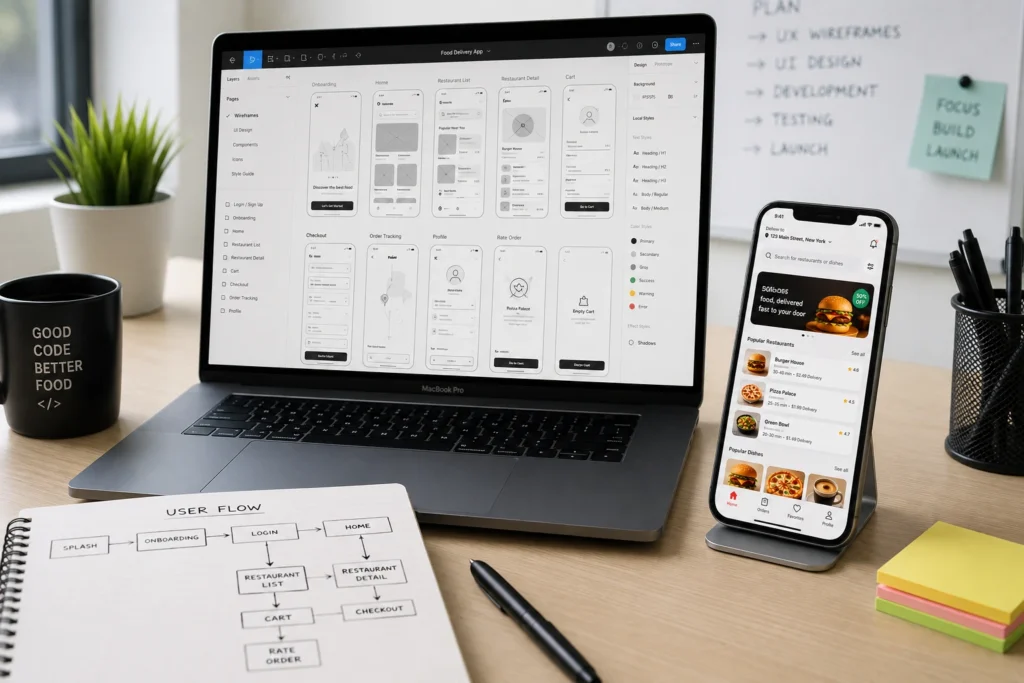
We Build Food Delivery Apps That Scale From 10 Orders to 10,000 Most food delivery apps work fine until the orders actually come in. You launch with 10 orders a day, and the app feels fast. Three months later, you hit 500 orders, and customers start reporting slow load times. Six months in, you are processing 2,000 daily orders, and the system goes down during the Friday dinner rush. We have seen this happen to food-tech startups that hired developers who built beautiful demos but never properly stress-tested the backend for real-world order volume. food delivery app development company build app for restaurants, cloud kitchens, and food-tech startups. Our on-demand food delivery app development work starts with a single question: where does this business need to be in 12 months? Then we design the backend architecture around that answer from the first line of code, not as an afterthought. when you are already losing customers to slow load times. Not apps that pass demos but collapse under real order volume. Real infrastructure, built for the traffic you plan to have, not just the traffic you have right now. We are not a general app agency that builds everything from e-commerce stores to fitness trackers. We work exclusively on delivery platforms: food delivery apps, grocery delivery systems, and on-demand logistics apps. That focus means we have already solved the integration problems that catch other developers off guard: payment gateways that break during checkout peaks, GPS tracking that drains mobile batteries, and driver dispatch logic that falls apart when 50 orders come in simultaneously. We know where the shortcuts are because we have seen what they cost clients who hired agencies that took them. Here is what food delivery app scalability actually means in practice. When you go from 50 restaurants to 500, the app still loads in under 2 seconds. When order volume doubles overnight because you ran a promotion, the system absorbs the spike without any slowdown. When you expand to three new cities next year, you add them to the platform without rebuilding the backend. And when your platform grows from 20,000 monthly transactions to significantly higher volumes, your reporting, payouts, and payment infrastructure scale with the revenue instead of becoming bottlenecks. Want to see how we would approach your specific food delivery app? Schedule a free 30-minute call. We will ask about your business model, your target market, and the scale you are planning for and then walk you through exactly what we would build and why. No pitch. Just an honest technical conversation. ⚡ GET IN TOUCH Ready to build your food delivery app? Get transparent pricing and realistic timelines – free project estimate in 24 hours. 💬 Chat on WhatsApp 📞 Call 0307 3319555 Which Custom Food Delivery App Model Does Your Business Actually Need? The first question we ask every potential client is this: what kind of food delivery business are you actually building? Most people who contact us know they need an app. But they have not thought through whether they need a simple restaurant ordering system, a full marketplace platform, or something built specifically for delivery-only kitchens. That decision changes everything: the features you need, the timeline to launch, and what the project will actually cost. A food tech startup with venture funding building the next regional UberEats competitor needs a completely different platform than a single restaurant owner who is tired of handing 30% of every order to DoorDash. And both of those are completely different from someone running three cloud kitchens under five different brand names out of one location. We have built more than 25 projects across these three models, including restaurant apps, aggregator platforms, and cloud kitchen systems. Single-Restaurant Food Delivery App This restaurant delivery app model is for independent restaurants or small chains that want a branded ordering platform they own outright; no commission fees are paid to third-party marketplaces on every transaction. You get a customer-facing ordering app where people browse your menu and place orders directly with you. You get an admin dashboard to manage incoming orders, update menu items in real time, and track daily sales by location. That is the full scope. No driver marketplace to manage. No multi-restaurant complexity to maintain. Just direct ordering between your restaurant and your customers, with you keeping the full margin. Cost range: PKR 15,000 to 20,000. Timeline: 8 to 12 weeks from kickoff to launch. This is the fastest path to your own ordering platform because we build specifically for one restaurant model with a focused, proven feature set—nothing unnecessary. In our experience, restaurant owners who move to direct ordering typically recover the development investment within 6 to 9 months from the commission fees they stop paying to DoorDash and UberEats alone. Independent restaurants, small chains with 2 to 5 locations, cafes, and bakeries. Anyone who wants to own the customer relationship and stop splitting revenue with third-party platforms. If you’re specifically a restaurant owner in Pakistan, check out our detailed guide on restaurant app development in Pakistan for market-specific insights and local considerations. Aggregator Platform (UberEats or DoorDash Clone) This model is for entrepreneurs building a multi-restaurant marketplace where customers order from dozens or hundreds of restaurant partners through one unified app. You need all four panels built and fully integrated: a customer ordering app, a restaurant partner dashboard, a delivery driver app, and a central admin system to run the entire marketplace. The backend has to handle commission splits, real-time driver assignments, automated restaurant payouts, and surge pricing during peak hours simultaneously and reliably. This is the most technically demanding food delivery app development project we deliver, and it is the one where backend architecture decisions matter most. Cost range: PKR 25,000 to 30,000. Timeline: 4 to 6 months depending on how many custom features you need beyond the core UberEats clone app functionality. The higher investment covers building a true on-demand delivery platform with precise geolocation tracking, intelligent dispatch logic, and financial systems that handle