
Tecveq PWA Studio Plugin: How to Turn Your WordPress Site Into a Progressive Web App for Free (2026)
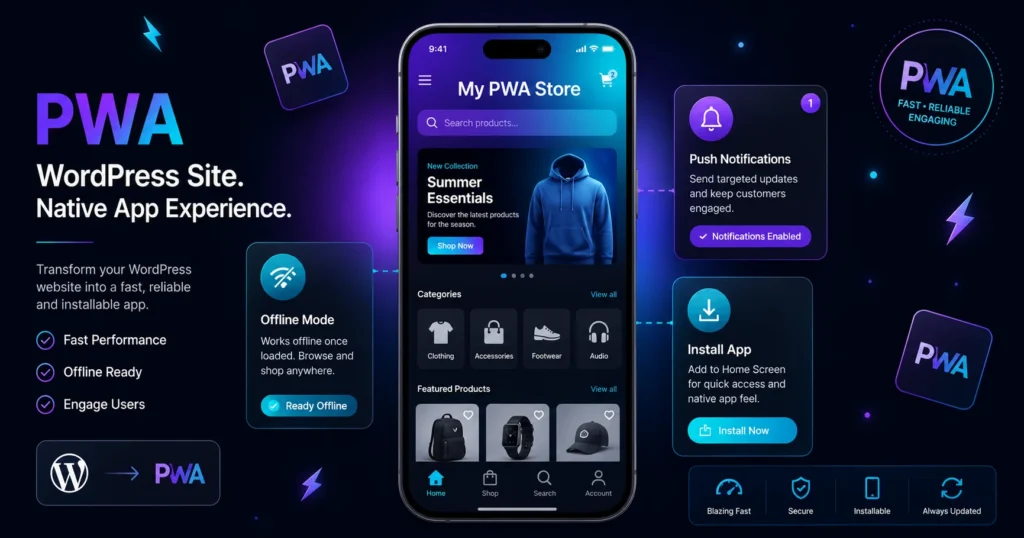
I have built a lot of WordPress sites over the years. And one question that keeps coming up from clients is this: “Can my website work like a mobile app without paying thousands for native development?” The answer is yes. And the tool I keep going back to is the Tecveq PWA Studio Plugin. This guide covers everything you need to know about converting your WordPress site into a Progressive Web App in 2026 what PWAs actually are, why they matter for your site performance and mobile users, and how Tecveq PWA Studio Plugin stacks up against every other option I have tested. What Is a Progressive Web App and Why Should You Care? A Progressive Web App is a website that behaves like a native mobile app. It loads fast, works offline, can be installed directly to a phone’s home screen, and sends push notifications all without going anywhere near the Google Play Store or Apple App Store. That is the short version. The longer version is that PWAs close the gap between what a browser delivers and what a native app delivers. And for WordPress site owners, that gap used to require serious development work to close. Not anymore. PWA technology runs on three core building blocks: a web app manifest file, a service worker script, and HTTPS. The manifest tells browsers how your app should look when installed. The service worker handles caching and offline behavior. HTTPS keeps everything secure. Most people understand what a PWA is in theory. Where it gets interesting is seeing what it actually does for your site traffic, bounce rate, and mobile conversions. ⚡ Tecveq PWA Studio Plugin Free WordPress PWA plugin with offline mode, bottom nav, and WooCommerce support. ⬇ Download Free Why Mobile Users Expect More in 2026 Here is something I noticed working with WooCommerce stores specifically. Mobile traffic usually makes up 60 to 70 percent of total visits. But mobile conversion rates almost always lag behind desktop. The reason is usually friction. Slow load times, no offline access, no quick relaunch from the home screen. Users pull out their phone, tap a bookmark, wait for the page to load, and by then their attention has already moved somewhere else. A PWA removes most of that friction. Cached pages load almost instantly on repeat visits. The site works even on a spotty connection. Users can add it to their home screen with one tap and relaunch it like an app. That change in behavior matters. And it is why choosing the right WordPress PWA plugin is not a small decision. The WordPress PWA Plugin Landscape in 2026 I went through the main options available right now. Here is what I actually found after testing them. SuperPWA SuperPWA is the most downloaded option on WordPress.org and the easiest to set up. You install it, configure a few basic settings, and your site has a manifest and a service worker running. The problem is it does the basics and stops there. No bottom navigation bar. No offline cart for WooCommerce. No live preview of how your app looks. For a simple blog it is fine. For anything more complex, the limitations show up fast. PWA for WP and AMP This plugin goes deeper than SuperPWA. It has AMP integration, a system status dashboard, and better support for larger multi-site setups. The push notification compatibility through third-party services is a nice addition. But the interface feels dated. The WooCommerce offline features are limited. And the customization options, especially for mobile navigation, are minimal compared to what I know is possible. The Official PWA Plugin by WordPress Contributors This one is really for developers. There is no visual interface. It provides the underlying infrastructure for service workers and manifests, and it is built to prevent conflicts when multiple plugins try to register service workers at the same time. If you are building a custom theme from scratch and want clean foundations, this makes sense. For most site owners, it is not a practical standalone solution. Why I Use Tecveq PWA Studio Plugin Every option above does something useful. But none of them do everything I actually need on a real client project. That is what drew me to the Tecveq PWA Studio Plugin. The thing that immediately stood out was the live customizer. You make changes in the WordPress admin panel and watch a phone preview update in real time. That sounds like a small detail. In practice it saves a huge amount of back-and-forth testing. And everything is free. Not free with premium tiers. Not free with feature gates. Every single feature, including the ones competitors charge for, is included at no cost. Full Feature Breakdown: Tecveq PWA Studio Plugin Offline Mode with Workbox Caching The Tecveq PWA Studio Plugin uses Workbox under the hood. Workbox is the same caching library Google recommends for production PWAs. You get three caching strategies to choose from. Cache First loads content from the local cache before checking the network. This is the fastest option for returning visitors. Network First checks for fresh content first and falls back to cache if offline. Stale While Revalidate serves cached content instantly while quietly fetching a fresh version in the background. For most WordPress sites I recommend stale while revalidate. It feels fast to users and keeps content reasonably fresh. Push Notifications The push notification setup inside Tecveq PWA Studio Plugin connects through FCM, which is Firebase Cloud Messaging. You add your server key, configure the notification icon and vibration pattern, and you can send test notifications directly from the WordPress dashboard. The WooCommerce order notification feature is genuinely useful for store owners. When a customer places an order, the store owner gets a push notification. No third-party service required for the basic setup. Bottom Navigation Bar This is the feature that separates Tecveq PWA Studio Plugin from everything else I have tested. Native mobile apps almost universally use bottom navigation. It is where your thumbs naturally reach