
E-commerce Advertising Agency in Pakistan

Why Most Ecommerce Ad Campaigns Fail to Deliver ROI Most e-commerce stores are already spending money on ads. The problem is not getting campaigns live. The problem is getting campaigns that actually make money. We have audited over 200 e-commerce advertising accounts in the past three years. The same seven issues show up repeatedly, and they are costing store owners thousands in wasted ad spend every month. High ad spend with terrible ROAS. Store owners tell us they are spending 15,000 to 30,000 rupees daily on Meta and Google ads but seeing 1.5x or 2x return. Sometimes less. These campaigns are technically running, but the numbers do not make business sense. When we dig into the account data, we find budget allocated to audiences that never convert and keywords that drive traffic but zero sales. Generic targeting that misses actual buyers. Most agencies set up broad interest targeting or use the same lookalike audiences for every client. They target “people interested in shopping” instead of people who actually buy from e-commerce stores using COD in Pakistan. We see campaigns targeting 18-65-year-olds interested in “online shopping” when the real buyers are 25-40-year-old women in Karachi and Lahore who buy specific product categories. Your actual customers have specific behaviors. Generic targeting ignores these completely. Creative testing that stopped months ago. The same product photos and basic slideshow ads have been running for 6 months straight. No video content. No user-generated content. No seasonal updates. Facebook and Instagram users see the same static product ads until they completely ignore them. Fresh creative is essential for maintaining performance as audiences become saturated and ad fatigue sets in. Static product images that run unchanged for months can lose effectiveness, which is why we continuously test new formats, messaging, angles, and product presentations. Zero retargeting strategy. Visitors come to the store, browse products, maybe add something to the cart, and then leave forever. No retargeting campaigns to bring them back. No abandoned cart email sequences. No dynamic product ads showing them exactly what they looked at. We find accounts where 80% of the ad budget goes to cold traffic acquisition and only 20% goes to converting people who already showed interest. Disconnected advertising channels. Meta campaigns are running independently from Google campaigns, which are running independently from marketplace advertising. No unified customer journey. No shared audience data between platforms. A customer might see the same ad 5 times on Facebook and never see remarketing on Google, where they actually prefer to buy. International strategies forced onto local COD behavior. Agencies copy campaign structures from US or UK case studies and apply them directly to Pakistani e-commerce without adjustment. COD customers behave differently than credit card customers. Price sensitivity is higher. Trust requirements are different. Social proof needs are different. But the campaigns ignore all of this. Reporting that hides actual performance. Clients get reports showing impressions, clicks, CPM, and other vanity metrics instead of revenue, profit margins, and actual ROAS. Beautiful dashboards full of charts that make the agency look busy but tell the store owner nothing about whether the advertising is actually growing the business or just spending money. These problems compound each other. Poor targeting leads to weak creative performance. Weak creative performance leads to higher costs. Higher costs with poor retargeting leads to terrible overall ROAS. Most store owners assume this is normal for e-commerce advertising and keep paying for campaigns that barely break even. It is not normal. These are fixable problems with the right approach. Tecveq is an ecommerce advertising agency built for online stores that need advertising to generate measurable revenue. Our approach combines paid advertising with broader ecommerce marketing, including customer acquisition, retargeting, conversion optimization, and campaign data analysis. We manage Meta, Google, and marketplace campaigns for Shopify, WooCommerce, and custom ecommerce stores across Pakistan, with a focus on profitable customer acquisition and sustainable sales growth. If your current campaigns are spending money without delivering consistent returns, this is exactly the problem we solve. ⚡ GET IN TOUCH Get a Free Ecommerce Ad Audit Find out where your ad budget is being wasted and what could improve your ROAS. 💬 Chat on WhatsApp 📞 Call 0307 3319555 How Tecveq Solves This We fix these problems through structured digital marketing campaigns built around ecommerce sales, not generic traffic or engagement. Meta, Google, retargeting, and marketplace campaigns work together around the same revenue goals, customer data, and conversion tracking. Not one-size-fits-all campaigns. Advertising systems built specifically for Pakistani e-commerce stores that need to convert ad spend into predictable revenue. Here is exactly how we address each issue that is killing your current ROAS: Problem Tecveq’s Solution High ad spend, low ROAS We audit your account data first, then reallocate budget to audiences and keywords that actually convert. Our clients see 3x to 5x ROAS within 60 days because we eliminate wasteful spending and focus budget on profitable campaigns only. Generic targeting Custom audience research for your specific products and customer base. We build lookalike audiences from your actual buyers, not generic e-commerce templates. Target women aged 25-40 in Karachi who buy skincare, not “people interested in shopping.” Weak creative testing Fresh ad creatives every 2 weeks with systematic A/B testing. Video ads, user-generated content, seasonal updates, and dynamic product showcases. We create and test multiple ad variations continuously, never the same static images for months. No retargeting strategy Dynamic retargeting campaigns that follow visitors with the exact products they viewed. Abandoned cart sequences, cross-sell campaigns, and win-back ads for past customers. 40% of our client revenue comes from retargeting, not cold traffic. Disconnected channels One unified advertising funnel across Meta, Google, and marketplace ads managed by our team. Shared audience data, consistent messaging, coordinated campaign timing. Your customers see coordinated ads, not random messages from different platforms. No COD-specific approach Campaigns designed for COD conversion behavior and local buyer psychology. Price-sensitive messaging, trust signals for cash-on-delivery, and social proof specific to Pakistani e-commerce shoppers. Not copy-pasted international templates. Zero visibility into performance Weekly reports showing revenue, profit
Best Salon Management System in Pakistan (2026): Complete Guide
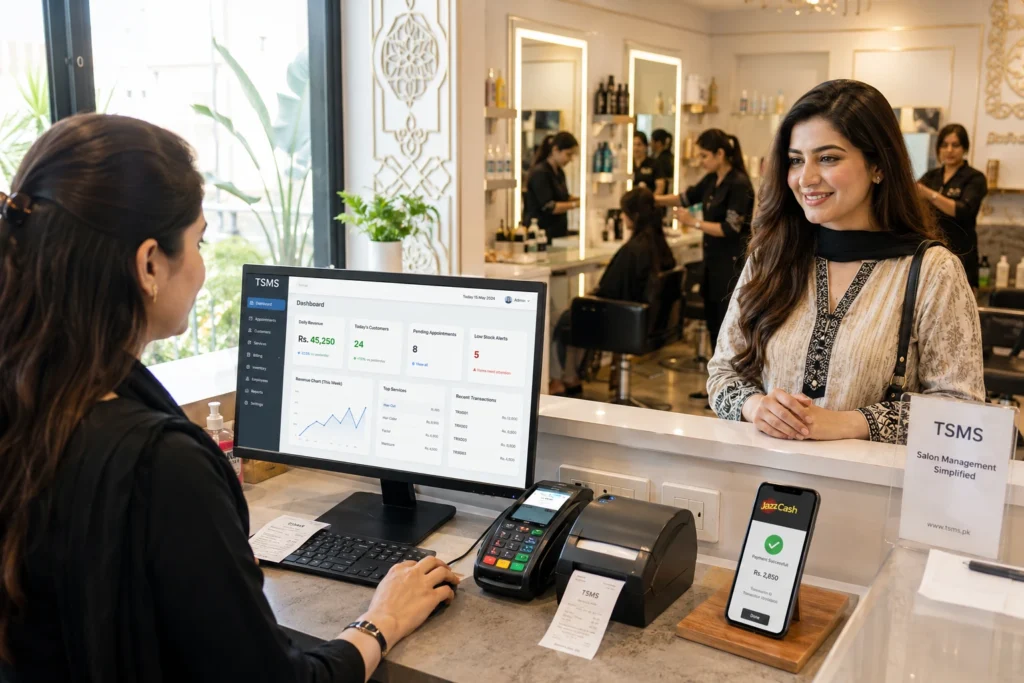
The Real Problem Why Salons in Pakistan Lose Time and Money Most salon owners in Pakistan are working harder than ever but still struggling to understand where their profit actually goes. We see this constantly. You’re fully booked, your team is working nonstop, and customers keep coming back. But at the end of the month when you sit down to count what’s left, the numbers don’t match the effort you put in. The problem isn’t your skills or your service quality. It’s the systems you’re using to run the business side of your salon. Manual processes steal your time, hide your real costs, and make it nearly impossible to spot problems before they drain your revenue. And the worst part? Most salon owners don’t realize how much money they’re losing until it’s already gone. Manual Billing Slows Down Checkout Paper bills and calculator-based checkout create a bottleneck at the front desk that costs you money every single day. We’ve watched salons lose customers simply because the billing process took too long during peak hours. Here’s what happens. A customer finishes their service and walks to the counter ready to pay. Your receptionist has to write down each service by hand, calculate the total, apply any discount, figure out the tax, and then process the payment. That entire process takes 3 to 5 minutes per customer when done manually. Three minutes doesn’t sound like much. But when you have 10 customers waiting during your Friday or Saturday rush, that’s 30 minutes of slow checkout creating a line at your door. Some customers will leave rather than wait. Others will pay but won’t come back because the experience felt disorganized. And billing errors happen constantly with manual systems. Wrong totals. Forgotten services. Discounts applied incorrectly. Every mistake either costs you money directly or damages the customer’s trust in your professionalism. Speed matters at checkout. The faster you can close a transaction accurately, the more customers you can serve during your busiest hours without anyone walking out frustrated. WhatsApp & Registers Can’t Track Inventory or Staff Most salons in Pakistan are running their entire operation through WhatsApp messages and handwritten registers. It feels simple at first. But the moment your business grows beyond a handful of regular customers, these tools completely fall apart. WhatsApp works for booking appointments. But it can’t tell you which products are running low, which employee generated the most revenue this week, or how much you spent on supplies versus how much you earned. Every piece of business data lives in scattered screenshots, voice notes, and messages that disappear into chat history the moment something new comes in. Registers are even worse for inventory tracking. You write down what you bought. You try to remember what you used. But there’s no automatic alert when your stock hits a critical level, no way to see product usage patterns over time, and no connection between what you’re selling and what you’re running out of. And staff management through informal systems creates its own problems. You can’t easily track which stylist is bringing in the most clients, who’s underperforming, or how to structure commissions fairly based on actual sales data. Everything is based on memory and rough estimates instead of real numbers. When you don’t have clear visibility into inventory levels and staff performance, you make expensive mistakes. You run out of popular products right when you need them most. You overpay employees who aren’t pulling their weight and underpay the ones who deserve raises. You reorder supplies you already have while forgetting the ones you actually need. Product Information & Features TSMS (Tecveq Salon Management System) Complete Product Details Product Specification Details SOFTWARE NAME TSMS (Tecveq Salon Management System) DEVELOPER Tecveq INDUSTRY Salon Management Software TARGET MARKET Pakistani Salons, Barbershops & Grooming Centers DEPLOYMENT Cloud-based & On-premise LANGUAGE SUPPORT English, Urdu DEVICE COMPATIBILITY Desktop, Tablet, Mobile (Fully Responsive) PAYMENT METHODS Cash, JazzCash, Meezan Bank, UBL Omni, POS, Udhar BILLING SPEED Under 30 seconds per transaction CUSTOMER MANAGEMENT Complete profiles, search by name/mobile, transaction history GROOM CUSTOMERS MODULE Dedicated bridal & groom client management SERVICE MANAGEMENT Add/edit/delete services, categories, pricing control GROOM PACKAGES Multi-day packages, multiple services, flexible pricing SPECIAL DEALS Time-limited offers, discount percentages, auto activation PROMO CODES Unlimited custom codes, validity periods, usage tracking EMPLOYEE MANAGEMENT Staff directory, salary tracking, commission calculation INVENTORY MANAGEMENT Real-time tracking, low stock alerts, usage history USER ACCESS CONTROL Role-based permissions, secure login, session expiry REPORTS & ANALYTICS Profit & loss, sales, inventory, staff performance reports FINANCE MODULE Expense tracking, income entry, payment method recording DASHBOARD Real-time metrics, KPIs, date range filtering THEME Modern dark theme UI NOTIFICATIONS Real-time alerts for low stock, pending payments DEMO AVAILABILITY Free demo with no commitment SETUP & TRAINING Complete setup assistance and staff training included No Reports Means No Idea Where Profit Is Going This is the biggest problem we see salon owners face. Without proper reporting, you’re running your business completely blind. You know money is coming in. You know money is going out. But you have no clear picture of which services are actually profitable, which expenses are eating into your margins, or whether you made more this month than last month after accounting for everything. Most salon owners we talk to can tell us their rough monthly revenue. But when we ask about profit, the answer gets vague. They know they paid rent, salaries, product costs, and utilities. But they don’t know the exact breakdown or whether their pricing actually covers all these costs and leaves enough margin. Without reports, you can’t answer basic business questions. Which service should you promote more because it has the highest profit margin? Which employee is your top revenue generator? Are special deals and discounts actually bringing in enough new customers to justify the reduced pricing? Is your inventory cost going up or down compared to three months ago? You’re making decisions based on gut feeling instead of real data. And gut feeling doesn’t tell you when a