
Best LMS for Schools in 2026 Why Tecveq Is the Smarter Choice for K-12 Education
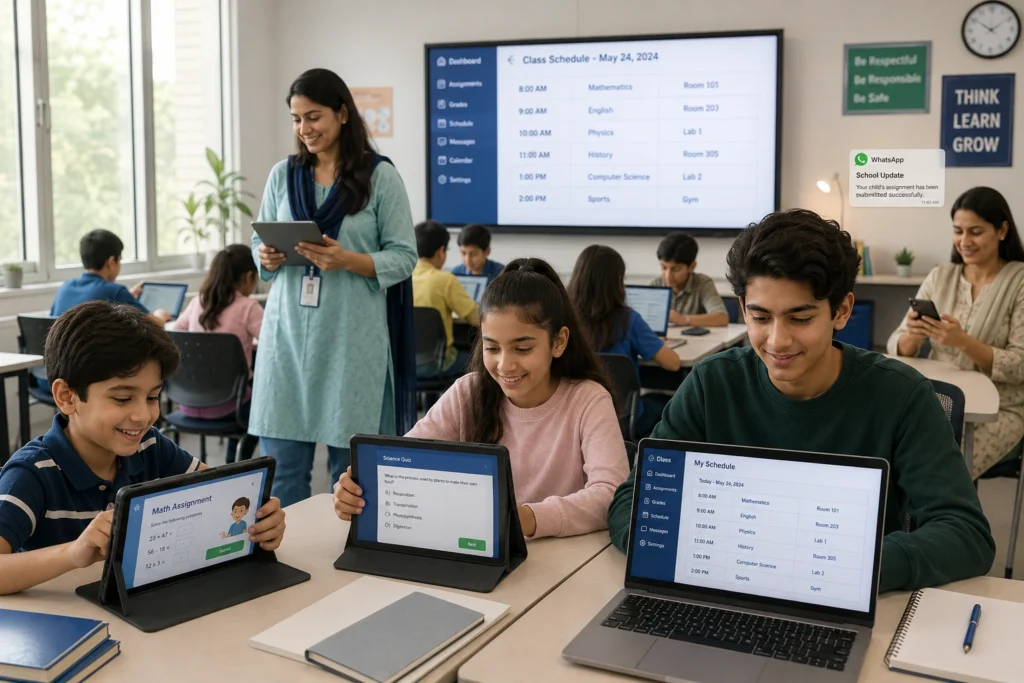
What Is a Learning Management System and Why Do Schools Need One in 2026? A Learning Management System (LMS) is software that helps schools organize teaching, learning, assessment, communication, and student progress in one digital environment. Depending on the platform, an LMS can manage courses, assignments, quizzes, attendance, grades, learning materials, schedules, and communication between teachers, students, administrators, and parents. Tecveq LMS brings these functions together for K-12 schools, including class scheduling, assignment management, quizzes, attendance tracking, parent communication, and student progress reporting. Most schools still run on spreadsheets, paper attendance sheets, and email chains between teachers and parents. That worked 15 years ago. It does not work now. We designed Tecveq specifically for K-12 schools that need to coordinate hundreds of students, dozens of teachers, and parents who want real-time updates on their child’s progress. Everything happens in one system. Teachers post assignments. Students submit work online. Parents check grades and attendance from their phone. Admins see the whole school at a glance. And it all syncs automatically. ⚡ GET IN TOUCH See the Best LMS for Schools 2026 in Action Free Tecveq demo with AI detection + WhatsApp access. 💬 Chat on WhatsApp 📞 Call 0307 3319555 How an LMS Transforms Traditional Classroom Management Traditional classroom management means teachers spend hours every week on administrative work that has nothing to do with teaching. Tracking attendance by hand. Collecting paper assignments. Emailing parents individually when a student misses class. Manually calculating grades at the end of each term. Tecveq eliminates most of that work. When a teacher schedules a class in our system, students see it on their personal calendar. Attendance gets marked digitally during class. If a student skips, the system sends an automatic notification to the teacher and the principal within minutes. No phone calls. No manual tracking. The system handles it. Teachers create assignments once and upload them to the platform. Students download the assignment, complete it, and submit it back through Tecveq. Teachers grade it online and students see their score immediately. Parents can log in and see exactly which assignments their child completed and which ones they missed. We have also built in AI detection for assignments and quizzes.Tecveq can screen submitted assignments and quizzes for signals associated with AI-generated text and flag submissions for teacher review. The result should be treated as an indicator rather than definitive proof that a student used an AI tool. Teachers can review the submission alongside the student’s previous work and apply the school’s academic integrity policy before making a decision.Teachers get an alert and can review the submission before grading. This protects academic integrity without teachers having to manually check every assignment for AI-generated content.the time savings are significant. Tecveq is designed to reduce repetitive administrative work by digitizing attendance, assignment collection, grading workflows, scheduling, and routine parent communication. The exact time savings will vary depending on the school’s size, existing processes, and how much work was previously handled manually. What Is a Cloud-Based LMS? A cloud-based LMS is a learning management system hosted online rather than installed and maintained on individual school computers. Teachers, students, administrators, and parents can access the platform through supported devices while school data and learning activities remain connected in one central system. For schools, a cloud-based LMS can make it easier to manage assignments, attendance, schedules, grades, and communication without maintaining separate software installations. LMS Approach How It Works Potential Benefits Considerations for Schools Cloud-based LMS Hosted online and accessed through supported devices Easier centralized access, provider-managed infrastructure, remote accessibility Schools should evaluate security, integrations, support, and data policies Open source LMS Source code is available under its applicable license and can be customized High customization potential and greater control May require technical resources for hosting, maintenance, updates, and customization Locally hosted LMS Installed and maintained on school-controlled infrastructure Greater control over infrastructure and configuration Requires internal infrastructure, maintenance, backups, and technical support Key Problems Schools Face Without a Proper LMS Schools without a centralized learning management system run into the same problems repeatedly. We have seen it at every school that contacts us before switching to Tecveq. Communication breakdowns between teachers and parents. Parents have no easy way to check their child’s attendance or assignment grades without emailing the teacher directly. Teachers get overwhelmed with individual parent requests for updates. Everyone wastes time repeating the same information to different people. No real-time visibility into student performance. Admins and principals cannot see how students are performing across different classes without asking every teacher for a manual report. By the time they identify a struggling student, weeks have passed and the student has fallen further behind. Attendance tracking chaos. Teachers mark attendance on paper. Someone has to manually enter that data into a spreadsheet. If a student is absent frequently, no one notices until it becomes a serious problem. There is no automated system to alert anyone when attendance patterns indicate trouble. Lost assignments and grade disputes. Students claim they submitted an assignment. Teachers have no record of it. Parents get involved. Everyone spends time trying to figure out what actually happened. With no digital submission system, there is no clear proof either way. Inconsistent scheduling and missed classes. Class schedules get updated but students do not get notified. Students show up at the wrong time or miss classes entirely because no one told them about a schedule change. Teachers waste time tracking down absent students who never knew class was happening. Parent frustration and disengagement. Parents want to stay involved in their child’s education but they have no easy way to monitor progress without constantly emailing teachers. Most parents eventually stop asking because they feel like they are bothering the teacher. Student performance suffers when parents are not engaged. No way to manage bulk administrative tasks. Admins need to assign 30 students to a new subject. Without an LMS, they have to do it one student at a time. It takes hours. Simple administrative changes become all-day projects. Tecveq is designed to address these common problems by
ERP Accounting Software in Pakistan for Growing Businesses Tecveq
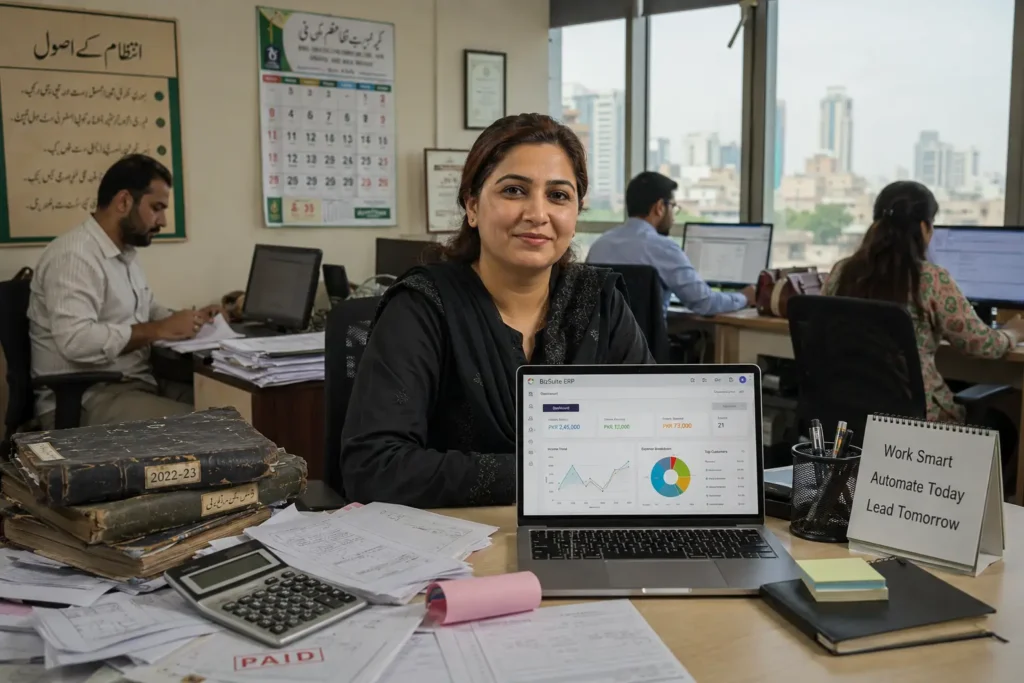
Why Pakistani Businesses Are Moving from Manual Accounting to ERP Software If you are searching for ERP accounting software in Pakistan, you have probably already identified the problem. Your accounts live in Tally. Your inventory sits in Excel. Your sales team maintains a separate sheet. And when month end arrives, someone spends three days trying to reconcile numbers from three different sources that never quite agree That is not a small business problem. That is what happens to every growing Pakistani business that outpaces its tools. We have configured Tecveq for businesses operating in textiles, pharma distribution, FMCG, and trading, and this pattern shows up consistently regardless of industry. A company starts small. Tally handles the books, Excel tracks the stock, and everything holds together. Then the second branch opens. A third salesperson joins. Purchase orders start arriving from Karachi and Lahore simultaneously, and suddenly the same data exists in four different places, nobody agrees on which version is current, and your accountant is manually copying figures from one file into another before any real analysis can happen. The cost of operating on disconnected systems is not just inconvenience. Inventory errors mean you are promising customers stock you do not have, or placing reorders for items already sitting in a warehouse no one checked. Someone has to find that mistake, trace it back through two systems, and correct it manually. In a typical Pakistani SME running on Excel and Tally, that error-finding process costs accounting staff four to eight hours per week on average, hours that should be going toward analysis and planning. When your manager is making strategic decisions based on numbers from five days ago, decisions that should cost one thing end up costing another. And then there is the FBR pressure. When an audit notice arrives, the scramble starts immediately. Purchase registers pulled from one system, sales records from another, withholding tax figures manually calculated from paper files that may or may not reflect every transaction. What should take two hours takes two weeks. Pakistani SMEs are losing staff time, management focus, and in some cases facing compliance penalties not because of intentional errors, but because their accounting tools were never built to handle FBR reporting at the scale a growing business demands. That specific problem is something Tecveq was designed to eliminate from day one. The move to ERP accounting software in Pakistan is not driven by fashion. It is driven by a simple business calculation: when the cost of staying with disconnected systems exceeds the cost of replacing them, businesses make the change. Standalone accounting tools were built for straightforward bookkeeping and they do that job genuinely well. But when your business runs multiple departments, manages stock across more than one location, and carries real FBR compliance obligations, those same tools become operational bottlenecks regardless of how comfortable your team is with them. This is why businesses across textile manufacturing, pharmaceutical distribution, retail, trading, and FMCG in Pakistan are making the switch, and most of them tell us they waited longer than they should have. Dealing with exactly these problems right now? Tecveq ERP was built specifically to eliminate them for Pakistani SMEs. Book a free 30-minute demo and we will show you how businesses in your industry handle this in the system live ⚡ GET IN TOUCH See Tecveq ERP configured for YOUR industry – Free 30-minute demo for Pakistani businesses 💬 Chat on WhatsApp 📞 Call 0307 3319555 ERP vs Basic Accounting Software: What’s the Difference for Pakistan Businesses? The difference between accounting software and ERP comes down to one practical question: how many parts of your business need to share the same data at the same time? Accounting software manages your books. ERP manages your entire operation and ensures that every department, from sales to warehouse to finance, works from identical numbers in real time. For a growing Pakistani business managing multiple departments or locations, that difference determines whether your manager makes decisions on accurate current data or on yesterday’s figures manually compiled by your accounts team. A standalone accounting management system like Tally records your transactions, maintains your ledger, and produces financial reports. It does that job reliably. But Tally has no visibility into your warehouse stock levels. Your sales team’s order register exists somewhere separate. Production floor data, payroll calculations, and branch figures from Karachi never reach Tally automatically someone has to pull them, compile them, and enter them manually. By the time your Lahore head office sees consolidated numbers from all those sources, the data is already a day or two old and it took staff hours to produce. An integrated accounting system like Tecveq ERP connects all of those departments in one shared database. Record a sale in Lahore and inventory adjusts automatically in your Karachi warehouse. Approve a purchase order and the accounts payable entry appears without your accountant retyping it. Your manager in Islamabad no longer needs to send WhatsApp messages to three offices asking for today’s cash position — the dashboard shows every branch’s figures in real time the moment they log in. That is not a feature. That is a fundamentally different way of running daily operations When Basic Accounting Software is Enough Not every business needs ERP, and we will say that clearly before recommending anything. If your business runs from a single location with straightforward operations, Tally probably still serves you well. However, if you’re unsure whether your business has outgrown basic accounting software, our comprehensive guide on selecting the best ERP software for small business covers the key indicators that signal ERP readiness and helps you evaluate your options systematically. Basic accounting software for businesses at this stage is often exactly the right fit. It is affordable, familiar and handles the core job without requiring more infrastructure than the business actually needs. If that describes where your business is today, there is no reason to change yet. But keep reading, because growth shifts that calculation faster than most Pakistani business owners anticipate.