
SaaS Ideas for Small Business in Pakistan With Low Investment (2026 Guide)
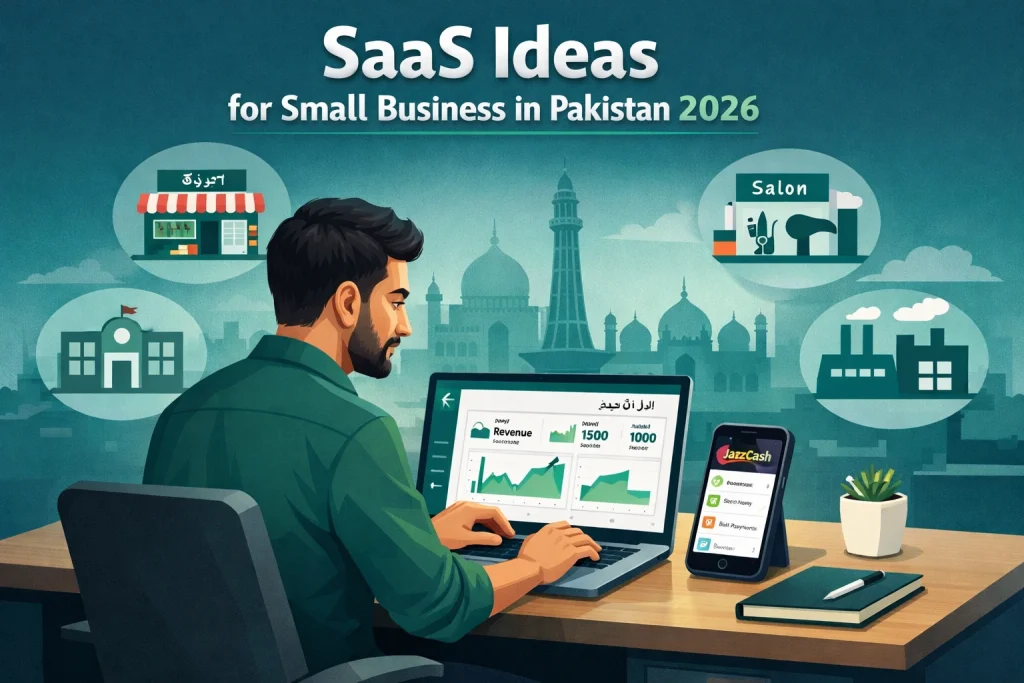
What is SaaS and How to Start a SaaS Business in Pakistan (2026 Beginner Guide) If you have ever used Netflix, Google Docs, or Shopify, then you have already used SaaS even if you did not realize it. SaaS (Software as a Service) is one of the fastest growing business models in the world. And in 2026 it is becoming a huge opportunity in Pakistan. What is SaaS? Simple Explanation for Beginners in Pakistan Think of SaaS like renting software instead of buying it. You know how you pay for Netflix every month? You do not buy Netflix. You do not download it permanently. You just pay a small fee and use it whenever you want. SaaS works exactly the same way Instead of buying expensive software, SaaS lets you pay monthly. For example: That is the basic idea behind SaaS. You use it, you pay for it monthly, and you can cancel anytime. What is Micro SaaS? Small Software Businesses Explained Now here is where it gets really exciting especially if you want to start your own SaaS business in Pakistan with low investment. Micro SaaS is a small software product built to solve one specific problem for a specific group of people. Instead of solving 100 problems, it focuses on solving one problem extremely well. Global companies like Salesforce or HubSpot solve 100 problems for 100 types of businesses. Micro-SaaS solves ONE problem really well. Here is a real Pakistan example. Imagine a small software that only helps Daraz sellers track their inventory. Nothing else. Just that one thing. That is Micro SaaS. The beauty? You can build it with PKR 50,000 to PKR 150,000 using no-code tools. No big team needed. No fancy office needed. Just you, a laptop, and a real problem to solve. Why Pakistan’s Small Business Market Needs SaaS Right Now (Huge Opportunity) Here is something most people completely ignore when discussing SaaS in Pakistan. Pakistan has over 3.8 million small and medium businesses (SMEs). And guess what? Most of them are still running on paper registers, WhatsApp screenshots, and Excel sheets. I personally visited a clothing shop in Lahore last year. The owner was managing his entire inventory in a physical notebook. He was losing sales every single week because he did not know which items were out of stock. A simple PKR 2,000/month inventory SaaS would have saved him thousands of rupees every month. This is the reality of Pakistan’s market right now: This gap is your opportunity. The demand is real. The competition is low. And Pakistani business owners are ready to pay for tools that solve their daily problems. How Much Investment Do You Need to Start a SaaS Business in Pakistan? This is the question everyone asks me. And my honest answer always surprises people. You do not need millions. Here is a realistic breakdown based on my own research and conversations with Pakistani SaaS founders: Build Type Estimated Cost (PKR) Best For No-Code SaaS (Bubble, Glide) PKR 50,000 – 150,000 Beginners, solopreneurs WordPress-Based SaaS PKR 30,000 – 100,000 Bloggers, freelancers Custom Coded SaaS PKR 300,000 – 1,200,000 Developers, funded startups The best part? If you start with a no code tool like Bubble or Glide, you can launch your first Micro SaaS product in Pakistan for less than PKR 100,000. That is less than the cost of one month’s rent for a small shop in Lahore. And once you get your first 10 paying customers the software pays for itself. 5 Reasons Why Pakistan is Ready for Low Cost SaaS Businesses I want to tell you something that most tech bloggers in Pakistan completely ignore. We always look at Silicon Valley and think“SaaS is for them, not for us.” But after spending months talking to small business owners, freelancers, and startup founders across Lahore, Karachi, and Islamabad I can tell you with full confidence: Pakistan is not just ready for SaaS. Pakistan is hungry for it. Here are 5 real reasons why 2026 is the perfect time to start a low-cost SaaS business in Pakistan. 1. 190M+ Smartphone Users & Growing Internet Penetration Let me share a number that shocked me when I first saw it. Pakistan now has over 190 million smartphone users. That is more smartphones than the entire population of most European countries. And internet usage? It is growing faster than ever. 4G coverage now reaches over 50% of Pakistan’s population and with 5G auctions already happening in 2025 that number is only going up. What does this mean for SaaS? It means your potential customers are already carrying your product in their pocket. They wake up with a smartphone. They run their business on a smartphone. They buy things on a smartphone. When I tested a simple WhatsApp based ordering tool with a small grocery shop owner in Gulberg, Lahore he was using it confidently within 20 minutes. No training needed. No laptop needed. Just his phone. Mobile first SaaS in Pakistan is not the future. It is the present. 2. Massive Untapped SME Market (3.8 Million SMEs) Here is the opportunity that keeps me up at night in the best way possible. Pakistan has 3.8 million registered small and medium enterprises (SMEs). These businesses contribute over 40% of Pakistan’s GDP. And yet most of them are running on paper, WhatsApp, and manual Excel sheets. I personally spoke to a garment shop owner in Faisalabad last year. He was tracking 500+ products in a physical register. He had no idea which items were selling fast and which were collecting dust. A simple PKR 1,500/month inventory SaaS would have completely transformed his business. Now multiply that one shop owner by 3.8 million businesses across Pakistan. That is your market. That is your opportunity. And right now almost nobody is serving them with affordable local SaaS. 3. No Code Tools Make Building Cheaper Than Ever This one personally changed my life. Two years ago, if you wanted to build a SaaS product you needed a
Restaurant App Development in Pakistan Complete Guide 2026
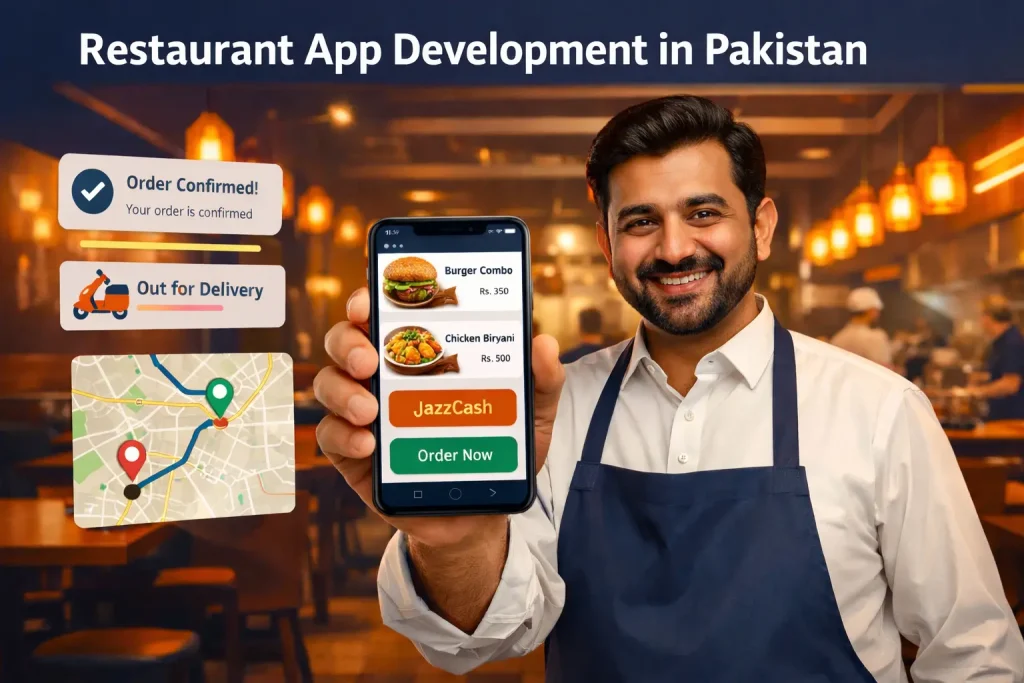
Why Restaurants in Pakistan Need Their Own Mobile App in 2026 Let me be honest with you. If your restaurant is only on Foodpanda right now you are giving away a big chunk of your hard earned money every single month. And most restaurant owners in Pakistan do not even realise how much they are actually losing. Let me show you the real numbers. The Foodpanda Commission Problem Food delivery platforms like Foodpanda typically charge restaurants between 15% and 30% commission on every order. For many restaurants in Pakistan using an online food ordering system, this commission can significantly reduce profit margins. Now think about how many orders you get in a month. Multiply that number by 25%. That is the money leaving your pocket and going straight into Foodpanda’s account. And it gets worse. There was even a time when Foodpanda tried to increase its commission from 18% all the way to 35% which caused nearly 200 restaurants in Karachi to boycott the platform completely. Sdh Restaurant owners were furious. And they had every right to be. Here is the hard truth. When you rely only on Foodpanda, you do not own your customers. You do not have their phone numbers. You cannot send them offers directly. You cannot build loyalty. Foodpanda owns that relationship not you. What You Are Actually Losing Every time a customer orders through Foodpanda, three things happen that hurt your business: First, you pay a commission on that order. Second, Foodpanda shows your competitor’s restaurant right next to yours sometimes even above yours. Third, if Foodpanda ever shuts down or removes your listing, all those customers are gone. You have nothing. This is not a business. This is renting your customers from someone else. Pakistan’s Food Delivery Market is Explodin But Who is Winning? Here is the good news. The food delivery market in Pakistan is growing fast. Pakistan’s online food delivery market is projected to reach over $2.66 billion by 2029, growing at a strong annual rate of 10.29%. Digital Waffle More people than ever are ordering food from their phones in Lahore, Karachi, Islamabad and beyond. By 2028, the number of meal delivery users in Pakistan is expected to reach 88.8 million people. Codeshaper That is an enormous number of potential customers for your restaurant. But right now, most of that money is going to platforms like Foodpanda not directly to restaurant owners. Your Own App Changes Everything That is exactly why restaurant app development in Pakistan is becoming one of the smartest investments for restaurants that want to increase profit and build long-term customer relationships. I have seen this work firsthand. Restaurants that move even 30% of their orders to their own app see a massive jump in monthly profits simply because the commission is gone. That is exactly why restaurant app development in Pakistan is one of the smartest investments a restaurant owner can make in 2026. In the next section, we will break down exactly what features your restaurant app needs and how much it will cost you in PKR no hidden surprises. What is Restaurant App Development and How Does It Work? Let me explain this in the simplest way possible. Restaurant app development means building a mobile app that belongs to your restaurant with your name, your logo, your menu and your brand colours. Customers download it on their phone, browse your menu, place an order, pay directly and track their delivery. All of this happens without any third party platform sitting in the middle. That is it. Nothing complicated. Nothing technical. Just your restaurant in your customer’s pocket. But here is where most restaurant owners in Pakistan get confused. They think a restaurant app and Foodpanda are the same thing. They are not. They are completely different and understanding this difference can change how much money your restaurant makes every single month. Your Own App vs Foodpanda What is the Real Difference? Unlike Foodpanda, a custom restaurant mobile app allows restaurants to control their entire ordering process. Think of it this way. Foodpanda is like renting a stall in someone else’s market. Yes customers walk in and find you. But the market owner takes a big cut of every sale. They also decide where your stall sits. They can move you to the back. They can put your competitor right next to you. And worst of all when a customer buys from you inside that market, they become the market’s customer not yours. Your own restaurant app is like owning your own shop on your own street. Every customer that walks in is YOUR customer. You have their number. You know what they ordered last time. You can send them a deal on Eid. You can give them a loyalty reward after 5 orders. And most importantly every single rupee they pay comes directly to you. No commission. No cut. No middleman. Research shows that 71% of customers actually prefer ordering through a restaurant’s own branded app over third-party platforms because it feels more personal, more affordable and easier to use. That is a huge number. And it proves one thing clearly customers WANT to order directly from you. They just need you to give them the option. What Does a Restaurant App Actually Do? A good restaurant app does six things really well: 1. Shows your full menu with photos, prices, descriptions and categories. Customers can browse easily and find exactly what they want. 2. Takes orders directly customers tap, select and order in under two minutes. No phone calls. No confusion. No missed orders during rush hours. 3. Accepts payments through JazzCash, Easypaisa, credit card or cash on delivery. All the payment methods Pakistanis actually use are right there in the app. 4. Tracks the delivery customers see exactly where their order is in real time. This reduces “where is my order” calls to almost zero. 5. Sends push notifications you can send a special offer or discount directly to every customer’s phone